
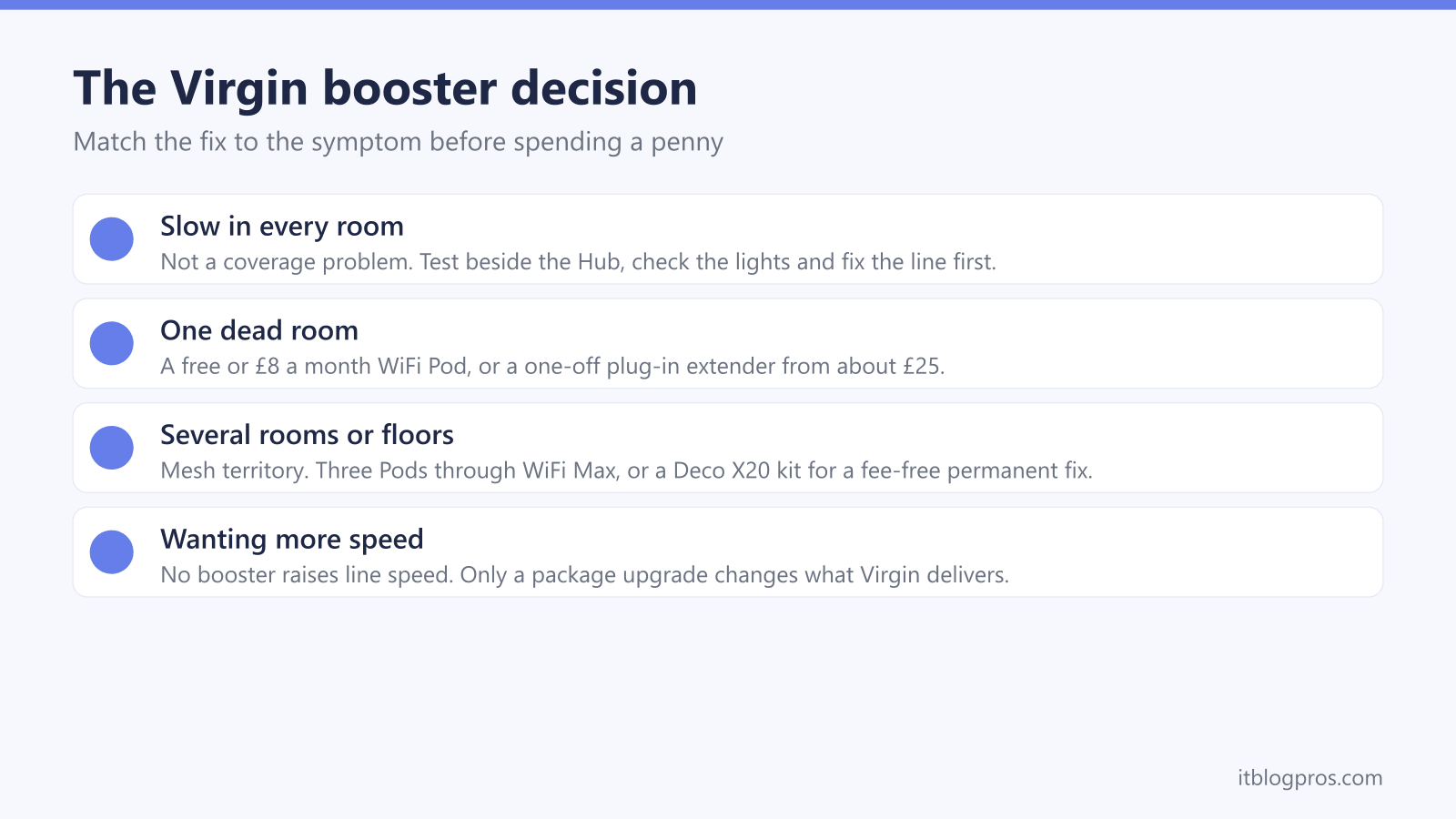
A Virgin Media home with one dead bedroom and a Virgin Media home that feels slow everywhere are two completely different problems, and only one of them is fixed by a booster. Before spending anything, the symptom needs matching to the right fix: Virgin's own WiFi Pods, a cheap plug-in extender, a proper mesh kit, or no booster at all. This guide walks the decision in order, Virgin's route first, with the honest limits printed before any recommendation.
You need a Virgin WiFi booster only when the Hub's signal fails to reach part of your home; no booster raises your line speed. One dead room is fixed by a Virgin WiFi Pod (free on Gig1, Gig2 and Volt, £8 a month otherwise) or a plug-in extender from about £25. Several weak rooms or floors need mesh, either three Pods through WiFi Max or a Deco kit running behind the Hub.
Key Takeaways
- A booster fixes coverage only; no Pod, extender or mesh kit can raise the line speed of your Virgin Media package.
- Virgin's own WiFi Pods come free with Gig1, Gig2 and Volt through WiFi Max, cost £8 a month on M50 to M500 packages, and carry a 30Mbps-in-every-room guarantee or £100 bill credit.
- No Virgin Hub (3, 4, 5 or 5x) has a WiFi strength setting, so a persistent dead zone always needs extra hardware rather than a settings tweak.
- One dead room is solved cheapest by a Pod or a plug-in extender; the TP-Link RE315 suits mid-tier packages and the WiFi 6 RE705X matches Hub 5 speeds.
- Several weak rooms or floors call for mesh; the TP-Link Deco X10 three-pack runs behind any Virgin Hub or takes over completely with a Hub 3, 4 or 5 switched to modem mode.
A booster fixes coverage, not speed
The single most useful test costs nothing: run a speed test on a phone stood next to the Hub, then run the same test in the room that struggles. If the result is poor right next to the Hub, no booster on earth will help, because the problem is the line, the Hub or the package rather than the signal's reach. Start with the Virgin Media WiFi troubleshooting guide and check the Hub's status lights against the complete Virgin Media Hub lights guide before reading any further.
If the test is fast beside the Hub but collapses in the back bedroom, the loft office or the kitchen extension, that is a genuine coverage problem, and coverage problems are exactly what Pods, extenders and mesh exist to solve. Keep the distinction in mind throughout: every product on this page redistributes the speed you already pay for. None of them adds a single megabit to it.
Rule out the Hub before spending anything
Five free minutes often removes the need for a booster entirely. Restart the Hub from the power switch and give it ten minutes to settle. Stand it upright, out in the open rather than inside a TV cabinet, and at least a metre from televisions, wireless speakers and baby monitors. If a neighbour's network crowds yours, signing in to the Hub settings at 192.168.0.1 (the settings password is printed on the base) allows a manual wireless channel change.
That is roughly where the Hub's own options end. No Virgin Hub, whether Hub 3, Hub 4, Hub 5 or Hub 5x, has a WiFi strength or transmit power setting; the radios already broadcast at the regulatory maximum, and the settings pages offer channels, band splitting and guest controls, nothing more. So when repositioning and a channel change fail, the honest menu is short: Virgin's WiFi Pods, a third-party extender, or mesh. One more free avenue is worth a call first, though. The Hub 3 and Hub 4 are WiFi 5 hardware, while the Hub 5 carries seven internal aerials and WiFi 6; customers on an old Hub 3 sometimes gain more from asking Virgin about a Hub upgrade than from any plug-in gadget.
Virgin's own fix comes first with WiFi Max and WiFi Pods
Virgin's official answer to dead zones is WiFi Max, a service that adds mesh WiFi Pods to the Hub's network. On Gig1, Gig2 and Volt packages it is included at no extra cost, which makes it the obvious first move for those customers; there is little sense buying third-party kit while free Pods sit unclaimed. On M50 to M500 packages, WiFi Max is an £8 a month add-on, with the first Pod sent out on sign-up.
The headline promise is the WiFi Guarantee: download speeds of at least 30Mbps in every room, or a one-off £100 credit on the bill. Virgin supplies up to three Pods per home, one at a time, guided by scans run in the free Virgin Media Connect app; if three Pods still cannot deliver 30Mbps everywhere, the £100 credit applies. Pods plug straight into a wall socket, join the Hub's network name automatically and hand devices between Hub and Pod as you move about, which is genuine mesh behaviour rather than a crude repeat.
The fair caveat is the running cost for anyone not on a free tier. £8 a month is £96 a year, every year, and the Pods stay Virgin's property when you leave. A one-off extender purchase costs less than four months of WiFi Max, which is exactly why the rest of this page exists.
The honest limits every booster shares
Three physical facts apply to Pods, extenders and mesh alike, and they belong here, before any product pitch. First, the line speed ceiling: a booster redistributes the package speed and can never exceed it, so an M125 home never sees more than 125Mbps anywhere, booster or not.
Second, the repeating penalty. A single-band repeater must receive and retransmit every packet on the same radio, which can cost up to half the throughput. Dual-band extenders soften this considerably by using one band to talk to the Hub and the other to serve devices, typically preserving most of the original speed, but wireless repeating always taxes performance. Placement matters for the same reason: an extender belongs roughly halfway between the Hub and the dead zone, where it still receives a strong signal, never in the dead room itself repeating a weak one.
Third, walls. Thick stone, reinforced concrete and foil-backed plasterboard absorb or reflect WiFi, and a repeater cannot push through what the Hub could not. In homes built like that, a wired Ethernet run or a mesh node in each affected zone beats any single extender. For a fuller comparison of the two approaches, see WiFi extender versus mesh for dead zones.
TP-Link RE315: the cheap one-room fix
For a single stubborn room on a mid-tier package, the TP-Link RE315 is the sensible budget answer. It is a dual-band AC1200 unit (867Mbps on 5GHz plus 300Mbps on 2.4GHz) with two adjustable aerials, and because it repeats on both bands it avoids the worst of the single-band throughput penalty. Setup is a few minutes in the Tether app or via the WPS button on the Hub, and the extender's own settings page afterwards lives at the tplinkrepeater.net login.
Two honest notes. Its OneMesh and EasyMesh features only activate when paired with a compatible TP-Link router, so behind a Virgin Hub it behaves as a standard extender; devices will connect to an extended network rather than roaming seamlessly, though naming it identically to the Hub's network keeps switching largely automatic. Its Ethernet socket is also a 10/100 port, fine for plugging in a smart TV or an older console in the far room, but a 100Mbps cap on wired traffic. That combination makes the RE315 the right pick for M125 and M250 class packages and one dead bedroom or home office, and the wrong pick for a Gig1 household chasing full speed.

TP-Link RE705X: the better one-room fix for Hub 5 homes
Households on a Hub 5 or Hub 5x with a faster package deserve an extender that keeps up, and the TP-Link RE705X is that step up. It is a WiFi 6 (AX3000) unit carrying 2402Mbps on 5GHz plus 574Mbps on 2.4GHz, so it speaks the same 802.11ax standard as the Hub 5's own radios and holds far more of an M500 or Gig1 line's speed in the extended room than any AC-class repeater can.
It also fixes both RE315 compromises that matter at speed: the Ethernet socket is full gigabit, and the unit can run as a proper wired access point if the far room ever gains an Ethernet or Powerline feed. The same mesh caveat applies, so behind a Virgin Hub treat it as a high-quality conventional extender rather than part of a mesh. As the better one-room fix it costs more than the RE315, and that money is wasted on a slow package; on Hub 5 speeds it is the difference between a dead zone patched and a dead zone actually fast.

TP-Link Deco X10: the whole-home alternative
Once two or more rooms, or a whole floor, sit outside the Hub's reach, chaining extenders turns into whack-a-mole, and mesh becomes the honest recommendation. The TP-Link Deco X10 three-pack is the fit for Virgin homes. TP-Link sells it as Dual-Band WiFi 6 AX1500, which means WiFi 6 on the 5GHz band and an older 802.11n radio on 2.4GHz, and rates the three-pack at up to 5,600 square feet (520 square metres) for three to five bedroom homes, with connections for up to 120 devices and two gigabit Ethernet ports on every node. All three units broadcast one network name and hand devices over silently as you move, which is the roaming behaviour Pods offer, without the monthly fee.
It runs on Virgin in two ways. The simple route leaves the Hub as the router and runs the Deco system in access point mode behind it, which works on every Hub model. The cleaner route switches the Hub to modem mode, following Virgin Media's help page: sign in at 192.168.0.1, choose Modem Mode, Enable Modem Mode and Apply Changes, then connect the first Deco to one of the Hub's Ethernet ports (Virgin says the Hub's own address becomes 192.168.100.1 afterwards). That page does not name a port, so if the Deco gets no internet, try the Hub's other Ethernet ports. Modem mode hands the entire network to the Deco system, avoids double NAT and retires the Hub's WiFi completely, but Virgin's page lists it for the Hub 3, 4 and 5 and says it is not currently available for the Hub 5x. Anyone weighing a single powerful router against mesh for that takeover should read the best router for Virgin Media guide alongside this one.

The decision in one pass
Slow everywhere, even beside the Hub: not a booster problem. Work through the Virgin WiFi troubleshooting steps, check the Hub lights, and consider the package itself.
On Gig1, Gig2 or Volt: claim WiFi Max first, because the Pods are already included and carry the 30Mbps-per-room guarantee. Third-party kit only makes sense here if three Pods have already failed.
One dead room on M50 to M500: a one-off extender beats £96 a year. The RE315 covers mid-tier packages cheaply; the RE705X is worth the extra on a Hub 5 with a fast package.
Several weak rooms or multiple floors: mesh. Three Pods via WiFi Max if the free tier applies or the guarantee appeals; the Deco X10 three-pack for a permanent, fee-free fix that can even replace the Hub's routing entirely with a Hub 3, 4 or 5 in modem mode.
Wanting more speed rather than more reach: no booster changes what Virgin delivers down the line. Only a package change does that.