
Run a speed test at 8pm on a Virgin Media line and the result can look nothing like the package you pay for. The obvious suspect is throttling, and plenty of forum threads will happily confirm the theory. The reality is more useful than the rumour, because once you know what Virgin actually does, you can test your own line and fix the real problem.
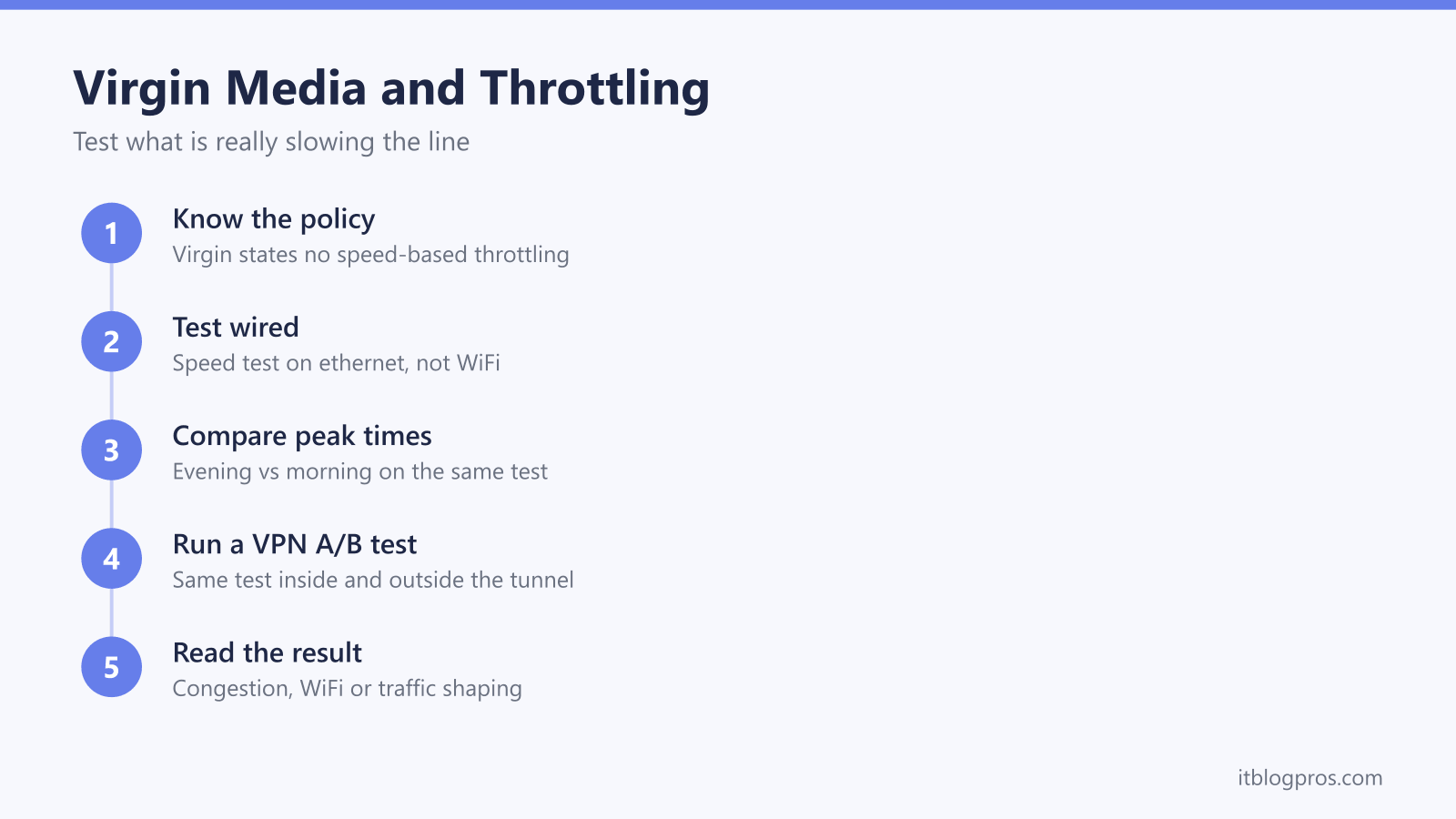
Virgin Media states that it applies no speed-based traffic management to home broadband, so downloads, streaming and gaming are not deliberately slowed, and the old peak-time policies were retired years ago. Evening slowdowns on a Virgin line are almost always shared-network congestion or WiFi trouble instead. A wired speed test, a peak versus off-peak comparison and a VPN A/B test will tell you which one you are dealing with.
Key Takeaways
- Virgin Media's published traffic management policy applies no speed-based slowing to downloads or uploads on its home broadband packages.
- The peak-time policies that once slowed heavy users were retired years ago, so older articles describing them are out of date.
- Throttling, network congestion and weak WiFi all produce the same symptom, and only a structured test tells them apart.
- A wired speed test at peak and off-peak times, plus the same test inside a VPN tunnel, identifies the real cause in well under an hour.
- A VPN prevents traffic-type shaping where it genuinely occurs and keeps browsing private, but it cannot fix congestion on a shared cable segment.
Virgin Media states it does not throttle home broadband
The short version comes straight from the provider. Virgin Media's published traffic management policy states that its home broadband packages come with unlimited usage and that it does not slow customers' speeds based on what they download or upload. In plain English, Virgin does not deliberately slow your connection because you streamed too much, downloaded a huge game update or spent the whole weekend on video calls.
That was not always true, which is why the rumour refuses to die. Years ago, Virgin ran peak-time traffic management that temporarily slowed its heaviest downloaders during busy evening hours, and older forum posts and articles still describe those rules as if they were current. Those policies were retired years ago, and the current policy is explicit that speeds are not reduced for usage on any home package.
What the policy does still cover is the unglamorous plumbing every large ISP runs: blocking websites a court has ordered blocked, detecting and absorbing denial-of-service attacks, and the optional Web Safe filter that households can switch on or off. Virgin also says it monitors total data volumes across its network rather than the specific applications or content individual customers use. None of that slows a normal connection, and none of it is throttling in the sense people mean when a speed test disappoints them.
Throttling, congestion and WiFi problems feel identical
Three very different problems produce the exact same evening: video that buffers, downloads that crawl and a speed test well below the number on your bill. Telling them apart matters, because the fixes have nothing in common.
Throttling, properly called traffic-type shaping, is a deliberate act. A network identifies a category of traffic, with streaming and peer-to-peer being the classic targets, then slows that category on purpose while everything else runs at full speed. Crucially, it only works when the network can see what kind of traffic you are sending.
Congestion is nobody slowing anything on purpose. Virgin's cable network shares capacity between homes in a local area, so when a street full of households starts streaming at 8pm, everyone divides up a pipe that felt roomy at 8am. Speeds dip for everybody at once and recover when demand falls away, which is why the pattern tracks the time of day so neatly.
WiFi limits are the most common culprit of the three and have nothing to do with Virgin's network at all. A hub tucked behind the TV, interference from neighbouring networks and older devices on the far side of the house can cut real-world speeds to a fraction of what the line delivers, at any hour of the day.
From the sofa, all three look the same. The tests below are how you tell them apart.
The reliable test uses a cable and a clock
Start by taking WiFi out of the equation. Plug a laptop or PC directly into the Virgin hub with an Ethernet cable, close everything else that is using the connection, and run a speed test. That one change eliminates the most common cause of disappointing results, and the wired number is the honest measure of what the line is actually delivering.
Next, use the clock. Run the same wired test in the quiet hours, with early morning working well, and again during the 8pm to 10pm peak. Write both numbers down rather than trusting memory, because the pattern is the diagnosis. A line that hits its advertised speed off-peak but sags noticeably every evening is showing the classic signature of shared-network congestion. A line that sits far below its package speed at every hour, even wired, points to a fault; your contract paperwork includes a minimum guaranteed speed, and sustained wired results below that figure are worth raising with Virgin Media support so an engineer can check the physical connection. And a line that tests fine on the cable while the WiFi crawls has a wireless problem, not a broadband one.
Neither reading proves shaping on its own, though, because congestion and shaping can both drag the evening numbers down. Separating those two takes one more measurement.
The VPN A/B test shows whether traffic is being singled out
The logic is simple. Shaping only works when a network can see what type of traffic is passing through it. A VPN wraps everything in encryption, so streaming, downloads and browsing all become indistinguishable from each other, and traffic-type rules have nothing left to grab. Congestion, by contrast, slows all traffic equally, encrypted or not.
That difference makes for a clean experiment. Run a wired speed test with no VPN and note the result. Then connect a VPN to a nearby UK server and immediately run the same test on the same site. Repeat the pair a couple of times, because individual runs always bounce around a little, and back the numbers up with a real-world check such as timing a large download, since a few networks treat well-known speed test sites more kindly than ordinary traffic.
Reading the result is straightforward. Speeds that are consistently and dramatically faster inside the tunnel suggest something on the path is discriminating by traffic type, because hiding the traffic removed the penalty. Speeds that are the same or slightly lower inside the tunnel mean no shaping is happening; the small drop is normal encryption overhead, and whatever is slowing you down is congestion or WiFi instead.
On a Virgin Media home line, expect the second result. That matches the published policy, and it is what this test returns on a healthy Virgin connection. The A/B test is still worth running, because it settles the question for your specific line in ten minutes, with evidence rather than forum folklore.
A VPN earns its keep on shaping and privacy, never on congestion
Being straight about this matters, because plenty of VPN marketing is not. A VPN cannot un-congest a shared cable segment, cannot lift a line above its package speed, and on a Virgin connection that is not shaping traffic it will not make anything faster; the encryption adds a small overhead instead.
Where an encrypted tunnel genuinely earns its keep is everywhere traffic-type discrimination still happens. Hotel and public WiFi that squeezes streaming, some workplace and campus networks, and mobile tethering on plans that treat tethered video differently are the everyday examples. On any of those, the same A/B test above will expose the gap, and the same tunnel closes it, because traffic that cannot be identified cannot be selectively slowed. There is also a quieter benefit that applies on every network, Virgin's included: an encrypted tunnel keeps your browsing activity private from whoever runs the network.
Stop speed-based throttling of streaming →
For choosing a service that suits a Virgin line specifically, the reasoning is covered in our best VPN for Virgin Media guide, and the step-by-step install lives in the NordVPN with Virgin Media setup guide.
Congestion and WiFi problems have their own fixes
Once the test points away from throttling, the fix depends on which problem you actually found.
Evening sag on a wired connection is congestion, and there are practical ways to deal with it, from shifting big downloads off-peak to reporting a repeatable evening pattern to Virgin Media. The full set of options is in our Virgin Media slow at night fixes guide, which is built around exactly this pattern. Sustained under-speed at every hour is a different animal; wired results far below the package all day long are a line fault, so log it with Virgin Media support rather than reaching for workarounds at home.
A line that tests fine on the cable but crawls over wireless needs WiFi work rather than a word with the ISP. Hub placement, crowded channels and band issues are all fixable at home, and the walkthrough in how to fix Virgin Media WiFi not working covers them in order of likelihood.
The honest bottom line is this: Virgin Media says it does not throttle home broadband, a short structured test lets you verify that on your own line, and once throttling is ruled out, the real fix usually sits closer to the sofa than to the ISP.