The ATTWiFiManager status page has a blunt way of ruining a workday: the WiFi bars look fine, every device shows connected, and the banner still reads data connection disconnected. The useful news hiding inside that message is that the hotspot is already half working, and the half that failed usually comes back with a plan check or a session reset rather than a repair. This guide explains what the portal actually is, what the error really means, and the fix order that clears it fastest, starting with the free two-minute checks.
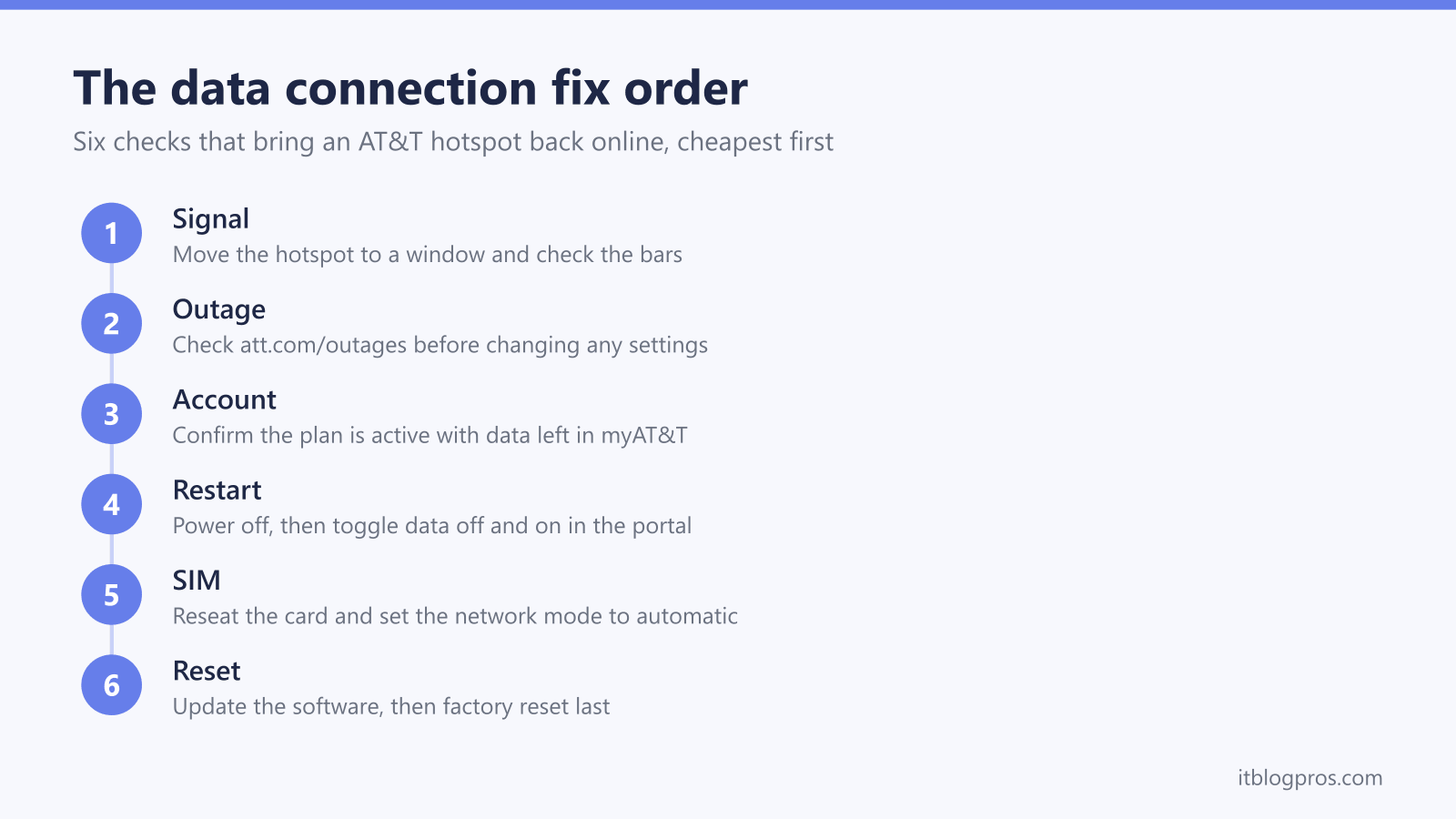
The data connection disconnected message means the hotspot's WiFi is running but it has no cellular data session with AT&T. Check the signal bars and move the unit to a window, confirm the plan is active with data left in myAT&T, then restart the hotspot and toggle its data connection off and on. Reseat the SIM, update the software, and factory reset last, which restores AT&T's correct APN automatically.
Key Takeaways
- The data connection disconnected message means the hotspot's WiFi side is running normally while the cellular side has no data session with AT&T, so WiFi settings are the wrong place to look.
- An expired or out-of-data AT&T Prepaid plan is the most common cause and produces this exact error with full signal bars, so the plan check in myAT&T comes before any settings change.
- A stalled cellular session usually clears with a full restart plus the data off-and-on toggle inside ATTWiFiManager, the hotspot equivalent of airplane mode on a phone.
- Weak coverage mimics a broken device, so moving the hotspot to a window or upper floor and checking att.com/outages rules out signal and network problems for free.
- A factory reset stays last because it wipes every custom setting, but it also restores AT&T's stock APN automatically, which cures a mistyped APN without entering any values by hand.
ATTWiFiManager is the hotspot's own admin page, not an app
ATTWiFiManager is the local admin portal built into AT&T-branded mobile hotspots. It is served by the hotspot itself, which is why the page still opens when the internet is down: the request never leaves the device. From a phone or laptop connected to the hotspot's WiFi, the portal loads at http://attwifimanager or 192.168.1.1, and AT&T's default admin password is attadmin, which is case sensitive.
AT&T's own support pages give that address for the Netgear-built hotspot line, including the Netgear Nighthawk LTE Mobile Hotspot Router (MR1100), and for the AT&T Wireless Internet 4G LTE router. The older AT&T Unite family came from the same Netgear stable, with the Unite Pro sold as the Netgear AC781S and the rugged Unite Explore as the AC815S.
The Franklin A50 (RG2102), AT&T's newer 5G hotspot, is the odd one out. Its official manual puts the admin page at http://mobile.hotspot with a default password of admin, so an A50 owner hunting for attwifimanager should use that address instead. Whichever model is on the desk, the portal is where the data connection status, signal bars, and every setting in this guide live.
The error points at the cellular side, not the WiFi
A mobile hotspot runs two radios at once. The WiFi radio links your phones and laptops to the hotspot, and the cellular modem holds a data session with the nearest AT&T tower. Data connection disconnected means the first half is healthy, which is why devices stay connected and the portal opens, while the second half has no active data session with AT&T's network.
That split matters because it rules out half the usual troubleshooting. Changing the WiFi name, password, channel, or band does nothing here, since the WiFi leg already works. The fault sits between the hotspot and AT&T, and in practice the overwhelming majority of cases are coverage or account state rather than failed hardware. The same connected-but-offline pattern turns up on home routers too, and the no internet message explained guide covers that wider family of faults. On an AT&T hotspot specifically, the fix ladder below runs from most likely to least likely cause.
Signal and coverage checks come first
The cellular session cannot form without usable signal, so check the bars on the hotspot's screen or on the portal's home page before anything else. Hotspots carry small internal antennas and lose signal faster than phones do, so placement counts double. Move the unit to a windowsill, an upper floor if there is one, and away from metal shelving, appliances, and basement corners, then give it a minute to retry the connection.
If the location is new, rural, or deep inside a large building, check AT&T's coverage map for the address to confirm the spot is actually served. One age-related trap is worth knowing: AT&T retired its 3G network in February 2022, so a hotspot old enough to be 3G-only can no longer establish a data session anywhere, and no setting will bring it back. The LTE and 5G models this guide covers are unaffected, but a very old unit pulled out of a drawer may have hit this wall rather than a fixable fault.
An AT&T outage looks identical from the couch
When the tower itself is down, every device behaves exactly as if the hotspot were broken, and nothing on the device can fix it. Rule this out before spending effort on settings. Sign in at att.com/outages, which checks for reported outages against your service and area. Downdetector makes a useful second opinion because it shows live user reports, and a sudden spike in AT&T complaints in the past hour points firmly at the network.
There is also a zero-tool test: any AT&T phone in the same room. Turn its WiFi off and try a website on cellular data. If the phone has no data either, the problem is AT&T's side of the connection, and the honest fix is patience. Retry the hotspot every so often, and expect the data session to rebuild on its own once service returns, with a restart forcing the issue if the banner lingers after coverage is clearly back.
The account causes more of these errors than the hardware
Most AT&T hotspots run on AT&T Prepaid data plans, and prepaid plans end in two undramatic ways: the data allowance runs out, or the plan period expires. Either way AT&T refuses the next data session while the WiFi half of the hotspot carries on running, which produces this exact error with full signal bars. An autopay card that expired quietly does the same thing a day later.
Checking takes two minutes, but it needs a connection that does not depend on the hotspot, so use a phone's own data. Open the myAT&T app or sign in at att.com, then open the prepaid account view to see the balance, the data remaining, and the renewal date. From an AT&T Prepaid phone, dialing *777# returns the balance by text, though for a data-only hotspot the app or website is the practical route. If the plan has lapsed and the sign-in details are long forgotten, the AT&T FastPay guide covers paying without logging in. After a refill or payment the data session normally returns within minutes, and a restart of the hotspot hurries it along.
A restart and the data toggle clear stalled sessions
With coverage confirmed and the plan active, the next suspect is a data session that has simply stalled. Power the hotspot off, wait 30 to 60 seconds, and power it back on so the modem negotiates a completely fresh session with the tower. On the Nighthawk MR1100 the battery is removable, and pulling it for a few seconds guarantees a genuine full restart rather than a sleep-and-wake.
The portal offers a faster version of the same medicine. Sign in to ATTWiFiManager, find the mobile or cellular data setting, switch data off, apply, then switch it back on and apply again. This is the hotspot equivalent of flicking airplane mode on a phone, and it forces the modem to drop and rebuild its connection to AT&T. Owners on Netgear's own community forums report exactly this toggle bringing a Nighthawk M1 back from the disconnected banner. If the toggle works but the error keeps returning every few hours, treat that as a symptom worth carrying down the ladder rather than a cure.
The SIM reseat and network mode check
The hotspot's identity on AT&T's network lives on the SIM, and a card that has shifted fractionally in its slot, or grown a film of oxidation over years of heat cycles, produces intermittent or failed data sessions. Power the hotspot off first, every time. On the Netgear units the SIM sits under the back cover near the battery, while other models use a covered side slot. Remove the card, check it for damage, wipe the contacts with a dry lint-free cloth, seat it firmly until it clicks or sits flush, and power back on.
While the portal is open, give the mobile settings one inspection. Confirm mobile data itself is switched on, since the toggle can be left off after an experiment or a partial reset. Confirm the network mode or network selection sits on automatic rather than forced to a single technology or band. A band lock applied months ago for a marginal signal spot is a classic cause of a hotspot that refuses to connect somewhere new.
Software updates and the factory reset finish the ladder
Modem firmware bugs occasionally break carrier connections, and updates fix them, so check for software updates in the portal's settings or about section before reaching for the reset pin. Netgear's units can also update through the NETGEAR Mobile app. Let any update finish completely on a charged battery.
The factory reset comes last because of its cost: it wipes the WiFi name, password, admin password, and every custom setting back to the values printed on the device label or under the cover. It earns its place on this ladder for one specific reason: a reset restores AT&T's stock APN profile automatically. The APN is the profile that tells the modem how to join AT&T's data network, and a mistyped or experimental APN produces a permanent data connection disconnected. No APN values appear in this guide deliberately, because they differ by plan and change over time; the reset restores the correct profile without typing anything, and AT&T support can confirm current values in the rare case manual entry is genuinely needed. Reset from the portal's settings, or hold the recessed reset button, then reconnect devices using the label details.
The rare case where the hotspot itself has failed
A hotspot that still shows data connection disconnected with strong signal, an active plan with data remaining, a reseated SIM, current software, and a fresh factory reset has nearly exhausted the fixable causes, and at that point the cellular modem itself becomes the suspect. Cross-testing settles it. Try the SIM in another AT&T device that takes the same size card, or borrow a known-good AT&T SIM for the hotspot. If the SIM works elsewhere while the hotspot fails with every card, the radio has likely failed, and AT&T support or a warranty claim is the sensible next step rather than more settings work.
That ending is genuinely uncommon. Most units that show this error are healthy hardware attached to an expired plan, a weak corner of the house, or a stalled session, which is why the cheap checks at the top of the ladder resolve the majority of cases before any talk of replacement.