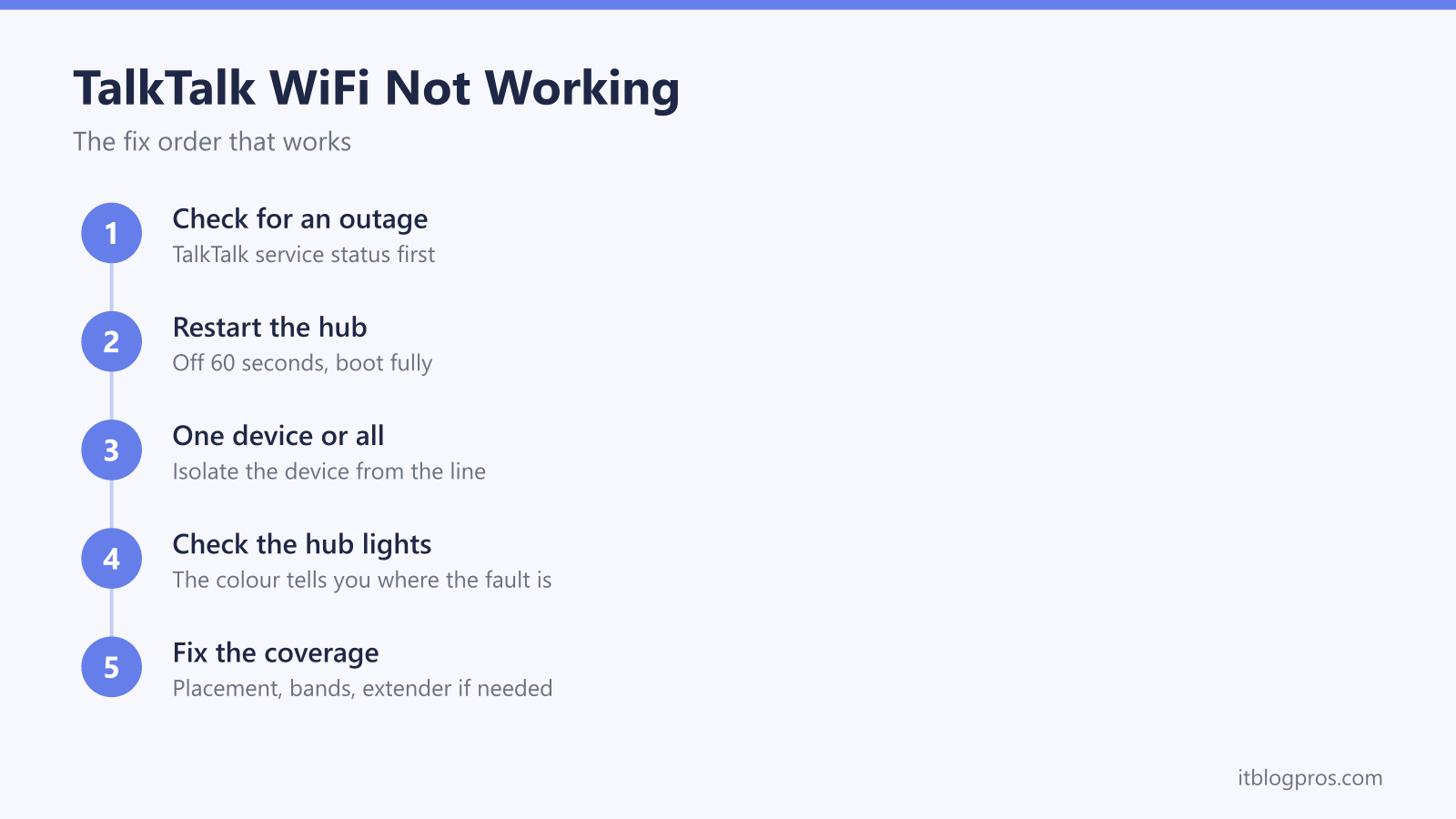
When TalkTalk WiFi stops working, the cause is nearly always one of a short list: an outage at TalkTalk's end, a hub that needs a proper restart, a fault on the line, or coverage that never reached the far rooms. Each of those has a completely different fix, and testing them in the right order saves both time and pointless spending. This guide runs the checks in that order, from the free two-minute ones to the point where TalkTalk needs to get involved.
When TalkTalk WiFi is not working, check the service status page for an outage first, then switch the hub off at the plug for 60 seconds and let it restart fully. That restart clears stalled device addresses and lets the hub pick a cleaner WiFi channel on boot. If a wired device still gets online while WiFi does not, the fault is coverage or settings rather than the broadband line.
Key Takeaways
- A 60 second power-off restart clears more TalkTalk WiFi faults than any other step, because the hub rebuilds its device address table and rescans for a cleaner WiFi channel on boot.
- Checking TalkTalk's service status page first stops an hour of troubleshooting during an outage that only TalkTalk can fix.
- One device offline points at that device, while every device offline at once points at the hub or the broadband line.
- An Ethernet cable test separates a dead broadband line from weak WiFi in under a minute, and the two faults need entirely different fixes.
- An extender can fix one dead room, but no extender can fix a dead line, so confirm the broadband is healthy before buying anything.
Check for a TalkTalk outage before touching anything
An outage makes every other fix pointless, so rule it out first. Sign in to My Account on the TalkTalk website or open the TalkTalk app and run the service status check, which looks up known problems in your area and can test your connection from TalkTalk's side. One honest wrinkle is worth knowing: official checkers can lag behind a very fresh or very local fault, so a clean result is not an absolute guarantee. Downdetector fills that gap because it shows live user reports, and a sudden spike in TalkTalk complaints over the past hour usually means the problem is at TalkTalk's end, in which case the only fix is patience.
Work out whether one device or the whole house is offline
Count the affected devices before changing anything. One phone or laptop refusing to connect while everything else works points at that device, not the hub: forget the network and rejoin, toggle WiFi off and on, and restart the device. Every device failing at once points at the hub or the line, which is what the rest of this guide covers.
Then split broadband from WiFi with an Ethernet cable. Plug a laptop into one of the LAN ports on the back of the hub and try a few websites. If the wired connection works, the broadband line is healthy and the fault lives in the WiFi, so the settings and coverage sections below will sort it. If the wired connection is dead too, no WiFi tinkering will help, and the line fault section further down is the place to go.
No laptop with an Ethernet port is not a dead end. Stand right next to the hub with your phone showing full WiFi bars. Full signal beside the hub with nothing loading behaves like a broadband fault, while a strong connection near the hub that collapses two rooms away is a coverage problem.
The 60 second restart, done properly
Switch the hub off at the plug or with its power button, wait a full 60 seconds, then power it back on and give it three or four minutes to boot and reconnect. This clears more TalkTalk WiFi faults than every other step combined, for two concrete reasons.
The first is DHCP, the system the hub uses to hand each device a local address. Over weeks of uptime that address table can get into a tangle, especially in a busy house where phones, TVs and smart devices join and leave constantly, and a tangled table produces the classic connected-but-no-internet symptom. Restarting wipes the table clean, and every device negotiates a fresh address when it rejoins.
The second is channel congestion. In a terrace or a block of flats, dozens of networks share the same airwaves, and the hub chooses its operating channel when it boots. The restart forces a fresh scan, so the hub lands on cleaner air instead of fighting next door for the same slice of spectrum. Restart the struggling device as well, since the same stale-connection logic applies at that end.
One caution: restarting means the plug or the power button, never the recessed pinhole on the back. Holding the pinhole for around ten seconds performs a factory reset, which wipes your WiFi name, password and every custom setting.
Read the hub light before changing settings
The light on the front tells you which half of the system is broken. On the current Wi-Fi Hub, Wi-Fi Hub Black and Wi-Fi Hub 2, a steady white light means the hub is connected to the internet, so a device that still cannot get online has a WiFi or settings problem rather than a broadband one. Flashing during the first few minutes after power-on is normal boot behaviour. An amber or orange light that stays put once the hub has settled means it cannot reach the internet, and that points at the line, not your WiFi.
Older Super Routers use a row of separate lights instead of one, and the broadband light is the one that matters: steady means the hub can see the line, while a broadband light that stays off or keeps flashing after boot means the connection to TalkTalk has not synced.
Anything deeper than reading lights happens in the hub's admin panel at 192.168.1.1, and the TalkTalk router login guide walks through the address, the admin password on the sticker under the pull-out card, and where each setting lives once signed in.
Wi-Fi Hub settings that quietly cause trouble
TalkTalk's help page on changing your Wi-Fi name gives the Wi-Fi Hub and Wi-Fi Hub Black a single Wi-Fi network name box, while its steps for the Huawei HG633 and HG635 Super Routers have separate name boxes for Wireless 2.4 GHz SSID and Wireless 5 GHz SSID. On the Wi-Fi Hub Black, TalkTalk's security settings page shows separate 2.4G and 5G Basic Network Settings under Advanced Configuration and WLAN, so check there whether each band has its own name box. Some smart devices only use 2.4GHz: TP-Link's Tapo smart plug setup FAQ says the Tapo device does not support 5GHz, and Blink's WiFi guide says Blink products can only connect to 2.4GHz networks, so check the box or the maker's setup guide for the bands a device supports. Where the router has separate boxes, giving the 5GHz network a different name, for example HomeWiFi and HomeWiFi-5G, lets you pick the 2.4GHz name deliberately if a 2.4GHz-only device's setup keeps failing. Separate names also give you a lever for coverage, because TP-Link's FAQ on the differences between 2.4GHz and 5GHz says 2.4GHz reaches farther than 5GHz, so a distant device can be pointed at the longer-range band deliberately instead of letting the hub decide.
The same admin panel lets you change the WiFi channel manually, which is worth trying in a congested street if problems continue after a restart. After any factory reset, the WiFi name and password revert to the values printed on the hub's sticker, so devices set up with a custom name will sit disconnected until they are rejoined.
Interference is the last quiet culprit. Microwaves, cordless phone bases, baby monitors and Bluetooth speakers all crowd the same 2.4GHz airspace, so a hub sitting next to any of them, or shut inside a cabinet, will behave far worse than the same hub in open air.
Rule out a line fault before reporting it
If the Ethernet test failed, or the hub light never settles to white, the fault sits on the line between your home and TalkTalk, and no WiFi setting will change that. Two checks strengthen your hand before reporting it.
On connections that come in over the phone line, such as TalkTalk's part-fibre packages, go to the master socket, unscrew the two small screws on the faceplate, and plug the hub's broadband cable into the test socket revealed behind it. The test socket bypasses every internal extension in the house, so a hub that connects there points to your internal wiring, while a hub that stays down even in the test socket points to TalkTalk's line. On Full Fibre there is no master socket to test; check the small ONT box on the wall instead, since a dead ONT is a fibre problem that only an engineer can fix.
Then report the fault. TalkTalk can run a remote test on the line from their side, through the connection checker in My Account or during a support conversation. Having your evidence ready shortens the process considerably: when the fault started, what the hub light is doing, and the results of the Ethernet and test socket checks. Those answers let the agent skip the basic script and raise a line fault or book an engineer sooner.
Fix weak coverage in the rooms the hub cannot reach
If the broadband is healthy and the WiFi only fails in certain rooms, the problem is coverage, and no amount of restarting will change it. Placement comes first because it is free: the hub wants to be central, out in the open and off the floor, with as few thick walls and large metal objects as possible between it and the rooms you use most. Moving it even a metre or two into open air can noticeably change the signal at the far end of the house.
For one stubborn dead room, an extender is the honest budget fix, with the honest limits stated up front. An extender fixes coverage and nothing else: it cannot revive a dead line, and it can only rebroadcast what it receives, so it needs to sit roughly half way between the hub and the dead zone where the signal is still strong, not inside the weak room itself. The TP-Link RE315 is the straightforward option at the cheaper end. One note on it: its OneMesh feature only works with TP-Link OneMesh routers, so behind a TalkTalk hub it runs as an ordinary extender. You can still give it the same network name as the hub, which stops most devices asking you to switch manually, though handover will not be as seamless as a proper mesh system.

Once one arrives, the TP-Link extender setup guide covers placement and pairing step by step. When several rooms are patchy rather than one, an extender is the wrong shape of fix, and the extender versus mesh comparison explains which option genuinely cures a whole-house dead zone problem.
WiFi that drops and comes back is a different fault
Everything above assumes the WiFi is down and staying down. A connection that dies for a minute and then returns, over and over, has its own set of causes: channel interference, devices flapping between bands, a stalled address lease renewing badly, or a hub overheating in an enclosed space. Those need a different diagnostic order, and the WiFi keeps dropping guide works through the free fixes in sequence before any hardware is replaced.