When EE WiFi stops working, the whole house tends to notice at once. Most EE broadband and WiFi faults come from a short list of causes, and they sort themselves into a clear order, from a 60 second restart to a line fault that needs EE's help. This guide works down that ladder so the cheap, quick fixes come first.
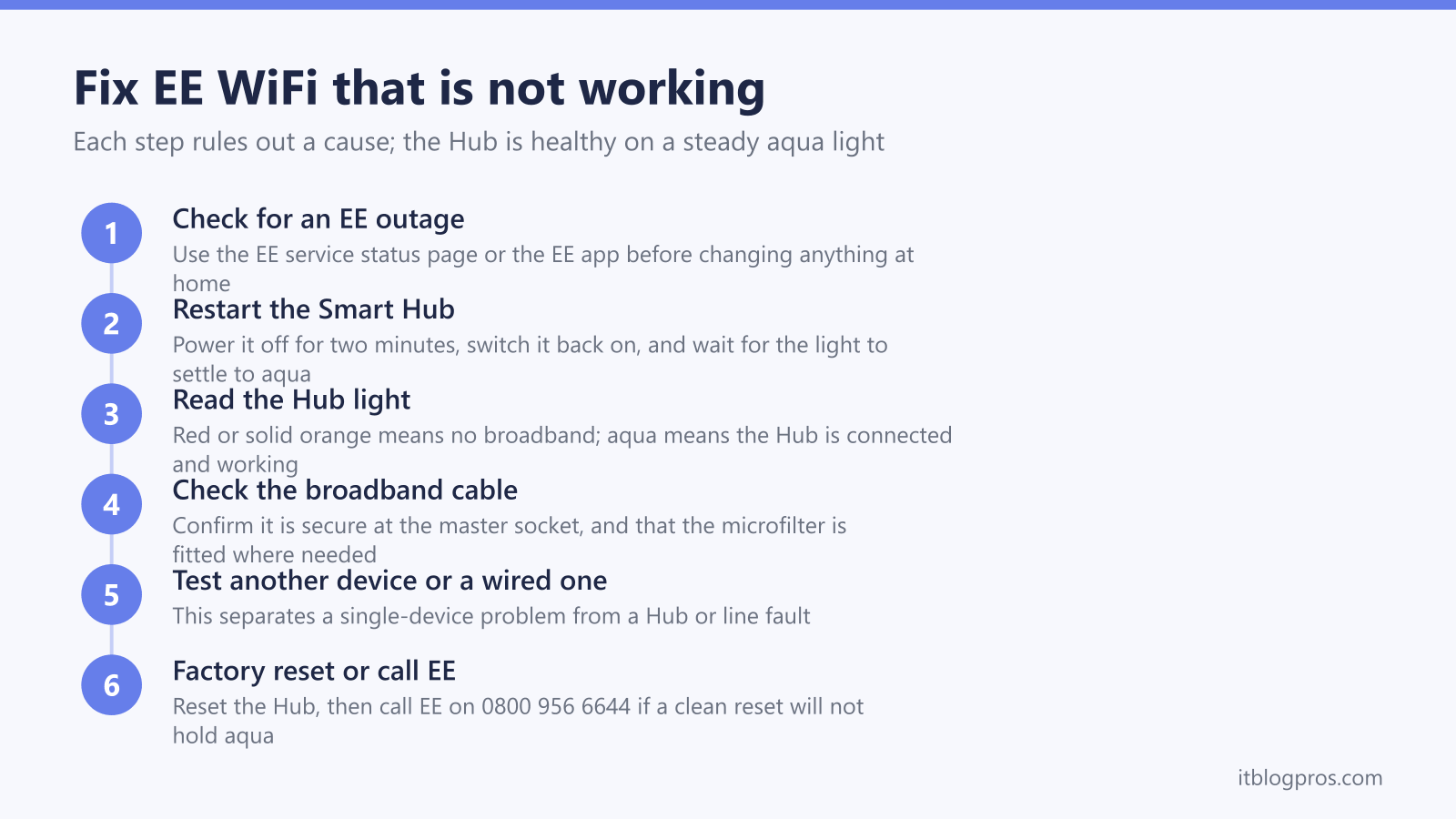
When EE WiFi is not working, check the EE service status checker for an outage first, then switch the Smart Hub off at the plug for 60 seconds and let it restart. That one restart clears stalled connections and lets the hub pick a cleaner WiFi channel on boot. If wired devices still work while WiFi does not, the fault is coverage or settings rather than the broadband line.
Key Takeaways
- A 60 second power-off restart fixes more EE WiFi faults than any other step, because the hub rebuilds its device address table and picks a cleaner WiFi channel on boot.
- Checking the EE service status page and the hub light first stops you troubleshooting your own kit in the middle of an EE outage.
- One device failing points at that device's settings, while every device failing at once points at the hub or the broadband line.
- An Ethernet cable test separates a broadband fault from a WiFi fault in under a minute, and each has a completely different fix.
- An extender solves one weak room, but no extender can fix a broadband fault, so confirm the line is healthy before buying anything.
Quick triage before touching any settings
Three quick checks tell you where the fault sits, and together they take about two minutes.
First, rule out an outage. Open the EE app or the service status page on EE's website and run the checker for your postcode. One honest wrinkle is worth knowing here: EE's own checker can lag behind a fresh or very localised fault, so a clean result does not always mean a clean line. Downdetector fills that gap because it shows live user reports, and a sudden spike of complaints over the last hour usually means the problem is EE's, in which case the only fix is patience.
Second, glance at the hub. The light on the front of an EE Smart Hub tells you a surprising amount; a solid, steady light generally means the broadband side is happy, while flashing or coloured warning states mean the hub is still trying to connect. The full guide to what the lights on your EE router mean decodes every state and gives the matching fix.
Third, count the affected devices. One phone or laptop refusing to connect while everything else works points at that device, so start there by forgetting the network and rejoining, or toggling WiFi off and on. Every device failing at once points at the hub or the line, which is where the rest of this guide comes in.
The 60 second restart and why it actually works
Switch the hub off at the wall or pull the power lead, wait a full 60 seconds, then power it back on and give it three or four minutes to fully reconnect. This is not superstition, and it clears more EE WiFi faults than every other step combined, for two concrete reasons.
The first is DHCP, the system the hub uses to hand every device a local address. Over weeks of uptime that address table can get into a tangle, especially in a busy house where phones, TVs and smart devices join and leave constantly. A tangled table shows up as the classic connected-but-no-internet symptom on one or more devices. Restarting wipes the table clean, and each device negotiates a fresh address when it rejoins.
The second is channel congestion. WiFi in a terrace or a block of flats shares the airwaves with every neighbouring network, and EE hubs choose their operating channel when they boot. A channel that was quiet last month may be crowded now. Powering the hub off for a minute forces a fresh scan on startup, so the hub lands on a cleaner channel instead of fighting next door for the same slice of spectrum.
Restart the struggling device too, since the same stale-connection logic applies at that end. One caution: restarting means the power switch or the plug, never the recessed pinhole button on the back of the hub. Holding the pinhole performs a factory reset, which wipes your WiFi name, password and settings.
An Ethernet test separates broadband faults from WiFi faults
Before changing any settings, establish which of two very different problems you have. EE broadband being down and EE WiFi being weak produce the same symptom on a phone, yet the fixes have nothing in common.
Plug a laptop into one of the hub's LAN ports with an Ethernet cable and try a few websites. If the wired connection works, the broadband line is healthy and the fault lives in the WiFi, so the settings and coverage sections below will sort it. If the wired connection is dead as well, no amount of WiFi tinkering will help, and you can jump straight to the line checks at the end of this guide.
No laptop with an Ethernet port is not a dead end. Stand right next to the hub with your phone showing full WiFi bars. Full signal beside the hub with nothing loading behaves like a broadband fault, while a strong connection near the hub that collapses two rooms away is a coverage problem.
EE Smart Hub settings that quietly break WiFi
A handful of Smart Hub behaviours cause faults that look far more serious than they are. Everything below lives in the Hub Manager, so open Hub Manager at 192.168.1.254 in a browser on a device connected to the hub. The EE Smart Hub login guide walks through the address and where each setting hides, and EE's Compatible WiFi page puts the hub's admin password on the pull-out card on the back of the hub. If that sticker has worn off, how to find the router admin password covers the fallbacks.
Compatible WiFi is the setting to know about. EE's Compatible WiFi help page says EE's latest Smart Hubs use newer WiFi technology and that most devices connect without problems, but some may not. It suggests Compatible WiFi, a separate network on 2.4GHz, for a device that cannot find the main WiFi, keeps failing during setup even with the correct password, disconnects often, or is a smart home device that only works on 2.4GHz, and it lists smart bulbs, doorbells and cameras among the devices that may need it. The same page turns it on in the EE app under Manage, Broadband and the WiFi networks section, or in Hub Manager under Advanced Settings, Wireless, then Compatible WiFi. EE's Smart Hub comparison page lists Compatible WiFi for the Smart Hub 7 Pro, Smart Hub 7 Plus and Smart Hub 6 Plus, with multiple network names on select Smart Hub 6 Plus models or software, and lists the original Smart Hub as single SSID.
WPS deserves a mention. The WPS button on the hub pairs a device or an extender without typing the password, but it only listens for a short window after a press. Failed WPS attempts are common with some devices, and joining manually with the WiFi password is the reliable fallback rather than a sign of a fault.
The Guest network catches people out too. A device that joined Guest WiFi instead of the main network gets internet access but cannot see printers, smart speakers or anything else on the main network, which is easily mistaken for broken WiFi. Check which network name the misbehaving device actually joined before troubleshooting anything deeper.
Coverage fixes when EE WiFi is weak rather than broken
Placement comes first because it is free. The hub wants to be central, out in the open and roughly at waist height or above, not on the floor behind the TV or shut inside a cabinet. Thick walls, metal and large appliances between the hub and the room you use most all cost signal, and moving the hub even a metre or two into open air can noticeably change coverage at the far end of the house.
Where your hub offers Compatible WiFi, it gives you a second lever. TP-Link's FAQ on the differences between 2.4GHz and 5GHz says 2.4GHz reaches farther than 5GHz, and EE's Compatible WiFi page says its 2.4GHz network may be slightly slower than the main WiFi, so a distant device can be joined to Compatible WiFi deliberately instead of letting the hub decide.
For one stubborn dead room, an extender is the honest budget fix, with two caveats worth knowing before buying. Placement decides everything: an extender has to sit roughly half way between the hub and the dead zone, somewhere the signal is still strong, because it can only rebroadcast what it already receives, and putting one inside the weak room just rebroadcasts a weak signal. The second caveat is that a single-band extender repeats on the same radio it listens on, which roughly halves throughput for anything connected through it. That is a fair trade for a room with no usable signal, and a poor one for a room that was merely slow.
The TP-Link RE315 is the straightforward option at the cheaper end. One honest note on it: its OneMesh feature only works with TP-Link OneMesh routers, so behind an EE hub it runs as an ordinary extender. You can still give it the same network name as the hub, which stops most devices asking you to switch manually, though handover between the two will not be as seamless as a proper mesh system.

Once one arrives, the TP-Link extender setup guide covers getting it onto an EE hub, including which RE model suits which size of home. If you already run one of EE's own extenders and its light has started flashing, the EE WiFi extender lights guide decodes each state. When the whole house is patchy rather than one room, the hub itself is usually the limit; the best router for EE broadband guide covers the mesh systems and routers that genuinely outperform it.
When it is the line, not the WiFi
If the Ethernet test failed, or the hub's broadband light never settles, the fault sits on the line between your home and EE, and no WiFi setting will change that. A couple of checks strengthen your hand before phoning.
On part-fibre connections that still use the phone line, unscrew the two small screws on the master socket faceplate and plug the hub's broadband cable into the test socket revealed behind it. The test socket bypasses every internal extension in the house, so a hub that connects there points to your internal wiring, while a hub that stays down even in the test socket points to EE's line. On full fibre there is no master socket to test; check the small ONT box on the wall instead, since a dead or red-lit ONT means the fibre itself has a problem that only an engineer can fix.
Run the outage check one final time, then contact EE on 150 from an EE phone or 0800 956 6644 from any other line. Having your evidence ready shortens the call considerably: when the fault started, what the hub light is doing, and the results of the Ethernet and test socket checks. Those answers let the agent skip the basic script and raise a line fault or book an engineer sooner.