
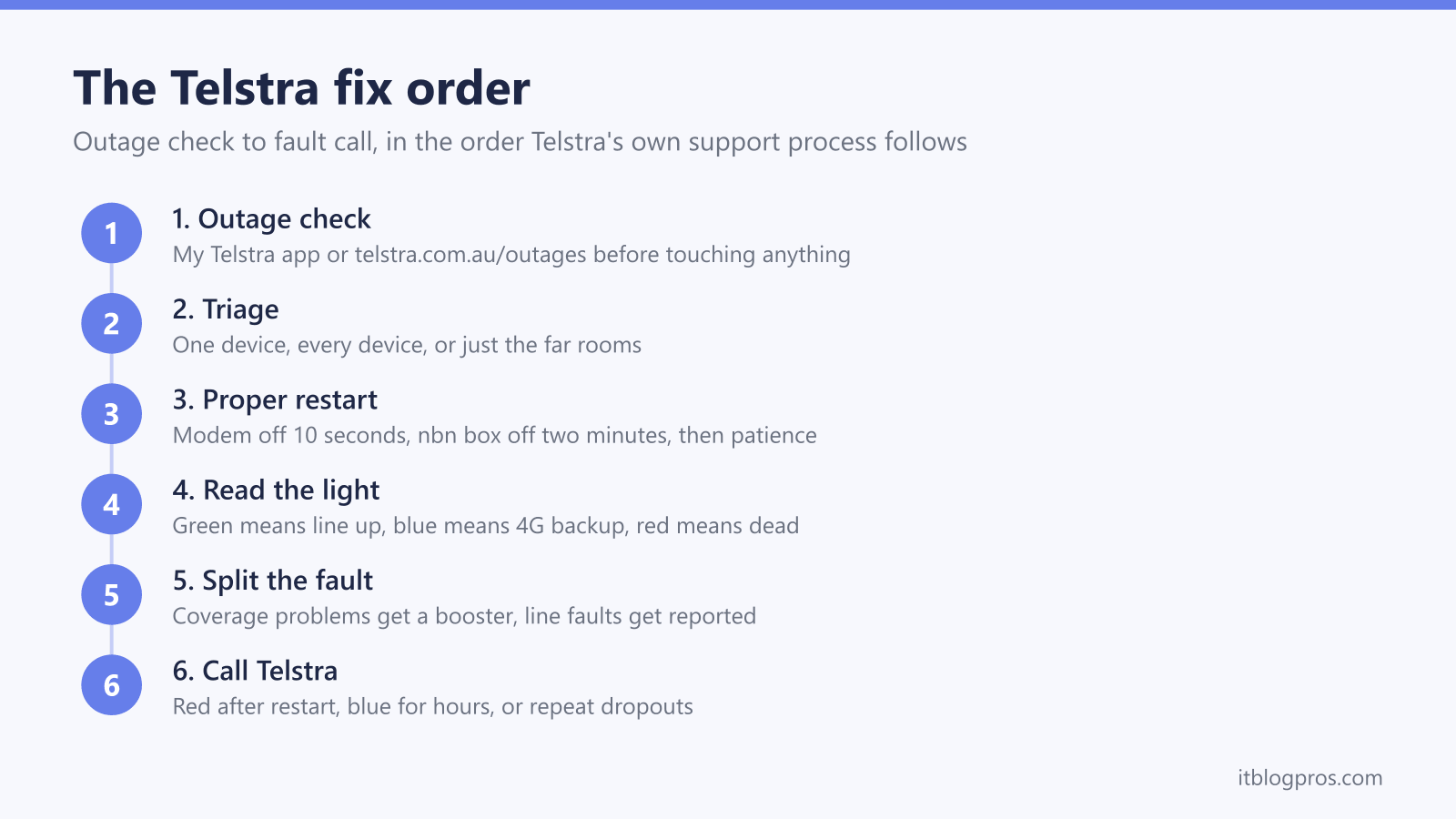
Telstra WiFi problems get solved fastest when the steps run in the right order, and most people run them backwards. The Telstra Smart Modem is unusual among ISP routers because it carries its own 4G or 5G mobile backup, which means the front light tells you in one glance whether the nbn line has dropped or the trouble sits inside your own home WiFi. This guide walks the fix ladder Telstra's own support process follows: outage first, triage second, a proper restart, a light readout, and only then a decision between a coverage fix and a fault call.
Check for a Telstra outage in the My Telstra app first, because a blue front light means the nbn line has dropped and the Smart Modem is running on 4G backup. If there is no outage, restart the modem and any nbn connection box, wait a few minutes for resync, then read the front light. Green means the line is fine and the problem is WiFi coverage.
Key Takeaways
- A blue front light on a Telstra Smart Modem means the fixed nbn line has dropped and the modem is running on 4G or 5G mobile backup, capped at 25/5 Mbps on home internet plans.
- The My Telstra app checks for outages and runs Telstra's own line test, so it comes before any restart, cable check, or phone call.
- Telstra's restart procedure is 10 seconds off at the power for the modem, at least two minutes off for an nbn connection box, and a few minutes of patience for the resync.
- One slow room points to WiFi coverage, every device down points to the line, and that split decides whether a booster or a Telstra fault report is the fix.
- A Telstra Smart WiFi Booster or a third-party mesh kit extends coverage behind the Smart Modem but never raises the speed of the nbn plan itself.
Telstra Smart Modem front light states, meanings and fixes
| Light | What it means | What to do |
|---|---|---|
| Solid green | Connected to the nbn network and working normally. | Nothing to fix on the line. If some rooms still have poor WiFi, treat it as a coverage problem, not a connection fault. |
| Solid blue | Mobile backup is active. The fixed nbn line has dropped and the modem has failed over to 4G, or 5G on the Smart Modem 4, capped at 25/5 Mbps. | Check for outages in the My Telstra app. If none is listed, reseat cables and power cycle the modem. If it stays blue for more than a few hours, run the app troubleshooter and contact Telstra. |
| Solid red | No connection at all. Both the fixed line and the mobile backup have failed. | Check every cable, restart the modem and any nbn connection box, and check for outages. If it stays red after a full restart, contact Telstra. |
| Flashing white | Booting up (slower flash) or connecting to the network (faster flash) after a restart. | Wait it out. A normal restart settles to green within two to five minutes. |
| Orange | Trying to connect to the network (Smart Modem 3). | Allow a few minutes. If it never reaches green, restart the modem and any nbn box, then run the My Telstra troubleshooter. |
| Flashing blue and green | Firmware update in progress (Smart Modem 4), taking up to 10 minutes. | Leave the modem powered on until the light settles. Unplugging during an update can damage the firmware. |
| No light | The modem is off, or the status lights have been switched off with the modem's light button. | Check the power lead and wall switch first, then try the light button on the modem, which toggles the LEDs on and off. |
Check for a Telstra outage before touching anything
Every minute spent rebooting during an outage is a minute wasted, so the outage check comes first. Open the My Telstra app, head to the support section and use check for outages, or visit telstra.com.au/outages and sign in with your Telstra ID to see anything affecting your specific services. If an outage is listed, Telstra already knows about it and shows an estimated fix time, so there is nothing to report and nothing to reboot.
The Smart Modem gives you a second outage detector for free: the front light. Telstra's Smart Modems fail over to mobile backup when the fixed line drops, and the front light turns solid blue when that happens. A house full of working-but-slow internet and a blue modem light is the classic signature of an nbn line problem that Telstra's 4G backup is quietly papering over. If the app shows no outage but the light is blue, the fault is specific to your service, and that is worth a fault report rather than a restart loop.
If the app shows no outage and the light is green, the line is up and the problem almost certainly lives inside your home. That single observation saves you a support call, because the fix will be a WiFi fix, not a line fix.
One device or every device decides the next step
Before restarting anything, spend thirty seconds on triage, because the answer changes the entire path.
One device offline, everything else fine. The line and the modem are innocent. Toggle flight mode or WiFi off and on, forget the network and rejoin with the WiFi password printed on the modem's base, and restart the device itself. A device that says connected but refuses to load pages has its own guide in why WiFi says no internet.
Every device offline or crawling. The problem is upstream: the modem, the nbn connection, or an outage. Continue down the ladder with the restart and the light readout.
Fine near the modem, hopeless in the back rooms. That is a coverage problem, not a connection problem. No amount of restarting fixes a brick wall, so jump ahead to the coverage section. Australian homes with double-brick internal walls are notorious for this pattern, and the fix is placement or a booster, never a fault call.
This triage matters with Telstra more than most ISPs because the blue-light backup can mask a line fault. A household can run on 4G backup for hours without noticing anything except that streaming buffers, so pair the device check with a glance at the front light every time.
Restart the modem properly and give the resync time
Telstra's own instruction for the Smart Modem is simple: remove the power cable for about 10 seconds, then plug it back in. The front light flashes white while the modem boots and connects, and a normal restart settles within two to five minutes. Resist the urge to declare failure at the sixty-second mark.
If your connection type includes a separate nbn connection box, restart it too, and give it more respect: switch it off at the wall, disconnect the power cord from any backup battery unit if one is fitted, and wait at least two minutes before powering it back on. Then start the Smart Modem after the nbn box has had a head start.
Two warnings stop the most common self-inflicted wounds. First, the recessed pinhole on the modem is a factory reset, not a restart. Holding a paperclip in it wipes your WiFi name, password, and settings, so leave it alone unless Telstra support asks for it. Second, a Smart Modem 4 that flashes blue and green after a restart is installing a firmware update, which can take up to 10 minutes, and pulling the power mid-update is the one way to turn a healthy modem into a sick one. Leave it be until the light settles.
While you are behind the cabinet, reseat the cables: the power lead, the line cable into the correct port, and any ethernet into the WAN port if your setup uses one. A half-clicked connector after moving furniture causes a remarkable share of sudden Telstra outages.
The Smart Modem front light tells you where the fault sits
Telstra has shipped several Smart Modem generations, and the front light language is consistent across the family: the Smart Modem Gen 2 (the 2018 Technicolor unit), the Smart Modem 3 (also badged Telstra Smart Modem Gen 3, with WiFi 6), and the current Smart Modem 4 (WiFi 7, with 5G as well as 4G backup). The full state table is below, but the three states that matter for troubleshooting are easy to memorise.
Solid green means the modem is connected to the nbn network and working normally. If the internet still feels broken on green, the fault is WiFi coverage or a single device, not the line.
Solid blue means mobile backup is active: the fixed line has dropped and the modem has failed over to 4G, or 5G on the Smart Modem 4. You still have internet, just slower.
Solid red means both the fixed line and the mobile backup have failed, which is a genuine no-connection state and the fastest route to a Telstra fault report if a restart does not clear it.
The back of the modem carries a second, easily missed indicator: the mobile signal light. On the Gen 2 and Smart Modem 3 it shows green for a strong 4G signal, orange for okay, and red for weak; the Smart Modem 4 shows signal bars instead. This light only matters while the front light is blue, but when it does matter it matters a lot, because a red or single-bar backup signal explains why backup mode feels unusable, and moving the modem nearer a window can genuinely help. If nothing on the front lights up at all, check the power lead first; the modem also has a button that toggles the lights off, and a helpful family member may have pressed it.
For non-Telstra hardware in the house, the same colour-reading approach is covered in the general router lights guide.
Blue light honesty: 4G backup keeps you online at reduced speed
Mobile backup is the Smart Modem's best feature and its most misunderstood one. On eligible Telstra home internet plans, the modem automatically switches to the Telstra mobile network when the fixed line fails, and it switches back once the line recovers. There is nothing to configure and nothing to press.
The honest caveat: backup speeds are capped at 25 Mbps down and 5 Mbps up, and Telstra notes actual speeds may be lower still. That is enough for email, browsing, video calls, and standard-definition streaming for a small household, but it is not your 100 Mbps plan, and it will strain under 4K streams or big downloads. The Smart Modem 4 can use 5G for backup where coverage exists, which improves latency, but the same 25/5 cap applies. Backup also only works at addresses with Telstra 4G or 5G coverage, so a poor mobile signal at your address means a poor safety net.
Telstra's guidance for a modem that stays blue is worth following in order: check for outages first, then reseat cables and power cycle the modem, and if backup has been running for more than a few hours with no listed outage, run test and troubleshoot in the My Telstra app and contact Telstra if it stays blue. A blue light is a symptom of a line fault, and line faults do not fix themselves.
The fault can sit with nbn, Telstra, or your own WiFi
Telstra home broadband rides the nbn network, and the connection type at your address decides what equipment sits in your home and where a fault can hide.
FTTP (Fibre to the Premises) homes have an nbn connection box (the NTD) that the Smart Modem plugs into by ethernet. HFC homes have an nbn connection box fed by a coaxial cable. FTTC (Fibre to the Curb) homes have a small powered nbn connection device between the phone socket and the modem. FTTN (Fibre to the Node) homes have no nbn box at all: the Smart Modem plugs straight into the telephone wall socket and the connection quality depends heavily on the copper distance to the node.
The practical rule: wherever an nbn box exists, its lights matter as much as the modem's, and it belongs in the restart routine described earlier. A dead nbn box with a happy-looking modem still means no fixed-line internet, and on a Smart Modem the only clue may be that quiet blue light.
The fault-ownership rule is even simpler: you always deal with Telstra, never nbn co directly. Residential customers cannot log faults with nbn; Telstra runs the diagnostics, and if the fault sits in the nbn network, Telstra raises it and books any technician visit. That is also why the My Telstra app troubleshooter is worth running before calling: it performs the same line test a consultant starts with, and completing it first shortens the call.
Coverage problems need a booster, and no booster raises plan speed
If the front light is green, speeds near the modem are fine, and the far bedrooms are a dead zone, you have a coverage problem, and two honest limits frame every fix. First, no booster, extender, or mesh kit increases the speed of your nbn plan; coverage gear only carries the speed you already pay for into rooms it currently does not reach. Second, placement is free and comes first: a Smart Modem out of a cupboard, off the floor, and away from the microwave often recovers a surprising amount of coverage.
Telstra's own answer is the Telstra Smart WiFi Booster, currently in its Gen 3 version with WiFi 6. It meshes with the Smart Modem, keeps a single network name so devices roam between modem and booster automatically, and pairs over an ethernet cable before being positioned roughly halfway between the modem and the weak zone. Telstra supports up to three boosters on one modem, suggesting one for a small home, two for a larger one, and three for multi-storey houses, and it works across the Smart Modem family including the Gen 2, Smart Modem 3, and Smart Modem 4. Telstra sells it at $7 per month over 24 months or $168 outright.
The booster is convenient but not compulsory. The Smart Modem broadcasts standard WiFi, so third-party extenders and full mesh systems work behind it exactly as they do behind any other router. A quality third-party mesh kit often outperforms a single booster in a large or double-brick home, and the trade-offs between the approaches are laid out in WiFi extender versus mesh.
Calling Telstra beats another restart at a defined point
The ladder ends with a call, and these are the states that justify it. A solid red light that survives a full restart of the modem and any nbn box is a dead connection with a dead backup, and only Telstra can trace it. A blue light for more than a few hours with no outage listed means a line fault on your service specifically. Repeat dropouts across days deserve a fault report even though each individual drop recovers, and a simple log of dates and times turns a vague complaint into an evidenced fault, which matters on FTTN where line quality issues are common and intermittent.
Before the call, run test and troubleshoot in the My Telstra app under the support section. It tests the line remotely, walks the same script a consultant uses, and either fixes the issue, books it as a fault, or hands you to a human with the diagnostics already done. Have your account details ready, know your connection type if you can, and be ready to say the restart has already been done properly, because that is always the first thing asked.
One last expectation-setter: if the fault sits in the nbn network, Telstra raises it with nbn and relays the fix timeline, and a technician visit may be booked for line faults. The blue-light backup means a Telstra household usually stays online through all of it, slower but connected, which is precisely what that odd blue glow was designed for.