
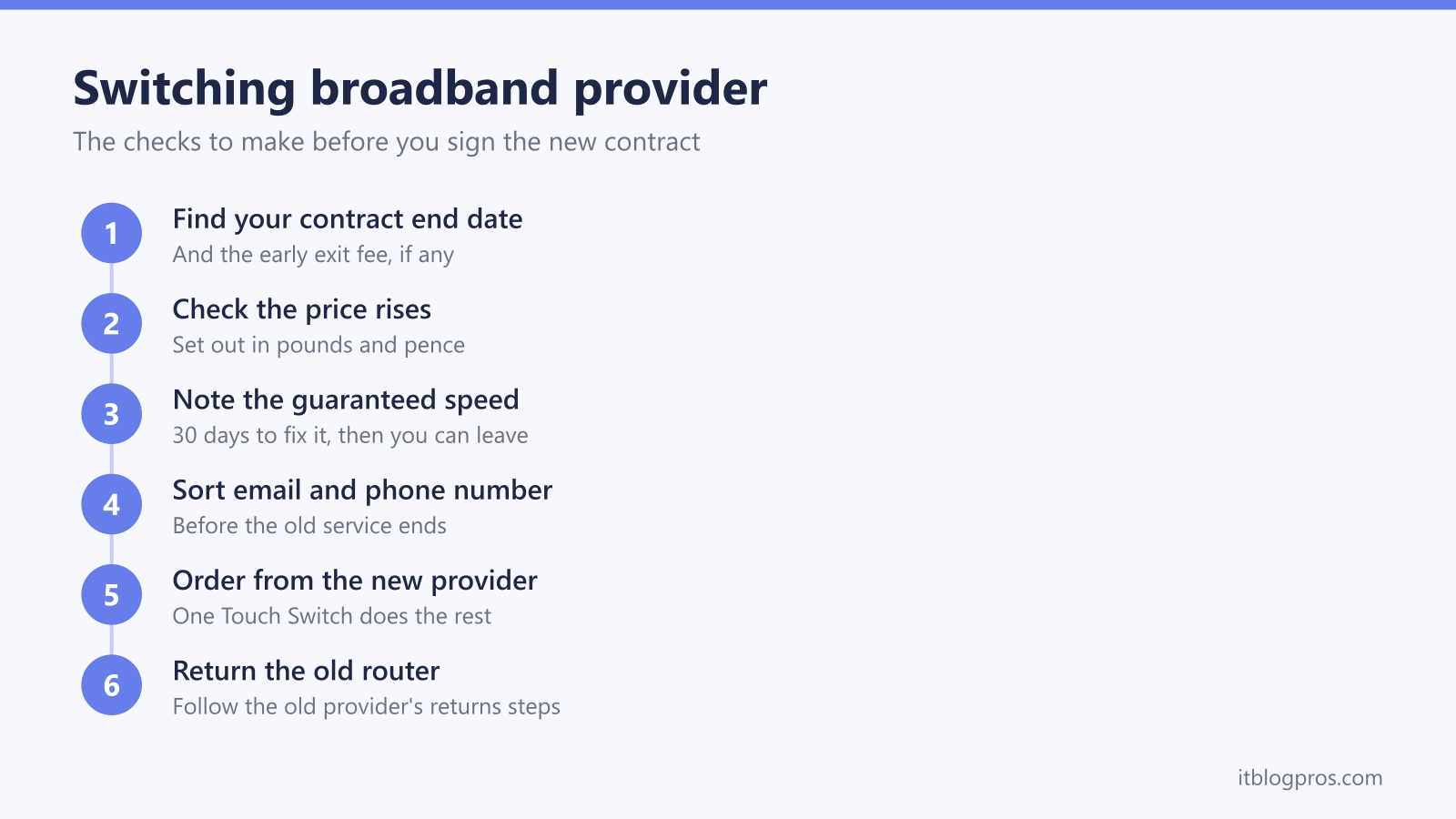
Black Friday has started early in the broadband aisle. ISPreview reported that Virgin Media O2's broadband and TV sale opened on 5 November and runs for new customers until 6 December 2026, and that Sky's sale, which began the same day, includes a cut on its 5Gbps package in CityFibre areas, with most of Sky's offers running until around 2 to 9 December. The switch itself is now mostly one phone call. The checks that catch people out sit around it, and they apply in any month, not only in a sale.
Before signing with a new broadband provider, check your current contract end date and exit fee, read the new contract summary for price rises set out in pounds and pence, and note the minimum guaranteed speed. Ofcom's One Touch Switch means the new provider handles the move. Sort your email address and phone number first, then return the old router the way the old provider asks.
Key Takeaways
- Ofcom says that under One Touch Switch you contact only the new provider, and the old one must not charge for any notice period after the switch date.
- Ofcom says early termination charges shouldn't be more than the payments left on the contract, and providers must warn you 10 to 40 days before it ends.
- Since 17 January 2025, Ofcom has required any price rise written into a new contract to be set out in pounds and pence.
- Ofcom gives 14 calendar days to cancel a new broadband order, but the old service does not come back by itself.
- BT, Sky and Virgin Media all ask for their routers back, and each handles email addresses and returns differently.
The switch itself is now the easy part
Ofcom's switching guidance is short: contact the provider you want to move to, and it manages the switch for you. Ofcom adds that an engineer visit or new equipment is sometimes needed, and the new provider should explain this. If that means a full fibre installation, the guide to full fibre install day walks through it.
Ofcom says new-provider-led switching has existed since 2015, but only within Openreach's network, so a move to or from Virgin Media meant contacting the old provider too. One Touch Switch, which Ofcom announced as live on 12 September 2024, extended the same process across networks for broadband and landline. Ofcom names Virgin Media as an example of a different network but doesn't publish a list of every network or altnet covered, so ask the new provider whether the order uses One Touch Switch.
On switch day, Ofcom says the old provider must not charge for any notice period after the switchover date, any loss of service should not last longer than one working day, and compensation applies if you're left without service for longer than that or an appointment is missed. A TV package in a bundle is different: Ofcom says you might need to contact the current provider to cancel it.
Your contract end date sets what leaving will cost
The first check is the date your current contract ends. Ofcom's rules, in force since 15 February 2020, require phone, broadband and pay-TV providers to warn customers between 10 and 40 days before the contract ends, by text, email or letter, setting out when it ends, what you pay now and afterwards, any notice period and the provider's best deals. If that message has gone astray, check the provider's app or online account for the end date. Sky customers can find it using the Sky contract end date guide.
Leaving before that date normally brings early termination charges. Ofcom says these shouldn't be more than the payments left on the contract and in some cases could be a lot less, and that with One Touch Switch the provider must tell you about any charges before you switch. Some sale offers try to soak up that cost: ISPreview reported that Virgin Media O2's Black Friday deals come with Contract Buyout bill credits aimed at exit fees from another provider, and Ofcom's switching page notes that some providers pay towards exit fees. Read the terms of any buyout offer before counting on it.
For the new deal, Ofcom says providers must offer a contract option of 12 months or less, and residential contracts should be no longer than 24 months.
Price rises must now be in pounds and pence
Ofcom banned inflation-linked and percentage-based price rise terms in new contracts from 17 January 2025. Any rise written into a contract must now be set out in pounds and pence at the point of sale, with the timing made clear. Ofcom's ban covers new contracts, so one signed before that date may still carry inflation-linked terms. The guide to April broadband price rises sets out each big provider's rise in pounds and pence from its own price-change page.
Rises that were not agreed are a different matter. Ofcom says a provider that raises prices beyond what was agreed at sign-up must give at least one month's notice and a right to leave without penalty. A rise that was made clear when you signed gives no such right, which is why the summary matters. Ofcom says you should receive a one-page contract summary in writing (three pages for bundled services) covering the charges, the contract length and how to cancel.
You have 14 days to change your mind
Ofcom says you can cancel a broadband order within 14 calendar days by contacting the new provider. The Consumer Contracts Regulations 2013 set the same window in law: for a service contract agreed online or by phone, regulation 30 says the cancellation period ends 14 days after the day the contract is entered into.
Ofcom adds that you may still pay for anything you've already used plus installation costs, and that your old service will not automatically be reinstated. The checks belong before the order, not after it.
Your phone number, landline and email need sorting first
Ofcom says you can keep your phone number when the landline moves, and even after cancelling a landline you can still ask to keep the number free of charge, provided you ask within one month of cancelling. Ofcom also warns that moving broadband away while keeping the landline with the current provider can affect the landline linked to it, so say what you're moving when you order.
The landline itself is changing as well. Ofcom says digital landlines plug into the broadband router, keep the same number and need mains power, so they won't work in a power cut without battery backup, and that BT plans to retire its old landline network by 31 January 2027. Ofcom says anyone who relies on the landline, including telecare users, should tell their provider, which must then give at least one hour of backup for emergency calls. The landline switch-off guide covers phones, alarms and backup.
Email is where a quick switch can do lasting damage. Ofcom says an address from your old provider may be affected and advises setting up a new one before you switch if you can't keep it. BT says that when BT Broadband ends you can keep a BT address as Basic email, pay for Premium email (you have 60 days after leaving to choose it), close the address or link it to another BT Broadband account, and that BT moves you to Basic if you make no choice. Confirm the choice in My BT before cancelling. Sky says it deletes Sky Yahoo Mail accounts unused for 12 months or more, advises signing in at least every six months and warns that auto-forwarding can make an account look inactive. Sky's page doesn't spell out what happens to the account after you leave Sky Broadband, so ask Sky before you go and sign in through sky.com rather than relying on forwarding.
The guaranteed minimum speed is your exit route
Ofcom says the contract summary should clearly explain the minimum, normally available and maximum download and upload speeds. Under Ofcom's voluntary Broadband Speeds Code of Practice, the provider gives you a personalised minimum guaranteed speed, and if a problem on its network isn't fixed within 30 days you can leave without an early exit fee. Ofcom says the right extends to bundles.
Ofcom lists the code's members as BT, EE, NOW Broadband, Plusnet, Sky, TalkTalk, Utility Warehouse, Virgin Media and Zen Internet. Vodafone and full fibre altnets such as Hyperoptic, Community Fibre and YouFibre aren't on that list, so ask those providers for their minimum speed and what happens if it's missed, in writing, before you sign.
Test the current line on a cable at the router, as Ofcom advises, with the broadband speed test guide, and keep the result. After the switch, the WiFi speed test guide separates line speed from weak WiFi, and the gigabit WiFi bottleneck guide explains why a faster sale tier may feel no faster over WiFi.
Some households gain little by switching
Someone part way through a contract, on a fair price, with a speed that matches the guarantee and no complaints about service, gains little and may pay an exit fee for the privilege. If the real complaint is a weak signal in one part of the house, run a wired speed test first: a wired result that matches the plan points at the WiFi rather than the line, and the mesh, extender or new router decider is a better first stop. A household still on an old copper line is the opposite case: Broadband Genie says all ten of the slowest UK streets in its 2026 study could already get part fibre, as the slowest broadband streets guide sets out.
Households on certain benefits should look at social tariffs before anything else. Ofcom describes these as cheaper broadband and phone packages for people on Universal Credit, Pension Credit and some other benefits, says you can move to your own provider's social tariff at any time free of charge, and says all major providers include people on Pension Credit, Employment and Support Allowance, Jobseeker's Allowance and Income Support. Ofcom's switching page adds that social tariffs come with no mid-contract price rises. Ofcom says the person claiming the benefit needs to be the main person on the contract.
The old router goes back, and your own kit can stay
Ofcom says the new provider should explain how to set up its equipment, usually a new router, and that you can either connect your devices to the new WiFi or set the new router to use your old WiFi name and password.
The old router usually has to go back:
- BT says all its equipment is on loan and must be returned when no longer needed, gives 60 days from when you stopped using it before charging, emails a QR code and printable label (text LABEL to 61996 for another), and refunds the charge in full if the kit comes back within two years. BT says the charges don't apply to kit supplied before 13 December 2019.
- Sky asks for the Sky Hub and any Sky Boosters or WiFi Pods, contacts you by text or email about what to return, and sends returns packaging automatically 30 days after you tell it you're leaving. Sky says Openreach master sockets and ONTs stay put.
- Virgin Media sends a free returns pack, which you can ask for again if it hasn't arrived 10 days after disconnection, and says it may charge for kit that isn't returned. It notifies any charge by text and email and cancels it if you call with the Yodel tracking number. Virgin Media's help page gives no fixed return deadline, so keep that receipt and watch for any text or email about a charge.
Kit you own stays with you. A mesh system in Access Point mode behind the new provider's router keeps the same network and coverage, and TP-Link lists that mode on the Deco X50. For a router of your own, the guide to using your own router with any UK ISP covers which providers make it easy. TP-Link's Archer BE550 has a 2.5Gbps WAN port for full fibre above 1Gbps, though TP-Link's own footnote says a separate modem or gateway may be needed, and the gigabit-only Archer AX55 suits packages up to about 900Mbps. BT customers can follow the BT full fibre own router guide.
For the digital landline, Panasonic's KX-TGE820EB lists an answering machine and call blocking, but Panasonic doesn't document digital-line use, so check that the new router has a phone port. TalentCell lists 99.9Wh for its SL3400 battery backup but doesn't state a switchover time, so check the voltage and plug on your router's and ONT's power adapters before buying.
Most people switching need none of this, and a household happy with the new provider's WiFi can skip the table.
| Product | Best for | Key specs | Price | |
|---|---|---|---|---|
 | TP-Link Deco X50 AX3000 Mesh WiFi 6 System (3-pack) Mesh for any provider | Keeping the same whole-home WiFi through a switch, run in Access Point mode behind the new provider's router | WiFi 6 AX3000, dual band, 3 Gigabit Ethernet ports per unit, Router and Access Point modes; TP-Link says the 3-pack covers up to 6,500 sq ft | Check price → |
 | TP-Link Archer BE550 Tri-Band BE9300 WiFi 7 Router WiFi 7 own router | Full fibre above 1Gbps, with a router of your own that stays the same across providers | WiFi 7 BE9300 tri band; 1x 2.5Gbps WAN and 4x 2.5Gbps LAN; USB 3.0; EasyMesh; PPPoE, Dynamic and Static IP | Check price → |
 | TP-Link Archer AX55 AX3000 Dual-Band WiFi 6 Router Budget own router | Packages up to about 900Mbps, with a lower-cost router that moves between providers | WiFi 6 AX3000 dual band; 1x Gigabit WAN and 4x Gigabit LAN; USB 3.0; EasyMesh and OneMesh; Access Point mode | Check price → |
 | Panasonic KX-TGE820EB Digital Cordless Phone with Answering Machine Digital landline phone | Keeping a home phone after the move to a digital landline, with the base plugged into the router's phone port | Panasonic lists a 40-minute answering machine, Automated Call Block (needs Caller ID), Talking Caller ID and a large illuminated keypad; single handset | Check price → |
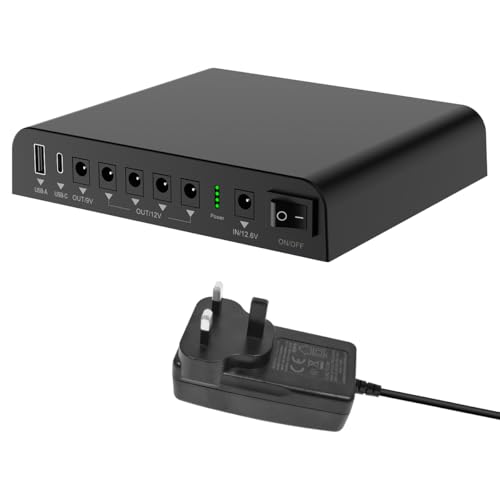 | TalentCell SL3400 Mini UPS (99.9Wh, 12V/9V DC and USB-A/USB-C outputs) Router battery backup | Keeping the router, and the digital landline that runs through it, going during a power cut | TalentCell lists 99.9Wh, 4x 12V DC outputs, 1x 9V DC output, USB-A and USB-C at 18W; DC5521 and DC5525 cables included | Check price → |