
Black Friday broadband deals lead with one monthly price, but the contract behind it already sets out what happens next April. With most big providers, anyone signing up in November 2026 is agreeing to the spring 2027 rise at the point of sale, and the amount is in the paperwork in pounds and pence. This guide sets out each big UK provider's rise from its own price-change page, which contracts each figure covers, and when a rise lets you walk away.
The big UK providers' broadband contracts now rise by a fixed £3 to £4 a month each spring. BT, EE, Plusnet, Virgin Media, TalkTalk and Vodafone publish the amount on their own price-change pages, and Ofcom requires it in the contract in pounds and pence. Sky publishes no amount, NOW's latest rise came in July, and most social tariffs are left out of the rise.
Key Takeaways
- Ofcom banned inflation-linked and percentage price rise terms in new phone and broadband contracts from 17 January 2025.
- On their own price-change pages, BT lists £4 a month, EE and Plusnet £3 or £4, Virgin Media £3.50 or £4, TalkTalk £3 or £4 and Vodafone £3.50, depending on when you signed.
- Sky's broadband page says only that prices may change in the minimum term, and Sky's help page gives a 30-day window to cancel without charges when a rise is notified.
- Ofcom says a rise not set out in the contract, or bigger than it allows, brings 30 days' notice and then 30 days to exit fee-free, while an agreed rise gives no such right.
- BT, EE, NOW, Virgin Media and Vodafone leave their social tariffs out of the annual rise, and Ofcom says you can switch to one free of charge.
Ofcom Requires the Rise in Pounds and Pence Before You Sign
Ofcom's rule changed the way rises are sold. From 17 January 2025, Ofcom says phone, broadband and pay TV providers are prohibited from including inflation-linked or percentage-based price rise terms in all new contracts. Under the older terms, the size of the rise depended on an inflation figure that wasn't known when you signed.
Now the amount has to be fixed in advance. Ofcom's guide to price rise rights says any rise written into a contract must be set out clearly, in pounds and pence, before you sign, and the provider must say when the change takes place. Ofcom's page sets no limit on how large the rise can be, so the figure still varies between providers.
That is why the sale price only tells half the story. A £4 rise each spring of a 24-month deal adds £4 a month after the first rise and £8 a month after the second, and the contract summary is where that shows up.
Each Provider's Broadband Rise, From Its Own Price-Change Page
Each row below comes from the named provider's own page. None of these providers publishes a separate April 2027 table; BT, EE, Plusnet, Virgin Media, TalkTalk and Vodafone each describe the rise as repeating every year of the minimum term, so the same amount applies again in spring 2027 unless a new notice says otherwise.
| Provider | Broadband rise | When it applies | Contracts it covers | Source |
|---|---|---|---|---|
| BT | £4 a month | 31 March each year in the minimum term, 1 March after it ends | Broadband plans; no change for fixed price plans, BT Basic or Home Essentials with BT broadband | BT's annual price change page and Price changes explained |
| EE | £3 or £4 a month | 31 March in the minimum term (from 31 March 2026), 1 March after | £3 for contracts from 10 April 2024, £4 from 6 August 2025 | EE's About annual price changes |
| Plusnet | £3 or £4 a month | 31 March each year, from 31 March 2026 | £3 for 11 July 2024 to 4 August 2025, £4 from 5 August 2025 | Plusnet's About annual price changes |
| Virgin Media | £3.50 or £4 a month | Each April | £4 for joining or renewing after 2 October 2025, £3.50 for 9 January to 2 October 2025 | Virgin Media's Our annual price change explained |
| TalkTalk | £3 or £4 a month | Each April, from 2026 | £4 from 16 November 2025, £3 for 12 August 2024 to 15 November 2025 | TalkTalk's Annual price change |
| Vodafone | £3.50 a month | 1 April each year | Home Broadband plans; Vodafone's page does not say which signing dates | Vodafone's Annual price changes page |
| Sky | No amount published | Some Broadband & Talk prices changed from 1 April 2026 | Details sent in each customer's email or letter | Sky's Changes to your Sky subscription |
| NOW | £3 a month | Bills from 3 July 2026, not April | Broadband plans; NOW Broadband Basics unchanged | NOW's Changes to your NOW Broadband Membership |
A few rows need a closer look. BT's annual price change page heads its table "products bought on or after 10 April 2024", while EE, in the same group, splits that period into £3 and £4 bands at 6 August 2025, so BT customers on a contract from before August 2025 should check their own summary. Virgin Media says its rise applies to both the discounted price and the price after the offer ends. TalkTalk's worked example applies its £4 rise in April 2026 and again in April 2027.
Sky and NOW Break From the Fixed April Pattern
Sky is the outlier. Its help page says it changed some Sky Broadband & Talk prices from 1 April 2026 and gave the details in each customer's email or letter, without stating the amount publicly. thinkbroadband reported that Sky's broadband page said in March 2026 that the price would rise by £3 a month from 1 April 2026, and that by April it said only that pricing may change. Sky's broadband page now reads "Prices may change during your minimum term", so there is no published April 2027 figure to check.
The trade-off works in the customer's favour in one way. Sky's help page says Broadband & Talk customers can cancel without early termination charges if they contact Sky within 30 days of receiving the notification. The Sky contract end date guide covers how the end date decides any exit fee, and anyone staying with Sky but unhappy with the WiFi can look at the best routers for Sky broadband instead.
NOW works to a different calendar. NOW says its broadband plan prices increased by £3 per month, showing on bills from 3 July 2026, and that customers can cancel penalty-free within 31 days of receiving the notification. NOW publishes no annual April rise term for new contracts.
Contracts Signed Before 17 January 2025 Can Still Carry Inflation Rises
Ofcom says contracts signed before 17 January 2025 might still include price rises linked to inflation or set out as a percentage. Several providers' pages still describe those older terms:
- Virgin Media says RPI plus 3.9% applies only to contract terms that began before 9 January 2025.
- Plusnet says customers who have not changed contracts stay on CPI plus 3.9%.
- TalkTalk lists CPI plus 3.7% for in-contract customers who joined before 12 August 2024, and £4 for out-of-contract customers from that period.
- BT says customers outside their minimum term on old CPI plus 3.9% terms are being moved to pounds-and-pence terms, while in-term customers keep the rise they signed up for.
The government has also stepped in. The Telecoms Consumer Charter, a voluntary agreement GOV.UK published on 11 February 2026, says April 2026 will be the final increase expressed in those terms for legacy customers' core subscription, and lists BT Group, VMO2, VodafoneThree, Sky and TalkTalk among its signatories. Virgin Media's and Plusnet's pages still describe the older formula, so anyone on a pre-2025 contract should read the notice that arrives before the next rise to see which basis applies.
A Rise Not in Your Contract Gives You 30 Days to Leave
The exit right depends on what you agreed. Ofcom says that if a contract does not set out the rise, or the provider raises the price by more than the contract says, the provider must tell you at least 30 days before the increase takes effect and then give you 30 days to leave without exit fees, either to a new deal with the same provider or to a new provider. A rise already written into the contract gives no such right; Virgin Media says plainly that because its rise is in the terms, there is no right to cancel in the minimum period without a fee.
When a notice does open the door, the checks before switching broadband provider cover the end date, One Touch Switch, email and returning the router. A slow line is a separate argument with the provider, and the broadband speed test guide explains how to measure it properly first.
Landline customers get letters too. BT lists £1 for landline-only customers outside their minimum term on pounds-and-pence terms, and the 2027 landline switch-off guide covers the other change heading for home phones.
Social Tariffs Are Left Out of Most April Rises
Ofcom describes social tariffs as cheaper broadband and phone packages for people claiming Universal Credit, Pension Credit and some other benefits, and says all major providers also accept Employment and Support Allowance, Jobseeker's Allowance and Income Support. The person receiving the benefit needs to be the main person on the contract.
The providers' own pages show which tariffs escape the rise:
- BT lists no change for Home Essentials with BT broadband.
- EE says prices are frozen for BT Home Essentials, EE Mobile Basics and pay as you go plans.
- Virgin Media says the annual adjustment doesn't apply to Essential broadband or Essential broadband plus, and promises at least 30 days' written notice and the right to cancel if it raises those prices.
- Vodafone says it doesn't raise prices for social tariff customers or customers registered as financially vulnerable.
- NOW says NOW Broadband Basics customers keep the same price.
Sky's pages don't say whether Sky Superfast 35 or Sky Full Fibre 75 rise in April, though Ofcom says a social tariff price won't go up mid-contract. TalkTalk and Plusnet don't appear in Ofcom's social tariff list. Moving is straightforward: Ofcom says you can switch to your provider's social tariff at any time free of charge, even in contract, and won't pay a fee to leave it.
The Check Before Signing a Black Friday Deal
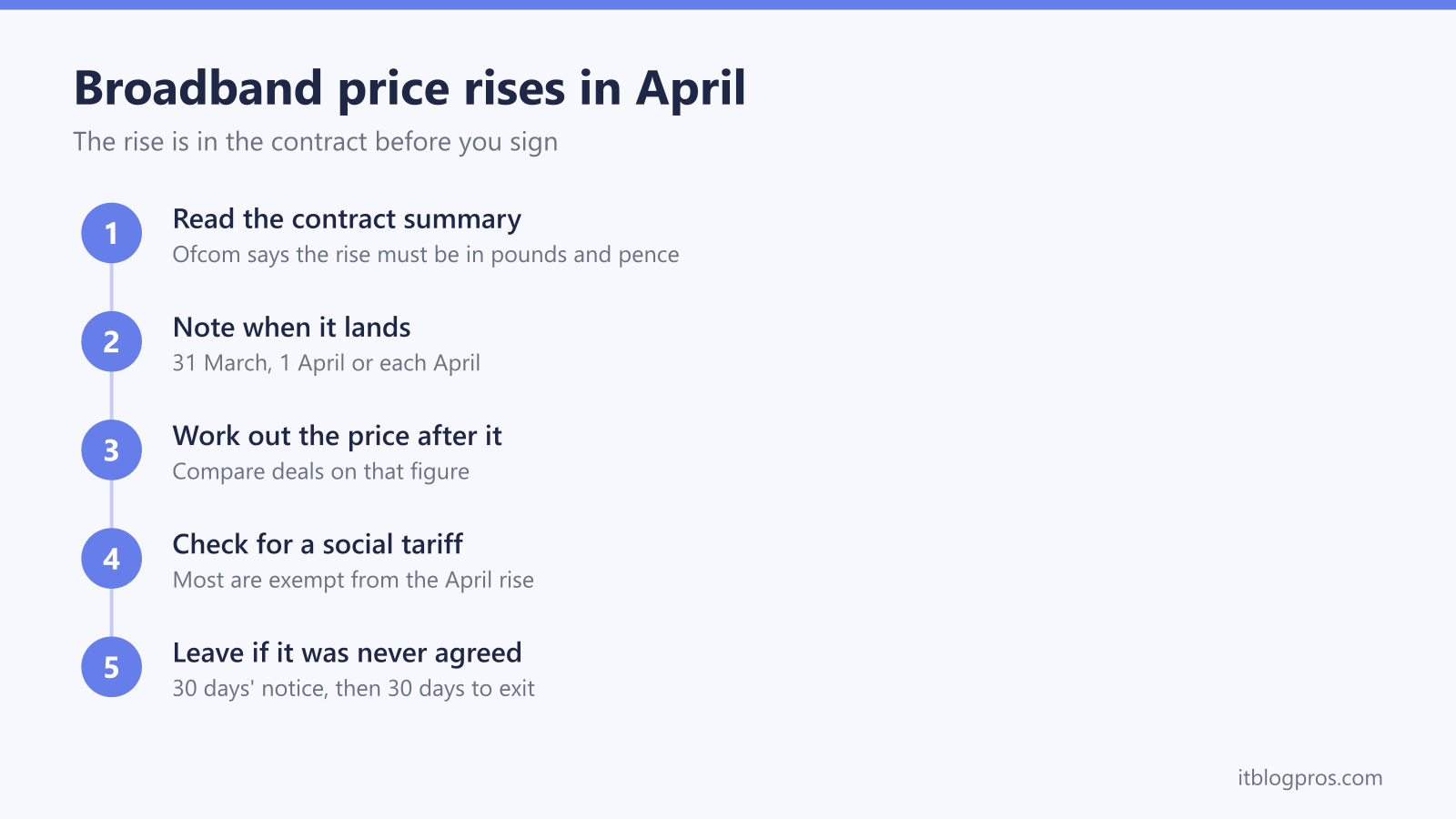
Ofcom's contract summary rules, in force since 17 June 2022, require a short one-page summary before you sign (three pages for bundles), including clear examples of how any price increases will affect the price you pay. That page is the one to read before clicking buy.
- Find the rise. It should be in pounds and pence, with the date it lands.
- Count the rises. A 24-month deal signed in November runs through two springs before it ends, and the summary shows the rise due in each.
- Work out the price after each one. Compare deals on that figure, not the headline price.
- Check the speed you actually need. A faster tier costs more every month, and the gigabit broadband bottleneck guide shows whether your WiFi and devices can use it.
Staying Put Makes Sense if the Price After the Rise Suits You
Not everyone needs to act. Anyone who is happy with what they pay after the rise, and happy with the service, gains nothing by switching. The rise was agreed, the WiFi works, and changing provider means a new hub, a new setup and a new contract with its own rise in it.
Switching earns its keep when the minimum term has ended and the price has gone up since, when a notice brings a rise you never agreed to, or when a social tariff fits your circumstances.
A Router of Your Own Makes Switching Easier
Nobody has to buy anything to deal with a price rise. If you are staying put and the WiFi reaches every room, keep your money. A router or mesh system of your own only helps when you expect to switch, or switch often, because the home network then stays the same whichever hub the new provider sends. The guide to using your own router with any UK provider covers how it connects, and the BT full fibre router guide covers the settings BT Full Fibre needs.
TP-Link's Archer AX55 is the simplest option: WiFi 6 at AX3000, one gigabit WAN port and four gigabit LAN ports, and it can sit behind the provider's hub as the home's own WiFi. For a larger home, TP-Link says its Deco X50 3-pack covers up to 6,500 sq ft and runs in Access Point Mode behind a provider hub or as the router itself. TP-Link pitches its Deco X10 2-pack at 2 to 4 bedroom homes and rates it at up to 3,900 sq ft; its 2.4 GHz band is 802.11n rather than WiFi 6.
| Product | Best for | Key specs | Price | |
|---|---|---|---|---|
 | TP-Link Archer AX55 AX3000 Dual-Band WiFi 6 Router Own router | Keeping the same WiFi name, password and settings whichever provider you stay with or move to | WiFi 6 AX3000: 2402 Mbps on 5 GHz and 574 Mbps on 2.4 GHz; 1x Gigabit WAN, 4x Gigabit LAN; OneMesh supported | Check price → |
 | TP-Link Deco X50 AX3000 Mesh WiFi 6 System (3-pack) Whole-home mesh | Larger homes that want the same whole-home WiFi after a switch, run in Access Point Mode behind a provider hub | WiFi 6 AX3000 dual band; 3 Gigabit ports per unit; TP-Link says the 3-pack covers up to 6,500 sq ft and more than 150 devices | Check price → |
 | TP-Link Deco X10 AX1500 Mesh WiFi 6 System (2-pack) Smaller-home mesh | Flats and 2 to 4 bedroom homes that want their own mesh without a three-unit kit | AX1500: 1201 Mbps on 5 GHz (802.11ax) and 300 Mbps on 2.4 GHz (802.11n); 2 Gigabit ports per unit; up to 3,900 sq ft | Check price → |