
The letters have started arriving, the adverts mention a switch-off, and the home phone still works exactly as it always has. That combination leaves plenty of households unsure whether anything really needs doing. The short version is that the UK's analogue phone network is being retired by 31 January 2027, calls are moving onto broadband, and for most homes the whole change is one cable moved from the wall socket to the router. For a few groups the stakes are higher: anyone with a care alarm on the line, anyone without a mobile signal at home, and every Plusnet landline customer. This page sets out what changes, what each provider is offering, and the one action worth taking this month.
Openreach says all traditional phone lines go digital on 31 January 2027, and home phones move onto broadband. On switchover day the wall socket goes dead and the phone plugs into the router. BT, EE, Sky, Virgin Media, Vodafone and TalkTalk all run a digital phone service, but Plusnet does not, so Plusnet landline customers must move provider to keep their number. Telecare users and homes without mobile signal should contact their provider now.
Key Takeaways
- The analogue network, known as the PSTN, is being withdrawn by the end of January 2027, a date pushed back from December 2025 after telecare alarms failed during early switchovers.
- Switch-off means the wall socket stops carrying a dial tone and the phone plugs into a port on the broadband router, with the same number and the same handset in almost every home.
- BT, EE, Sky, Virgin Media, Vodafone and TalkTalk all run a digital phone service, although TalkTalk only offers Digital Voice to its existing Full Fibre customers.
- Plusnet will not offer a digital phone service and is moving to broadband only, so Plusnet customers who want to keep a landline number have to move to EE or another provider.
- A digital landline stops in a power cut, and Ofcom's guidance says providers should give customers who depend on the line a free way to reach 999 for at least one hour.
The analogue phone network is closing and broadband takes over
The network being switched off is the public switched telephone network, usually shortened to PSTN. It is the copper based system that has carried UK home phone calls since the analogue era, with the exchange feeding a small amount of power down the line so that a corded phone kept working through a blackout. The equipment is old, spare parts are scarce and running it costs more every year, so the industry decided to retire it. GOV.UK's guidance on the transition from analogue to digital landlines is clear that the withdrawal is industry led rather than a government decision, although government supports it.
The replacement carries calls over broadband. A phone service on the new network converts speech into data, sends it across the internet connection and turns it back into a normal call at the far end, which the industry calls VoIP or All-IP telephony. Every provider brands it differently. BT calls its service Digital Voice, EE calls it Digital Home Phone, Sky calls it Internet Calls, Vodafone and TalkTalk both use the name Digital Voice, and Virgin Media describes a home phone that runs over its fibre network. The handset, the number and the way calls are dialled stay the same for nearly everyone; the wiring in the house and the reliance on mains power are what change.
Openreach, the BT Group company that runs the majority of the network, has been closing it in stages. A national stop sell on 5 September 2023 ended new orders for analogue lines and the older broadband products that ride on them, and the final closure date is now fixed.
31 January 2027 is the date and the wall socket is what dies
Openreach's big switch off page says that on 31 January 2027 all traditional phone lines will be going digital, and that a service not switched by then may be limited. That date has moved once already. The original plan was to finish by the end of December 2025, but in May 2024 BT pushed its programme back to the end of January 2027 after telecare alarms failed for some customers who had been moved without the equipment being checked, and the rest of the industry now works to the same deadline. GOV.UK's guidance states that most customers are expected to have made the switch by the end of January 2027, and Openreach now talks about the date as settled, with its attention on withdrawing the remaining copper products.
Most households are switched well before the final date, one account at a time, and the provider writes, emails or texts with a specific switchover day. In practical terms, three things happen on that day. The phone socket on the wall stops carrying a dial tone, along with every extension socket wired to it. The phone, or the base station of a cordless phone, moves to a phone port on the back of the broadband router, and the exact port differs from hub to hub. From then on the router has to be switched on for the phone to work at all.
Nothing about the number, the handset or the dialling changes for the vast majority of homes. Any tone dialling phone, including corded models decades old, works on the new service; only pulse dialling rotary phones are left behind. Full fibre installations already work this way, so many homes made the switch the day their fibre went in without noticing. When the phone is connected correctly and the switchover day has passed but the line stays silent, the Digital Voice not working guide works through the faults in order.
Every provider's digital phone service and the one action for each
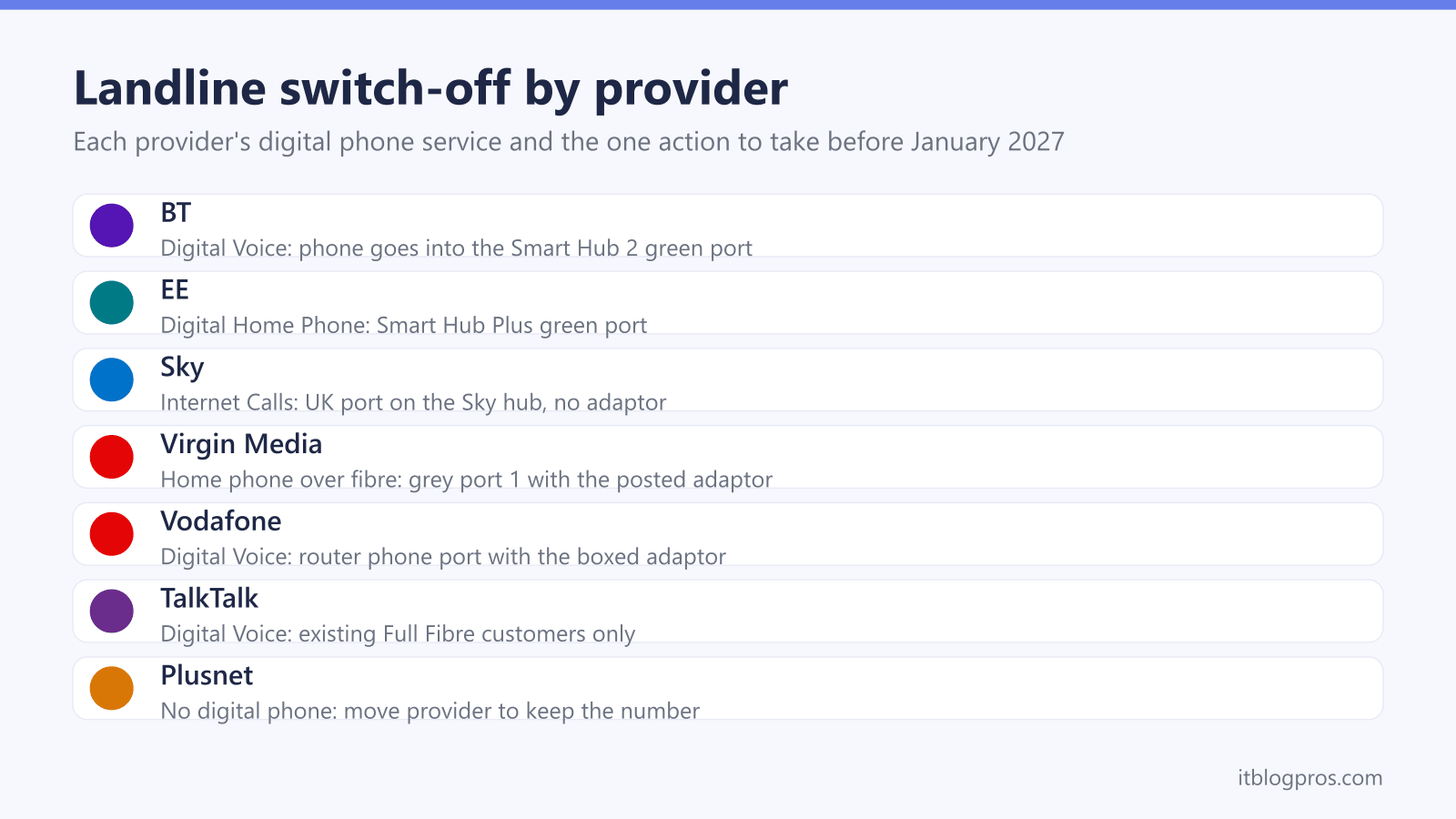
The table lists what each major provider calls its service, where the phone plugs in and the single action worth taking now. Anyone whose line has already gone quiet after the switch can jump to the per-provider fix guides linked below the table.
| Provider | Digital phone service | Where the phone plugs in | The one action now |
|---|---|---|---|
| BT | Digital Voice | Green phone port on the Smart Hub 2, as BT's setup page says; BT's own handsets pair wirelessly with the WPS button | Wait for the switchover letter and move the phone on the day; tell BT about any telecare device, medical need or lack of mobile signal first |
| EE | Digital Home Phone | Green phone port on the EE Smart Hub Plus; a wireless adaptor extends it to another room | Same as BT; register any additional needs with EE before the date |
| Sky | Internet Calls (Sky Talk) | Port marked UK on the Sky Broadband Hub and Sky Max Hub, using the phone's ordinary plug | Move the phone on the date; ask Sky about power cut cover where the household depends on the line |
| Virgin Media | Home phone over the fibre network | Top grey port labelled 1 on the Hub 3, Hub 4 or Hub 5, through the adaptor Virgin posts out | Fit the adaptor when it arrives; ask for the Emergency Backup Line where someone relies on the phone or has no mobile |
| Vodafone | Digital Voice | The router's phone port, which Vodafone's Digital Voice page does not name, using the adapter Vodafone says it sends | Ask to be recorded as landline dependent where that applies, which unlocks the free Broadband Battery Backup |
| TalkTalk | Digital Voice, existing Full Fibre customers only | Phone port on TalkTalk's Digital Voice Adapter, which its page connects by Ethernet to the router or eero | Existing Full Fibre customers add Digital Voice before their copper line closes; new customers cannot get a TalkTalk landline |
| Plusnet | None; broadband only from here on | No phone port is used, because no phone service exists | Move broadband and phone to EE or another provider to keep the number |
A few notes sit behind the table. BT is furthest along, with more than three million UK households already on Digital Voice, and it offers free engineer visits and backup power to customers with additional needs. Virgin Media's help pages say it aims to move everyone still on its old copper landline service onto the fibre network over the next 18 months. TalkTalk's Digital Voice page states that the service is available to its existing Full Fibre customers only, so a new TalkTalk customer who needs a home phone is in the same position as a Plusnet customer. Dedicated guides cover BT Digital Voice faults, EE Digital Home Phone faults, Sky Internet Calls faults, Virgin Media phone faults after the switchover and TalkTalk Digital Voice faults.
Plusnet is the exception and its landline customers must move to keep a number
Plusnet has decided not to launch a digital phone service. Its own switchover FAQ states that its packages will be broadband only and will not include any home phone options, and its marketing now leads with broadband without a landline. The analogue phone line a Plusnet customer has today keeps working for now, but it belongs to the network that closes by January 2027, and there is no Plusnet product for it to move to. That makes Plusnet the one major provider where doing nothing means losing the landline outright.
There are three routes. The first is the one Plusnet promotes: move broadband and phone to EE, its sister brand within BT Group, and take EE's Digital Home Phone service. Plusnet says the existing number can be kept in most cases, and the phone then plugs into the green port on the EE Smart Hub Plus. The second is to move to any other provider that offers a digital landline, such as BT, Sky, Virgin Media or Vodafone, and ask the new provider to bring the number across. The third is to stay with Plusnet on a broadband only deal and give up the landline, using a mobile with WiFi calling or a calling app instead, which suits the many households whose home phone has not rung in years.
Plusnet has also told customers that where no broadband only choice is made, it will keep them connected by moving their services to a broadband and Digital Home Phone package with EE. Whichever route is chosen, the order of events matters: place the order with the new provider first and let it port the number, because a line that is cancelled before the port goes through can take the number with it.
The households that need to act this month
Most homes can wait for the provider's letter. Four groups should not.
Telecare and care alarm users come first. Around 1.8 million people in the UK have a pendant, fall detector, pull cord or medication monitor that dials out over the phone line, and some of those devices do not work on a digital line. Under the charter the major providers signed in December 2023, a known telecare user should not be moved unless the provider or the alarm supplier has confirmed the device works, but that protection only applies when the provider knows. Tell the phone provider that a telecare device is on the line, and ask the alarm supplier or the council's telecare team whether the unit needs replacing with a digital ready model.
Other equipment on the line is next. Monitored burglar alarms, fire alarm signalling, lift emergency lines in blocks of flats, older payment terminals and fax machines all use the analogue line for signalling, and GOV.UK counts over 300 known uses for the network beyond voice calls. The alarm or lift maintenance company needs to be asked whether the dialler has been moved to a mobile or internet path, because a silent failure here stays hidden until the day something goes wrong.
Homes with no usable mobile signal are the third group, because a mobile is the fallback every provider assumes in a power cut. Ofcom's guidance says providers should offer these households free backup, covered in the next section, so ask to be recorded as landline dependent.
The fourth group is anyone with a phone line and no broadband. The digital service still needs a connection to carry it, so ask the provider what it offers landline only customers rather than assuming an internet package is compulsory.
A digital landline dies with the power, and the free backup rules
The old copper line carried its own power from the exchange, which is why a corded phone worked through a blackout. A digital line does not. The router, and on full fibre the ONT beside it, both need mains power, and the phone goes silent the instant the electricity does, including calls to 999. Every provider says so in its own words: TalkTalk's page states that if the power goes out the phone will not work, Vodafone says the landline is unavailable until the router comes back on, and EE warns that 999 cannot be called from the phone during an outage.
Ofcom's guidance on protecting access to emergency organisations sets the floor. It says providers should have at least one solution that lets customers reach the emergency services for a minimum of one hour in a power cut, and should offer it free of charge to customers who are at risk because they depend on the landline. That covers telecare users, people with a medical reliance on the phone, households without a mobile and homes without usable signal. The kit differs by provider. BT and EE supply a Battery Back Up unit that keeps the hub running for at least an hour, with a newer Plus version that runs around four hours, and BT also issues hybrid handsets with a roaming SIM. Vodafone's Broadband Battery Backup is rated at four to seven hours for customers registered as landline dependent. Virgin Media's Emergency Backup Line switches to the mobile network, with around eight hours of standby and an hour of talk time. TalkTalk offers a battery backup for up to an hour in areas with no mobile signal. The digital landline power cut rules compare them in detail and the free battery backup unit guide covers exactly how to ask.
Everyone else is expected to lean on a mobile, and a 999 call from a mobile roams onto any network with signal. For a household that has no mobile signal or genuinely relies on the line, and does not qualify for the provider's free unit, a small 12 V DC mini UPS powering both the router and the ONT keeps the phone and broadband alive through a typical cut, since the pair draws under 30 watts. The router UPS runtime guide works out how long a given unit lasts and the battery backup for router and ONT guide compares the options. The TalentCell 97Wh unit is the one we point people to for this job, with enough capacity for several hours on a hub and ONT; check the voltage printed on both power supplies against the unit's outputs before ordering.
Check the TalentCell 97Wh mini UPS on Amazon UK →
The phone number stays, provided nobody cancels first
Keeping the number through the switch takes no action when the same provider does the migration; the number simply moves to the digital service. Moving provider to get a digital phone, which is the route Plusnet customers face, keeps the number too, as long as the order is placed in the right sequence.
Since 12 September 2024 fixed broadband and landline switches use Ofcom's One Touch Switch process. Only the new provider needs contacting. It asks for the address, the current provider, the services being moved and whether the number is to be kept, then runs the switch and tells the old provider. The old line should be left running until the new provider confirms the switch is complete. Cancelling the old contract first ceases the line, and a ceased number is often gone for good.
Two smaller points catch people out. The extension sockets around the house stop working after the switch, but the number is unaffected; the fix is a cordless base station on the hub, or the provider's wireless adaptor. And a number that was only ever used for broadband, on a line nobody rang, does not need to be kept at all, because a broadband only deal is cheaper and no worse.
The do-nothing outcome
GOV.UK's advice is that no action is needed until the provider makes contact, and every provider is contacting customers before moving them. The trouble starts when that contact is ignored. BT's own guidance is that failing to respond to its messages may result in disruption to phone or broadband services, and the same applies elsewhere. An account that is switched to the digital service on the scheduled day leaves a phone still plugged into the wall socket completely silent, and the fix is the two minute job of moving the cable to the hub.
Beyond the final date the outcome is blunter. The analogue network is withdrawn, so a line that has not been moved to a digital service stops working, and with Plusnet there is no digital service to move it to. Telecare users are protected from a forced switch only when the provider knows about the device, which brings the advice back to the same place: read the letter, tell the provider about anything unusual on the line, and make the change on the day it asks.
The checklist for this month
- Find out who provides the landline and whether the account has already been switched. A phone that works plugged into the router rather than the wall is already on the digital service.
- Tell the provider about any telecare device, medical need, lack of mobile signal or alarm on the line, and ask to be recorded as landline dependent where it applies.
- Plusnet customers choose now between EE Digital Home Phone, another provider or broadband only, and place the order with the new provider first.
- Check every other device on the phone line: burglar alarm, lift line, payment terminal, fax. Ask the maintainer how it signals after the switch.
- Locate the phone port on the hub and have a corded phone or a cordless base station ready to move on the day.
- Decide on power cut cover: the provider's free unit for those who qualify, a charged mobile for everyone else, and a small UPS on the router and ONT where the line really matters.