A power cut used to take out the lights and leave the phone working. Full fibre reverses that: the moment the sockets go dead, the router and the Openreach ONT go down with them, and broadband, WiFi and any Digital Voice landline stop together. The fix is cheap and slightly boring, a small battery backup that carries the two boxes through the outage. Because a router and ONT together draw less power than a single old-fashioned light bulb, even the smallest UPS on the market holds them up for an hour or more, and the right choice runs them for several. This guide covers the sizing maths, the two product classes worth buying, two specific APC mains picks, realistic runtime numbers, and the landline rules that might get you a battery backup free of charge.
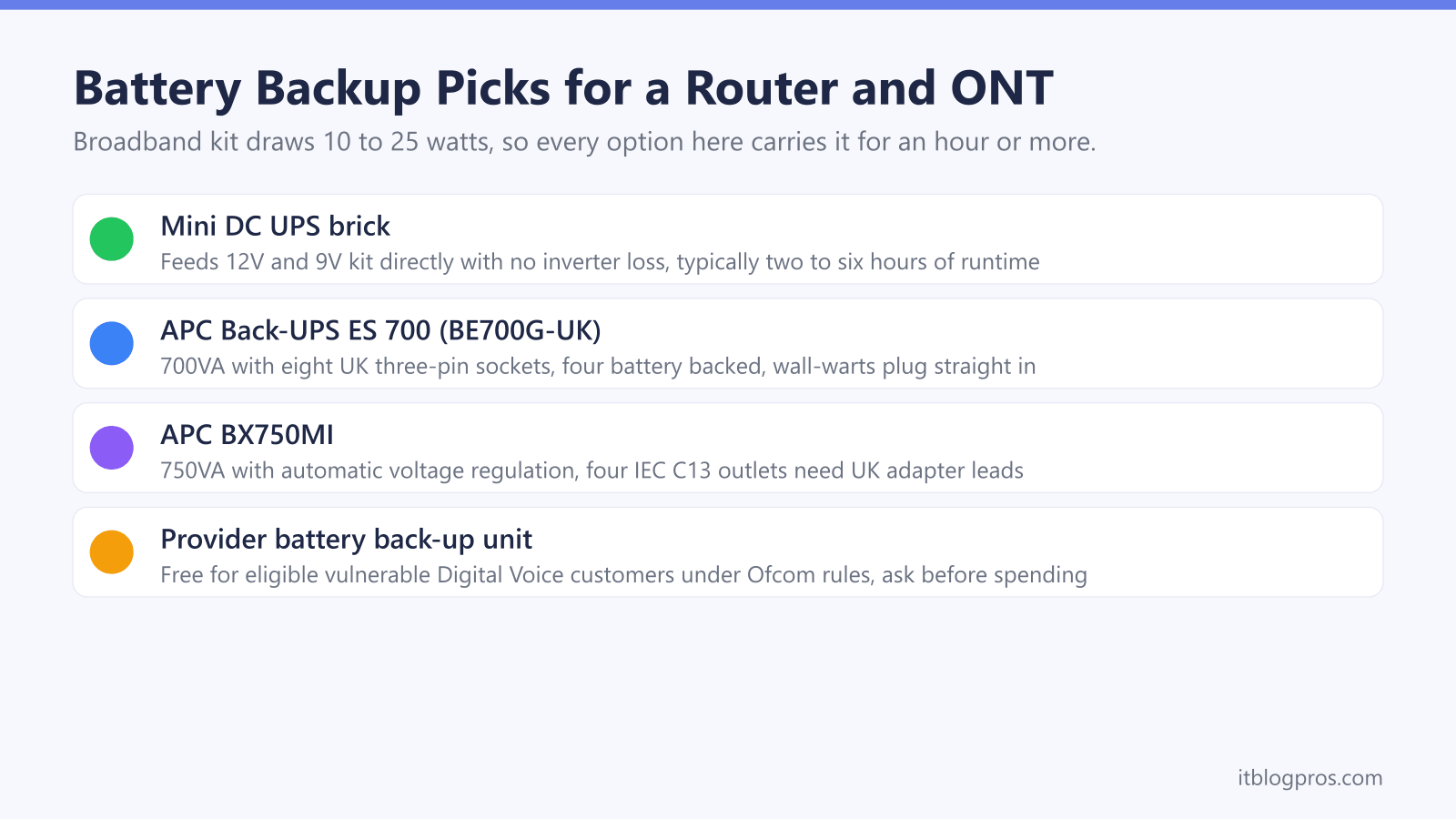
A router and Openreach ONT together draw roughly 10 to 25 watts, so even a small UPS keeps broadband alive for an hour or more. The most efficient option is a mini DC UPS brick that feeds 12V and 9V kit directly; the simplest is a compact mains UPS such as the APC Back-UPS BE650G2-UK or the APC BX950MI, both of which run typical full-fibre kit for well over an hour.
Key Takeaways
- A router plus Openreach ONT typically draws 10 to 25 watts in total, a small fraction of the 400 watts APC lists for its BE650G2-UK, so runtime is measured in hours rather than minutes.
- Mini DC UPS bricks skip the inverter and feed 12V and 9V kit directly, which stretches a small lithium battery to roughly two to six hours of router-and-ONT runtime.
- APC lists eight UK three-pin sockets on the Back-UPS BE650G2-UK, six of them battery backed, so wall-wart power adapters plug straight in with no extra leads.
- The APC BX950MI adds automatic voltage regulation for homes with dips and brownouts, but its six IEC C13 outlets need C14-to-UK-socket adapter leads for wall-wart plugs.
- Ofcom requires providers to offer at least one solution that keeps emergency calls working for a minimum of one hour in a power cut, free for customers who depend on their landline, so that entitlement is worth checking before spending anything.
A Router and ONT Draw Less Power Than an Old Light Bulb
Sizing a UPS normally involves adding up loads and worrying about headroom. For home broadband the maths is almost comically easy. The Openreach ONT, the small white box the fibre terminates in, sips power: BT quotes 4 to 5 watts for its units, and independent measurements put typical ONTs between 5 and 8 watts. Routers vary more, but most ISP hubs sit between 10 and 20 watts, with BT's hubs measured at around 11 watts. A typical full-fibre setup therefore idles at roughly 16 watts in total. The main outlier is Virgin Media's Hub 5, a cable gateway that can pull around 35 watts on its own, though cable homes have no separate ONT to feed.
Consumer UPSes are rated in volt-amps and watts. The smaller APC pick in this guide, the BE650G2-UK, is rated by APC at 650VA and 400 watts, which means a 16 watt broadband load uses about 4 per cent of its capacity. Capacity is simply not the constraint, and paying for a bigger UPS buys almost nothing for this job. What actually matters is threefold: how long the battery holds a tiny load, whether your plugs physically fit the sockets on the UPS, and how many extra boxes need to stay up. A cordless phone base, a mesh satellite or a small network switch each add a handful of watts, and each one needs a socket, so count the boxes before choosing.
The Honest Caveats Before Any Recommendation
First, the entitlement check. Ofcom requires phone providers to keep customers able to reach 999 for at least an hour in a power cut, and to provide a solution free of charge to people who depend on their landline, including many on the Priority Services Register. BT and EE, for example, supply a battery back-up unit free to eligible vulnerable customers and charge everyone else for it. Anyone in that category should ask their provider before buying anything in this guide.
Second, the socket problem. The APC BX950MI uses six IEC C13 outlets, the kettle-lead style connector, so a UK wall-wart power adapter will not plug into it directly; each one needs a short C14-plug-to-UK-socket adapter lead, which costs a few pounds. The BE650G2-UK avoids this entirely with standard UK three-pin sockets.
Third, waveform and batteries. Both APC units output a stepped approximation of a sine wave on battery. That is completely fine for the switch-mode wall-wart adapters that power routers, ONTs and phone bases, though it is not the right choice for a desktop PC with an active PFC power supply. Both units use sealed lead-acid batteries that fade with age; APC's BE650G2-UK manual gives an average battery life of three to five years, so budget for a replacement cartridge, and test the UPS twice a year by pulling its plug.
Finally, efficiency. A mains UPS runs an inverter to turn 12V battery power back into 230V, only for your wall-warts to convert it straight back down again. At a 16 watt load, that round trip plus the UPS's own electronics wastes a meaningful slice of the battery. Mini DC UPS bricks avoid the round trip entirely, which is why they run longer on smaller batteries.
The picks at a glance
| Product | Best for | Key specs | Price | |
|---|---|---|---|---|
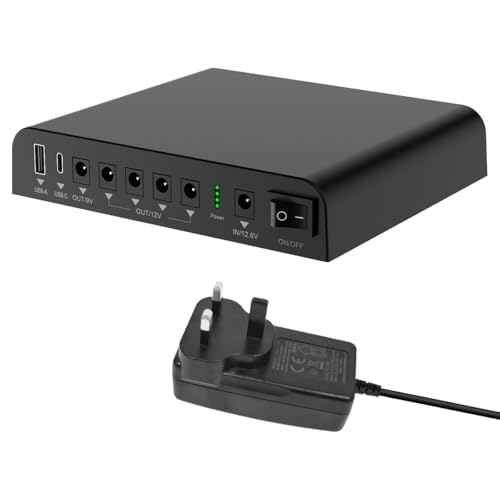 | TalentCell 97Wh USB-C mini UPS Most runtime | Homes that mainly want broadband to survive long rural outages | 97Wh lithium battery, 12V and 9V DC plus USB-A and USB-C 18W outputs | Check price → |
 | APC Back-UPS BE650G2-UK Simplest pick | Keeping broadband and a digital landline alive with zero adapter faff | 650VA/400W, eight UK BS1363A sockets, six battery backed | Check price → |
 | APC BX950MI Unstable mains pick | Homes with dips, brownouts and visibly unstable mains | 950VA/520W with AVR, six IEC C13 outlets | Check price → |
Mini DC UPS Bricks Give the Most Runtime Per Pound
A mini DC UPS is a lithium battery pack, usually somewhere between 8,000 and 20,000mAh (roughly 30 to 74 watt-hours), with DC barrel outputs at selectable voltages, typically 5V, 9V and 12V, plus a USB port. It sits inline between the wall adapter and the router or ONT, passes power through in normal use, and switches to battery instantly when the mains drops. Because there is no inverter, almost every watt-hour in the cell reaches the device: a mid-sized brick will run a 12 watt load for around four hours, and typical router-plus-ONT setups see anywhere from two to six hours depending on capacity.
The caveats are all about matching. Feeding 12V into a 9V device can kill it, so the output voltage must be set to match the label on each device's original power adapter before anything is connected. Check the output current too; many routers need 12V at 2A or more, and an underpowered brick will brown out under load. Check the plug tip, with 5.5 x 2.1mm the most common barrel size but not universal. And check that the brick has two independently powered outputs if it needs to feed the router and the ONT at the same time, because a single-output unit only solves half the problem. Quality varies widely in this category, capacity figures on listings are frequently optimistic, and a proper UPS-grade battery management system matters for something that charges continuously for years. The TalentCell brick below is here because it answers each of those checks on TalentCell's own specification: four 12V outputs plus a separate 9V output, so a router and an ONT can run at once without a splitter; 4A available on the 12V rail, which covers routers rated at 12V 2A or more; DC5521 barrel plugs, the common 5.5 x 2.1mm size; and a stated 97.2Wh, a watt-hour figure rather than a bare mAh headline. Check one thing against your own kit first: its 12V output follows the battery down from 12.6V to 9V rather than holding a regulated 12V.
APC Back-UPS BE650G2-UK Takes UK Plugs Straight In
The APC Back-UPS BE650G2-UK is the low-friction option. APC rates it at 650VA and 400 watts, and its UK brochure lists eight BS1363A three-pin sockets: six with battery backup plus surge protection, and two with surge protection only. That layout suits broadband kit well. The router and ONT wall-warts go straight into battery-backed sockets with no adapter leads, a cordless phone base or mesh node takes a third, three more battery-backed sockets stay spare, and the two surge-only sockets suit anything on the same shelf that does not need to stay up in a power cut.
APC's UK brochure for the BE range gives three runtime points for this unit: 70 minutes at 40 watts, a load it describes as an entry-level desktop with a 20in monitor plus an internet modem and router, 21 minutes at 119 watts and 7 minutes at 240 watts. APC publishes nothing below 40 watts, and a router and ONT typically draw half that or less. Working from the 12V 7Ah APCRBC110 cartridge APC lists for the unit, this site estimates about 2 to 2.75 hours at a 20 watt broadband load on a healthy battery, and closer to 1 to 1.4 hours on an aged one; the runtime guide linked further down shows the working. APC lists the battery as user-replaceable and gives a typical recharge time of 16 hours, so back-to-back long outages are its weak spot.
The recharge is slow, but for the core job, keeping broadband and a digital landline alive through a typical UK power cut with zero adapter faff, it is the easiest recommendation in this guide.
APC BX950MI Adds Voltage Regulation but Uses IEC Sockets
The APC BX950MI takes a different approach. APC's Back-UPS BX series brochure rates it at 950VA and 520 watts, line-interactive with automatic voltage regulation (AVR), with a 273 joule surge rating, gigabit data line protection and six IEC C13 outlets, all of them battery backed. The same brochure gives a typical recharge time of 6 to 8 hours, half or less of the BE650G2-UK's 16 hours, which matters if your area suffers repeated outages in the same week.
AVR is the reason to pick this model. Rather than jumping to battery every time the mains sags, the BX950MI corrects dips and swells electronically and saves the battery for genuine outages. Homes at the end of long rural lines, or anywhere the lights visibly flicker in bad weather, will get more battery life and less relay-clicking from this unit than from a basic standby design.
The trade-off is the sockets. All six outlets are IEC C13, so every UK wall-wart needs a short C14-plug-to-UK-socket adapter lead before it can plug in. The leads are cheap and sold widely, but they are an extra purchase and an extra point of clutter, and it is the one practical annoyance in an otherwise stronger specification. On runtime, APC's BX series chart lists 80 minutes at 40 watts for this unit, ten minutes more than APC gives the BE650G2-UK at the same load, so this site estimates roughly 2.25 to 3 hours at a 20 watt router-and-ONT load on a healthy battery. One thing to know before buying: APC's UK product page lists the BX950MI as due to be discontinued on 31 December 2026, with the BXR950MI named as its replacement, so stock may thin out during 2027.
Realistic Runtime Expectations at Broadband Loads
Manufacturers mostly publish runtime at heavier loads, which tells you little about a 16 watt broadband setup; the lightest point APC gives for the BE650G2-UK is 70 minutes at 40 watts, more than double that load. The table below gives honest working estimates for a healthy battery, combining APC's published figures and battery capacity for the mains units, and typical measured performance for lithium DC bricks. Treat them as planning numbers, not promises, and roughly halve them for a battery that is a few years old.
| Kit kept on battery | Typical draw | Mini DC UPS (30 to 74Wh) | APC 650 to 950VA mains UPS |
|---|---|---|---|
| ONT only | 4 to 8W | 5 to 12 hours | About 4.5 to 6 hours at 5W on the BE650G2-UK (estimate); APC publishes no figure this light for either unit |
| Router plus ONT | 12 to 20W | 2 to 6 hours | About 2 to 2.75 hours at 20W on the BE650G2-UK and roughly 2.25 to 3 hours on the BX950MI (estimates) |
| Router, ONT and cordless phone base | 15 to 25W | Rarely practical, base adapters vary | Roughly 1.5 to 2.5 hours |
| Router, ONT, mesh node and switch | 35 to 50W | Beyond most single bricks | Roughly 45 to 90 minutes; APC lists 70 minutes at 40W for the BE650G2-UK and 80 minutes for the BX950MI |
Two patterns stand out. The DC brick's advantage grows as the load shrinks, because a mains UPS spends a fixed overhead just running its own inverter, which is pure waste at single-digit loads. And the mains UPS pulls ahead on flexibility the moment anything without a DC barrel input needs power, since it will take any plug (directly on the BE650G2-UK, via adapter leads on the BX950MI). The full maths behind these numbers, including how to estimate runtime for your exact kit from the battery's watt-hour rating, is worked through in the router UPS runtime guide.
Keeping a Digital Voice Landline Alive Through a Power Cut
For a growing number of UK homes the real reason to buy a UPS is not WiFi, it is the phone. Digital landlines run through the router, so a power cut silences them exactly when a call may matter most. Ofcom's guidance requires providers to give customers at least one way to contact emergency services during a power cut, lasting a minimum of one hour, and to provide that solution free to customers who depend on their landline, such as those without a mobile or with poor mobile signal. The detail of who qualifies and what each provider offers is covered in the guide to digital landline power cut rules.
A UPS on the router and ONT does the same job with more headroom, but only if the whole voice chain stays powered. A corded handset plugged into the router's phone port needs nothing else. A cordless handset is different: its base station has its own wall adapter, and if that base loses power the phone is dead even though the broadband is up, so the base must occupy one of the UPS sockets too. BT and EE also supply their own battery back-up unit free to eligible vulnerable customers, which keeps the hub running for at least an hour, so households on the Priority Services Register should claim that before buying anything. And if the landline is misbehaving even with the power on, start with the Digital Voice not working pillar rather than a battery.
The Right Pick for Each Household
Households where someone depends on the landline should start with a phone call, not a purchase: under Ofcom's rules the provider may be obliged to supply a battery back-up solution free of charge, and BT and EE already do for eligible customers.
For everyone else, the choice splits cleanly. The mini DC UPS brick wins on runtime per pound and per shelf-centimetre, running a router and ONT for an afternoon rather than an hour, and it is the pick for homes that mainly want broadband to survive long rural outages, provided the voltage, current and plug checks are done carefully. The APC Back-UPS BE650G2-UK is the pick for simplicity: eight UK sockets, six of them battery backed, no adapters, everything on the broadband shelf protected in one go, and an estimated 2 to 2.75 hours of runtime at a 20 watt load. The APC BX950MI is the pick for homes with visibly unstable mains, where its automatic voltage regulation earns its keep daily and the faster recharge shrugs off repeated cuts, as long as the IEC adapter leads are in the basket alongside it.
Whichever route you take, test it. Pull the UPS's plug once it is set up, confirm the router, ONT and phone stay up, and confirm a call still connects. A battery backup that has never been tested is a hope, not a plan.