
Digital landlines stop working the moment the power goes off, because the phone now runs through your broadband router rather than a powered copper line. Ofcom saw that problem coming and put rules in place: if you depend on your landline, your provider must give you a free way to reach 999 during a power cut. Most people never hear about this entitlement because providers rarely advertise it. This guide sets out who qualifies, what each major UK provider actually supplies, the exact numbers to ring, and the extra steps telecare and care-alarm users need to take.
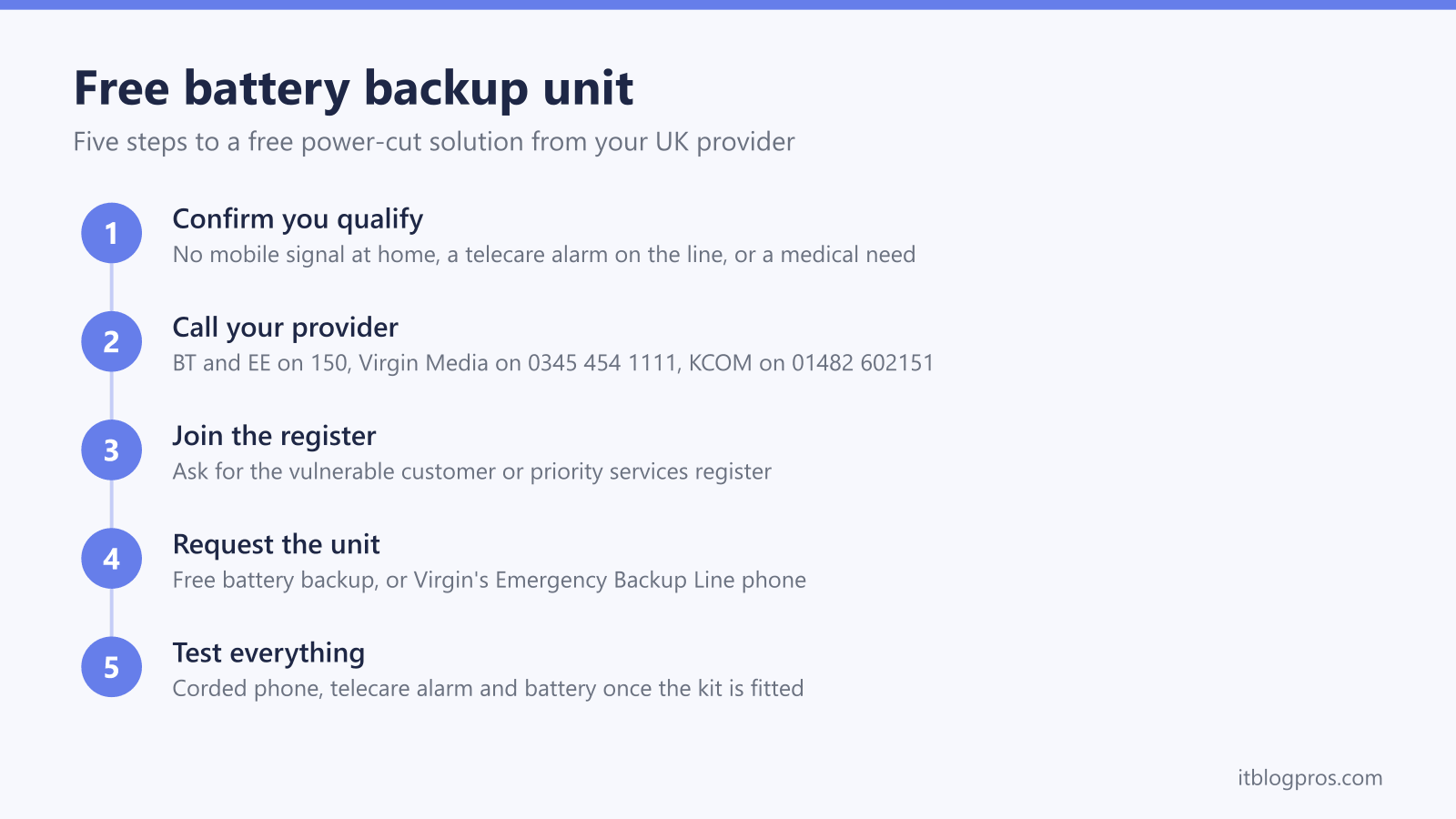
Ofcom requires every UK phone provider to offer a free power-cut solution to customers who depend on their landline. You qualify if you have no usable mobile signal at home, rely on a telecare or care alarm, or cannot call 999 any other way. Ring your provider, ask to be added to its vulnerable customer register, and request a battery backup unit; BT, EE, Vodafone, KCOM and TalkTalk all supply one free.
Key Takeaways
- Ofcom guidance obliges every UK provider to offer at least one free solution that keeps 999 access working for a minimum of one hour during a power cut for at-risk customers.
- You count as landline dependent if you have no mobile or no signal at home, use a telecare or care alarm, or have a medical or disability-related need for the phone line.
- BT and EE supply a free Battery Back Up unit to eligible Digital Voice customers, while Vodafone, KCOM and TalkTalk run their own free schemes with different hardware.
- Virgin Media takes a different route with a free Emergency Backup Line phone that switches to the mobile network, but it does not power telecare or pendant alarms.
- Telecare users must contact both their phone provider and their alarm provider, then test the alarm after the switchover and after any backup unit is fitted.
The Ofcom rule that makes the free unit possible
The UK is switching every home phone line from the old analogue network to digital calls carried over broadband, with the migration due to complete around January 2027. An analogue line drew its power from the exchange, so a corded phone kept working in a blackout. A digital landline dies with the mains, because the router and any fibre equipment need electricity.
Ofcom's guidance on protecting access to emergency organisations closes that gap. Providers must have at least one solution that lets customers reach 999 for a minimum of one hour during a power cut at the premises, and they must offer that solution free of charge to customers who are at risk because they depend on the landline. The one-hour figure is a floor, not a ceiling, and several providers now go well beyond it. The entitlement is not automatic, though. In almost every case you have to tell your provider that you depend on the line before anything gets sent out, which is exactly what the steps below cover.
Who counts as landline dependent
Providers use slightly different wording, but the qualifying situations are consistent across the industry. You are treated as landline dependent, and therefore entitled to a free solution, if any of the following apply:
- There is no mobile phone in the household, or no usable mobile signal indoors, so the landline is the only way to call 999.
- A telecare device is connected to the line, such as a careline, lifeline, pendant alarm or fall detector.
- A medical condition, disability or age-related vulnerability means losing the phone would put you at risk.
Every major provider keeps a register for customers in these situations, variously called a vulnerable customer register, priority services register or accessibility register. BT and EE run theirs under the Here For You banner. Joining costs nothing and unlocks more than the battery unit, including priority fault repair in many cases. If you are arranging this for an elderly relative, you can usually register on their behalf provided you are named on the account or have the account holder with you on the call.
BT and EE supply a free Battery Back Up for Digital Voice
BT and EE, both part of BT Group, provide a free Battery Back Up unit to eligible customers on Digital Voice or Digital Home Phone. The unit sits between the mains and the Smart Hub and keeps the hub powered for at least an hour in a power cut, so a corded phone or Digital Voice handset plugged into the hub can still make emergency calls. The current unit includes a hibernation mode that switches to standby once 25 percent of charge remains, holding back a reserve so you can wake it for a 999 call even after a long outage.
BT recommends the unit specifically for customers who use a health alarm or medical pendant on the line, or who have no mobile phone as a fallback. To request one, call BT on 150 from a BT line, or register through the Here For You page; EE customers use the equivalent EE accessibility route. BT Group has also been rolling out a longer-life Battery Back Up Plus, developed through the same industry programme as Vodafone's unit described below, which extends cover from one hour to several hours.
Vodafone's Broadband Battery Backup runs for four to seven hours
Vodafone worked with BT, KCOM and Zen Internet to develop a purpose-built Broadband Battery Backup that goes well past the Ofcom minimum. Depending on how much power your router draws, it keeps the connection alive for roughly four hours with a 55 watt router and up to seven hours with a 25 watt router. Because it powers the broadband itself, calls, WiFi and connected telecare equipment can all keep working, not just a single emergency handset.
The unit includes an emergency mode that automatically reserves 25 percent of the battery. That matters for power cuts that happen overnight, when nobody notices the outage until morning and a drained battery would otherwise leave the house cut off. Vodafone supplies the device free to landline-dependent customers, defined as people who rely on the line to reach emergency services, have telecare devices or alarms, or live in an area with low mobile coverage. Anyone outside those groups can buy the same unit for around 150 pounds. Vodafone customers should contact customer services or the accessibility team and ask to be assessed as landline dependent.
KCOM includes free annual battery checks in Hull and East Yorkshire
KCOM, the incumbent provider for Hull and East Yorkshire, supplies a free battery back-up unit to customers who rely on the landline to contact emergency services or who have equipment such as a lifeline or care alarm connected. The unit keeps power flowing to the fibre equipment and gives roughly one hour and twenty minutes of talk time during an outage.
KCOM's scheme stands out for its aftercare. Eligible customers get a free engineer visit every twelve months to check the battery, with replacement batteries fitted at no charge when needed. The visit takes about fifteen minutes. One practical point applies here as everywhere: the battery powers the network equipment, not your phone, so you need a corded handset. A cordless phone base station plugged into a dead mains socket will not work no matter what the fibre kit is doing. To request the unit, call KCOM on 151 from a KCOM landline or 01482 602151 from a mobile.
Virgin Media provides an Emergency Backup Line instead of a battery
Virgin Media approaches the problem differently. Rather than a battery for the Hub, eligible customers get a free Emergency Backup Line: a phone that plugs into the WiFi Hub and automatically switches over to the mobile network when the power or the Virgin network goes down. Its internal battery lasts around eight hours on standby and gives about one hour of talk time once the mains is off, enough to reach 999, family or friends.
Virgin offers it at no extra cost to customers who rely on their home phone because of disability, long-term illness or accessibility needs, and to customers without access to a mobile phone. To request one, call 150 from a Virgin Media landline or 0345 454 1111 from any other phone; Relay UK and video relay services are also supported.
One caveat matters more than the rest here, and Virgin states it plainly: the Emergency Backup Line does not cover other devices connected to the phone line. Telecare and lifeline equipment such as care or pendant alarms will not work through it, so alarm users on Virgin need the separate telecare conversation covered below.
TalkTalk and Sky handle requests through support and accessibility teams
TalkTalk offers a free battery backup to customers who rely on the landline for emergency calls and have no mobile phone or no mobile signal at home. It keeps the router powered for up to an hour, in line with the Ofcom minimum, and is arranged through TalkTalk customer support as part of the digital voice migration.
Sky is the outlier among the big providers. Sky does not advertise a standard battery backup product on its help pages, and its own community forum threads show landline-dependent customers being handled case by case through the Sky accessibility team. The Ofcom guidance applies to Sky exactly as it does to everyone else, so if you depend on Sky Talk or Internet Calls to reach 999, contact Sky, explain the dependence, ask to be recorded as a vulnerable customer and ask what free power-cut solution Sky will provide for your line. Persistence pays here. If the first agent has no answer, ask for the accessibility team by name.
Telecare and care alarm users need both providers involved
A battery backup solves the power half of the problem, but telecare adds a compatibility half. Some older analogue alarm units do not signal reliably over digital phone lines even when everything is powered, which is why the government urges telecare users to speak to both companies before the switchover reaches them.
Three actions cover it. First, tell your phone provider that a telecare device is connected to the line. Providers have committed not to migrate identified telecare users to digital calls without safeguards in place, and most will send an engineer who tests the alarm as part of the switchover visit. Second, tell your telecare or careline provider you are moving to a digital line and ask whether the unit needs an upgrade, an adapter or a mobile-network version. Third, test the alarm yourself after the switchover, after any backup unit is fitted, and periodically afterwards by pressing the pendant and confirming the monitoring centre answers. A silent failure can sit unnoticed for months, and testing is the only way to catch it.
The one-hour limit and other honest caveats
The free schemes are genuinely worth having, but their limits deserve stating plainly. Most standard units guarantee only around one hour of emergency calling, which covers a typical trip-switch or local fault but not a storm outage lasting all night. The longer-life units from Vodafone, BT and KCOM stretch that to between four and twelve hours depending on the hardware, so ask specifically for the longer-life option if outages in your area run long. Those hour figures come from simple watt-hour arithmetic, and the router UPS runtime sizing guide applies the same sums to a router and ONT running together.
On full fibre, everything in the chain needs power: the ONT on the wall as well as the router. BT drew criticism in early 2026 after installations where the backup powered the hub but left the ONT dead, which produced a powered router with no line. When your unit arrives, check which boxes it feeds and query anything that looks unpowered.
Finally, keep a corded phone. Cordless handsets die with their base station, and a backup unit cannot help a phone that has no power of its own. A basic corded handset in a drawer costs little and completes the setup.
The next step for everyone who does not qualify
The free schemes exist for people whose safety depends on the line, and providers do check. If you have a working mobile with signal at home and no telecare equipment, you will normally be asked to buy your own resilience rather than being sent a free unit, and that is the deal Ofcom struck: free protection for the at-risk, paid options for everyone else.
Your rights during a power cut go beyond hardware, and it helps to know exactly what providers must do before you negotiate with one. The full breakdown is in the guide to the digital landline power cut rules, which covers the Ofcom requirements, the switchover timeline and the compensation position.
If you simply want the broadband to survive an outage for working from home, streaming or smart home kit, a purchased uninterruptible power supply sized for your router and ONT does the job for a modest outlay. The guide to the best battery backup for a router and ONT in the UK walks through capacity, runtime and connector types so the unit you buy actually fits the kit on your wall.