
The old copper phone network carried its own power down the line, which is why a corded phone kept working when the lights went out. Digital landlines do not. Every UK provider is moving voice calls onto broadband before the analogue network closes on 31 January 2027, and a digital phone goes silent the instant the router loses mains power. Ofcom saw this coming and wrote rules to protect the people who depend on a landline most, and every major provider now supplies free battery backup units to customers who qualify. This guide explains the rules in plain English, names who gets free kit from BT, EE, Vodafone and KCOM, and covers the DIY fix for everyone else.
A digital landline stops working the moment the power goes off, because the router and the fibre ONT need mains electricity. Ofcom requires every provider to offer a free solution, usually a battery backup unit, giving at least one hour of emergency calls to customers who depend on their landline. Everyone else should keep a charged mobile handy or fit a small UPS on the router and ONT.
Key Takeaways
- A digital landline goes dead the moment mains power fails, because the router and the fibre ONT need electricity that the phone network no longer supplies.
- Ofcom requires every provider to offer a free solution giving at least one hour of emergency calls in a power cut to customers who depend on their landline.
- Telecare users, people with a medical reliance on the line and homes without usable mobile signal qualify for free battery backup units from BT, EE, Vodafone and KCOM.
- A charged mobile is the official fallback for everyone else, and 999 calls roam onto any network with signal, though call handlers cannot ring back on a borrowed network.
- Households that fail the free-unit test can fit a small UPS powering both the router and the ONT, which keeps calls and broadband running through a typical cut.
A digital landline dies with the power by design
The copper network that ran UK landlines for over a century supplied its own electricity, feeding roughly 50 volts down the line from the exchange, which is why a corded phone worked through a blackout. Digital landlines, sold as Digital Voice by BT and EE, or simply as digital home phone, route calls over broadband instead. The phone service now depends on the router staying powered, and on full fibre it also depends on the ONT, the small box on the wall where the fibre enters the home. Neither has a battery inside.
When the mains fails, both boxes shut off within seconds and the landline goes silent, including handsets plugged straight into the router. That behaviour is by design rather than a fault, and it applies to every provider migrating customers off the analogue network before the switch-off completes on 31 January 2027. A phone that is dead while the power and broadband are fine is a different problem with different fixes, and the digital voice not working guide works through those in order.
Ofcom guarantees one hour of emergency calls, for those who need it most
Ofcom's guidance on protecting access to emergency organisations, in force since October 2018, sets the baseline. Providers must have at least one solution available that enables access to emergency organisations for a minimum of one hour in the event of a power cut at the premises, and they must offer that solution free of charge to customers who are at risk because they depend on their landline.
Three details in the wording matter. First, one hour is a floor rather than a target, and Ofcom expects providers to consider longer-lasting solutions where power cuts are common or prolonged, as they are in parts of rural Scotland and Wales. Second, the free obligation covers only customers who depend on the landline, so most households are expected to lean on a mobile instead. Third, the solution exists to reach the emergency services, not to keep the whole house online, which is why most providers hand out a battery pack for the phone kit rather than anything grander.
The rules have kept tightening since. In December 2023 the major providers signed a charter committing to protections beyond the one-hour minimum, including a pause on forced migrations of telecare users until safeguards were confirmed, and government pressure since then has pushed the industry towards battery backup measured in hours rather than minutes. The newest generation of units runs for four hours or more.
Landline dependent has a specific meaning, and it decides who pays
Every provider applies broadly the same test when deciding who gets free protection. A household is likely to qualify if any of the following applies:
- A telecare pendant, fall detector or personal alarm dials out through the phone line.
- A medical condition means the phone line is relied on to reach help or health services.
- No usable mobile signal reaches the home, or nobody in the household has a mobile phone.
- A disability or impairment makes using a mobile difficult in an emergency.
Providers rarely volunteer the kit, so the household has to ask. Ring the provider's accessibility or extra-help team, ask to be recorded as landline dependent, and request the battery backup unit. It is worth joining the energy network's Priority Services Register at the same time, since that is a separate list held by the electricity operator rather than the broadband provider. The free battery backup unit guide covers the exact routes, contact points and wording to use with each provider.
The free kit compared across BT, EE, Vodafone and KCOM
The four providers named most often in switchover complaints all supply free units, but the kit and the runtime differ.
| Provider | Free unit goes to | What the unit does |
|---|---|---|
| BT | Telecare and pendant alarm users, customers with a medical reliance on the line, and customers on its priority repair scheme | Battery Back Up keeps the hub running for at least an hour; the newer Battery Back Up Plus runs around four hours, then idles with enough reserve left for an emergency call |
| EE | Vulnerable Digital Home Phone customers, including health pendant users and homes without a mobile | The same Battery Back Up family as BT; other customers can buy one, at roughly £85 |
| Vodafone | Customers recognised as landline dependent | Broadband Battery Backup rated at four to seven hours of WiFi and calls, with an emergency mode that reserves a quarter of the runtime; £150 to buy otherwise |
| KCOM | Customers in Hull and East Yorkshire who rely on their landline | A battery back-up unit fitted free that powers the ONT, giving about an hour of talk time and around 24 hours on standby; newer units provide up to 12 hours of emergency voice cover |
BT also issues hybrid handsets to some customers, phones with a built-in battery and a roaming SIM that hop onto the mobile network when the broadband or the power fails. They are a good answer where at least one mobile network reaches the house, and no answer at all in a true black spot. Other providers run equivalent schemes, such as Virgin Media's Emergency Backup Line, and the free unit guide covers those too.
One honest warning applies across the board. A unit that powers only the router does nothing on a full fibre line if the ONT beside it stays dark, a failure BT customers reported during the winter storms in early 2026. When ordering, confirm which boxes the unit will feed, and where the ONT and router are separate devices, both need power before the phone works.
A charged mobile is the official fallback, with honest limits
For every household that fails the landline dependent test, the official answer is blunt: use a mobile. It is a fairer answer than it sounds, because UK networks have supported emergency roaming since 2009. A 999 or 112 call from a mobile goes out over any network with signal, even when the phone's own network shows no bars, so a power cut that kills the home broadband rarely blocks an emergency call.
The limits deserve equal billing. A roamed emergency call cannot be called back, because the handler cannot reach a phone camping on another operator's network, so stay on the line until told otherwise. Rural black spots exist where no network reaches indoors, and those homes should be claiming the free battery unit rather than relying on a mobile. Mobile masts also carry their own batteries with a finite reserve, often only a few hours, so multi-day storm outages of the kind Storm Arwen caused eventually silence mobiles as well as landlines.
A charged power bank closes most of the remaining gap, and in Great Britain the number 105 reaches the local electricity network operator from a mobile, which answers the most common power cut question of all, namely how long the outage will last.
A small UPS on the router and the ONT covers everyone else
The DIY fix costs less than most providers charge for their branded units and does more. A digital landline needs two boxes alive, the router and, on full fibre, the ONT. Together they typically draw under 30 watts, a trivial load for even a small uninterruptible power supply. A compact UPS, or a 12 volt DC mini UPS wired to both boxes, keeps calls and WiFi running for one to four hours or more, long enough to see out the overwhelming majority of UK power cuts, which are measured in minutes rather than days.
Three details separate a backup that works from one that disappoints. Power both boxes, because a router on battery achieves nothing while the ONT next to it is dark. Include the cordless phone base station in the backup, or use handsets that pair directly with the hub, or keep a cheap corded phone plugged into the hub's phone socket, since a dead base station silences every handset even when the line itself is up. And test the whole chain by pulling the wall plug and making a real call, rather than trusting the spec sheet.
One caveat keeps the mobile in the plan. A home UPS rides out a local cut, but a wide outage can also take down street cabinets, mast sites or exchange equipment upstream, and no amount of battery in the hallway fixes that. The best battery backup for router and ONT guide sizes the realistic options, from plug-in UPS units to DC packs built for exactly this job.
A ten-minute plan now beats a scramble in the dark
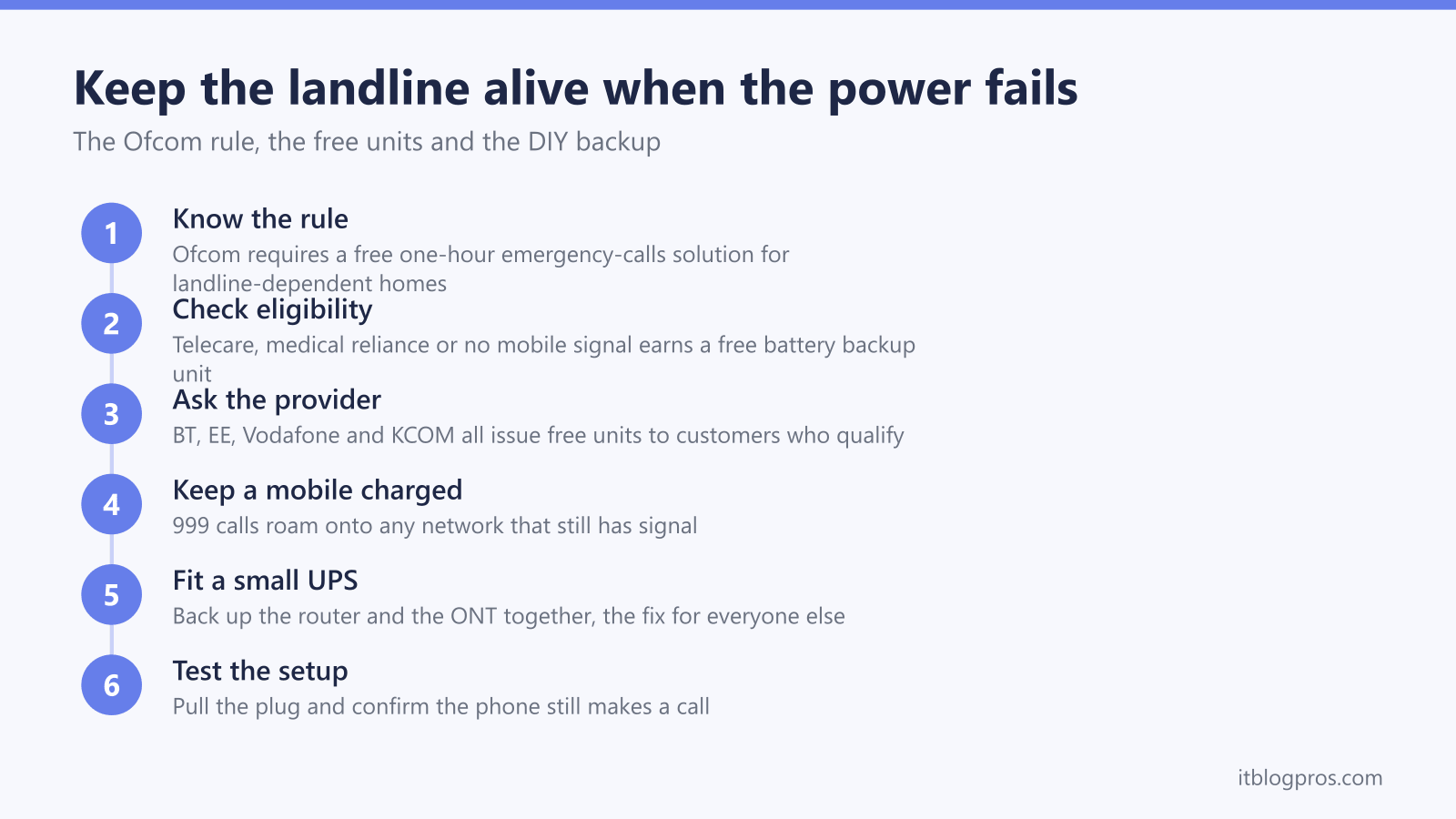
- Work out the household's status. Telecare, a medical reliance on the line or no usable mobile signal means free protection; everyone else is in DIY territory.
- Make the call. Ask the provider's accessibility or extra-help team to record the household as landline dependent and supply the battery backup unit, or order a UPS sized for the router and ONT.
- Fit it properly. Power the router, the ONT and the phone base station, not just the first box in the chain.
- Test it. Pull the plug, confirm dial tone, make a call, and repeat every few months, because backup batteries age quietly.
- Prepare the fallback. Keep a mobile and a power bank charged, write the provider's fault line and 105 on paper, and remember that 999 roams onto any network with signal.