
Buying a TV means picking through four panel types, a stack of HDR logos and five smart platforms before screen size even comes up. The makers' own spec sheets settle most of it. This guide takes each choice as LG, Samsung, Sony, Hisense and TCL describe it: OLED against QLED and Mini LED, size against viewing distance, HDR formats, what a PS5 or Xbox Series X needs, smart platforms and Freeview Play, and sound. Five current TVs follow, from budget 4K sets to a 65-inch gaming screen.
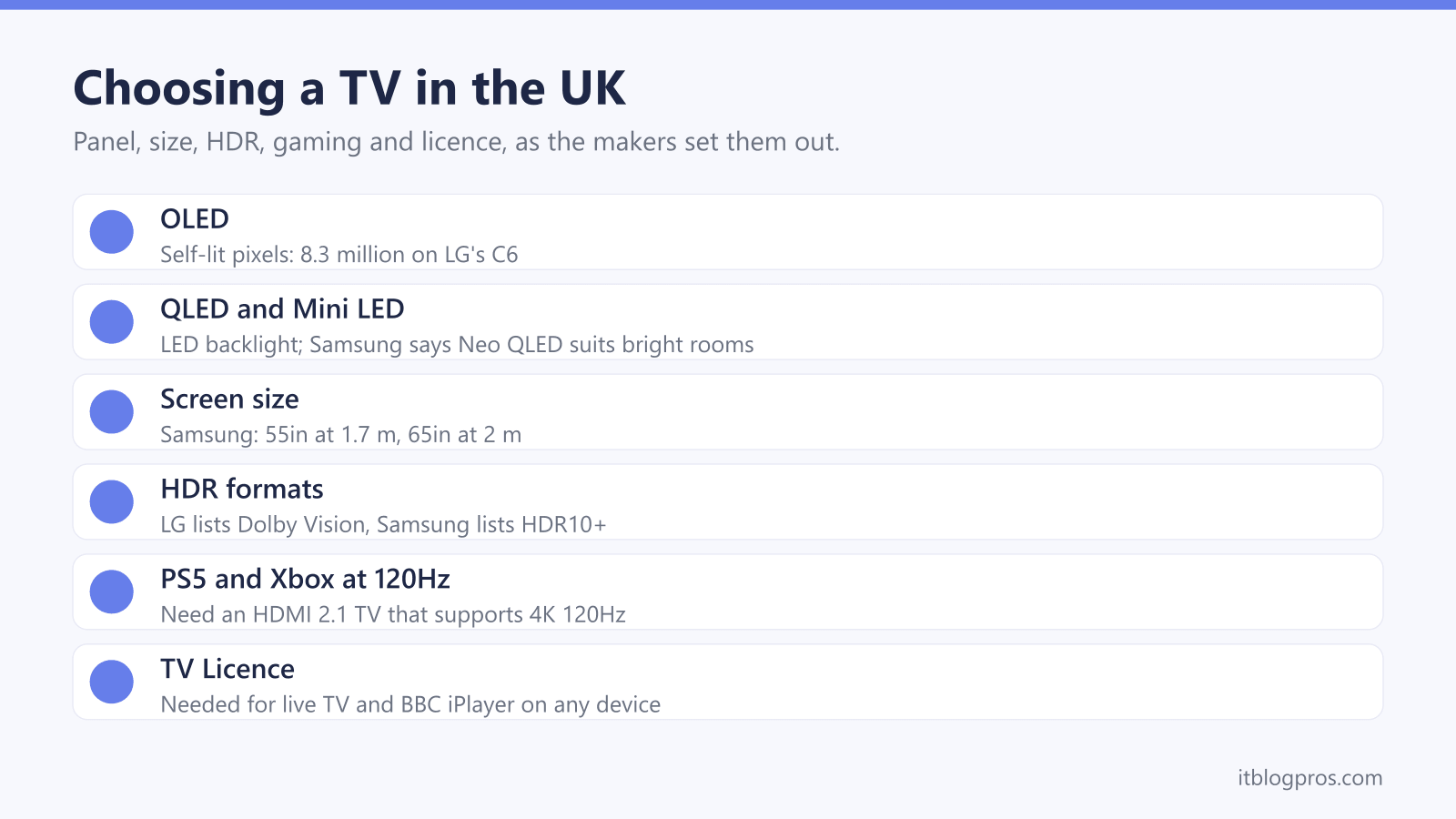
Start with the room and the distance. Samsung's size guide puts a 55-inch TV at about 1.7 metres and a 65-inch at 2 metres. Samsung, which sells both types, says OLED is better suited to gaming in darker rooms and Neo QLED to bright ones. For a PS5 or Xbox Series X at 4K 120Hz, Sony and Microsoft say the TV needs HDMI 2.1 and 120Hz support, which LG's C6 and TCL's 65P8L list.
Key Takeaways
- Samsung says QLED adds Quantum Dots to an LED-backlit TV, while OLED pixels make their own light, and it suggests Neo QLED for gaming in bright or well-lit rooms.
- Samsung's size guide suggests sitting about 1.2 times the screen size away, which puts a 55-inch TV at 1.7 metres and a 65-inch at 2 metres.
- HDR formats split by brand: LG's C6 spec sheet lists Dolby Vision but not HDR10+, and Samsung's QN70H page lists HDR10+ but not Dolby Vision.
- Sony lists a TV that outputs 4K at 120Hz and HDMI 2.1 as separate PS5 requirements, and Hisense lists HDMI 2.1 on a 60Hz set.
- GOV.UK says a TV Licence is needed to watch live TV on any channel or device and to use BBC iPlayer, whichever TV is bought.
OLED Lights Each Pixel While QLED and Mini LED Use a Backlight
The labels on a TV box describe how the picture is lit. Samsung's buying guide puts it plainly: LED simply refers to the backlight that lights up the screen, and QLED adds Quantum Dots, nanocrystals that emit precise colours based on their size. Mini LED, in Samsung's words, uses tiny LEDs for more precise backlight control through local dimming, where zones of the backlight are controlled independently. Samsung's Neo QLED sets combine the two.
OLED works differently. Samsung describes OLED pixels as self-illuminating, producing both light and colour individually, and LG's page for its C6 says the processor controls 8.3 million self-lit pixels.
Brightness is the trade-off Samsung points to, and it sells both types. Its guide says Neo QLED suits gaming in a bright or well-lit room, while OLEDs still get bright but are better suited to gaming in darker rooms. Budget sets sit at the other end of the scale: Hisense's spec sheet for the 55E7STUK lists a DLED backlight with Hi-QLED colour, and TCL lists its 55V6D as DLED.
Screen Size Follows the Distance From the Sofa
Measure from the sofa to the wall before choosing a size. Samsung's size guide suggests sitting at roughly 1.2 times the screen size, and its table puts a 55-inch TV at 1.7 metres and a 65-inch at 2 metres. The same page also suggests dividing the viewing distance by two to pick a size, which points to a larger screen, so the guide does not settle on one answer.
Sony comes at it from the other side. Its UK support article gives a minimum rather than an ideal: at least 1.5 times the screen's vertical height for a 4K TV, the distance at which individual pixels stop being visible. Sony's table puts that minimum at about 1 metre for a 55-inch set and 1.2 metres for a 65-inch. So a sofa 2 metres back suits a 65-inch on both counts.
Wall mounting needs the VESA pattern from the spec sheet: LG lists 300 x 200 for the C6 and TCL 400 x 300 for the 65P8L. The TV wall bracket guide explains how to match one.
Dolby Vision, HDR10+ and HLG Depend on the Brand
HDR, or high dynamic range, is a video signal with a wider range of brightness and colour than standard pictures, as Sony's HDR FAQ explains. Sony describes HDR10 as the most widespread format, used on Ultra HD Blu-ray, and Dolby Vision as Dolby's standard with dynamic metadata that adjusts the picture to what is on screen. Samsung says HDR10+ also uses dynamic metadata and claims to have pioneered it. HLG, in Sony's words, is a hybrid that carries SDR and HDR pictures in one signal, so it still looks balanced on a TV without HDR.
The brands split along these lines. LG's C6 spec sheet lists Dolby Vision, HDR10 and HLG, with no HDR10+. Samsung's QN70H page lists HDR10+ but neither Dolby Vision nor HLG. Hisense lists HDR10, HDR10+, HLG and Dolby Vision IQ on the 55E7STUK, and TCL lists Dolby Vision, HDR10+ and HLG on both the 65P8L and the 55V6D. A set that lists both Dolby Vision and HDR10+ covers both dynamic formats, whichever one a film or series uses.
PS5 and Xbox Series X Need 4K at 120Hz Over HDMI 2.1
Both consoles reach 120 frames per second only on the right TV. Xbox's UK support page lists three things for 4K at 120Hz on Xbox Series X: the console, an Ultra High Speed HDMI cable that supports HDMI 2.1, and a TV that supports HDMI 2.1. PlayStation's support page says the PS5 supports HDMI 2.1 and 4K 120Hz, asks whether it is plugged into an HDMI 2.1 port, and warns that the TV's settings may need changing. Sony's TV support adds that many PS5 games run at 60 FPS or lower.
An HDMI 2.1 label is not the whole answer. Hisense lists HDMI 2.1 on the 55E7STUK, but with a 60Hz panel, and Samsung lists the QN70H at 4K 60Hz on every HDMI port. LG lists 4K 120Hz, VRR and ALLM on all four HDMI ports of the C6, and TCL lists the 65P8L at 4K 144Hz with HDMI 2.1 and FreeSync. The PS5 vs PS5 Pro and Xbox Series X vs Series S guides cover the consoles, and the HDMI cable guide the cable.
Smart Platforms, Freeview Play and the TV Licence
The smart platform runs the apps, and each brand uses its own or borrows one. LG's C6 runs webOS 26, and LG's page offers webOS Re:New upgrades for up to five years. Samsung's QN70H runs Tizen, with OS upgrades for up to seven years on 2026 models. TCL's 65P8L runs Google TV, which TCL says needs a Google Account, a free TCL Account and broadband, while its 55V6D runs Fire TV. Hisense uses VIDAA Smart OS and lists AirPlay 2 on the 55E7STUK. A set that will not get online is covered in the smart TV WiFi fix.
Freeview's site says Freeview Play is built into most new TVs, adding catch-up over broadband of at least 2Mbps, and that tuning to channel 100 shows whether a TV has it. Freely's site says it needs no aerial but 10Mbps for live internet channels. The Freeview Play box guide covers older sets. Whatever the screen, GOV.UK says a TV Licence is needed for live TV on any channel or device and for BBC iPlayer.
Built-In Speakers Are Modest, Which Is Where a Soundbar Helps
The speaker figures on each spec sheet are worth a look. Samsung lists 20W across two channels for the QN70H, Hisense 2 x 10W for the 55E7STUK, and TCL 2 x 10W for the 55V6D. The dearer sets go further: LG lists 40W in a 2.2-channel layout with down-firing speakers on the C6, and TCL fits the 65-inch P8L with 2 x 10W plus 15W in a 2.1-channel Onkyo system.
The makers themselves point to soundbars. Samsung's QN70H page says its Q-Symphony feature lets the TV and a soundbar play together for a bigger, more immersive sound. LG says the C6 supports up to 13.1.7 channels with a suitable soundbar, against its own 2.2. Samsung's sound guide adds that, without Q-Symphony, the TV speakers are usually turned off and the soundbar plays alone.
The connection is eARC, the HDMI audio return channel, which every set here lists. LG puts it on HDMI 2 of the C6 and Hisense on HDMI 3 of the 55E7STUK, so check which port before planning the cables. The soundbar guide covers choosing one.
Five TVs for Dark Rooms, Bright Rooms, Gaming and Tight Budgets
Two caveats come before the table. A new TV is not the only fix for a slow or dated smart platform: a streaming stick adds a fresh set of apps to a working TV with a spare HDMI port, as the Fire TV Stick guide and the Fire Stick vs Roku vs Google TV comparison explain. And only two of these five list 4K at 120Hz or above for a PS5 or Xbox Series X.
With that settled, the LG OLED evo C6 is the OLED pick at 55 inches, with self-lit pixels, Dolby Vision and four HDMI ports rated for 4K 120Hz. Samsung's QN70H Neo QLED uses the Quantum Mini LED backlight Samsung suggests for gaming in bright rooms, though its HDMI ports stop at 4K 60Hz. TCL's 65-inch P8L is the big-screen gaming choice, with 4K at 144Hz, FreeSync and Google TV. Hisense's 55E7STUK is the budget 4K set that lists HDR10, HDR10+, HLG and Dolby Vision IQ, and TCL's 55V6D brings Fire TV built in on a standard DLED panel.
| Product | Best for | Key specs | Price | |
|---|---|---|---|---|
 | LG OLED evo C6 55in (OLED55C65LA) OLED pick | Films in a dim room, and PS5 or Xbox at 4K 120Hz | OLED, 4 HDMI at 4K 120Hz, VRR to 165Hz, Dolby Vision | Check price → |
 | Samsung QN70H 55in Neo QLED (QE55QN70HAU) Bright rooms | Bright living rooms and HDR10+ streaming | Quantum Mini LED, HDR10+, Tizen, 3 HDMI at 4K 60Hz | Check price → |
 | TCL P8L 65in QD-Mini LED (65P8L-UK) 65in gaming | A 65in screen for PS5 or Xbox Series X games | 4K 144Hz, HDMI 2.1, FreeSync, Dolby Vision, Google TV | Check price → |
 | Hisense E7S 55in Hi-QLED (55E7STUK) Budget | A budget 55in 4K set with Dolby Vision and HDR10+ | 60Hz, Dolby Vision IQ, HDR10+, HLG, VIDAA, 2 x 10W | Check price → |
 | TCL V6D 55in Fire TV (55V6D-UK) Fire TV | Homes that want Fire TV built into the set | DLED, 60Hz, Dolby Vision, HDR10+, HLG, Fire TV, 2 x 10W | Check price → |