
Freeview is still how millions of UK homes get free live TV, but the box under the telly now does far more than tune channels. A Freeview Play box or recorder adds catch-up apps over broadband, Freely streams live channels with no aerial at all, and the aerial on the roof decides whether any of it works. This guide sets out what Freeview, Everyone TV, Manhattan, Humax, Panasonic, One For All and Labgear say about each piece, then lists four products worth shortlisting.
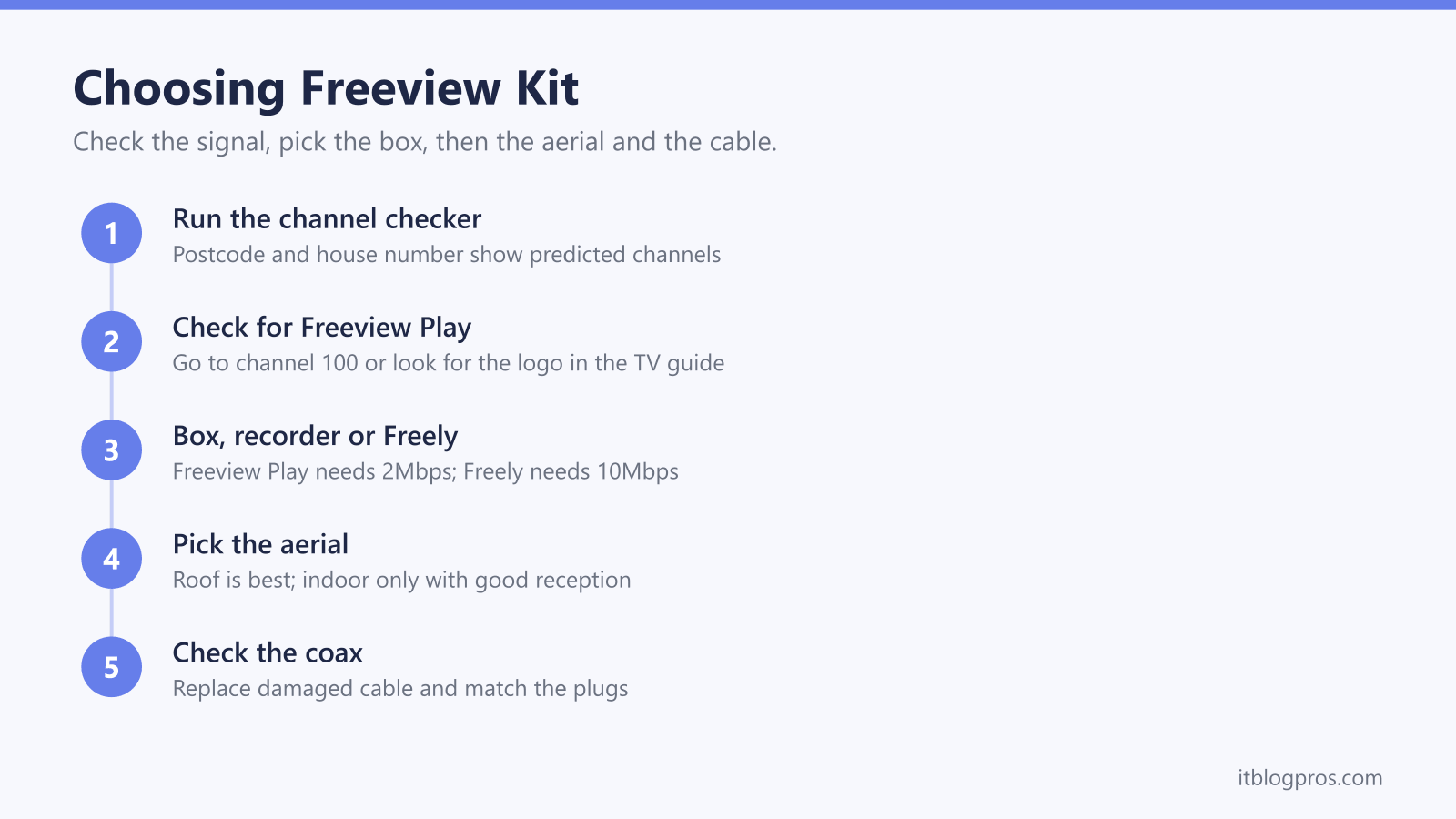
Check the signal first, then pick the box. Freeview's channel checker predicts the channels at your postcode and house number, and Freeview recommends a roof aerial, with indoor and loft aerials only for areas with good reception. A Freeview Play box adds catch-up apps over broadband of at least 2Mbps, a recorder adds pause, record and rewind, and Freely needs 10Mbps but no aerial.
Key Takeaways
- Freeview's channel checker predicts the channels at your address from a postcode and house number, and Freeview suggests running it before calling an aerial installer.
- Freeview says a Freeview Play TV, box or recorder adds catch-up and on-demand players to live TV, and asks for broadband of at least 2Mbps for them.
- Freely, run by Everyone TV, streams live and on-demand TV over WiFi with no aerial, and Freely's site asks for a minimum broadband speed of 10Mbps.
- Freeview recommends a roof aerial of the wideband type, while One For All suggests an unamplified indoor aerial only within about 3 miles of a transmitter.
- GOV.UK says a TV Licence is needed to watch or record live TV on any channel or service and to watch BBC programmes on iPlayer, whatever the box.
Freeview Play Adds Catch-Up Apps to the Live Channels
Plain Freeview is live TV from an aerial and nothing more. Freeview's equipment page says a Freeview Play TV, box or recorder keeps those live channels and adds access to catch-up and on-demand content, and its Freeview Play page counts over 60,000 hours of TV on demand, with paid services such as Netflix, NOW and Prime Video at extra cost. Those players need broadband: Freeview asks for a minimum of 2Mbps and notes that streaming counts towards any monthly data allowance.
The older Freeview HD label is fading out. Freeview announced in August 2020 that it would stop licensing the Freeview HD brand for new TVs made from 2021 and for new set-top boxes from 2022, citing the success of Freeview Play.
Many TVs already have it. Freeview's check is to connect the TV to the internet and go to channel 100, or look for the Freeview Play logo in the TV guide. A TV that will not get online is covered in the smart TV WiFi guide, and the which TV to buy guide covers new sets.
Freely Streams Live Channels Over Broadband Instead of an Aerial
Freely is the newer service from the same organisation. Everyone TV, formerly Digital UK, says it runs Freely, Freeview and Freesat and is owned and supported by the BBC, ITV, Channel 4 and Channel 5. Freely's own site says all you need is WiFi, with no dish or aerial, and that plugging in an aerial unlocks more live channels. The catch is speed: Freely asks for at least 10Mbps to stream live internet channels or watch on demand, five times the 2Mbps Freeview gives for Freeview Play.
Freely comes built into TVs from Hisense, TCL, Sharp, Haier and Philips, and Freely's site lists two streaming devices for existing TVs, the Netgem PLEIO and the Manhattan Aero. Manhattan says the Aero needs no aerial and cannot record live TV, and suggests about 25Mbps for comfortable 4K.
Recording still needs an aerial. Humax's AuraEZ has Freely built in, yet Humax states that recording is not compatible with the Freely platform and requires an aerial. For general streaming boxes, the Fire Stick, Roku and Google TV comparison sets out the options.
Recorders Differ in Tuners, Hours and How They Count Them
Tuners decide how many channels a recorder can capture at once, and makers count storage differently. Manhattan says its T4-R records two programmes while you watch a third, pauses live TV for up to two hours, and comes in 500GB, 1TB and 2TB sizes, quoting up to 1200 hours only for the 2TB model. Its sister T4 box does not record at all, though Manhattan says it can pause live TV for up to 90 minutes.
Humax's Aura has three tuners, which Humax says record four programmes while you watch a fifth, with up to 500 hours on 1TB and 1000 hours on 2TB. Humax bases those hours on standard-definition capture, not HD. Panasonic's store lists twin HD tuners and a 500GB drive for its DMR-PWT550EB, a Blu-ray player and recorder in one, but gives no hours figure.
Recording live TV also needs a licence. GOV.UK says a TV Licence is needed to watch or record live TV on any channel or service, and to watch on-demand BBC programmes on iPlayer, but not for Netflix, Disney Plus or YouTube.
Freeview's Channel Checker Comes Before the Box or the Aerial
Reception varies from street to street, so the free check comes first. Freeview's channel checker asks for a postcode and house number and shows which channels you are predicted to get at that address, and Freeview's help on HD channels says the number of HD and SD channels depends on coverage there. Freeview suggests running it before consulting any aerial installer.
Neighbours make a useful second opinion. Freeview's aerial advice is to go outside and check that your aerial points the same way as others nearby, and it says that if the neighbours get good reception, you probably will too. Manhattan's page for the T4-R makes the same point from the box side: it needs a rooftop aerial to pick up most live TV and radio channels.
For a new roof aerial, Freeview recommends a qualified installer, who will have experience working at heights and information on transmitters in your area. It points to GetMeViewing.org.uk from the Confederation of Aerial Industries and GetMeDigital.com from Registered Digital Installers, and advises getting more than one quote.
Indoor and Loft Aerials Only Suit Strong Signal Areas
Freeview is cautious about anything below the roof. Its equipment page says indoor aerials, loft or portable, may pick up Freeview but recommends a roof aerial for best results, and its aerial help says they may work in areas with good reception but can suffer electrical interference from other appliances. For indoor use, a Freeview blog suggests a windowsill at head height.
One For All, an aerial maker, is more generous. Its rule of thumb is an indoor aerial within 15 miles of the nearest transmitter and an outdoor one beyond that, with an unamplified model fine within about 3 miles where trees, large buildings and mountains are not in the way. The two sources differ, so the checker result and the neighbours' aerials are the better guide.
The aerial type matters too. Freeview recommends a wideband aerial, Type T or Type W, which covers the entire range of signals used for digital TV. Labgear's LAB450K is instead a Group K aerial tuned to channels 21 to 48, so an installer should confirm it suits your transmitter.
Coax Cable and Connectors Carry the Signal to the Box
The cable between aerial and box is the part most often ignored. Freeview's advice on existing cables is to remove the connectors, check the whole length of coaxial cable for damage to the outer layer and the tip for corrosion, and replace it if there is damage. Its troubleshooting guide also suggests removing unnecessary amplifiers or splitters, and fitting a filter between the aerial cable and the TV if mobile broadband is interfering. Freeview adds that a TV signal will not come through Sky or Virgin Media cabling.
Connectors vary. Labgear's LAB450K uses an F-type connector, and Labgear's 25 metre RG6 cable is a 75 ohm coax with an aluminium foil screen and a braid, which Labgear says helps reduce interference and signal loss; its page does not say plugs are included. At the box, Freeview says the aerial socket is marked RF in, Antenna, Aerial or Ant in.
From there the picture reaches the TV over HDMI, which the HDMI cable guide covers, and the TV wall bracket guide deals with mounting a wall-hung set.
The Freeview Recorder, Aerials and Cable Worth Shortlisting
Each pick has a limit, so match it to the checker result first. Panasonic's DMR-PWT550EB is the recorder here: Panasonic's store lists twin HD tuners, a 500GB drive and Freeview Play, and the box also plays Blu-ray discs. Panasonic's support site lists it among its 2015 Freeview Play models, so it is an older design, and its store page gives no recording hours.
One For All's SV9015 is the simple indoor option, with telescopic antennas, a tiltable loop and a 1 metre coax lead, but One For All recommends it only within 3 miles of the nearest transmitter. Labgear's LAB450K suits a loft or a roof, and Labgear rates it for medium, weak and fringe signal areas, though it is a Group K aerial rather than the wideband type Freeview recommends.
Labgear's 25 metre RG6 cable runs the new lead, with plugs bought to match the F-type aerial connector and the box socket. For paid streaming apps on their own, the Fire TV Stick guide is the better starting point.
Humax's Aura and Manhattan's T4-R recorders are sold on Amazon UK mainly through third-party sellers rather than by Amazon itself, so this link runs a search of Amazon UK for Humax Freeview Play recorders instead of pointing at one listing. Check the seller, the drive size and the model name against Humax's own page before ordering.
| Product | Best for | Key specs | Price | |
|---|---|---|---|---|
 | Panasonic DMR-PWT550EB Blu-ray Player and HDD Recorder with Freeview Play Recorder | Recording two channels and playing Blu-ray discs | Freeview Play, twin HD tuners, 500GB hard drive | Check price → |
 | One For All SV9015 Unamplified Indoor Digital TV Aerial Indoor | Homes within 3 miles of a transmitter | Unamplified, 0 to 3 miles, loop and telescopic, 1m coax | Check price → |
 | Labgear LAB450K Tri-Boom TV Aerial, Group K Loft or roof | Loft or roof fitting in medium to fringe areas | Channels 21 to 48, 13.5dBi gain, F-type connector | Check price → |
 | Labgear 27600F25 RG6 Coaxial Cable, 25m, Black Coax cable | A new lead from a loft or roof aerial | 25m RG6 coax, 75 ohm, foil and braid screened | Check price → |