
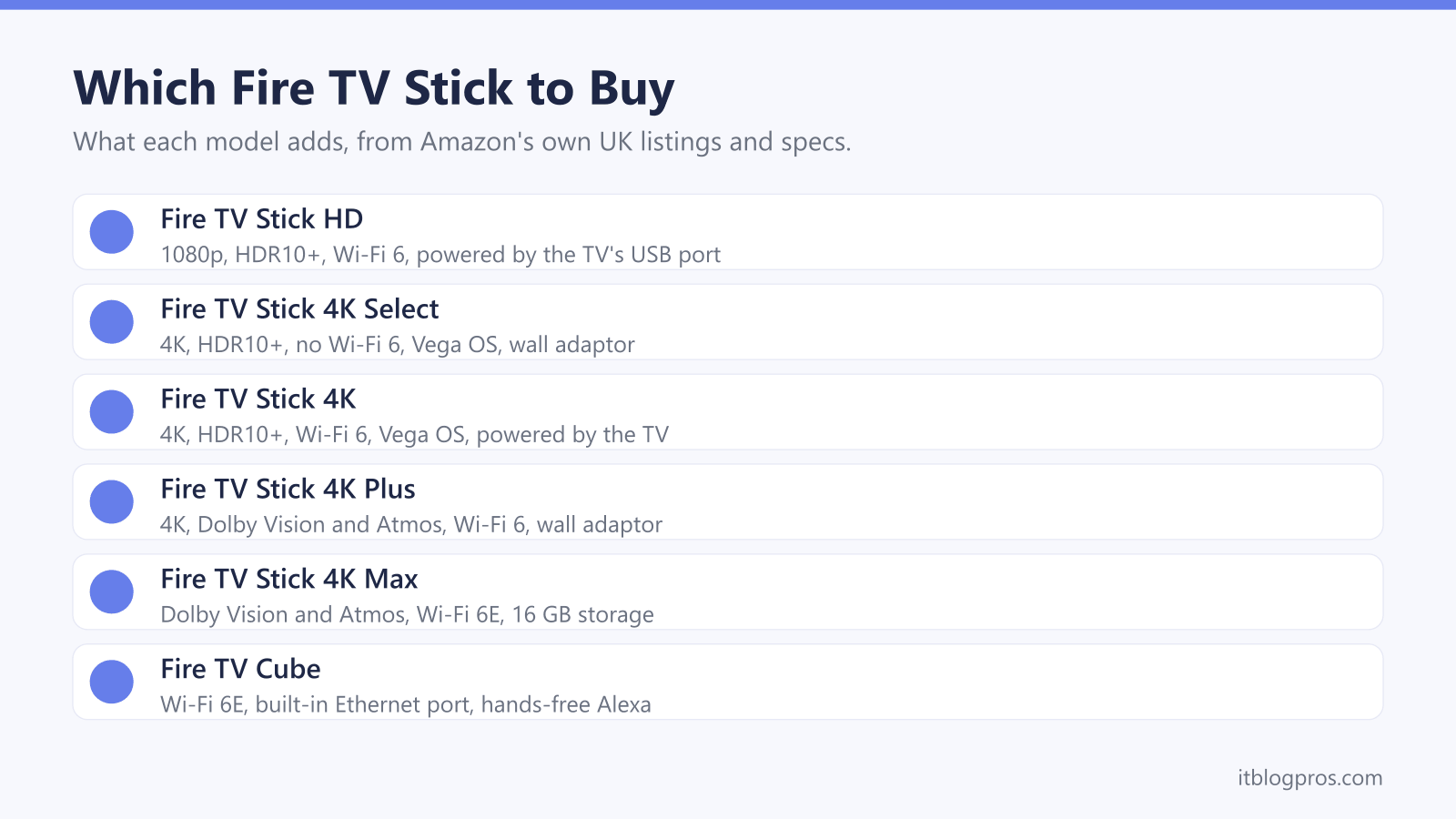
Amazon now sells six Fire TV streaming devices in the UK, and the names do little to explain them. The Fire TV Stick HD, 4K Select, 4K, 4K Plus, 4K Max and Fire TV Cube split on picture formats, Dolby Atmos, WiFi, storage, power and even operating system. This guide takes each difference from Amazon's own UK listings and help pages, sets out which UK apps their makers list, and covers WiFi, Ethernet and powering a stick from the TV.
For most 4K TVs the Fire TV Stick 4K Plus is the one to buy: Amazon lists 4K with Dolby Vision, HDR10+ and Dolby Atmos, Wi-Fi 6, and a power adaptor and HDMI extender in the box. Pick the 4K Max for Wi-Fi 6E and 16 GB of storage, the Cube for a built-in Ethernet port and hands-free Alexa, and the HD for a 1080p TV.
Key Takeaways
- Amazon's comparison chart lists Dolby Vision and Dolby Atmos on the 4K Plus, 4K Max and Cube, while the HD and 4K get HDR10, HDR10+ and HLG with Dolby audio passed through.
- Amazon's developer specifications list Vega OS on the 4K Select and the newest HD and 4K, Fire OS 8 on the 4K Plus and 4K Max, and Fire OS 7 on the Cube.
- Amazon's 4K help page asks for an Ultra HD TV with an HDCP 2.2 HDMI input and at least 15 Mbps, and a 4K stick on an HD TV plays at 1080p or 720p.
- ITV, Channel 4 and the BBC all list Fire TV devices, but NOW's list skips the 4K Select and newest HD, and Sky lists Sky Go on Amazon phones and tablets only.
- Only the Cube has a built-in Ethernet port, and Amazon says the newest HD and 4K run from the TV's USB port while the other sticks need their wall adaptor.
Picture and Sound Formats Split the Fire TV Range
Amazon's UK listings carry a comparison chart, and picture quality is the first split on it. The Fire TV Stick HD outputs 1080p Full HD, while the Fire TV Stick 4K, 4K Plus, 4K Max and Fire TV Cube all output 4K Ultra HD. HDR, the wider range of brightness and colour on newer TVs, comes in competing formats. The chart gives the HD and the 4K HDR10, HDR10+ and HLG, then adds Dolby Vision on the 4K Plus, 4K Max and Cube. The 4K Select is not in that chart, but its own listing shows the same HDR10, HDR10+ and HLG set without Dolby Vision.
Sound follows the same line. Amazon lists Dolby Atmos on the 4K Plus, 4K Max and Cube, and only HDMI pass-through of Dolby-encoded audio on the HD, 4K and 4K Select. Amazon adds that Atmos works only on select services with compatible equipment, such as a Dolby Atmos soundbar. The chart also lists Alexa Home Cinema on those three, which Amazon's 4K Max setup page describes as pairing compatible Echo speakers for fuller sound.
WiFi, Storage, Processor and Operating System Differ Too
Amazon's spec pages list Wi-Fi 6 dual-band on the HD, 4K and 4K Plus, and Wi-Fi 6E tri-band, which adds a 6 GHz band, on the 4K Max and Cube. The 4K Select lists 802.11a/b/g/n/ac only, so it has no Wi-Fi 6. One contradiction is worth knowing: Amazon's comparison chart says Wi-Fi 7 for the newest Fire TV Stick 4K, while that stick's own specifications, and Amazon's developer specifications, say Wi-Fi 6 dual-band.
Storage is 8 GB on every stick except the 4K Max, which has 16 GB, the same as the Cube. Amazon gives the HD, 4K, 4K Select and 4K Plus a quad-core 1.7 GHz processor, the 4K Max a quad-core 2.0 GHz one and the Cube an octa-core chip.
The operating system is the quiet difference. Amazon's developer specifications list Vega OS on the 4K Select, the newest HD and the newest 4K, Fire OS 8 on the 4K Plus and 4K Max, and Fire OS 7 on the Cube. Even so, Amazon's listings promise the newest Fire TV experience (2026) on all six.
A 4K Stick Only Shows 4K on a 4K TV
Amazon's spec pages are plain about it: 4K Ultra HD needs a compatible Ultra HD TV. Amazon's 4K help page lists the rest. The connection needs at least 15 Mbps, with some apps such as Netflix recommending 20 Mbps, and the TV needs an HDMI input that supports HDCP 2.2, a content protection standard. Every device in between needs HDCP 2.2 as well, including AV receivers and soundbars, and Amazon says TV ports labelled HDCP 2.2, UHD or 4K typically support it.
On an HD TV, a 4K stick still works. Amazon's TV compatibility notes say each 4K model also runs on HD TVs at 1080p or 720p, so the picture stays HD. That makes the HD the sensible stick for a 1080p set, since Amazon lists the same quad-core 1.7 GHz processor and Wi-Fi 6 on it as on the 4K Plus. The Cube box has no HDMI cable, and Amazon asks for one rated 18Gbps or higher for 4K; the HDMI cable guide explains the ratings.
UK Apps Depend on What Each App Maker Lists
Amazon's listings name BBC iPlayer, ITVX, Channel 4 and NOW among their apps, though each model's listing names a different mix. The app makers' own pages carry more weight. ITV's help page lists Amazon Fire tablets, Cube, Stick and TVs for ITVX, and Channel 4's minimum requirements name Amazon Fire among its TV platforms. The BBC certifies Fire TV devices by model number, and its list includes the numbers Amazon's developer specifications give the newest 4K and HD, the 4K Select, the 4K Plus and the Cube. The second-generation 4K Max's number, AFTKRT, is missing. The BBC says unlisted devices may not have been submitted yet, but it only supports certified ones.
NOW's UK help page lists the Fire TV Stick 4K, 4K Max and Cube, but not the 4K Select or the newest HD, even though Amazon's listings for both name NOW. Sky Go is the real gap: Sky's app requirements page lists Sky Go on Amazon phones and tablets, not Fire TV. For app faults, the NOW app fixes cover the most common one.
Amazon's Ethernet Adapters Take WiFi Out of the Picture
Speed needs are modest on paper. Amazon's 4K help page asks for at least 15 Mbps, and the BBC's help page asks for 24 Mbit/s for full 3840-pixel Ultra HD on iPlayer, or 12 Mbit/s for 2560-pixel. When a stick still struggles, Amazon's WiFi help page says to restart the Fire TV and router, move them closer together if possible, and connect by Ethernet, adding that some Fire TV devices need an adapter for it. Newer WiFi standards only help with a matching router, too, and Amazon says Wi-Fi 6E needs a Wi-Fi 6E router.
Only the Cube has an Ethernet port built in, rated 10/100 Mbps. Amazon's Micro-USB Ethernet Adaptor names the 4K Select, 4K Plus, 4K Max and Cube, runs at 10/100 and can be powered by the Fire TV's own power adaptor. It does not fit USB-C, so the newest HD and 4K take Amazon's Right Angle USB-C Ethernet Adapter, rated at up to 480 Mbps. The NOW buffering guide and TV WiFi fixes cover the network side.
The Newest HD and 4K Run From the TV's USB Port
Amazon's setup pages for the newest Fire TV Stick HD and 4K describe Direct Power. A 0.4 m USB-C cable runs from the stick to a USB-A port on the TV, and there is no wall adaptor in the box. If that port is too far from the HDMI port, or an insufficient power message appears, Amazon suggests a USB-C cable and a 5V 1A USB adaptor in a wall socket instead. Its low power help page also suggests trying another USB port or the TV's USB 3.0 port.
The other models work the opposite way. Amazon's setup pages for the 4K Plus and 4K Max say to plug the power adaptor into the wall and avoid plugging the USB cable directly into the TV, and both boxes include the adaptor and an HDMI extender. The 4K Select also ships with a power adaptor and lists an electrical socket under its system requirements, and the Cube comes with its own. The newest HD and 4K leave the HDMI extender out, and Amazon sells it separately.
Five Fire TV Picks for Different TVs and Homes
Some caveats come first. No stick speeds up a slow line, since Amazon's 4K page still asks for at least 15 Mbps, and Sky's requirements page lists no Fire TV device for Sky Go. Anyone who relies on BBC iPlayer may prefer a model on the BBC's certified list, which does not currently include the second-generation 4K Max.
With that settled, the Fire TV Stick 4K Plus is the all-round pick for a 4K TV, with Dolby Vision, Dolby Atmos, Wi-Fi 6, a power adaptor and an HDMI extender in the box. Amazon's listing explains that it is the Fire TV Stick 4K renamed. The Fire TV Stick HD suits 1080p TVs and runs from the TV's USB port. The 4K Max adds Wi-Fi 6E and 16 GB of storage for homes with a Wi-Fi 6E router. The Cube suits a wired setup, with its own Ethernet port, hands-free Alexa and control of a set-top box, but the HDMI cable is extra. Amazon's Micro-USB Ethernet Adaptor wires up a 4K Plus or 4K Max.
| Product | Best for | Key specs | Price | |
|---|---|---|---|---|
 | Amazon Fire TV Stick 4K Plus Our pick | Most 4K TVs, with Dolby Vision and Dolby Atmos | 4K, Dolby Vision, HDR10+, Atmos, Wi-Fi 6, 8 GB | Check price → |
 | Amazon Fire TV Stick HD (newest gen) Budget | 1080p TVs and a tidy setup powered by the TV | 1080p, HDR10+, Wi-Fi 6, USB-C Direct Power, 8 GB | Check price → |
 | Amazon Fire TV Stick 4K Max (2nd gen) Wi-Fi 6E | Wi-Fi 6E routers and more room for apps | 4K, Dolby Vision, Atmos, Wi-Fi 6E, 16 GB, 2.0 GHz | Check price → |
 | Amazon Fire TV Cube (3rd gen) Ethernet built in | Wired homes and hands-free Alexa control | 4K, Dolby Vision, Atmos, Wi-Fi 6E, 10/100 Ethernet | Check price → |
 | Amazon Micro-USB Ethernet Adaptor for Fire TV Wired | Wiring a 4K Plus, 4K Max or 4K Select to the router | 10/100 Ethernet, micro-USB, not for USB-C sticks | Check price → |