
Apple TV means two things in the UK: Apple's streaming service, and the small box that plugs into a TV. The box is the Apple TV 4K, and Apple has just replaced it, with the 4th-generation model on sale from 13 November. Below, the specs come from Apple's own UK pages and the app support from each UK app maker's device list. The Siri Remote, the home hub role, and Google TV Streamer, Fire TV and Roku follow.
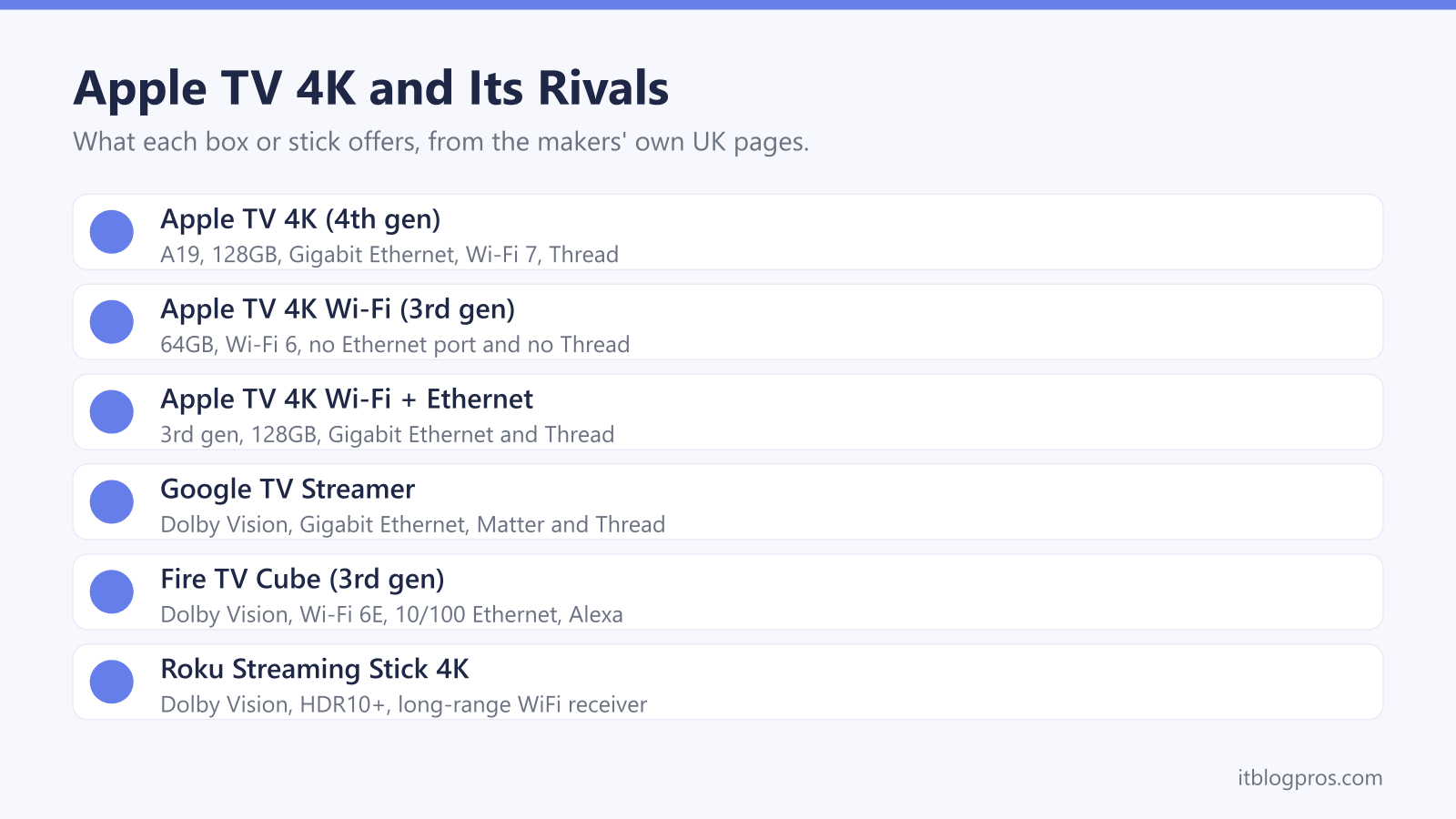
The Apple TV 4K is Apple's streaming box, and it is separate from the Apple TV app and subscription, which Apple also offers on other TVs and devices. Apple's current UK model is the 4th-generation Apple TV 4K, listed with an A19 chip, 128GB, Gigabit Ethernet, Wi-Fi 7, Thread and Dolby Vision. It suits iPhone and HomeKit homes; Google TV Streamer is the closest rival.
Key Takeaways
- Apple uses the Apple TV name for the box, the app and the subscription, and Apple's app page lists the app on Samsung, LG, Roku, Fire TV, Google TV, PlayStation and Xbox.
- Apple's UK tech specs list one 4th-generation Apple TV 4K with an A19 chip, 128GB, Gigabit Ethernet, Wi-Fi 7 and Thread, on sale from 13 November.
- Apple's support specs split the 3rd generation into a 64GB Wi-Fi model and a 128GB Wi-Fi + Ethernet model, and only the second has Ethernet and Thread.
- BBC iPlayer, ITVX, Channel 4 and NOW all list Apple TV, with ITV asking for tvOS 18 or later and the BBC for the latest tvOS.
- Google lists Ethernet, Thread and Dolby Vision on its TV Streamer, Amazon gives the Fire TV Cube 10/100 Ethernet and Alexa, and Roku's UK range is sticks only.
The Apple TV Box Is Not the Apple TV App or Service
Apple uses one name for three things, which explains most of the confusion. Apple TV is a subscription service of Apple Original shows and films, and Apple's UK pages invite people to stream them "on Apple TV with a subscription". The Apple TV app is where that service lives, alongside films to buy or rent and add-on channels. The Apple TV 4K is the box: a small streamer that plugs into a TV's HDMI port.
The service does not need the box. Apple's Apple TV app page lists the app on Samsung, LG and Sony smart TVs, on Sky, Virgin and EE, on Roku, Fire TV and Google TV, and on PlayStation and Xbox, plus iPhone, iPad, Mac, Android and PC. The same page says shows from Disney+, Prime Video, BBC iPlayer, ITVX, Channel 4 and NOW appear inside the app.
What the box adds is the rest of Apple on a TV. Apple's Apple TV 4K page lists the App Store, Apple Arcade, Apple Fitness+, FaceTime through a nearby iPhone or iPad, and a smart home hub.
The 4th-Generation Apple TV 4K Comes in One Version
Apple's UK tech specs page lists a single Apple TV 4K (4th generation), and Apple's product page gives 13 November as the day it goes on sale. There is no Wi-Fi-only version this time. Apple lists 128GB of storage, an A19 chip, Gigabit Ethernet, Wi-Fi 7 (802.11be), Bluetooth 6, Thread networking and an HDMI 2.1 port, with a footnote that Wi-Fi 7 is available only where a country or region supports it.
Apple claims the A19 delivers up to 50 per cent faster CPU performance than the previous generation, from its own tests on pre-production units. The bigger everyday change is the microphones. Apple's page says the box has three far-field microphones, so Siri works without picking up the remote, and its footnote lists English among the supported languages. Siri AI, Apple's new assistant, arrives as a beta and needs the home owner to have an Apple Intelligence iPhone or iPad.
Apple's in-the-box list is the Apple TV 4K, a Siri Remote (4th generation), a power lead and documentation. The HDMI cable is sold separately.
The 3rd-Generation Wi-Fi Model Has No Ethernet Port or Thread
Anyone buying a 3rd-generation box, new or second hand, needs to know that Apple sold it in two versions. Apple's support tech specs list the Apple TV 4K Wi-Fi with 64GB of storage and the Apple TV 4K Wi-Fi + Ethernet with 128GB. Both have the A15 Bionic chip, Wi-Fi 6, Bluetooth 5.0 and HDMI 2.1, and both came with the Siri Remote (3rd generation), which charges over USB-C.
The gap is more than a socket. Only the Wi-Fi + Ethernet version lists Gigabit Ethernet and Thread, a low-power mesh network for smart home accessories. Apple's home hub page says Thread-enabled Matter accessories need a Thread-enabled hub, and names the Apple TV 4K (3rd generation) Wi-Fi + Ethernet, HomePod mini or a supported third-party border router.
Apple's model identification page gives the numbers to check: A2737 for the Wi-Fi version and A2843 for the Wi-Fi + Ethernet version. The 64GB model is fine for streaming over a strong signal, but for a home hub or a wired TV, the Ethernet version is the one to look for.
Dolby Vision, HDR10+ and Dolby Atmos Need a Matching TV and Cable
Apple's tech specs list Dolby Vision, HDR10, HDR10+ and HLG at up to 2160p and 60 frames per second on the new model, with Dolby Atmos, Dolby Digital 5.1 and Dolby Digital Plus 7.1 for sound. HDR, high dynamic range, is the wider range of brightness and colour on newer TVs, and the TV decides which format it can show.
Apple's 4K and HDR support page sets the conditions. To switch to HDR10, HDR10+ or Dolby Vision automatically, the TV must show that format at 60 Hz, or 50 Hz in Europe. Some TVs only accept HDR on certain HDMI inputs, or hide it under names such as Ultra, Deep or Enhanced colour. Apple recommends HDMI cables with the Compatible Dolby Vision mark and names a Belkin Ultra High Speed HDMI Cable as an example; the HDMI cable guide explains the ratings.
Dolby Atmos needs the right speakers too. A Dolby Atmos soundbar is one route. Apple's other route on the new box is four HomePod (2nd generation) or HomePod mini 2 speakers in matching front and rear pairs.
BBC iPlayer, ITVX, Channel 4 and NOW All List Apple TV
The UK's main catch-up apps support Apple TV, though each sets its own terms. The BBC's iPlayer help page says an Apple TV needs the latest version of tvOS, Apple's TV software, before the iPlayer app will update. ITV's device list names Apple TV running tvOS 18 or later for ITVX and ITVX Premium. Channel 4's minimum requirements list Apple TV among its TV platforms, and NOW's help page lists the Apple TV HD (4th generation) and the Apple TV 4K.
Apple's own Apple TV 4K page names Disney+, Prime Video, Netflix and HBO Max among the apps, and the App Store holds the rest.
When a stream stalls, the network is the first place to look. Apple's system requirements accept 802.11 wireless, Ethernet or broadband access, and a Gigabit Ethernet port takes WiFi out of the picture wherever a cable reaches the router. The 3rd-generation Wi-Fi model has no Ethernet port, so it relies entirely on the WiFi signal. The NOW buffering guide and the TV WiFi fixes cover the network side.
The Siri Remote and Home Hub Do More Than Change Channels
Apple's tech specs describe the Siri Remote (4th generation) with a touch-enabled clickpad, a Siri button, Bluetooth 6 and an IR transmitter. It controls a TV or receiver through IR or HDMI-CEC, covering power, input switching, volume and mute. It charges over USB-C, with the cable and power adapter sold separately, and Apple says Find My can make it play a sound. Precision Finding needs one of the iPhones Apple lists, such as the iPhone Air or an iPhone 17 or later other than the iPhone 17e.
The box is also a home hub. Apple's support page says an Apple TV becomes one once it is added to a room under Settings, AirPlay and Apple Home, and only the home owner can add it. A hub lets the Home app run automations, share control and reach accessories away from home. Apple contradicts itself on Matter: the hub page says a hub is required to add Matter accessories, while its Matter page says an iPhone on iOS 18 or later can add them without one.
Google TV Streamer, Fire TV and Roku Take Different Routes
Google's tech specs make the Google TV Streamer the closest match. It runs Android TV OS and lists Dolby Vision, HDR10+, Dolby Atmos, a Gigabit Ethernet port, 32 GB of storage, and Matter with a Thread border router. Its WiFi is 802.11ac, and it also comes without an HDMI cable. The BBC certifies the Google TV Streamer 4K, though ITV's and NOW's device lists name Chromecast models rather than the Streamer.
Amazon's developer specifications give the Fire TV Cube (3rd generation) Dolby Vision, Dolby Atmos, Wi-Fi 6E, an HDMI input and a 10/100 Ethernet port, with hands-free Alexa; the Fire TV guide covers the sticks. Roku's UK players page lists three sticks and no box. Roku's pages for the Stick Plus and Stick 4K list WiFi only, HDR10+, and Apple AirPlay and HomeKit support, and the Stick 4K adds Dolby Vision and a long-range WiFi receiver.
One caveat before the picks: Apple's home hub page names HomePod, HomePod mini and Apple TV as hubs, so none of these replaces an Apple TV in a HomeKit home.
The new Apple TV 4K is on pre-order rather than in stock on Amazon UK, so this link runs a search of Amazon UK for the Apple TV 4K rather than pointing at one listing. Check that the seller is Amazon and that the listing is the 4th-generation model before ordering.
| Product | Best for | Key specs | Price | |
|---|---|---|---|---|
 | Google TV Streamer (4K) Closest rival | Google Home and Matter homes with a cable to the router | 4K, Dolby Vision, HDR10+, Atmos, Gigabit Ethernet, Thread | Check price → |
 | Amazon Fire TV Cube (3rd gen) Alexa homes | Hands-free Alexa and a wired connection | 4K, Dolby Vision, Atmos, Wi-Fi 6E, 10/100 Ethernet | Check price → |
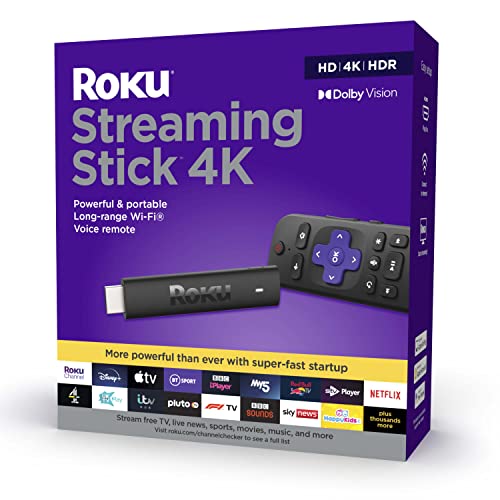 | Roku Streaming Stick 4K (3820EU) Budget | Dolby Vision on a TV a long way from the router | 4K, Dolby Vision, HDR10+, long-range Wi-Fi, AirPlay | Check price → |
 | Belkin 8K Ultra High Speed HDMI 2.1 Cable, 2m (AV10175bt2MBKV2) HDMI cable | Any Apple TV 4K, which ships without an HDMI cable | HDMI 2.1 certified, Dolby Vision, 4K at 120Hz, eARC, 2 m | Check price → |