
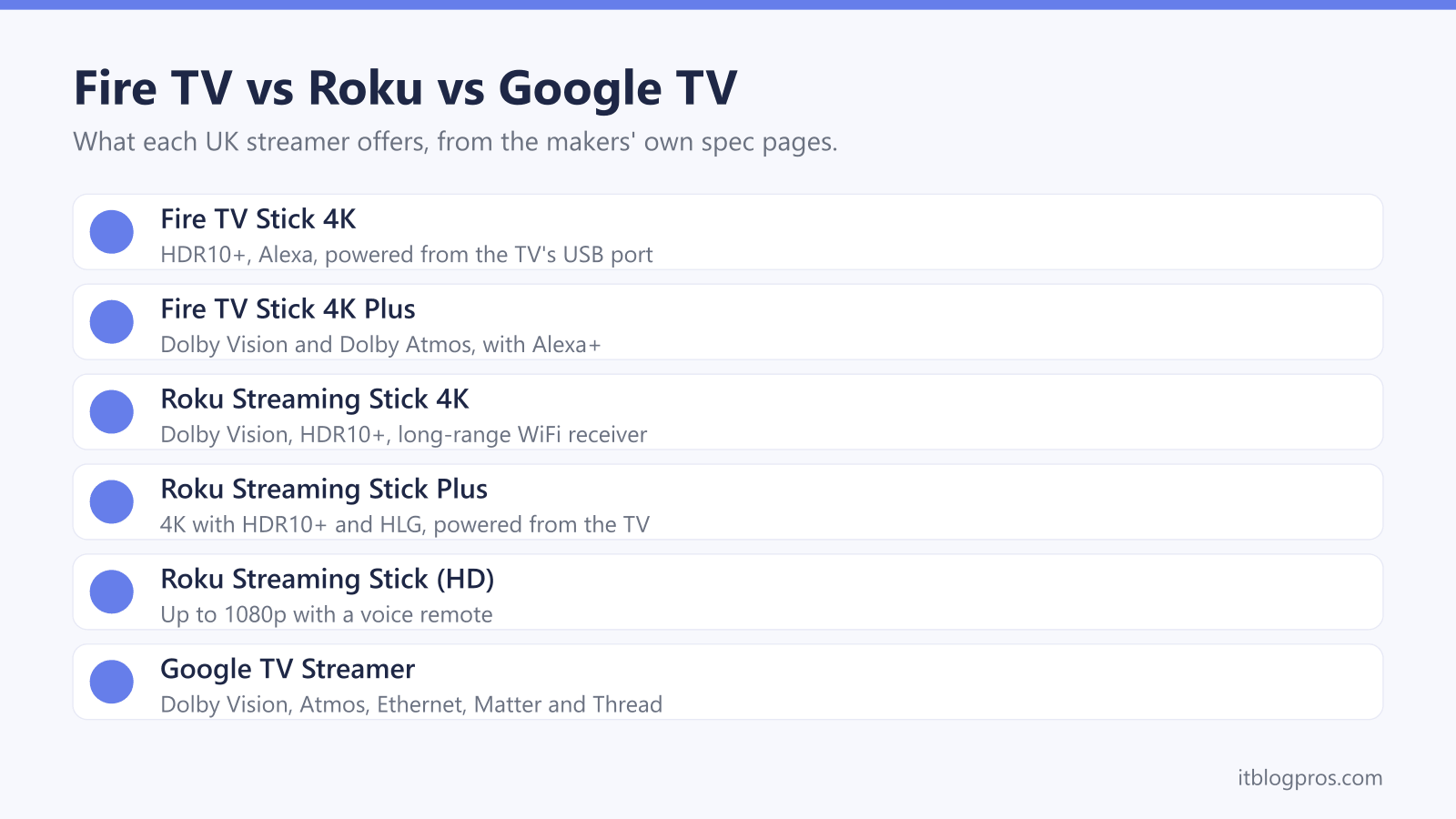
Amazon, Roku and Google each sell a stick or small box that turns a TV with an HDMI port into a streaming set, and in the UK they carry most of the same apps. The real differences sit in the detail: which HDR formats each model handles, whether Dolby Atmos is decoded or only passed through, which voice assistant answers, how much advertising the home screen carries, and whether a cable can stand in for WiFi. Here is how the three compare, model by model.
All three platforms carry BBC iPlayer, ITVX and Channel 4, so the choice comes down to the TV and the home. Roku's Streaming Stick 4K and Amazon's Fire TV Stick 4K Plus both list Dolby Vision, the Fire TV suits a home already using Alexa, and the Google TV Streamer is the box with a built-in Ethernet port and a Matter and Thread smart home hub. An HD TV needs only an HD stick.
Key Takeaways
- Roku's UK site lists three sticks, Amazon offers a wider Fire TV range, and Google said in August 2024 that it was ending Chromecast production as it launched the Google TV Streamer.
- Dolby Vision appears on the Roku Streaming Stick 4K, the Fire TV Stick 4K Plus and the Google TV Streamer, while the Roku Streaming Stick Plus and newest Fire TV Stick 4K list HDR10+ without it.
- The BBC certifies all three current Roku sticks, the newest Fire TV Stick 4K and HD, and the Google TV Streamer for iPlayer, and Channel 4 lists Amazon Fire, Roku and Google TV.
- Amazon's advertising specifications, Roku's UK support pages and Google's TV help all describe sponsored content on the home screen, so none of the three is ad-free.
- The Google TV Streamer has a 10/100/1,000 Mbps Ethernet port, a Matter hub and a Thread border router, while Fire TV Sticks need an adapter and Roku's wired list names none of its current sticks.
Three Makers Sell Very Different UK Line-Ups
Amazon has the widest choice. Its developer specifications cover a Fire TV Stick HD, 4K Select, 4K, 4K Plus and 4K Max, plus the Fire TV Cube box, and the Fire TV Stick buying guide sets out how each of those differs. Roku keeps things short. Its UK players page lists just three: the Roku Streaming Stick for HD, the Streaming Stick Plus for 4K and HDR, and the Streaming Stick 4K, which adds Dolby Vision. The older Express 4K still turns up on Roku's support pages, but not in that line-up.
Google has moved to a single streamer. In an August 2024 post on its blog, Google said it was ending production of Chromecast, which would be available only while supplies last, and introduced the Google TV Streamer as a more premium device for entertainment and the smart home. The same post promised no change to the support policy for existing Chromecast devices. For a household built around an iPhone, the Apple TV 4K guide covers a fourth option.
Dolby Vision, HDR10+ and Dolby Atmos Vary by Model
HDR, short for high dynamic range, is the wider spread of brightness and colour on newer TVs, and it comes in competing formats. Roku's spec pages list Dolby Vision, HDR10, HDR10+ and HLG on the Streaming Stick 4K, but only HDR10, HDR10+ and HLG on the Streaming Stick Plus. Google's tech specs give the Google TV Streamer Dolby Vision, HDR10, HDR10+ and HLG at up to 4K and 60 frames per second. On the Amazon side, the developer specifications list Dolby Vision on the Fire TV Stick 4K Plus and 4K Max, while the newest Fire TV Stick 4K stops at HDR10, HDR10+ and HLG.
Sound splits along similar lines. Google's store page says the Streamer plays Dolby Atmos without an AV receiver to decode it, and Amazon lists Atmos on the 4K Plus and 4K Max. Roku's sticks and the newest Fire TV Stick 4K pass Dolby audio over HDMI to a Dolby Atmos soundbar instead. Google also says the Streamer needs a certified HDMI 2.1 cable, sold separately, and the HDMI cable guide explains the ratings.
BBC iPlayer, ITVX and Channel 4 Are on All Three Platforms
The broadcasters' own device lists matter most. The BBC certifies devices by model number, and its lists include Roku's 3820EU, 3830EU and 3840EU, which Roku's UK pages give as the Streaming Stick 4K, Plus and HD. They also include the Google TV Streamer 4K and the model numbers Amazon gives the newest Fire TV Stick 4K and HD and the 4K Plus. The BBC also warns that Roku devices bought outside the UK region have not been approved, so iPlayer will not play on them.
Channel 4's minimum requirements page names Amazon Fire, Roku and Google TV. ITV's help page lists Amazon Fire sticks and Roku sticks, and names Google TV through the Chromecast with Google TV and NVIDIA Shield, while Google Store UK's apps page for the Streamer shows ITVX. ITV also says updates from 1 October limit ITVX to Roku devices on firmware v15.1 or later. Channel 5's help centre calls its app 5, though Roku's players page still says My5, and lists Amazon Fire TV and Roku among streaming devices; Google's apps page shows its logo too.
Alexa, Gemini and the Roku Voice Remote Work Differently
Every remote here has a voice button, but the assistant behind it differs. Amazon's UK listings describe pressing that button to talk naturally to Alexa+, which finds something to watch and manages the smart home, and the newest Fire TV Stick 4K listing says Alexa can check Ring cameras and dim the lights. Amazon's developer specifications add that hands-free, far-field voice works only through a linked Echo device.
Google's TV help lists the United Kingdom among the countries for Gemini for TV, which needs a Google TV device with Android 14 or higher and at least 2 GB of RAM. Google's spec page gives the Streamer 4 GB. Gemini answers adult profiles only, and Google says non-children's profiles for under-18s keep Google Assistant. A button on the back of the Streamer makes a lost remote ring, according to Google's store page.
Roku's voice remote searches across apps and controls TV power and volume, and Roku's spec pages say the sticks work with Alexa, Google Home, and Apple AirPlay and HomeKit, so an assistant from another maker can drive them.
All Three Makers Describe Ads on the Home Screen
None of these platforms is ad-free, and each maker says as much on its own pages. Amazon's advertising specifications describe a Custom Content Row, a row labelled Sponsored on the Fire TV Home tab, and list the UK among its locales. Amazon's listings also point to free, ad-supported films and programmes, which carry adverts of their own.
Roku's UK support page explains that ads appear on the Home Screen and the screensaver. A banner ad can be hidden with the remote's Star button, and categories such as gambling, alcohol and politics can be blocked, though Roku says those settings do not reach video ads or ads inside partner apps, and hides are capped each day.
Google's TV help offers two controls. A featured banner can be hidden from the top of the home screen for at least 18 months, and apps-only mode removes personalised recommendations from a profile. Even then, Google says, sponsored content and teasers for popular films and shows still appear, and Search and Google Assistant stop working in that mode.
The Google TV Streamer Adds Ethernet and a Smart Home Hub
WiFi does the job in most homes, but a cable takes it off the list of suspects when a stream stutters. Google's tech specs list a 10/100/1,000 Mbps Ethernet port on the Google TV Streamer. Amazon's developer specifications say the Fire TV Sticks need an Ethernet adapter, rated at 10/100 Mbps on the 4K Plus, and give the Fire TV Cube its own 10/100 Mbps port. Roku's UK wired-network page names the Express, Express 4K and Streambar, and none of the current sticks. Instead, Roku puts a long-range WiFi receiver in the Streaming Stick 4K's USB power cable, while the Streaming Stick and Streaming Stick Plus draw power from the TV's USB port.
Google's specs also list a Matter hub and a Thread border router. Its comparison page says the hub sets up and controls Matter and Works with Google Home devices, and that Thread helps them reach further, with a home panel on the TV for control. When streams still buffer, the NOW buffering guide and the TV WiFi fixes cover the usual causes.
Streaming Devices for Different TVs and Homes
Caveats first: no stick speeds up a slow broadband line, and Roku's spec pages say 4K and HDR need a TV with an HDMI input that supports HDCP 2.2, while an HD TV tops out at 1080p. iPlayer viewers should match the model number to the BBC's certified list, since the BBC says Roku sticks bought outside the UK are not approved.
With that settled, the Fire TV Stick 4K Plus brings Dolby Vision and Dolby Atmos to a 4K TV in a home already using Alexa, while the newest Fire TV Stick 4K runs from the TV's USB port with HDR10+. The Roku Streaming Stick Plus handles 4K with HDR10+ and also draws its power from the TV, and Roku's Streaming Stick 4K adds Dolby Vision and long-range WiFi. The Google TV Streamer is the wired, smart home choice, with Ethernet, Matter, Thread and 32 GB of storage. For a 1080p set, Roku's Streaming Stick in HD covers the basics with a voice remote. Anyone replacing the TV itself can start with the TV buying guide.
Roku's two 4K sticks, the Streaming Stick Plus and the Streaming Stick 4K, are sold on Amazon UK mainly through third-party sellers rather than by Amazon itself, so this link runs a search of Amazon UK for Roku 4K streaming sticks instead of pointing at one listing. Check the seller, and match the model number to the BBC's certified list, before ordering.
| Product | Best for | Key specs | Price | |
|---|---|---|---|---|
 | Amazon Fire TV Stick 4K Plus Alexa homes | Alexa homes wanting Dolby Vision and Dolby Atmos | 4K, Dolby Vision, HDR10+, Atmos, Wi-Fi 6, 8 GB | Check price → |
 | Google TV Streamer (4K) Wired, smart home | Ethernet, a Matter hub and Thread for the smart home | 4K, Dolby Vision, Atmos, 10/100/1,000 Ethernet, 32 GB | Check price → |
 | Amazon Fire TV Stick 4K (newest gen) TV powered | 4K with HDR10+ and no wall adaptor | 4K, HDR10+, HLG, Wi-Fi 6, Direct Power, 8 GB | Check price → |
 | Roku Streaming Stick (HD, 3840EU) Budget HD | 1080p TVs and second rooms | Up to 1080p, dual-band WiFi, USB-C power from the TV | Check price → |