
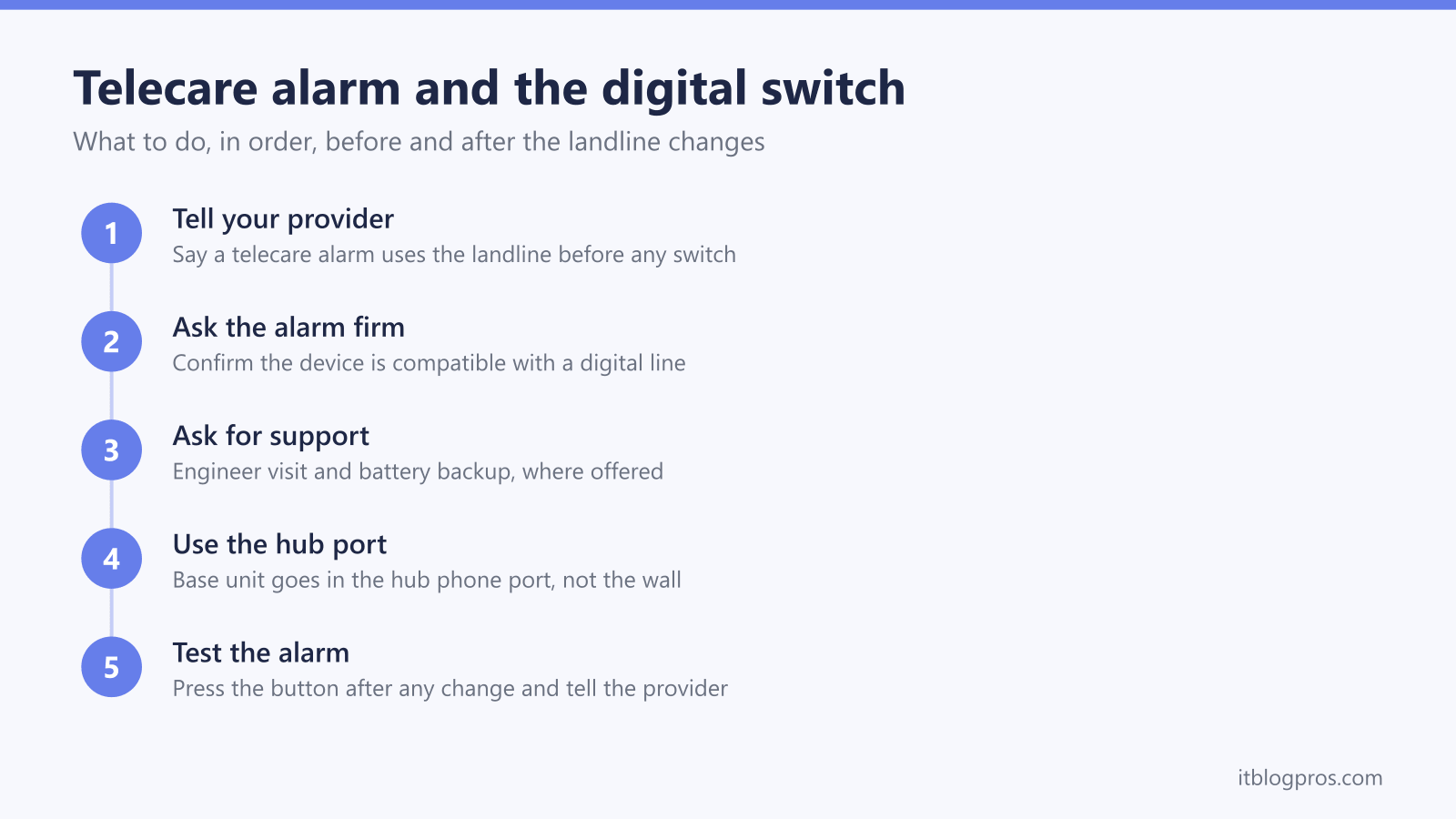
A telecare or pendant alarm that dials out over the landline is affected by the digital switchover, and it should not be assumed to keep working on a digital line. Government guidance comes down to three steps: tell the broadband or phone provider that an alarm is on the line, ask the alarm provider whether the device is compatible, and have the alarm tested after any change.
The detail differs by provider. This page sets out what BT, EE, Sky, Virgin Media, Vodafone and TalkTalk each say on their own help pages, what providers have promised the government, what the power cut rules do and do not cover, and what Openreach says happens to lines not moved by 31 January 2027.
Tell the broadband or phone provider that a telecare or pendant alarm uses the landline, then ask the alarm provider whether the device works on a digital line. Under the charter signed with government in December 2023, providers committed not to move a telecare user until a compatible, working alarm solution is confirmed. Have the alarm tested after any change. The alarm provider is the one who can confirm a specific device.
Key Takeaways
- The Telecare National Action Plan of 11 February 2025 urges telecare users and their families to tell the broadband or phone provider that an alarm is in the home.
- Under the charter signed in December 2023, providers including BT, Sky, Virgin Media O2, TalkTalk and Vodafone committed not to move a telecare user until a compatible, working alarm solution is confirmed.
- BT's help page says it arranges an engineer who checks the telecare device before and after the move, while Sky's page says it may message customers afterwards asking them to test the alarm.
- GOV.UK says Ofcom's guidance sets a one-hour minimum for emergency calls in a power cut, but the action plan says no rule requires providers to keep telecare alarm calls connected.
- Openreach says the analogue network closes on 31 January 2027, and lines not moved may go onto a limited emergency voice service or lose service altogether.
Two calls come before any switch date
The government's Telecare National Action Plan, published on 11 February 2025, urges telecare users and their support networks to tell the communication provider that a telecare device is in the home, so the line is not moved without working telecare. A family member can make that call.
The second call is to whoever supplied the alarm. GOV.UK's guidance on the analogue switch-off recommends contacting the equipment supplier or device manufacturer to find out whether the device will keep working on a digital phone line. The landline switch-off guide covers the wider timetable.
What each provider tells telecare and pendant alarm users
- BT. BT's Moving to Digital Voice page says a telecare alarm may not be supported on Digital Voice, and tells customers to confirm compatibility with the alarm provider, then ring BT on 0330 1234 150. A separate BT help page says that for a customer with a telecare device it arranges an engineer, who checks the device works before and after the move. BT's Battery Back Up page says the unit keeps the hub and Digital Voice running for at least an hour, and recommends one for anyone with a health alarm on the line.
- EE. EE's Digital Home Phone set-up page says anyone with a healthcare alarm or medical pendant must confirm compatibility with the alarm provider and then call EE. It says alarms must not be plugged into a Digital Home Phone Adapter, and that compatible devices go into the green phone port on the back of the hub. EE's Battery Back Up page recommends a unit for alarm users. EE's set-up and alarm pages do not mention an engineer visit, so ask.
- Sky. Sky's care alarm help page asks customers with a care alarm to get in touch through the form on that page. It says that with Internet Calls the alarm plugs directly into the port marked UK phone on the back of the hub, and will not work from the usual wall socket or when the broadband drops. It says Sky may send a WhatsApp or text message after activation asking the customer to test the alarm. Sky's copper switch-off page says customers it moves automatically are activated remotely, with no engineer visit, and tells alarm users to call the number on Sky's letter or email. Neither page mentions a battery backup unit.
- Virgin Media. Virgin Media's switchover page asks households with telecare devices on the landline to call 150 from a Virgin Media landline or 0345 454 1111 from any other phone, and says it will give extra support or carry out the switch differently at a later date. It tells customers to check with the device provider that the alarm will work independently in a power cut. Its emergency backup line page describes a phone, fitted by an engineer, that switches to the mobile network in a power cut. That page says telecare devices on the phone line cannot call out during one.
- Vodafone. Vodafone's Digital Voice help page says telecare devices that use the telephone wiring might not work with Digital Voice, and tells customers to contact the local authority or the device maker to check. It says an engineer visit is probably not needed. Vodafone's press release of 14 March 2025 says landline-dependent customers get its Broadband Battery Backup free, and its notes count telecare alarm users among them. The help page gives no route for registering an alarm, so raise it with customer care.
- TalkTalk. TalkTalk's Telecare Campaign help page asks customers to register a care alarm by live chat or on 0345 172 0088, and says nothing will change before TalkTalk has been in touch. TalkTalk's Digital Voice page says Digital Voice does not support care alarms that connect through a phone line, and tells users to speak to the alarm provider about an alternative before moving to Full Fibre with Digital Voice. It offers a battery backup lasting up to an hour to customers with no mobile signal. Neither page mentions an engineer visit.
What providers have promised the government
GOV.UK describes these as voluntary industry commitments.
- December 2023 charter. The Public Switched Telephone Network charter on GOV.UK, signed by BT, Virgin Media O2, Sky, TalkTalk, Vodafone and others, commits providers not to move any telecare user to a digital landline without the provider, the customer or the telecare company confirming "a compatible and functioning telecare solution" is in place.
- November 2024 checklist. The non-voluntary migration checklist, published in its current form on GOV.UK on 24 March 2026, says provider notices must state the proposed migration date and ask whether the customer uses telecare. It says customers who need additional support are offered a free engineer visit where appropriate.
- February 2025 action plan. The Telecare National Action Plan repeats the charter commitment as its first outcome. It applies to England only.
Power cut rules cover 999 calls, not alarm calls
GOV.UK's guidance says a digital landline will not work in a power cut without backup power, and that telecare devices connected to one may not work either. The same page says Ofcom's 2018 guidance expects providers to have at least one solution giving access to emergency organisations for a minimum of one hour in a power cut, offered free to customers at risk because they depend on their landline.
That rule is about reaching 999. The Telecare National Action Plan says there is no regulatory requirement for providers to keep telecare devices connected, because telecare devices do not dial 999. It lists three situations in which an alarm will not operate in a power cut:
- the alarm has no internal battery
- the alarm's battery runs out
- the alarm connects through a router that has no battery backup
The digital landline power cut rules page explains the one-hour rule.
Questions to put to the alarm provider
GOV.UK's guidance says a device on the phone line may need upgrading, its own battery and network backup, or an adaptor. For a new alarm, it says to check with the supplier that the device is compatible with digital phone lines or can connect to a mobile service such as 4G. The Telecare National Action Plan says devices designed for analogue lines fail more often on digital lines.
Questions worth asking:
- Whether this exact device is confirmed to work on the household's digital line.
- Whether it has its own battery, and a mobile connection as a second route.
- How it should be tested, and how often.
Where a council or housing provider supplied the alarm, the questions go to them.
The deadline is 31 January 2027 on the Openreach network
Openreach's news release of 24 September 2026 says the analogue network closes on 31 January 2027 and that the date is unchanged. Openreach's page for home users says lines not moved by then may be placed on a limited, temporary emergency voice-only service called EVAc, or may lose service altogether. Openreach's pages for home users do not say whether a telecare alarm call will connect on EVAc, so it is no plan for an alarm user.
A protocol published on GOV.UK on 24 March 2026 covers a known telecare user who has not responded. Before ceasing the line, providers following it send a final notice by letter at least 60 days ahead and notify the telecare provider or local authority, where known.
Virgin Media's help page gives no end date and says customers are being switched over gradually.
The alarm is tested after any change
The government's press release of 2 June 2025 says landline companies will send an engineer to carry out the switchover and test the alarm in person. Where no engineer attends, the test still needs doing.
BT's help page says that if an alarm stops working after the move, the base unit goes into the phone port on the back of the Smart Hub and the red button is pressed to reach the telecare provider. EE's page gives the same routine, or a call to the number shown on the alarm. Repeat the test after a new hub, a change of provider or a house move. The guide to connecting a phone to the router shows each hub's phone port.
Backup power for the hub comes from the provider first
Ask the provider for its battery backup before buying anything. The free battery backup unit guide sets out who qualifies and how to ask.
For households that do not qualify, the battery backup for a router and ONT guide covers the options, and the power cut guide covers the rest of an outage. A powered hub does not prove the alarm works. Only a test with the alarm provider does.