
When the lights go out, the first job is working out whether the fault sits inside the house or out on the network. Next comes reporting it to the right company, which is not the one that sends the bill, then keeping everyone safe, warm and in touch until the power returns. This guide follows the advice the UK's electricity network operators, Ofgem and Ofcom publish, and finishes with the torches, lanterns and power stations worth keeping in a cupboard.
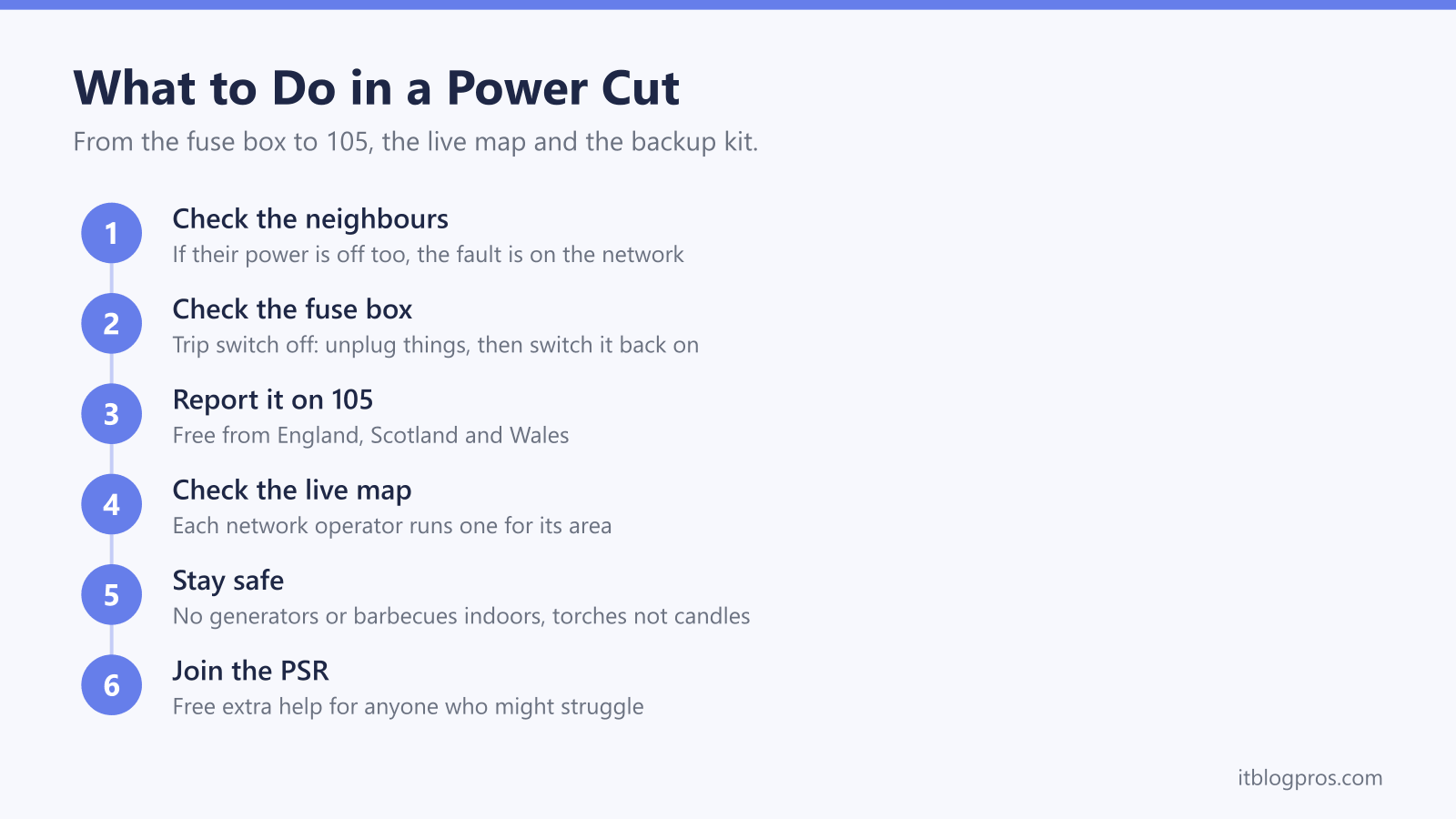
Check whether the neighbours have power and look at the fuse box first. If the fault is outside, report it on your network operator's website or call 105, which the Energy Networks Association says is free from England, Scotland and Wales and connects you to your local network operator, not your energy supplier. In Northern Ireland, call NIE Networks on 03457 643 643. Anyone who might struggle can join the free Priority Services Register.
Key Takeaways
- SSEN's three steps are check, reset and report: see whether the neighbours have power, reset the fuse box, then report the fault if the house is still without power.
- The Energy Networks Association says 105 is free from England, Scotland and Wales and connects callers to their local network operator, which fixes power cuts, rather than their energy supplier.
- UK Power Networks, SSEN, National Grid Electricity Distribution and the other operators each run a live power cut map, and PowerCut105.com finds the right operator from a postcode.
- Ofgem says the Priority Services Register brings priority support in an emergency and, wherever possible, advance notice of scheduled power cuts, and both your supplier and your network operator keep one.
- National Grid Electricity Distribution says never to use a portable generator or barbecue indoors, and Ofcom says digital landlines will not work in a power cut without a battery back-up.
Check the Neighbours and the Fuse Box First
A house with no power is not always a power cut. Scottish and Southern Electricity Networks (SSEN) sums up its advice in three steps: check, reset and report. Start at the window. SSEN says that if the neighbours have no power either, the fault is likely on its network, and National Grid Electricity Distribution suggests checking the street lights at night.
If everyone else has power, the fuse box comes next. National Grid Electricity Distribution says the trip switch is the biggest switch and is usually red, and if it is off, it advises unplugging or switching off everything on the sockets before turning it back on. SSEN describes a full reset: main switches off, then the smaller ones, then the main switches back on and the smaller ones one at a time. Electricity North West warns that trip switches found pointing down can mean a wiring problem or a faulty appliance, which may need a local electrician. Only when the fuse box checks out is it time to report a power cut.
Your Network Operator Fixes Power Cuts, Not Your Energy Supplier
Plenty of people ring the wrong company. The Energy Networks Association (ENA), which operates the technology behind 105, says customers often mistakenly call the electricity supplier they pay their bills to. Power cuts belong to the local network operator, the company that PowerCut105.com says maintains the cables, overhead wires and substations in your area. The ENA says 105 launched in 2016 and, called from England, Wales or Scotland, connects callers with their local network operator. SSEN says the call is free from a landline or a mobile. Ofgem notes one exception: if the supply is off because of a faulty meter, contact the energy supplier instead.
Online is often quicker. UK Power Networks says its website carries the same live information its call advisers give over the phone, and asks people to call if they are in danger or cannot use the online service. Northern Ireland is separate, with NIE Networks' helpline on 03457 643 643. For a damaged power line, the ENA says keep well away, call 105, and dial 999 if there is an immediate risk to life.
Every Network Operator Runs Its Own Live Power Cut Map
PowerCut105.com, which the ENA runs for the network operators, finds the right operator from a postcode. UK Power Networks covers London, East Anglia and South East England, with a live power cut map to search, track and report power cuts, plus text alerts. SSEN calls its map and app Power Track, and its pages split the area into the North of Scotland and central southern England. The app is free, SSEN says.
National Grid Electricity Distribution has a live power cut map with a postcode search, and its page covers the Midlands, the South West and South Wales, so despite the name it is one regional operator among several. Electricity North West, which its site also calls SP Electricity North West, lists live power cuts across the North West. Northern Powergrid's track or report page covers the North East, Yorkshire and northern Lincolnshire. SP Energy Networks' power cuts map covers central and southern Scotland, plus Cheshire, Merseyside, North Wales and North Shropshire. In Northern Ireland, NIE Networks' Powercheck map gives updates on power cuts by area.
The Priority Services Register Brings Extra Help
Ofgem says both your energy supplier and your network operator keep a Priority Services Register. Joining brings priority support in an emergency, advance notice of scheduled power cuts wherever possible, and a password scheme so anyone who calls or visits can prove they are genuine. Ofgem says you can ask to join if you have reached state pension age, are pregnant or have young children, struggle with speaking or reading English, or live with a disability or long-term medical condition, including needing medical equipment that requires a power supply. Recent changes count too, such as recovering from an injury, bereavement or losing a job.
PowerCut105.com calls the register free and says it covers England, Scotland and Wales. Names vary: Electricity North West calls its version the Extra Care register, and Northern Powergrid calls it Priority Services Membership. Ofgem says network operators must offer register customers extra help in power cuts, such as battery packs to charge phones or medical equipment, and SSEN says it is delivering Home Battery Packs to the Priority Services customers who need the most support.
Switch Off Appliances and Never Burn Fuel Indoors
A few habits prevent damage once the fault is reported. Electricity North West says to switch off appliances not designed to run unattended, such as cookers, grills, chip pans, hair straighteners and electric fires, and to leave one light on so you know when the power is back. National Grid Electricity Distribution adds that electrical surges during power cuts can damage phones, TVs and laptops, so it suggests turning them off or unplugging them.
Heat and light carry the real risks. National Grid Electricity Distribution says never to use a portable generator or barbecue indoors during a power cut, because anything burning gas, coal, oil, diesel, petrol or wood can release carbon monoxide, which it calls invisible and odourless. NIE Networks says to site any generator with plenty of airflow around it. A carbon monoxide alarm is the backstop, and the smoke alarm guide covers where one goes. Food advice differs: the ENA says a freezer keeps food for 24 to 48 hours depending on how full it is, while National Grid Electricity Distribution says up to 12 hours.
Broadband and Digital Landlines Go Down With the Power
PowerCut105.com reminds households that gas boilers and hobs, heat pumps, internet and phones will not work without power. The phone part catches people out after the move to digital landlines. Ofcom says digital landlines need mains electricity and will not work in a power cut unless there is a battery back-up, so a handset plugged into the router goes quiet along with the WiFi. The digital landline power cut guide explains Ofcom's free backup rules for people who depend on a landline, and the router battery backup guide covers keeping the router and fibre box running.
For most people, Ofcom says, a mobile is the practical alternative, and a 999 call connects through another network, if one is available, when yours has no signal. The ENA advises keeping a mobile fully charged, while Electricity North West suggests power saving mode and charging in the car. A power bank stretches that further. For local news, Electricity North West recommends a battery or wind-up radio, and the DAB radio guide covers battery sets.
Torches, Lanterns and Power Stations Keep the House Running
Light comes first on every operator's list. Electricity North West suggests a battery or wind-up torch or lantern instead of a candle, and National Grid Electricity Distribution says candles and paraffin lights can be dangerous. Ledlenser says its P5R torch runs on the rechargeable battery or a disposable one, at up to 750 lumens and 20 hours on low. Its ML4 lantern reaches 300 lumens, runs 45 hours on the lowest setting and takes AA batteries as backup, and the HF4R Signature head torch, at 600 lumens, keeps both hands free.
Portable power stations are large batteries with sockets, rated in watt-hours (Wh). Anker rates the SOLIX C1000 Gen 2 at 1,024Wh and 2,000W, with a 10 ms UPS switchover it says keeps CPAP machines and laptops running, though its UK page counts 10 ports in one place and 9 in another. Divide the Wh by a device's watts for a rough runtime, as the router UPS runtime guide shows. For powered medical equipment without backup, Electricity North West advises contacting the medical provider.
| Product | Best for | Key specs | Price | |
|---|---|---|---|---|
 | Anker SOLIX C1000 Gen 2 Portable Power Station Home backup | Running several essentials through a long power cut | 1,024Wh, 2,000W AC (3,000W peak), 10 ms UPS, 11.29kg | Check price → |
 | Ledlenser P5R Rechargeable Torch Torch | A pocket torch that also takes a disposable battery | 750lm, 280m beam, 20h on low, USB-C, IP68 | Check price → |
 | Ledlenser ML4 Rechargeable Lantern Lantern | Lighting a room without glare, with AA backup | 300lm, 45h on low, AA backup, IP66, 71g | Check price → |
 | Ledlenser HF4R Signature Rechargeable Head Torch Head torch | Hands-free light for the fuse box and the stairs | 600lm, 140m beam, 35h on low, magnetic charging, IP68 | Check price → |