
Rechargeable AA and AAA batteries save buying pack after pack of alkalines for the remote, the game controller and the kids' toys. Choosing them is less simple than it looks. Panasonic, Duracell and Energizer each sell cells with different capacities, recharge counts and storage claims, and chargers range from simple timers to units that watch every slot. This guide covers NiMH versus alkaline, mAh versus cycles, low self-discharge, smart chargers, the devices makers rule out, USB-C cells, 18650 safety and recycling.
For most UK homes, low self-discharge NiMH cells such as Panasonic's eneloop are the safe default: Panasonic rates them at 1.2V, up to 2,100 recharges on its older test and 70 per cent of charge kept after ten years in storage. Pick higher-capacity cells such as eneloop pro or Duracell's 2500 mAh AA for cameras and controllers, charge them in a smart charger, and keep smoke alarms on the battery their maker names.
Key Takeaways
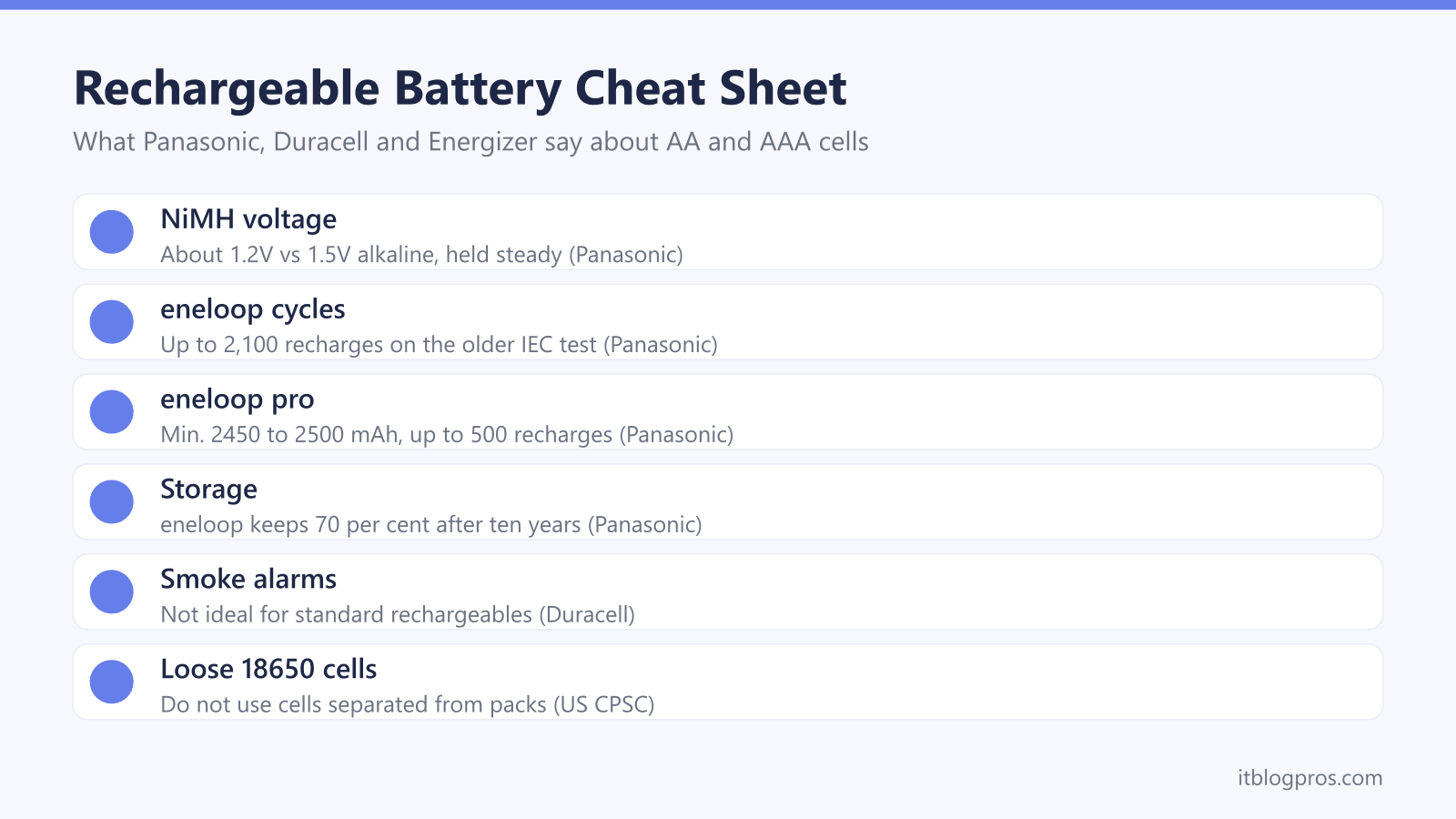
- Panasonic says eneloop starts at about 1.2V against roughly 1.5V for alkaline, but holds that voltage steadily, so most devices built for AA and AAA batteries run normally.
- Capacity costs cycles: Panasonic rates standard eneloop at up to 2,100 recharges and the higher-capacity eneloop pro at up to 500, both on an older IEC test.
- Low self-discharge cells arrive charged; Panasonic says eneloop keeps 70 per cent after ten years in storage, while Duracell says its base NiMH cells lose 1 to 2 per cent a day.
- A smart charger cuts power to each cell once it is full, and Panasonic warns that chargers without that feature can keep charging and shorten a battery's life.
- Duracell says smoke alarms are not ideal for standard rechargeables, and the US Consumer Product Safety Commission says not to use loose 18650 cells separated from battery packs.
NiMH Cells Run at 1.2V and Most Devices Cope Fine
Panasonic's eneloop FAQ gives the starting voltage of its cells as about 1.2V, against around 1.5V for an alkaline battery. That gap sounds bigger than it is. The same FAQ explains that an alkaline cell's voltage falls from the moment it is used, while eneloop holds close to 1.2V until it is nearly empty, and that most devices are designed to run anywhere between 0.9V and 1.5V.
Duracell's UK help pages say rechargeable round cells work in any device that takes an alkaline battery, unless the device maker says otherwise, and that they suit mid to high-drain kit such as cameras and game controllers best. Energizer's comparison chart points its NiMH range at cameras, controllers and wireless mice, which makes them a good match for the wireless keyboard and mouse on a desk.
A few gadgets do notice the difference. Panasonic says devices with a battery gauge may show less charge than the cells really hold, and Ansmann's product page says some devices have problems with the lower output voltage of NiMH.
Smoke Alarms and Sealed Torches Are the Exceptions
Duracell's UK FAQ says a smoke alarm is not an ideal device for standard rechargeable batteries, because they discharge over time and the alarm is an essential safety device. Use whatever battery the alarm's maker names, and test it as its instructions say.
Sealed torches are the other big one. Panasonic's eneloop FAQ says not to use its cells in anything with an airtight battery compartment, such as a waterproof torch, because an over-discharged NiMH cell releases hydrogen gas that cannot escape. Check the manual before fitting rechargeables to a waterproof head torch. Panasonic also rules out devices whose manuals say they are incompatible with NiMH, and battery compartments where the contacts do not touch the cell properly.
Mixing is the everyday mistake. Panasonic, Duracell and Energizer all say not to mix old and new cells, different brands or different types in one device. Panasonic goes further and suggests keeping each set of cells together for one device, charging them together and replacing them together.
Capacity Costs Recharge Cycles
Capacity, shown in mAh, is how long a cell runs on each charge. Panasonic's FAQ puts it simply: a 2000 mAh cell feeding a device that draws a steady 100 mA lasts roughly 20 hours, though real devices vary.
The catch is that more capacity usually means fewer recharges. Panasonic rates standard eneloop AA at up to 2000 mAh (minimum 1900) and up to 2,100 cycles, while eneloop pro AA has a minimum of 2450 to 2500 mAh depending on region and up to 500 cycles. Both cycle figures come from an older IEC 61951-2 test. Under the stricter 2017 version, Panasonic gives about 600 cycles for eneloop and 150 for eneloop pro, and it is good that it prints both.
Panasonic's FAQ says high-capacity cells suit high-drain kit such as cameras and camera flashes, while eneloop lite, at around 1000 mAh, is meant for clocks, mice and remotes. Duracell's 2500 mAh AA page promises recharges in the hundreds without a firmer number, and Energizer is similar, though its Power Plus AAA page says up to 500 times.
Low Self-Discharge Cells Arrive Charged and Stay Charged
Duracell's FAQ says standard rechargeable batteries discharge over time, which makes them a poor fit for gadgets that sit unused. Its base NiMH cells, it says, lose 1 to 2 per cent of their capacity a day in storage, while its StayCharged cells keep up to 75 per cent after a year. Duracell's 2500 mAh AA product page quotes up to 80 per cent after 12 months, so its own figures do not quite agree.
Low self-discharge cells fix that. Panasonic says eneloop is charged with solar energy at the factory and ready to use, and that it keeps 70 per cent of its capacity after ten years in storage, or 85 per cent after a year for eneloop pro. Even so, its FAQ recommends a top-up charge before first use, except in an emergency, because cells lose some charge in shipping and storage. Energizer says its Recharge cells come pre-charged and hold a charge for up to 12 months in storage.
That staying power is what makes a charged set worth keeping in a power cut kit.
A Smart Charger Stops Each Cell When It Is Full
Panasonic's FAQ describes Smart Charge as spotting when each cell is nearly full and cutting power to that slot, and warns that chargers without it can keep charging a full battery, over-charging it and shortening its life. Its chargers with Individual Charge Control take single cells in any slot, and Dry Battery Detection refuses alkalines put in by mistake.
GP's B631 USB charger lists -dV detection, a 14-hour safety timer and a light that flags bad or single-use batteries. Energizer's Pro Charger has overcharge protection and auto shut-off, though it charges cells in twos or fours rather than one at a time.
Duracell contradicts itself here. Its FAQ says its chargers switch to a trickle charge when done and should be unplugged, while its 4 hours charger page claims auto shut-off.
The brand matters. Electrical Safety First lists a recalled AA and AAA charger, sold on eBay, with a non-compliant plug and a counterfeit fuse. Panasonic recommends Panasonic chargers for eneloop, and Duracell says its chargers take other brands' NiMH cells but cannot vouch for them.
USB-C AA Cells and Loose 18650s Are Both Lithium-Ion
Ansmann's 1.5V AA cells are lithium-ion with a USB-C socket in each one. Ansmann's product page says they hold a steady 1.5V for over 95 per cent of their runtime, drop to 1.1V near empty as a warning, and charge only from the supplied four-way USB-C cable, so a laptop or power bank will do. It lists up to 1,500 recharges and a 2 A maximum draw, which rules out flash units.
The US Consumer Product Safety Commission says 18650 cells are made as industrial parts of battery packs, yet turn up loose in vapes, personal fans, head torches and toys. It warns that a loose cell shorted against keys or loose change in a pocket can overheat into thermal runaway, and its advice is plain: do not use loose 18650 cells separated from battery packs.
Electrical Safety First's vape advice agrees: buy from a reputable retailer rather than a third-party seller, use only replacement parts the maker approves, and keep cells away from coins and keys. If a torch takes an 18650, use the cell its maker names.
Five Picks From eneloop, Duracell and Energizer
Panasonic's standard eneloop in AA and AAA is the safe default for most homes: up to 2,100 recharges, a ten-year storage claim and cells that suit remotes, mice, toys and walkie-talkies that run on AA or AAA. eneloop pro AA trades cycles for capacity, which suits cameras and game controllers. Duracell's 2500 mAh AA covers the same high-drain jobs.
Energizer's Pro Charger kit includes four 2000 mAh AA cells. Its charger page calls them Universal cells, yet Energizer's own comparison chart lists Universal AA at 1300 mAh, so check the cells in the box. Energizer says the charger takes any AA or AAA NiMH cell, though Panasonic recommends its own chargers for eneloop.
When a set wears out, Panasonic suggests replacing cells once their runtime falls to about half. Recycle Your Electricals says never to put batteries in general rubbish because they create a fire hazard. Electrical Safety First says most large shops that sell batteries have collection bins, and that rechargeables are better taken to a council recycling centre.
| Product | Best for | Key specs | Price | |
|---|---|---|---|---|
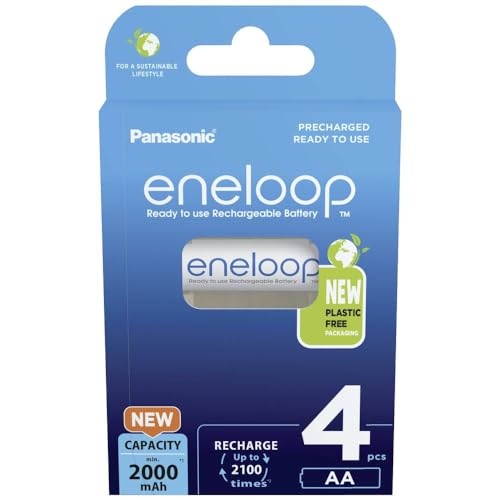 | Panasonic eneloop AA 2000 mAh (4 pack, BK-3MCDE/4BE) Our pick | Remotes, mice, toys and controllers in most homes | 1.2V NiMH, 2000 mAh (min. 1900), up to 2,100 cycles | Check price → |
 | Panasonic eneloop AAA 800 mAh (4 pack, BK-4MCDE/4BE) AAA pick | AAA remotes, keyboards, head torches and radios | 1.2V NiMH, 800 mAh (min. 750), up to 2,100 cycles | Check price → |
 | Panasonic eneloop pro AA 2500 mAh (4 pack, BK-3HCDE/4BE) High capacity | Cameras, flashes and other high-drain kit | 1.2V NiMH, min. 2450 to 2500 mAh, up to 500 cycles | Check price → |
 | Duracell Rechargeable AA 2500 mAh (4 pack) Duracell pick | Game controllers and other power-hungry gadgets | 2500 mAh NiMH; holds charge up to 12 months unused | Check price → |
 | Energizer Recharge Pro Charger with 4 AA 2000 mAh Charger kit | A first charger with four AA cells to start | Charges 2 or 4 AA/AAA in about 4 hrs; auto shut-off | Check price → |