
Walkie talkies earn their keep on campsites, building sites and ski slopes, and for calling children in from the far end of the garden, yet most boxes on the shelf look alike. The details that matter are in the small print: the PMR446 label that makes a set legal to use without a licence, a range figure that assumes open country, privacy codes that are not private, and the battery and water ratings. This guide works through each one using Ofcom's rules and the makers' own data sheets.
Buy radios marked PMR446. Ofcom lets anyone use them without a licence on 446.0 to 446.2 MHz, at up to 0.5 W ERP, from a handheld set with an integral antenna. Treat the range on the box as a best case, because makers tie it to open, unobstructed ground, and treat privacy codes as a filter for what you hear rather than protection for what you say.
Key Takeaways
- Ofcom's Business Radio Guidance says PMR446 radios need no licence on 446.0 to 446.2 MHz at up to 0.5 W ERP, used as handhelds with no base stations and no airborne use.
- Ofcom says operating equipment in the PMR446 band that does not meet the licence-exempt requirements may be an offence, and American FRS radios cannot be used licence-free in the UK.
- Motorola lists the same 500 mW transmit power for its Talkabout T42, T62 and T82 yet quotes up to 4 km, 8 km and 10 km, each subject to terrain and conditions.
- Privacy codes only filter what a radio plays: Motorola's T62 manual says its scan mode detects and displays any code another party is using.
- Business teams can stay licence-free on PMR446, while Ofcom's Simple UK Light licence covers handheld radios at up to 5 W ERP on 19 business frequencies.
PMR446 Is the UK's Licence-Free Walkie Talkie Band
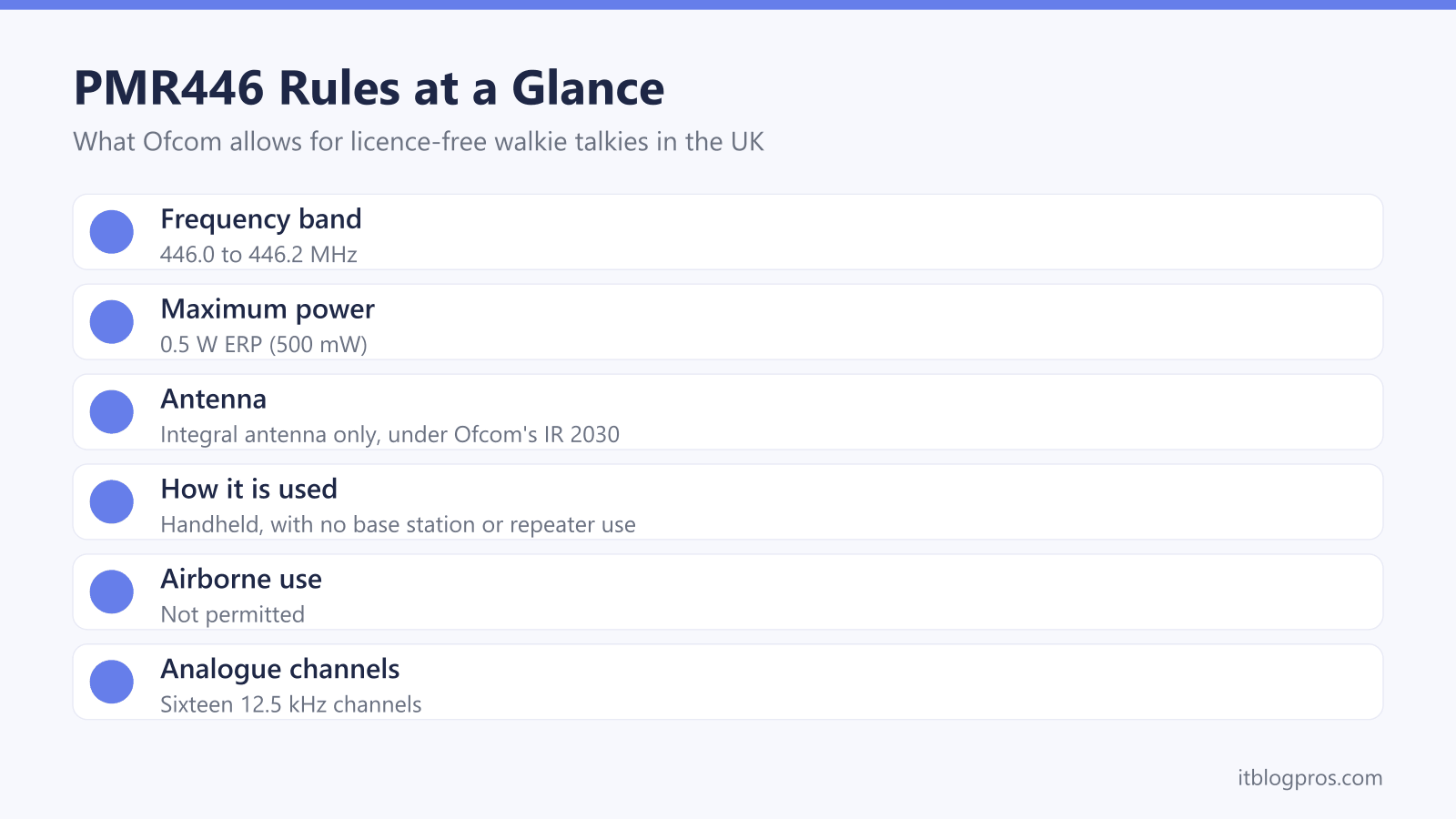
PMR446 is the label to look for. Ofcom's Business Radio Guidance describes PMR446 radios as low-power handheld walkie talkies operating between 446.0 and 446.2 MHz, used by professional and non-professional users alike, and says a licence from Ofcom is not required to use these frequencies. The conditions are short: a maximum of 0.5 W ERP (500 mW), mobile use only with no base stations, no airborne use, and operation on a non-interference and non-protected basis.
Ofcom's interface requirement for licence-exempt devices, IR 2030, adds that PMR446 equipment is hand portable with no base station or repeater use, and uses integral antennas only. In practice the aerial stays fixed to the radio. Ofcom's PMR446 information sheet gives analogue sets sixteen 12.5 kHz channels spread across the band.
The rules travel well, too. Ofcom says analogue PMR446 is harmonised throughout Europe, so a compliant set bought in the UK can be used licence-free in any European country, while digital PMR446 is not harmonised in the same way.
Radios Outside the PMR446 Rules Usually Need a Licence
Outside those conditions, different rules apply. Ofcom's page on the rules for using radio equipment says it is illegal to establish, install or use radio equipment except under an Ofcom licence or a licence exemption, and that the maximum punishment on conviction is imprisonment and an unlimited fine.
Ofcom's PMR446 information sheet lists the usual traps. American Family Radio Service (FRS) radios cannot be used in the UK on a licence-exempt basis. A radio approved for licensed use is not necessarily suitable for PMR446, because its channels may be too wide, sit outside the licence-free spectrum or put out more than 0.5 W ERP. Fitting an antenna connector must not push a radio past the limits, and Ofcom warns that operating equipment in 446.0 to 446.2 MHz that does not meet the PMR446 requirements may be an offence.
Handsets for the amateur bands are a separate case. Ofcom's amateur radio guidance says operating as a radio amateur needs an Ofcom licence, and that applicants must first pass an exam run by the Radio Society of Great Britain.
Range Figures Are Best Cases in Open Country
Every PMR446 radio works under the same 0.5 W ERP ceiling, so the range on the box says as much about how it was measured as about the radio. Motorola's data sheets list a 500 mW transmit power for the Talkabout T42, T62 and T82, yet quote up to 4 km, 8 km and 10 km respectively, each footnoted as subject to terrain and conditions. Retevis's page for its rugged RB648 gives a PMR communication distance of 2 km.
Midland explains the conditions behind such numbers. Its XT10 manual says maximum range is obtained in open space, that trees, buildings and other obstructions are the limiting factors, and that use inside a car or a metal structure reduces it. The quoted 4 km applies without obstructions and in sight, as in mountains.
Ofcom's own description is more modest. Its licence-exempt devices page calls PMR446 a short-range service, ideal for communication over short distances such as within office buildings, factories and building sites.
Privacy Codes Filter Calls but Do Not Make Them Private
Channels and codes multiply the numbers on the box. Motorola's T62 data sheet lists 16 channels plus 121 privacy codes, and its manual breaks those into 38 CTCSS and 83 DCS codes. Midland's XT10 manual describes CTCSS codes as sub-audio tones added to a channel. Motorola says the codes help minimise interference by blocking transmissions from unknown sources.
Blocking is all they do. The same Motorola manual describes a scan mode that stops on activity with any code, or no code, displays the code the other party is using and lets the user reply. Midland's XT10 manual calls a channel with a CTCSS tone a new private channel, yet it explains that such a channel reaches any radio set to the same channel and sub-tone, so anyone matching those settings is on it too.
The band is shared by design. Ofcom's Business Radio Guidance says PMR446 runs on a non-protected basis, and if someone else is on your channel, the answer is to move to another one. Motorola's T42 data sheet lists 16 channels and does not mention privacy codes.
Rechargeable Packs and AA Batteries Suit Different Users
Power comes in two styles. Motorola's Talkabout T42 takes three AAA alkaline batteries per radio, not included, and Motorola puts typical life at about 18 hours. The Talkabout T82 ships with NiMH packs and a mains charger with micro USB plugs, rates the included 800 mAh pack at up to 18 hours, and is also compatible with standard AA-size batteries.
The two work radios here use lithium-ion packs. Retevis gives its RB648 a 2000 mAh lithium-ion battery good for about 12 hours of continuous use and 48 hours on standby, charged over USB-C, and Motorola rates its XT185 at up to 24 hours. Motorola's figures rest on a 5/5/90 duty cycle, and its XT185 data sheet notes that actual runtime may vary.
Battery sets have a practical bonus. Because PMR446 radios talk handset to handset, with no base stations under Ofcom's rules, a pair with spare cells belongs in a power cut kit, and NiMH AAs from the rechargeable batteries guide cut the waste.
IP Ratings Show How Much Water a Radio Can Take
Check the IP rating before a radio goes out in the rain. The IEC, which sets out the IP code in its IEC 60529 standard, says the first numeral rates protection against solid objects on a scale from 0 to 6, where 6 means no ingress of dust, and the second rates protection against liquids from 0 to 9. The IEC also notes that marketing terms such as waterproof are hard to assess, so the digits are the better guide.
Retevis rates its RB648 at IP67, which it describes as fully dust-tight and able to survive 30 minutes submerged in 1 metre of water, and adds 2-metre drop protection. Motorola is less consistent about its XT185 business radio: the product page calls its IP54 rating weatherproof, while the data sheet calls the same IP54 waterproof and dust-tight. On the IEC's scale, that 5 sits a step below the 6 that means no dust gets in.
Motorola rates its Talkabout T82 at IPX2, which it calls splash proof, and its T42 data sheet lists no IP rating.
Kids' Sets and Business Radios Are Built for Different Users
Kids' walkie talkies come with the maker's age guidance, and it pays to read it closely. Amazon listings for Retevis's RT628 do not agree, giving ages 4 to 12 on one and 6 to 12 on another. The listing from Retevis's own store points to a keypad lock that stops children changing channel mid-game and to VOX, which lets them talk without pressing a button, and each radio needs three AA batteries, not included.
Business radios sit at the other end. Motorola says its XT185 was developed for business and commercial users, across the warehouse, shop floor or school playground, and it is still a licence-free PMR446 radio. Hytera describes its PMR446 range as a simple, cost-effective solution for users with local or infrequent needs. Teams that need more power can apply for Ofcom's Simple UK Light licence, which covers handheld or mobile radios anywhere in the UK on 19 frequencies at up to 5 W ERP, with no base stations. Ofcom's amateur radio guidance adds that an amateur licence does not authorise business use.
| Product | Best for | Key specs | Price | |
|---|---|---|---|---|
 | Motorola Talkabout T82 Twin Pack and Charger Our pick | Hiking and camping, with USB charging and a torch | 121 codes, up to 10 km, IPX2, NiMH or AA | Check price → |
 | Motorola Talkabout T42 Twin Pack, Red Budget | Simple family use around the home and garden | 16 channels, up to 4 km, 3 x AAA per radio | Check price → |
 | Retevis RB648 Walkie Talkies, 2 Pack, Yellow Waterproof | Wet, dusty work and outdoor jobs | IP67, 2000 mAh Li-ion, USB-C, 2 m drop protection | Check price → |
 | Retevis RT628 Kids' Walkie Talkies, Pair Kids | Children's games, with a keypad lock | PMR446, VOX, keypad lock, 3 x AA per radio | Check price → |