A power bank is a pocket battery that recharges a phone, tablet or laptop away from a socket. Choosing one comes down to four things: how much energy it really holds, how fast it can push that energy out over USB-C, whether it can run a laptop, and whether an airline will let it on board. This guide takes each in turn, with the makers' own figures and the UK Civil Aviation Authority's rules, then matches four power banks to the jobs they suit.
Compare power banks by watt-hours, not just mAh: multiply the mAh by the cell voltage the maker states and divide by 1,000. For a laptop, choose USB-C Power Delivery at the laptop charger's wattage. For flying, the Civil Aviation Authority allows two power banks per person in hand luggage only, up to 100Wh without airline approval, and none may be recharged on board.
Key Takeaways
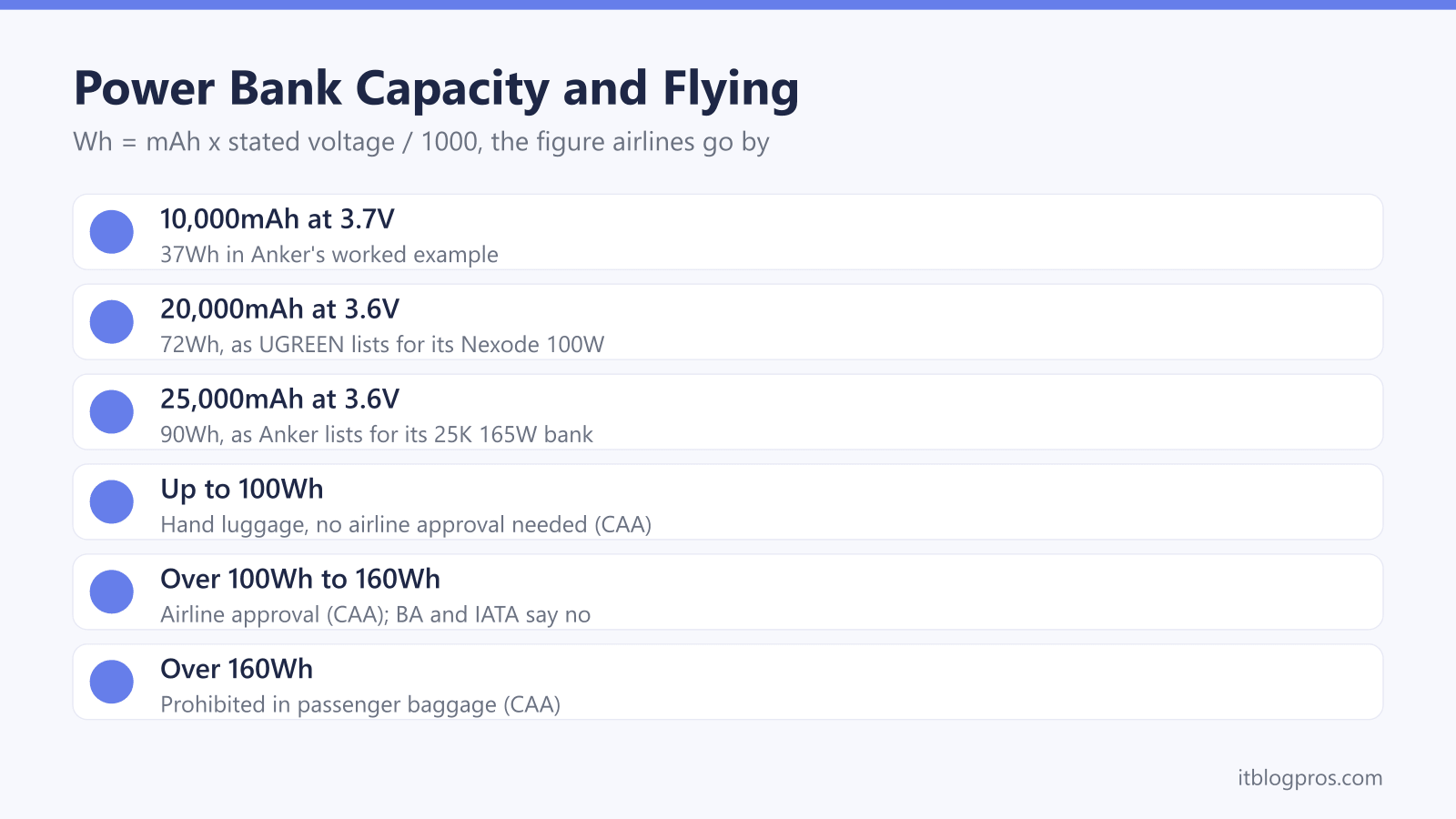
- The CAA's packing guide converts capacity with (V x mAh) / 1000 = Wh, and UGREEN's figures for its Nexode 100W bank, 20,000mAh at 3.6V, give the 72Wh it lists.
- Anker says power banks lose energy converting cell voltage to USB output, and puts the usable output of its 90Wh 25K bank at about 63 to 70Wh.
- The USB Implementers Forum says USB Power Delivery reached 100W at 20V over 5A cables, so a laptop bank needs one USB-C port rated at the laptop charger's wattage.
- Since 27 March 2026 the CAA has limited passengers to two power banks in carry-on bags, with no recharging on board and airline approval needed above 100Wh up to 160Wh.
- British Airways caps power banks at 100Wh and IATA's 2026 passenger guidance lists 100Wh to 160Wh power banks as forbidden, so 100Wh is the practical ceiling for travel.
Watt-Hours Measure a Power Bank Better Than mAh
The big number on the box, 10,000mAh or 20,000mAh, counts charge at the battery cells' own voltage rather than the energy stored. Anker's support articles on rated capacity say most lithium-ion power banks use cells with a nominal voltage of 3.7V and that watt-hours are the true measure of energy. Anker's worked example puts a 10,000mAh bank at 37Wh.
The UK Civil Aviation Authority prints the same sum in its packing guide: multiply the voltage by the mAh and divide by 1,000. Use the voltage the maker states, because it varies. UGREEN lists its Nexode 100W bank as 20,000mAh at 3.6V, or 72Wh, and Anker lists its 25K 165W bank as 25,000mAh at 3.6V, or 90Wh.
Some spec pages leave the sum to the buyer. INIU's page for its 25,000mAh P63-E1 gives no watt-hour figure, and UGREEN's UK page for its 45W 20,000mAh bank lists 7.4 volts without one. IATA's passenger guidance says lithium-ion batteries must carry the rating on the case, and that airline staff may refuse a battery whose rating they cannot verify.
Less Charge Reaches the Phone Than the Label Says
Some of that energy never reaches the phone. Anker's support article explains that a power bank has to convert its 3.7V cell voltage up to 5V or more to charge a device, and that the conversion circuit loses energy on the way. Its worked example starts with a 20,000mAh bank holding 74Wh and ends at roughly 12,140mAh delivered at 5V.
Anker also puts figures on individual models. Its UK page for the 25K 165W bank says a full charge typically delivers about 13,750 to 17,500mAh, and its US page gives the usable output as about 63 to 70Wh of the 90Wh rating, depending on the device, cable and charging protocol. For the MagGo 10K, Anker's page says about 5,500 to 6,500mAh of usable power.
UGREEN's and INIU's product pages do not publish a delivered figure, so for their models the label is the only number on offer. Either way, the practical lesson is the same: choose a bank with plenty of headroom above the battery it has to refill.
USB-C Power Delivery Sets the Charging Speed
USB Power Delivery, or USB PD, is the standard that lets a charger and a device agree on how much power flows. The USB Implementers Forum, which looks after USB, says Power Delivery was limited to 100W at 20V over USB-C cables rated at 5A, and that newer 28V, 36V and 48V levels allow 140W, 180W and 240W. It also says power direction is no longer fixed, which lets one USB-C port refill a bank and charge a phone.
Phones need less, and the small print matters. UGREEN says its 45W 20,000mAh bank supports up to 45W PD and PPS charging for most Android phones, but holds phones using non-standard protocols to a maximum of 22.5W.
Check the combined figure as well. UGREEN's page for that model says the total drops to 15W when two or three ports are in use, while Anker says its 25K bank gives up to 165W across two devices and 130W across three or four. Earbuds, a watch or a Bluetooth speaker top up from the same USB-C port.
A Laptop Power Bank Needs One Port at the Charger's Wattage
Laptops are the demanding case. The laptop's USB-C port has to accept charging, which not every port does, and the bank needs one USB-C port that matches the wattage of the laptop's own charger. The replacement laptop charger guide explains how to read that from the adapter's label.
Read the per-port figures rather than the headline. UGREEN's Nexode 100W bank gives 100W from its first USB-C port but 30W from the second, while Anker rates every USB-C cable and port on its 25K 165W bank at up to 100W. At 100W, the USB-IF's note about 5A cables applies to the cable too.
Pass-through charging, where the bank powers a device while it recharges itself, comes with conditions. Anker says its 25K bank needs a charger of at least 20W, with input power greater than output, and may hold off recharging while hot after high-power use. UGREEN says its Nexode 100W refills in 1.6 hours from a 65W input while powering devices through pass-through. For a power cut at home, the router battery backup guide covers keeping broadband running.
The CAA Allows Two Power Banks, in Hand Luggage Only
The UK Civil Aviation Authority tightened the rules from 27 March 2026. Its guidance says power banks must be carried in carry-on baggage, individually protected when not in use and never recharged on board, and should not be used to charge other devices on board. Each person may carry no more than two.
Size decides the rest. The CAA says power banks up to 100Wh need no approval from the airline, those above 100Wh up to 160Wh need the airline's approval, and anything over 160Wh is prohibited in passenger baggage. For protection, IATA suggests keeping power banks in their original packaging or taping over the terminals.
The reason is fire. The CAA said in July 2026 that its figures show reports of overheating or malfunctioning passenger devices nearly doubled between 2024 and 2025. Its packing guide says passengers may be asked to keep power banks in the seat back pocket rather than an overhead locker, and that a device getting hot should be switched off, taken off charge and reported to the cabin crew immediately.
British Airways and IATA Stop at 100Wh
Airlines can be stricter than the regulator, and the band between 100Wh and 160Wh is where they part company. British Airways' restricted items page allows up to two power banks per person, none above 100Wh, each displaying its capacity rating and stored in the seat pocket or in a bag under the seat in front. BA also says seat power is for charging devices, not power banks.
Jet2's dangerous goods page goes the other way, giving automatic approval for power banks above 100Wh up to 160Wh, while saying they must not be charged on board or used to charge or power any device.
IATA, the airline trade body, sides with BA. Its 2026 passenger guidance limits passengers to two lithium-ion power banks of no more than 100Wh, lists power banks between 100Wh and 160Wh as forbidden, and says power banks should not go in overhead lockers. IATA's summary of its 2027 regulations says power banks over 100Wh are forbidden for passengers and crew. A bank at or below 100Wh avoids the question on any airline.
Four Power Banks From Known Brands Cover Most Needs
Safety starts with where the bank comes from. Electrical Safety First, the UK electrical safety charity, advises buying from a reputable retailer rather than a third-party seller online, registering the product so the maker can reach you about a recall, not charging it overnight or while out, and unplugging it at once if it swells, sparks, smokes or smells odd. A brand name is no guarantee on its own: the Office for Product Safety and Standards recalled ESR HaloLock wireless power banks sold in the UK between October 2023 and August 2024 for a fire risk, and Anker's recall page lists a global voluntary recall of five models, none of which is in the table below.
The table covers the usual jobs. UGREEN's Nexode 100W is the all-rounder, with 72Wh and a 100W USB-C port. Anker's 10,000mAh 30W bank is the budget pocket choice. Anker's 25K 165W suits laptops at 90Wh, and the Anker MagGo 10K clips on to a MagSafe iPhone with 15W Qi2 wireless charging.
| Product | Best for | Key specs | Price | |
|---|---|---|---|---|
 | UGREEN Nexode Power Bank 20000mAh 100W Our pick | Phones, tablets and USB-C laptops up to 100W | 20,000mAh, 72Wh, 100W USB-C, 65W input, 420g | Check price → |
 | Anker Power Bank 10,000mAh 30W (A1688) Budget | Topping up a phone through the day | 10,000mAh, 30W USB-C output, USB-A port, 20W input | Check price → |
 | Anker Power Bank 25K 165W (A1695) For laptops | Charging a laptop and a phone at the same time | 25,000mAh, 90Wh, 100W per USB-C, 165W total, 595g | Check price → |
 | Anker MagGo Power Bank 10K (A1664) MagSafe-style | MagSafe iPhones, charging without a cable | 10,000mAh, Qi2 15W wireless, 30W USB-C, 14.7mm thick | Check price → |