
Apple's support pages say iPhone models no longer include a power adapter in the box, and Google's Pixel specs list adaptors as sold separately, so the plug is now a separate buy. The phone makers' own pages say what to get. Apple, Samsung and Google each name the wattage and charging standard behind their fastest speeds, and they differ more than the plugs on sale suggest. This guide covers what each family needs, USB PD versus PPS, multi-port chargers, cables and fakes.
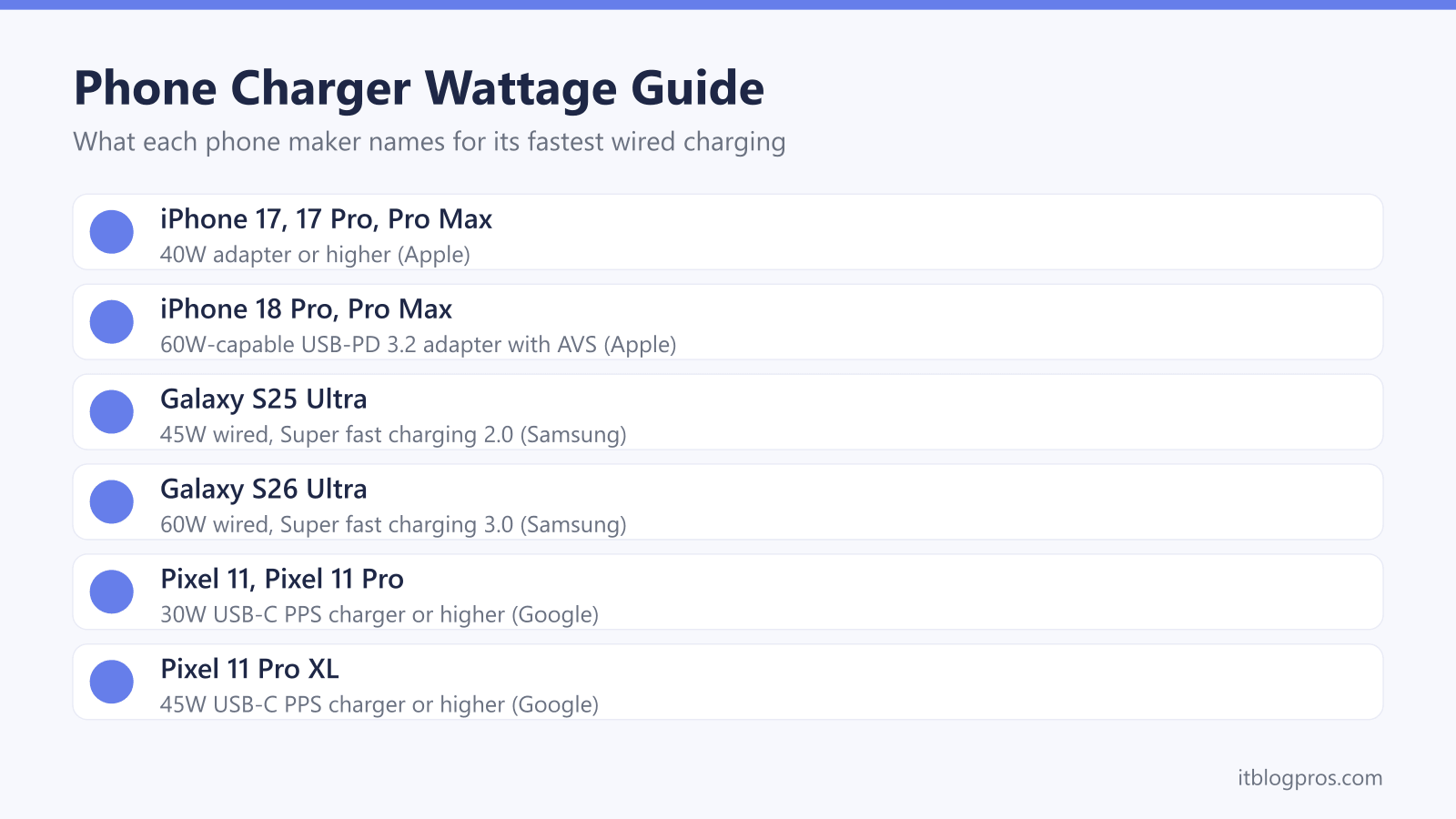
Buy a USB-C charger that meets the wattage and standard your phone maker names. Apple asks for USB Power Delivery: 18W or more for the iPhone 15 and 16, 40W for the iPhone 17 and a 60W-capable adapter for the iPhone 18 Pro. Samsung's Super fast charging needs PPS, and Google names 30W or 45W PPS chargers for Pixel. A bigger charger is safe, as the phone takes only what it needs.
Key Takeaways
- Apple's fast charging page says iPhone 17 models reach 50 per cent in around 20 minutes with a 40W adapter or higher, while iPhone 15 and 16 need an 18W or greater USB-C PD adapter.
- Samsung's support page says Super fast charging needs a charger with USB PD PPS, and that a high maximum output alone may not be enough to get it.
- Google's Pixel specs name a 30W USB-C PPS charger for the Pixel 11 and 11 Pro and a 45W one for the Pixel 11 Pro XL.
- Electrical Safety First says fast chargers negotiate higher voltages through a digital handshake and fall back to 5V, so a bigger charger does not force extra power into a phone.
- Electrical Safety First found 107 of 116 counterfeit and lookalike Apple 20W adapters failed a critical shock safety test, so buy from the maker or a reputable retailer.
Apple Names a Different Wattage for Each iPhone Generation
Apple's fast charging page says an iPhone 15 or later fast charges with an Apple 18W or greater USB-C Power Adapter, or a comparable third-party adapter that supports USB-PD, the USB Power Delivery standard. Its 20W adapter, Apple's product page says, takes iPhone 8 or later to 50 per cent in around 35 minutes.
Newer models want more. The iPhone 17, 17 Pro and 17 Pro Max reach 50 per cent in around 20 minutes with a 40W adapter or higher, Apple says, while the iPhone 17e and iPhone Air need only 20W for 50 per cent in around 30 minutes. For the iPhone 18 Pro and Pro Max, Apple quotes 50 per cent in around 15 minutes with its 40W Dynamic Power Adapter with 60W Max, or a third-party 60W-capable adapter with Adjustable Voltage Supply (AVS) that supports USB-PD 3.2.
Apple's testing notes for the iPhone 18 Pro say USB PD 3.1 or better, so the page contradicts itself slightly. Fast charging may also fail in a phone that is too hot or too cold.
Samsung Super Fast Charging Needs PPS, Not Just Watts
Samsung's UK support page says that to use Super fast charging, buyers should check not only the charger's power output but also whether it supports USB PD PPS, the Programmable Power Supply mode. A charger with a high maximum output may still miss Super fast charging if it lacks PPS.
The same page lists three tiers of official charger: 25W for Super fast charging, 45W for Super fast charging 2.0 and 60W for Super fast charging 3.0. Samsung's comparison of the Galaxy S26 and S25 series lists wired charging at 60W for the S26 Ultra and 45W for the S25 Ultra, and the S26 Ultra's own page claims up to 75 per cent in around 30 minutes.
Samsung's 45W adapter page lists the Galaxy S22+, S22 Ultra, S23+, S23 Ultra, S24+ and S24 Ultra for Super Fast Charging 2.0. A wider group, including the Z Flip3 and later and the A15 and later, sits under Super Fast Charging, the tier its support page pairs with the 25W charger.
Pixel Phones Charge Fastest From a 30W or 45W PPS Charger
Google's Pixel tech specs name a PPS charger for every current model. The Pixel 11 and Pixel 11 Pro reach up to 55 per cent in about 30 minutes with a 30W USB-C PPS charger or higher, and the Pixel 11 Pro XL reaches up to 75 per cent in about 30 minutes with a 45W one. The Pixel 10 and 10 Pro carry the same 30W figure, and the Pixel 10 Pro XL the 45W one.
Google's help page on charging lists what works with a Pixel: a Google 30W, 45W or 67W USB-C charger, any PPS adaptor rated for 30W or more, or another USB Power Delivery adaptor rated for 15W or more. It warns that other cables and adaptors might not work with Pixel phones, and that a USB-A to USB-C cable on a USB-A adaptor charges more slowly than USB-C at both ends.
Google's footnotes also say the wired rates are based on the Google 45W USB-C Charger in a wall socket, and that actual results may be slower.
A Bigger Charger Is Safe Because the Phone Sets the Pace
A 65W charger will not overload a phone rated for 25W. The USB Implementers Forum, the body behind the USB standards, says USB Power Delivery lets devices negotiate for only the power they require. Electrical Safety First, the UK electrical safety charity, explains that USB chargers start at 5V and fast chargers negotiate higher voltages through a digital handshake, falling back to 5V if that fails.
PPS builds on the same standard. The USB-IF's announcement of its Certified USB Fast Charger logo says those chargers support the Programmable Power Supply feature of USB Power Delivery 3.0, that phone and charger both need PPS for the full benefit, and that the chargers stay backwards compatible with ordinary USB Power Delivery devices. Samsung's 45W adapter page says PPS adjusts voltage and current in real time based on the device's charging status.
Apple's USB-C support page says a higher-wattage adapter, such as the one that came with a Mac laptop, can be used with an iPhone for faster charging. The replacement laptop charger guide covers the laptop side.
Multi-Port Chargers Share Their Watts Between Ports
A multi-port charger's headline figure is the total, not what each port gives once a second device joins. Belkin's support page for its BoostCharge Pro 65W dual charger says a single port gives up to 65W, while with both in use the top port gives up to 45W and the bottom port up to 20W.
Samsung's own multi-port chargers are stricter. Its support page says the 50W dual-port and 65W trio-port models give Super fast charging 2.0 only from port 1, and not at all when two or more ports are connected. So a Galaxy S25 Ultra sharing one with a second phone loses its fastest mode.
Many compact chargers are sold as GaN, short for gallium nitride. Anker's UK guide says GaN chargers use it instead of traditional silicon to deliver higher power in a smaller, more efficient package with less heat, and UGREEN's page for its Nexode 30W says the GaN chip enables cooler, more energy-efficient charging. A USB-C hub on the same charger keeps some watts back, as the USB-C hub guide explains.
The Cable Has to Be Rated for the Power
Samsung's support page says a cable below the required specification can stop the charger delivering its maximum, and that some third-party cables with higher electrical resistance can make charging stop intermittently. Samsung bases Super fast charging 2.0 on a 5A cable, though it says the Galaxy S25 and later get it with the 3A cable in the box. Anker's page for its Nano 45W agrees: S22 to S24 Plus and Ultra models need a 5A cable.
The USB-IF says certified USB-C to USB-C cables must be labelled 60W or 240W, and gives a cable supporting 20V at 3A as a 60W example. Apple's notes for the iPhone 18 Pro times specify a 60W-capable USB-C cable.
Away from a socket, the power bank guide covers the portable option. The CAA allows two power banks per person, in carry-on bags only, never recharged on board.
Five Genuine Chargers From Known Brands Cover Most Phones
Fakes are the bigger risk. Electrical Safety First tested 116 counterfeit and lookalike Apple 20W adapters and found 107 failed a critical safety test against electric shock, some with metal weights inside to feel genuine. The Intellectual Property Office's GOV.UK guidance names phone chargers among the most commonly counterfeited electrical goods, and the Office for Product Safety and Standards advises checking for UKCA or CE markings and the seller's UK contact details.
Apple's 20W adapter suits an iPhone 15 or 16, and its 40W Dynamic adapter covers the iPhone 17 and 18 Pro. Anker lists PPS at up to 5A and Samsung Super Fast Charging for its Nano 45W, which includes a cable and meets Google's 45W figure for Pixel Pro XL models. Anker's Nano 30W, a 30W PPS charger, fits Google's advice for the Pixel 10 and 11. Belkin's 65W dual charger runs two devices, though its USB-C PD 3.0 falls short of what Apple names for the iPhone 18 Pro's top speed. Samsung's support page lists only its own 60W charger for Super fast charging 3.0.
| Product | Best for | Key specs | Price | |
|---|---|---|---|---|
 | Apple 20W USB-C Power Adapter Everyday iPhone | iPhone 15 and 16, iPhone 17e and iPhone Air | 20W, one USB-C port; charging cable sold separately | Check price → |
 | Apple 40W Dynamic Power Adapter with 60W Max Newest iPhones | Fastest wired charging on iPhone 17 and iPhone 18 Pro | Up to 60W dynamic output, AVS; cable sold separately | Check price → |
 | Anker Nano Charger (45W) with USB-C Cable (A2692) For Galaxy | Galaxy Super Fast Charging and Pixel Pro XL models | 45W max; PPS 5V to 11V at 5A; USB-C cable included | Check price → |
 | Anker Nano USB-C Wall Charger 30W (A2337) Budget | Pixel 10 and 11, and iPhone 15 or later | 30W max with PPS; foldable plug; 49 x 49 x 32 mm | Check price → |
 | Belkin BoostCharge Pro 65W Dual USB-C GaN Charger Two devices | Two phones, or a phone and a tablet, from one socket | 65W from one port; 45W + 20W with both ports in use | Check price → |