A wireless charger looks simple, but the speed it delivers depends on three things: the phone, the charging standard and the plug behind the charger. Apple, Samsung and Google each publish the wireless rates their phones reach and the adapter each of their chargers needs, and the figures run from 7.5W to 25W. This guide covers Qi, Qi2 and the faster Qi2 25W tier, what MagSafe adds, what cases, metal and heat do, and how 3-in-1 stands handle a watch.
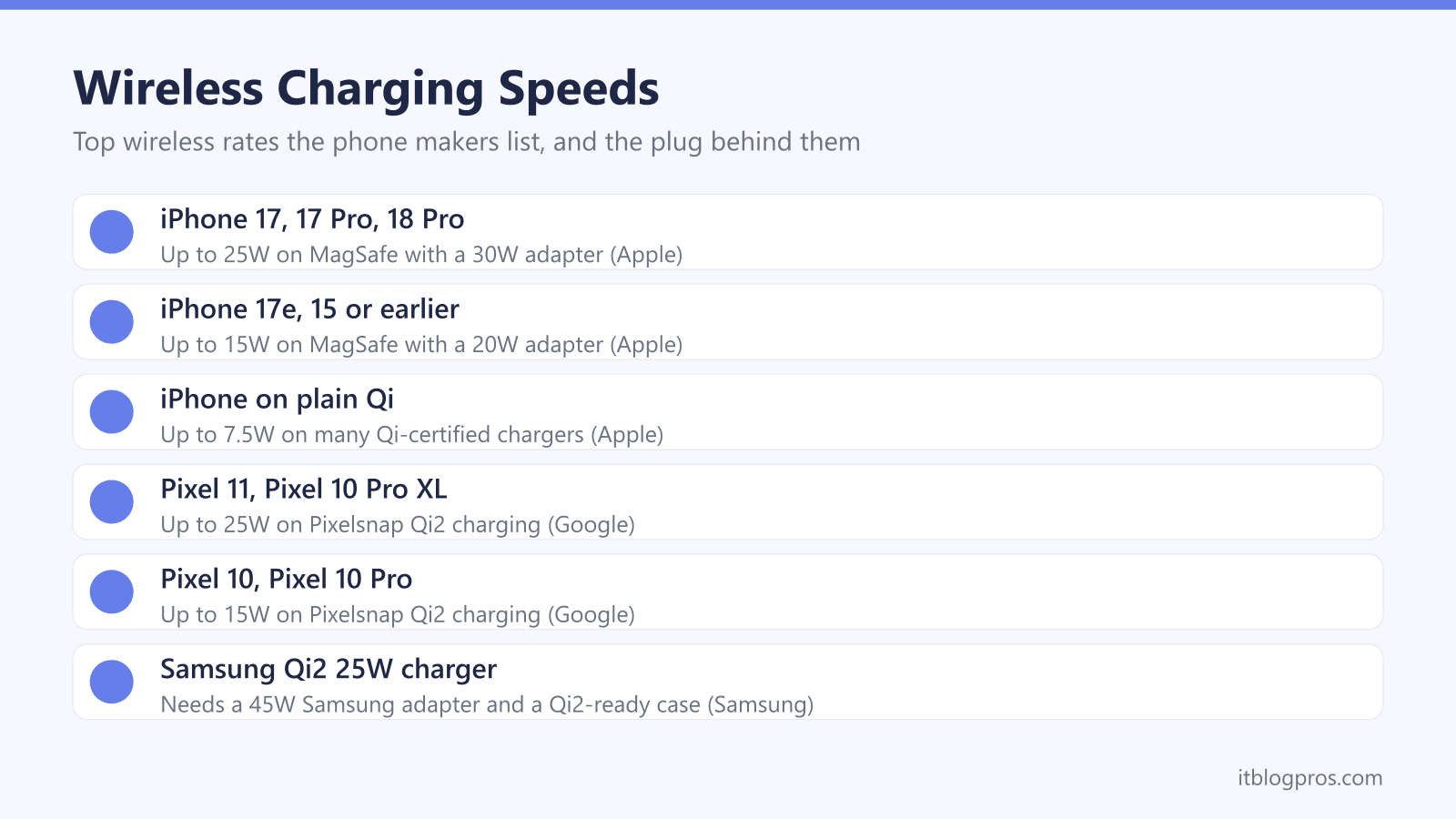
Match the charger to the phone, then the plug to the charger. Apple's iPhone 17, 17 Pro and 18 Pro models reach 25W on MagSafe with a 30W adapter, Google's Pixel 11 series reaches 25W on Pixelsnap, and Samsung's Qi2 25W charger needs a 45W Samsung adapter and a Qi2-ready case on Galaxy phones. Plain Qi pads still work, but Apple says many top out at 7.5W on iPhone.
Key Takeaways
- The Wireless Power Consortium says Qi2 adds magnetic alignment and 15W charging, and that Qi2 25W delivers nearly 70 per cent more power than Qi2.
- Apple's MagSafe support page lists up to 25W for the iPhone 17, 17 Pro and 18 Pro models with a 30W adapter, and up to 15W for the iPhone 17e and iPhone 15 or earlier with a 20W one.
- Samsung says its Qi2 25W Magnet Wireless Charger needs an official Samsung 45W adapter for full speed, and that Galaxy phones need a Qi2-ready case for the magnets.
- Google lists Pixelsnap charging at up to 25W on the Pixel 11 series and Pixel 10 Pro XL, and says the older Pixel Stand does not work on the Pixel 10 series.
- Apple Watch charges on its own magnetic charger even on a 3-in-1 stand, and Apple's MagSafe Charger and Google's Pixelsnap Charger both come without a plug.
Qi2 Adds Magnets and More Power to the Qi Standard
Qi is the open wireless charging standard run by the Wireless Power Consortium (WPC). The consortium says it launched in 2010 and covers over 13,000 certified products, and Apple's own help page describes Qi as an open, universal standard created by the WPC.
Qi2 is the newer generation. According to the WPC, Qi2 brought 15W charging and a magnetic attachment that lines the phone up with the charger, and its consumer site says that magnetic technology grew out of Apple's MagSafe. Qi2 25W, launched in July 2025 and known technically as Qi v2.2.1, is the faster tier. The WPC says it delivers nearly 70 per cent more power than Qi2 and has charged a phone from empty to 50 per cent in about 30 minutes, though it notes results vary.
Two labels matter when shopping. The WPC says a Qi2 Ready phone supports the standard but needs a matching magnetic case for the snap-on fit, and that full Qi2 speeds need devices of similar generations. Only certified products may carry the Qi or Qi2 logo.
Apple Ties iPhone Wireless Speeds to the Model and the Plug
Apple's MagSafe Charger support page splits iPhones into groups. The iPhone 18 Pro and Pro Max, iPhone 17, 17 Pro and Pro Max, iPhone 16 Plus and 16 Pro Max reach up to 25W on the current MagSafe Charger with an adapter of 30W or more, rated at 15V/2A or higher. The iPhone Air peaks at 20W. The iPhone 17e and iPhone 15 or earlier get up to 15W from a USB-C adapter of 20W or more.
That page says the iPhone 16 and 16 Pro peak at 22.5W, yet Apple's iPhone 16 tech specs list MagSafe and Qi2 wireless charging up to 25W, so Apple contradicts itself. Its iPhone 17 specs list MagSafe and Qi2 charging up to 25W alike, so a certified Qi2 25W charger is a fair alternative.
Plain Qi is slower. Apple's wireless charging page says many Qi-certified chargers charge an iPhone at up to 7.5 watts. Apple's MagSafe Charger page says it is certified for Qi2 25W and Qi, so it also charges an iPhone 8 or later and AirPods with a wireless charging case.
Galaxy Phones Need the Right Plug and Often a Magnet Case
Samsung's support page on fast charging says Fast wireless charging is switched on under Settings, Battery, Charging settings. It adds that charging may slow as heat builds, that chargers with cooling fans can make a little noise, and that keeping the screen off helps.
The plug sets the pace. Samsung's page for its 15W Super Fast Wireless Charger Pad says it needs a 25W Super Fast Charger or a USB PD adapter over 25W, and that Apple devices charge at up to 7.5W on it. For its Qi2 25W Magnet Wireless Charger, Samsung says the 25W figure needs an official Samsung 45W adapter or a higher PPS 20V one, and that speed depends on the phone.
Magnets are the other catch. Samsung says that charger's magnetic alignment works with the Galaxy S25 series or later and that Galaxy phones need a Qi2-ready case, and the WPC says the S25 and S26 have no magnets inside. Samsung's wireless charging page, last updated in October 2024, says Galaxy A and XCover series phones are not compatible with wireless charging.
Pixel Phones Split Between Pixelsnap and Plain Qi
Google's Pixel tech specs list Pixelsnap wireless charging, built on Qi2 magnets, across the Pixel 10 and 11 families. The Pixel 11, 11 Pro, 11 Pro XL and 11 Pro Fold are Qi2.2-certified for up to 25W, and the Pixel 10 Pro XL also reaches 25W, while the Pixel 10, 10 Pro and 10 Pro Fold reach up to 15W. Cheaper models use plain Qi instead: Google lists the Pixel 10a at up to 10W and the Pixel 9a at up to 7.5W, both on Qi-certified EPP chargers.
Google's Pixelsnap Charger page gives the same split, says it works with thousands of Qi2 devices, and lists the power adaptor as sold separately.
For older Pixels, Google's help page lists the second-generation stand at up to 23W on the Pixel 9 Pro XL, 8 Pro and 7 Pro, but only with a 30W USB PD adaptor supporting at least 14V. With a different adaptor, Google says rates can fall as low as 5W. The same page says Pixel Stand does not work on the Pixel 10 series.
Cases, Metal and Heat Slow Every Wireless Charger
Apple's wireless charging page says to place an iPhone in the centre of the charger, to try removing a thick, metal or battery case, and that magnetic mounts, cases or other objects in between may reduce performance. Google says the Pixel Stand charges through most cases up to 3mm thick, and Belkin rates its 15W BoostCharge pad for cases up to 5mm.
Cards and metal are a bigger worry: Apple's MagSafe page warns that credit cards, security badges, passports or key fobs between phone and charger can have their magnetic strips or RFID chips damaged. The WPC says Qi Certified chargers include Foreign Object Detection, which stops charging when a coin, bank card or other metal object is in the way, and that non-certified chargers without it can heat objects enough to cause third-degree burns.
On heat, Apple says software may limit charging above 80 per cent if the battery gets too warm, and the WPC says a detector shuts a Qi charger down if it gets too hot. Magnetic car mounts are covered in the car phone holder guide.
A 3-in-1 Stand Still Charges an Apple Watch on Its Own Puck
A 3-in-1 stand puts phone, watch and earbud chargers on one base, and the watch part is where brands differ. Apple's Apple Watch guide says to charge with the included magnetic charger, whose concave end snaps to the back of the watch, or with a MagSafe Duo or compatible third-party charger. Apple's fast charge page adds that fast charging needs Apple's USB-C Magnetic Fast Charging Cable.
Belkin's UltraCharge 3-in-1 Foldable follows that pattern. Belkin says it charges an Apple Watch Series 10 from 0 to 80 per cent in 30 minutes using an MFi-certified charging module, and its compatibility list names only Apple Watch models. Phones get up to 25W and AirPods up to 5W.
Galaxy Watch owners need a different plan. Samsung's Watch7 page recommends the watch's own EP-OL300 charger and says Wireless PowerShare, which let a Galaxy phone top up a watch, is no longer supported on the Watch7 and Watch Ultra. Apple says AirPods in a wireless charging case charge on a Qi-certified charger. The smartwatch guide and wireless earbuds guide cover the devices.
Many Wireless Chargers Arrive Without a Plug
Check the box before buying. Apple's MagSafe Charger page lists the 30W USB-C Power Adapter needed for 25W as sold separately, Google lists the Pixelsnap Charger's power adaptor as sold separately, and Anker recommends a 20W or higher charger, not included, for its Qi2 15W pad. Belkin varies by version: the UltraCharge 3-in-1 ships with a 45W power supply, and the 15W BoostCharge pad includes a 20W supply as the WIA012myBK but not as the WIA012hqBK. The USB-C phone charger guide covers choosing the plug.
The table covers the common cases. Apple's MagSafe Charger suits an iPhone 12 or later. Belkin's UltraCharge handles a phone, an Apple Watch and AirPods together, and Belkin lists the Galaxy S25 and later with a magnetic Qi2 case. Belkin's chart gives the Galaxy S24 and later 15W on its BoostCharge pad, with no magnets needed. Anker's Qi2 pad is the low-cost magnetic option, and its MagGo Power Bank 10K adds 15W Qi2 charging away from a socket, as the power bank guide explains.
| Product | Best for | Key specs | Price | |
|---|---|---|---|---|
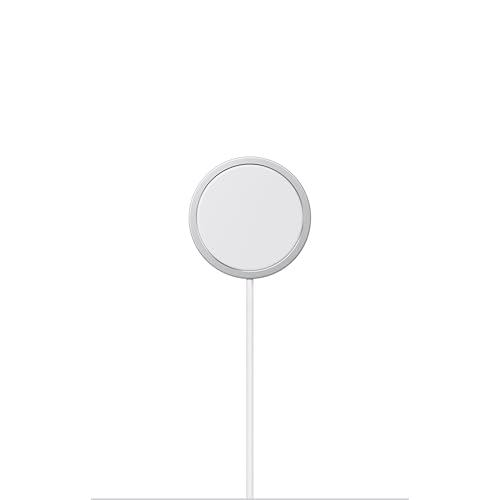 | Apple MagSafe Charger (1m) For iPhone | iPhone 12 or later, up to 25W on newer models | Qi2 25W and Qi certified; 1m cable; adapter not included | Check price → |
 | Belkin UltraCharge 3-in-1 Foldable Magnetic Charger, Qi2 25W 3-in-1 | iPhone, Apple Watch and AirPods on one stand | Qi2.2 25W phone, AirPods 5W, 45W power supply included | Check price → |
 | Belkin BoostCharge Wireless Charging Pad 15W (WIA012myBK) For Galaxy | Galaxy S24 and later at 15W, with no magnets needed | 15W Galaxy S24 or later, 7.5W iPhone, 20W plug in box | Check price → |
 | Anker MagGo Qi2 15W Wireless Charging Pad (A25M2) Budget | Magnetic Qi2 charging for MagSafe iPhones | Qi2 certified, 15W, 5 ft cable; 20W charger not included | Check price → |
 | Anker MagGo Power Bank 10K (A1664) Away from home | Topping up a MagSafe iPhone without a socket | 10,000mAh, Qi2 15W wireless, 30W USB-C port | Check price → |