
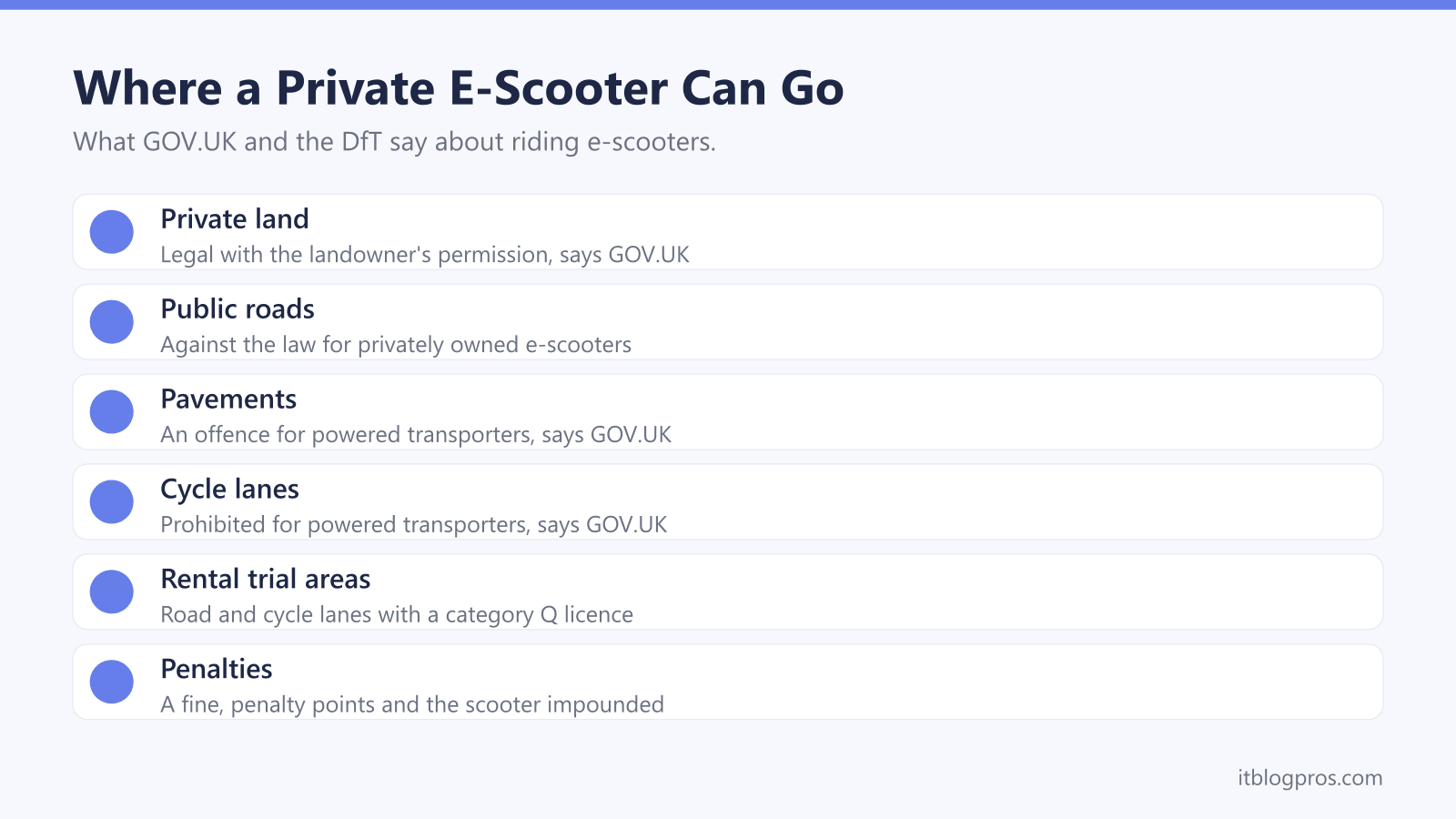
Electric scooters are easy to buy in the UK and, for most owners, hard to ride legally. GOV.UK says it is against the law to use a privately owned e-scooter on public land, which leaves private land as the place for the one in the box. This guide sets out the law as GOV.UK and the Department for Transport state it, the rental trials that are the exception, battery fire safety from the London Fire Brigade, Electrical Safety First and OPSS, and how to choose a scooter.
GOV.UK says it is against the law to use a privately owned electric scooter on public land, and its powered transporters guidance says riding on the pavement or in cycle lanes is illegal too. Riding is legal on private land with the landowner's permission. Rental e-scooters in official trial areas, which the DfT says run until May 2028, are the only ones allowed on the road.
Key Takeaways
- GOV.UK says it is against the law to use a privately owned electric scooter on public land, and that the rules for private e-scooters have not changed.
- GOV.UK's powered transporters guidance says e-scooters are legal on private land with the landowner's permission, and that using them on the pavement or in cycle lanes is illegal.
- Rental e-scooters in official trial areas are the exception: GOV.UK requires a full or provisional licence with category Q entitlement, and the DfT says the trials are due to end in May 2028.
- The London Fire Brigade says most fires involving e-bikes and e-scooters happen while the battery is charging, and says never to leave one charging unattended or while asleep.
- iScooter bases its range figures on a 75kg rider on flat roads at 32°C, and says terrain, rider weight, wind, temperature and tyre pressure change the real figure.
Private E-Scooters Are Legal Only on Private Land
GOV.UK's powered transporters guidance, from the Department for Transport and the DVSA, explains the rule. E-scooters fall within the legal definition of a motor vehicle, so the laws for motor vehicles apply to them. To use a public road lawfully, the guidance says, a motor vehicle needs insurance, conformity with technical standards, vehicle tax, licensing and registration, driver testing and licensing, and the right safety equipment. Users are likely to find all of that very difficult, it adds, which would make riding on the road a criminal offence.
Pavements and cycle lanes are out too. The same guidance says it is an offence to use powered transporters on the pavement, and that they are prohibited from cycle tracks, cycle lanes and bridleways. Car parks, privately owned roads, industrial estates and university campuses open to the public carry some of the same restrictions.
That leaves private land the public cannot access, with the permission of the owner or occupier. GOV.UK's rental guidance is blunt: it is against the law to use a privately owned electric scooter on public land.
Police Enforce the Law With Fines, Points and Seizure
GOV.UK's guidance for e-scooter riders lists three consequences of using an e-scooter illegally: you could face a fine, you could get penalty points on your licence, and the scooter could be impounded. The powered transporters guidance repeats all three.
That guidance also names who enforces it. Local police forces enforce the law and, together with the Crown Prosecution Service where relevant, prosecute offenders. Depending on the nature and gravity of the offence, it says, sentences range from fines and penalty points to disqualification from driving. Riding dangerously or under the influence of drink or drugs can lead to convictions carrying imprisonment, and speeding offences also apply.
Selling them is a different matter. GOV.UK says it is not illegal to sell powered transporters, and that responsible vendors will give customers accurate information about the legal restrictions. That is how a scooter can be on sale in a shop and still be illegal to ride on the street outside. iScooter's own product page says it is currently only legal to use an e-scooter on private land with the permission of the landowner.
Rental Trials Are the Legal Exception Until May 2028
The government's rental trials are the only legal route onto the road. GOV.UK's guidance for users says a rental e-scooter can be ridden on the road, except motorways, and in cycle lanes within an official trial area, but never on the pavement. Riders need a provisional or full UK driving licence with category Q entitlement, which comes with a category AM, A or B licence, and the operator provides third-party motor insurance. The maximum speed is 15.5mph, and helmets are recommended but not a legal requirement.
GOV.UK lists 21 trial areas, among them Leeds, Liverpool, participating London boroughs, Milton Keynes, Nottingham, Plymouth and the West of England, and the DfT's trials page says it applies to England. The DfT says the trials are currently due to end in May 2028, that private e-scooters remain illegal to use on public roads, and that the ongoing legal basis for e-scooters will be considered based on findings from the trials. GOV.UK's guidance, last updated on 7 July 2026, still says the rules for private e-scooters have not changed.
Most E-Scooter Fires Start While the Battery Is Charging
The London Fire Brigade says most fires involving e-bikes and e-scooters happen while the battery is charging, and explains that charging places stress on the battery. Its advice is to use the charger supplied with the battery or one the manufacturer recommends, since the wrong charger can overload the battery, and to unplug once charging has finished. After a ride, let the battery cool before charging it, and never leave a battery charging unattended or while you are asleep.
Where it charges matters as much as when. The Brigade says to charge on a hard, flat surface where heat can dissipate, away from a main through-route or exit, and to fit a smoke alarm where batteries are charged; the smoke alarm guide covers which type suits which room. OPSS's Buy Safe, Be Safe guidance says not to charge or store the battery in a hallway or anywhere it could block escape routes, and not to cover the charger or battery. Electrical Safety First calls charging continuously or overnight a fire risk.
Buy From a Reputable Seller and Keep the Original Charger
Electrical Safety First's advice is to buy e-scooters, chargers and batteries only from reputable retailers, and to avoid second-hand batteries and chargers and third-party sellers online. If the original charger is lost, it says to get a replacement from the manufacturer or one the manufacturer approves. To spot poor quality, it suggests looking for misspellings or bad translations in the instructions, and warns that substandard items often lack warranty cards and instructions. The charity gives similar advice for smaller lithium-ion packs, covered in the power bank guide.
OPSS adds two checks: look for the UKCA or CE mark, which it says UK product safety regulations require on e-scooters, and see whether the seller explains how the product complies. It says to use only manufacturer-recommended parts, chargers and batteries, and never to tamper with the battery.
OPSS lists overheating, deforming, hissing or cracking noises, smells, smoke and poor performance as reasons to stop using a charger or battery at once. If a battery fire starts, OPSS says never to tackle it: leave the building and call 999.
Maker Range Figures Assume a 75kg Rider on a Flat Road
Range comes with conditions. iScooter's UK spec pages give 30 to 40 km for the iX3 and 50 to 60 km for the iX6, both based on a 75kg rider on flat roads at 32°C. The same pages say terrain, rider weight, wind, temperature and tyre pressure change the real figure, so a heavier rider on hills in the cold is outside the test.
Power needs careful reading. The DfT's definition of a trial e-scooter caps the motor at 500W continuous and the speed at 15.5mph. iScooter's iX3 product page lists an 800W peak motor and 40 km/h, while its Amazon listing describes a 500W motor with modes up to 25 km/h.
Then the hardware. iScooter lists the iX3 at 22 kg for riders up to 120 kg, and the iX6 at 24.9 kg for riders up to 150 kg. Both have pneumatic tyres, front and rear disc brakes plus an electronic brake, and front and rear lights with indicators. Water ratings need checking too: the iX3 spec page says IP54, while its product page says IPX4.
Three Scooters for Private Land, Including One for Children
The caveat comes first. Every scooter here is for private land with the landowner's permission, and GOV.UK's powered transporters guidance has no separate rule for children's models. Rental schemes need a category Q driving licence, so they are no option for children.
Among electric scooters for adults, the iScooter iX3 is the all-rounder, with front and rear suspension, indicators and 10-inch tyres. iScooter's pages disagree on its minimum age: 12 on the spec page, 18 on the product page. The iX6 is the longer-range pick, with an 840Wh battery, 11-inch tyres and a 150 kg rider limit, for ages 14 and up by its spec page.
For a kids' electric scooter, iScooter's spec page lists the iK1S at 4.6 kg with a 100W motor, solid 5.5-inch tyres, a rear foot brake and a 50 kg load limit. Its age advice varies as well: 4 and up on the spec page, 6 to 10 or 6 to 12 on its Amazon listings, so the higher figure and the weight limit are the safer guide. All three are sold by Amazon itself.
| Product | Best for | Key specs | Price | |
|---|---|---|---|---|
 | iScooter iX3 All-rounder | Adults on private land who want suspension | 10-inch pneumatic tyres, dual suspension, 120 kg max | Check price → |
 | iScooter iX6 Longer range | Larger private sites and riders up to 150 kg | 840Wh battery, 50-60 km, 11-inch tyres, IPX4 | Check price → |
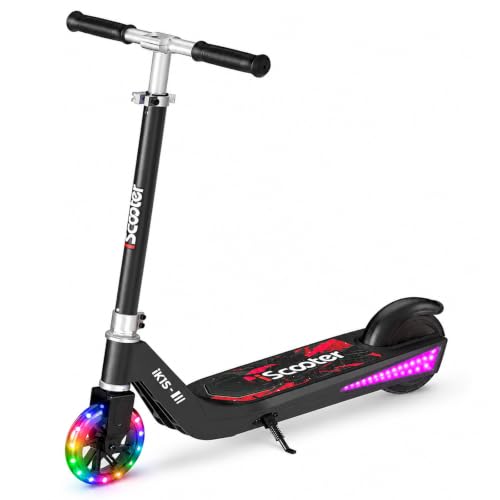 | iScooter iK1S For children | Younger children on private land, supervised | 100W motor, 4.6 kg, 50 kg max load, rear foot brake | Check price → |