
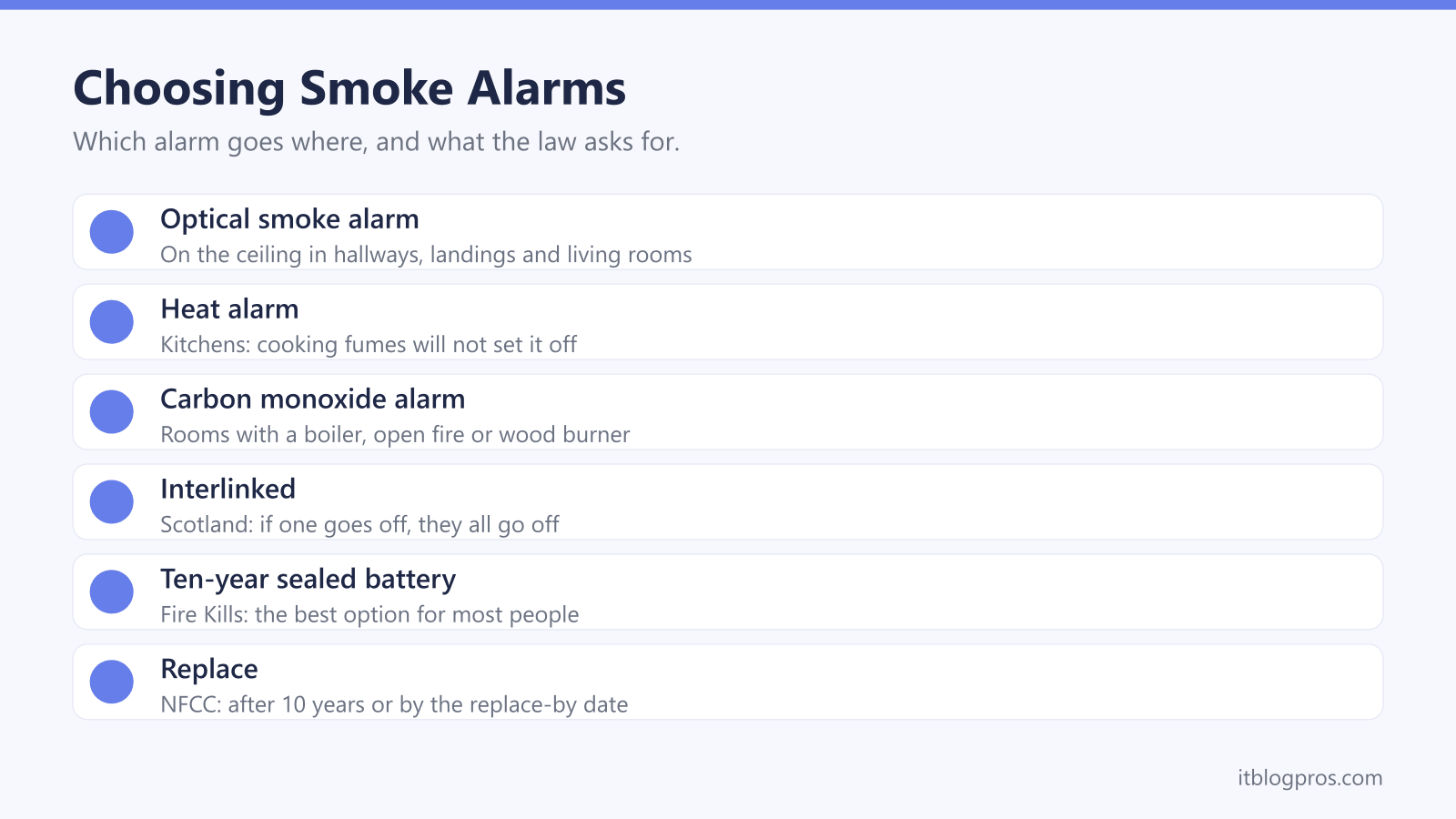
Smoke alarms are simple devices, but the rules around them now differ across Great Britain. Scotland requires interlinked smoke and heat alarms in every home, while England and Wales set their legal requirements for rented homes. This guide sets out each set of rules as GOV.UK, the Scottish Government and the Welsh Government publish them, explains optical, heat and carbon monoxide alarms as fire services and makers describe them, and covers four FireAngel alarms that suit common jobs.
GOV.UK's Fire Kills campaign calls ten-year sealed battery smoke alarms the best option for most people, with at least one on every level, tested at least monthly. Kitchens take a heat alarm, which London Fire Brigade says cooking fumes will not set off. Scotland requires interlinked smoke and heat alarms in every home, and the Scottish Government adds a carbon monoxide alarm in any room with a boiler, open fire or wood burner.
Key Takeaways
- The Scottish Government requires every home to have a smoke alarm in the living room or the room used most, one in every hallway and landing, and a heat alarm in the kitchen, all on the ceiling and interlinked.
- GOV.UK's guidance on the Smoke and Carbon Monoxide Alarm (Amendment) Regulations 2022 requires landlords in England to fit a smoke alarm on each storey and a carbon monoxide alarm in rooms with a fixed combustion appliance, excluding gas cookers.
- The Welsh Government's guidance says rented homes need a smoke alarm on every storey, connected to the electrical supply and interlinked, plus a carbon monoxide alarm in any room with a gas, oil or solid fuel burning appliance.
- The NFCC recommends an optical multi-sensor smoke alarm with a ten-year life span and a heat alarm in the kitchen, and FireAngel no longer makes ionisation alarms.
- The Scottish Government says the Nest Protect System will not meet its standard, and Google's own help page says Nest Protect is no longer available for sale but is still supported.
Scotland Requires Interlinked Smoke and Heat Alarms in Every Home
Scotland's rules cover every home. The Scottish Fire and Rescue Service says all Scottish homes have needed interlinked alarms since February 2022, and the Scottish Government's guidance sets out the minimum: one smoke alarm in the living room or the room you use most, one in every hallway and landing, and one heat alarm in the kitchen. All of them should be on the ceiling and interlinked, so if one goes off, they all go off.
The Scottish Government says a home with a carbon-fuelled appliance like a boiler, open fire or wood burner needs a carbon monoxide detector in the same room, that it does not need to be linked to the smoke alarms, and that gas cookers and hobs do not need one.
Meeting the standard is the property owner's responsibility, the guidance says. Its buying page allows sealed tamper-proof alarms with long-life lithium batteries, which you can fit yourself, or mains-wired alarms fitted by a qualified electrician, and rules out replaceable batteries. It lists BS EN14604:2005 for smoke alarms and BS 5446-2:2003 for heat alarms.
England's Alarm Rules Apply to Rented Homes
In England, the legal duty sits with landlords. GOV.UK's guidance says the Smoke and Carbon Monoxide Alarm (Amendment) Regulations 2022 came into force on 1 October 2022 and apply to homes rented by private landlords or registered providers of social housing. Landlords must make sure at least one smoke alarm is fitted on each storey used as living accommodation, plus a carbon monoxide alarm in any room used as living accommodation that contains a fixed combustion appliance, excluding gas cookers. A bathroom or lavatory counts as living accommodation.
Each alarm must be checked on the day a new tenancy begins, and landlords must repair or replace a faulty alarm once they are told about it. A council can fine a landlord up to 5,000 pounds per breach for failing to comply with a remedial notice. The regulations do not stipulate the type of alarm, though GOV.UK recommends smoke alarms compliant with BS 5839-6 and carbon monoxide alarms compliant with BS 50291, and calls sealed for life batteries the better option. Owner occupiers are not covered.
Wales Requires Mains-Connected, Interlinked Smoke Alarms in Rented Homes
Wales sets a firmer standard for rented homes. The Welsh Government's guidance for landlords covers the Renting Homes (Fitness for Human Habitation) (Wales) Regulations 2022, made under the Renting Homes (Wales) Act 2016, and explains what landlords must do from 1 December 2022. Every storey needs a smoke alarm in proper working order, connected to the electrical supply and interlinked with the other mains smoke alarms. Extra battery alarms are allowed on top, and the guidance says those do not have to be interlinked.
A carbon monoxide alarm must be present in any room with a gas, oil or solid fuel burning appliance installed, and the guidance does not list an exception for gas cookers. It adds that smoke alarms should be sited where the occupier can hear them when asleep, and that carbon monoxide alarms usually go lower than smoke alarms, because the gas could reach dangerous levels before it reaches ceiling height. A home that misses these requirements is treated as unfit for human habitation.
Optical Alarms Suit Living Areas and Heat Alarms Suit Kitchens
Aico says an optical smoke alarm uses an infra-red beam to detect smoke and performs best in living rooms and bedrooms, and FireAngel says optical alarms are more responsive to the dense smoke of slow, smouldering fires. FireAngel says ionisation alarms contain a small quantity of radioactive Americium 241, that it no longer manufactures them, and that it has not recommended them since April 2018. The National Fire Chiefs Council (NFCC) recommends an optical multi-sensor smoke alarm with a ten-year life span, a type FireAngel says combines optical and heat detection.
London Fire Brigade says heat alarms warn of a rise in temperature but will not be set off by cooking fumes, and Aico says heat alarms are only suitable for kitchens and garages, not bedrooms or hallways.
GOV.UK's Fire Kills campaign says to fit at least one smoke alarm on every level, ideally on the ceiling in the middle of a room and on the hallway and landing. London Fire Brigade adds that smoke alarms belong away from kitchens and bathrooms, as steam can damage them.
Carbon Monoxide Alarms Belong in Rooms With a Fuel-Burning Appliance
Aico calls a carbon monoxide alarm an essential add-on to a smoke alarm rather than a replacement. GOV.UK gives gas or oil boilers and log-burning stoves as examples of fixed combustion appliances, the Scottish Government names a boiler, open fire or wood burner, and the Welsh Government covers any gas, oil or solid fuel burning appliance.
Position advice differs. GOV.UK says carbon monoxide alarms should generally sit at head height on a wall or shelf, about 1 to 3 metres from the source, and that landlords should follow the maker's instructions. FireAngel's page for the FA3820 says the ceiling or a wall at least 150mm below it, 1 to 3 metres horizontally from the source, and never directly above a cooker or inside a boiler cupboard.
The standard is written differently on each page. GOV.UK recommends alarms compliant with BS 50291, the Scottish Government asks for the British Kitemark EN 50291-1, and FireAngel says the FA3820 is certified to BS EN 50291-1:2018 and BS EN 50291-2:2019. Heating controls are a separate upgrade, covered in the smart thermostat guide.
Test Alarms Regularly and Replace Them After Ten Years
Advice on how often to press the test button varies. GOV.UK's Fire Kills campaign and the NFCC say at least once a month, the Scottish Fire and Rescue Service says weekly, and FireAngel's FAQ says weekly for its FA6620-R smoke alarm but monthly for its heat and carbon monoxide alarms.
Alarms wear out even when the test beep works. The NFCC says a smoke alarm's sensor can degrade over time, and that alarms should be replaced after 10 years or by the replace-by date on the base. The Welsh Government notes that carbon monoxide sensors usually need replacing more often than smoke alarm sensors. Where the battery is replaceable, the NFCC recommends a new one every year.
The Scottish Government says the Scottish Fire and Rescue Service offers free fire safety visits to everyone in Scotland, London Fire Brigade offers free home fire safety visits to people at higher risk, and the Welsh Government links to visit requests for all three Welsh services. The NFCC's online Home Fire Safety Check can lead to a local fire service visit.
Four FireAngel Alarms Cover Smoke, Heat, Carbon Monoxide and Interlinking
Interlinking is the part that needs planning. The Scottish Government says sealed battery and mains-wired alarms both interlink by radio without WiFi, and London Fire Brigade says a mains-powered alarm should be installed by a qualified electrician. Smart alarms are thinner on the ground: Google's help page says Nest Protect is no longer available for sale but is still supported, and the Scottish Government says the Nest Protect System will not meet its standard because it does not meet the requirements for a heat alarm.
The smoke and heat alarms below run on sealed batteries, so a Welsh landlord still needs mains-connected, interlinked smoke alarms. FireAngel's pages do not describe the FA6620-R optical smoke alarm or the FA6720-R heat alarm as interlinkable, and the FA3820 handles carbon monoxide. For Scotland, the FP1720W2-R is the kitchen heat alarm in FireAngel's wireless Pro Connected range, alongside Pro Connected smoke alarms such as the FP2620W2-R, which FireAngel says meets Scotland's requirement with no cabling needed. Like a home security camera, the range can send phone alerts through FireAngel's gateway.
| Product | Best for | Key specs | Price | |
|---|---|---|---|---|
 | FireAngel FA6620-R Optical Smoke Alarm Smoke alarm | Hallways, landings, bedrooms and living rooms | Optical, 10-year sealed battery, EN 14604, 85dB(A) | Check price → |
 | FireAngel FA6720-R Kitchen Heat Alarm Kitchen | Kitchen ceilings, garages and unconverted lofts | Thermistor, 54 to 65°C, 10-year sealed battery, BS 5446-2 | Check price → |
 | FireAngel FA3820 Carbon Monoxide Alarm Carbon monoxide | Rooms with a boiler, gas fire or wood-burning stove | 10-year sealed battery, BS EN 50291-1 and -2, 85dB(A) | Check price → |
 | FireAngel FP1720W2-R Pro Connected Kitchen Heat Alarm Interlinked | A Scottish kitchen linked to Pro Connected smoke alarms | Heat alarm, wireless interlink up to 50 devices, app | Check price → |