
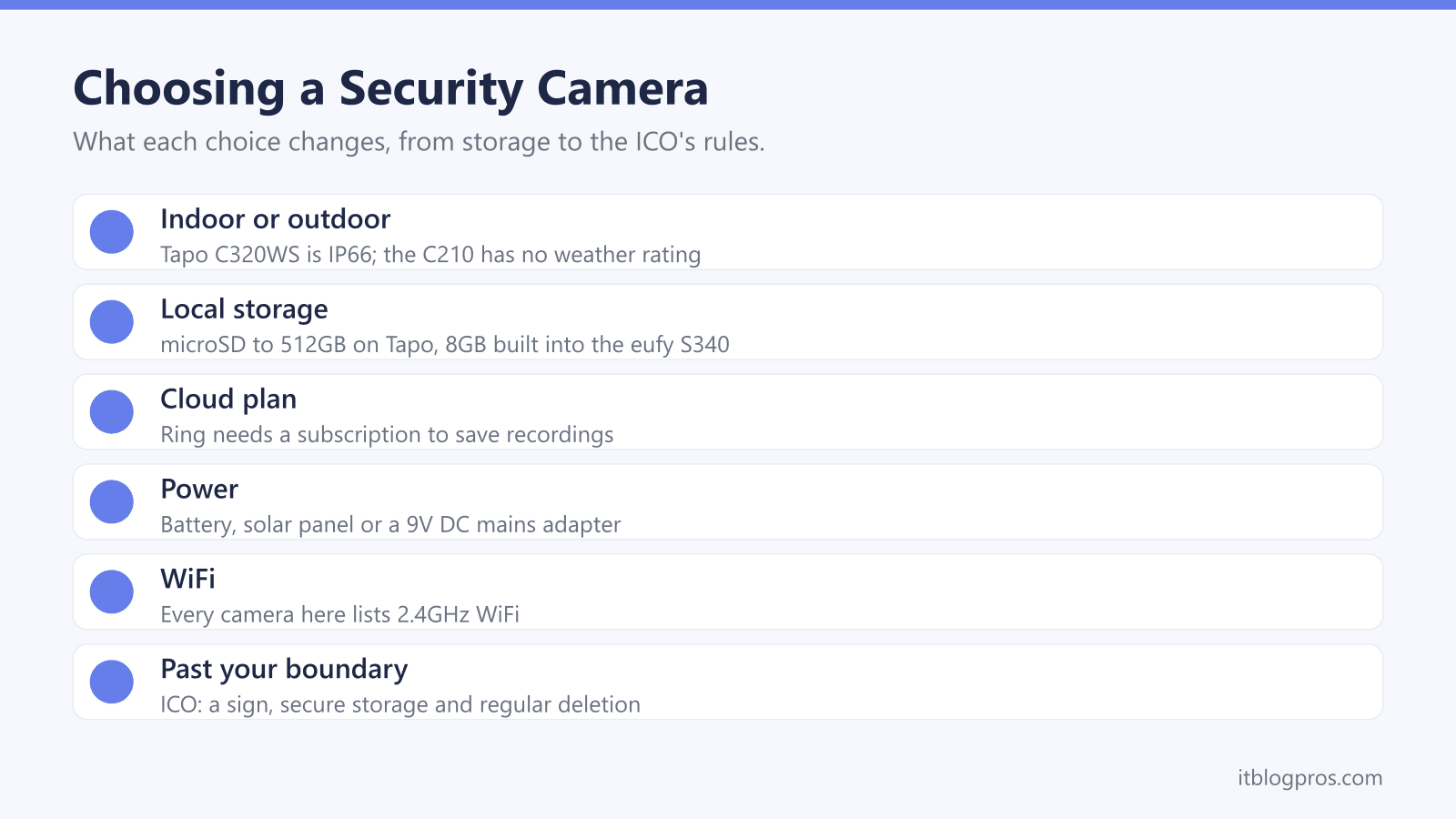
A home security camera is a WiFi camera that streams to your phone and records when something moves. Choosing one in the UK comes down to five decisions: indoor or outdoor, where the video is kept, how the camera is powered, whether the WiFi reaches it, and how much it sees beyond your own boundary. This guide takes each in turn as Tapo, Blink, Ring, eufy and Arlo describe it, alongside the ICO's guidance on home CCTV, then covers five cameras that suit the common setups.
For most homes, a camera that records to a microSD card or built-in memory avoids a monthly fee. TP-Link's Tapo C210 and C320WS take cards up to 512GB, and eufy builds 8GB into the SoloCam S340. Ring's FAQ says saving recordings needs a Ring subscription. Every camera here uses 2.4GHz WiFi, and the ICO says filming beyond your boundary brings data protection duties.
Key Takeaways
- The ICO's home CCTV guidance says data protection law applies once a camera captures someone else's property, a public area or a communal space, bringing duties such as a sign and regular deletion.
- Ring's FAQ says its cameras work without a subscription for live video and alerts, but saving, reviewing and sharing recordings needs a compatible Ring subscription.
- TP-Link lists a microSD slot for cards up to 512GB on the Tapo C210 and C320WS, and eufy builds 8GB of storage into the SoloCam S340, so none of them needs a plan to keep clips.
- Blink records for free only to a USB drive in a Sync Module 2, because Blink's storage page says the Sync Module Core does not support local storage.
- TP-Link, eufy, Blink and Ring all list 2.4GHz WiFi for the cameras here, so the 2.4GHz signal where the camera will sit matters more than the router's top speed.
Indoor and Outdoor Cameras Are Built for Different Jobs
An indoor camera is made for a shelf or a ceiling, not the weather. TP-Link's specification for the Tapo C210 lists tabletop and ceiling mounting, an operating range of 0 to 40°C and no weather resistance rating at all. It records 2K video at 2304 x 1296, and its pan head covers 360°, so one camera can sweep a whole room. TP-Link says its Privacy Mode stops recording, which suits a living room camera that only needs to watch while the house is empty.
Outdoor cameras carry a rating against rain and dust. TP-Link lists the Tapo C320WS as IP66 and wall-mounted, working from -20 to 45°C, with two built-in spotlights and a 91dB siren. Blink rates the Outdoor 4 at IP65, though its FAQ warns that the camera is no longer weather-resistant if the port cover is removed, unless it is powered through a weather-resistant USB-C adapter. eufy lists -20 to 50°C for the SoloCam S340. The rating on the maker's own page is the thing to check, not the word outdoor in a listing title.
Local Storage Means a Card, Built-In Memory or a Hub
Local storage keeps clips at home with nothing to pay each month, and the makers offer three routes. The first is a microSD card in the camera. TP-Link lists a slot for cards up to 512GB on both the Tapo C210 and the C320WS, and its product pages say the card is sold separately. The second is built-in memory: eufy's UK page gives the SoloCam S340 8GB of built-in eMMC storage and says it can also use the storage on a HomeBase S380.
The third is a hub indoors. Blink's storage page lists a USB flash drive in a Sync Module 2 and says the Sync Module Core does not support local storage, while the Sync Module 2 FAQ says drives over 256GB or under 1GB are not recognised. Arlo's support page says most of its wire-free cameras record locally when paired with an Arlo SmartHub or Base Station, using a USB drive with at least 16GB free, and keep recording to it if the internet goes down. The SD card guide explains which card suits a camera.
A Cloud Plan Adds History and a Copy Away From Home
Each brand here sells a cloud plan, and what you lose without one varies. Ring's FAQ says its devices don't require a subscription for live video and alerts, but saving, reviewing and sharing recordings needs one. Ring's UK plans page lists Ring Solo for one device and Ring Multi for every device at one location, with motion videos kept for up to 180 days. Arlo's UK plans page says motion alerts, live stream and local storage with an Arlo Hub or Base Station all work without a subscription.
TP-Link's Tapo Care plans keep 7 or 30 days of event videos, and its FAQ explains how to reach cloud videos when a camera is broken or stolen, something a card inside a stolen camera cannot offer. Without a plan, Blink's UK plans page limits live view to 5 minutes. Blink's own pages disagree on cloud history: the plans page says up to 60 days, while its storage support page gives 30 days for the UK. Ring's UK prices are set out in the video doorbell without a subscription guide.
Battery, Solar or Mains Power Decides Where a Camera Can Go
Battery cameras go anywhere a screw will hold, at the cost of recharging or replacing cells. Blink says the Outdoor 4 runs on two AA lithium batteries for up to two years on default settings, with real life varying by settings, use and environment. Ring's UK page lists a rechargeable quick-release battery pack for its Outdoor Camera Battery, also sold as the Stick Up Cam, and says it is compatible with solar power.
Solar tops a battery up rather than replacing it. eufy's page gives the SoloCam S340 a removable 2.2W panel and up to 3 months on battery alone, based on 300 seconds of recording a day, and says the power collected depends on the weather and available sunlight. eufy also says its battery cameras cannot record 24/7, even on a HomeBase 3.
Mains power ends the charging but needs a socket within reach. TP-Link lists a 9V DC power adapter for both the Tapo C210 and the C320WS, and the C320WS can also connect by Ethernet, which the garden network cable guide covers.
Every Camera Here Needs a Strong 2.4GHz Signal
On WiFi, the makers agree. TP-Link lists 2.4GHz 802.11b/g/n WiFi for the Tapo C210 and C320WS, eufy says the SoloCam S340 is 2.4GHz only, Blink lists a 2.4GHz network for the Outdoor 4, and Ring's UK page lists 2.4GHz WiFi for its Outdoor Camera Battery. Ring's FAQ says all Ring devices support 2.4GHz and only some can use 5GHz. Blink's Sync Module 2 FAQ also asks for an always-on connection with at least 2MB per second of upload speed.
Placement is where most trouble starts. A camera on the far side of an outside wall can sit at the very edge of the router's reach, and Ring's FAQ suggests placing its Chime Pro extender near the Ring device for the best signal. The WiFi extender for a Ring doorbell guide applies to any outdoor camera, and hubs that merge both bands under one name can be split, as the Sky Hub and BT Smart Hub guides show. For a camera that keeps dropping, the Blink, Nest and Wyze offline guides cover the fixes.
The ICO's Rules Start at Your Property Boundary
The ICO's home CCTV guidance, which also covers smart doorbells, says owners should position cameras to capture only their own property where possible. If a camera captures someone else's property, a public area or a communal space, data protection law applies, because images and voices count as personal information. By that test, an indoor camera watching your own hallway stays inside the line, while one covering the pavement does not.
Past the boundary, the ICO lists the duties: have a clear reason, capture no more than you need, including whether audio is needed, put up a CCTV sign, store footage securely, delete it regularly or automatically, and respond to requests from people who appear in it, usually within one calendar month. Stop recording anyone who objects, unless there is a legitimate reason to continue. The ICO also suggests privacy blockers, and the makers offer them: TP-Link's Privacy Zone on the C210 blocks chosen areas from recording, and Ring lists customisable privacy zones. The ICO says this guidance is under review after the Data (Use and Access) Act.
Five Cameras Cover Indoor, Outdoor and No-Fee Setups
None of these cameras will fix a weak WiFi signal at the spot it has to watch, and none removes the ICO's duties if it films the street. With those caveats in place, the table covers the common setups. The Tapo C210 is the indoor pick, with a microSD slot, a 360° pan head and Privacy Mode. For an outside wall with a socket nearby, the Tapo C320WS runs on mains power, takes an Ethernet cable as an option and is rated IP66.
The eufy SoloCam S340 suits a spot with no socket, pairing a solar panel with 8GB built in, so there is nothing extra to buy for storage. The Blink Outdoor 4 listed here is an add-on camera: Blink's FAQ says it needs a Sync Module, and only a Sync Module 2 with a USB drive saves clips with no plan. The Ring Outdoor Camera Battery suits a Ring home that already pays for a plan, since Ring's FAQ says recordings need a subscription.
| Product | Best for | Key specs | Price | |
|---|---|---|---|---|
 | Tapo C210 Pan/Tilt Indoor Security Camera Indoor pick | Indoor pan and tilt with free microSD recording | 2304 x 1296, microSD to 512GB, 2.4GHz, 9V DC adapter | Check price → |
 | Tapo C320WS Outdoor Security Camera Outdoor wired | An outside wall with a socket or Ethernet nearby | 2560 x 1440, IP66, microSD to 512GB, Ethernet port | Check price → |
 | eufy Security SoloCam S340 Solar | A wire-free outdoor spot with no monthly fee | 3K and 2K dual lens, 8GB built in, 2.2W solar panel | Check price → |
 | Blink Outdoor 4 (add-on camera) Blink homes | Adding to a Blink system with a Sync Module 2 | 1080p HD, two AA lithium batteries, IP65, 2.4GHz | Check price → |
 | Ring Outdoor Camera Battery (Stick Up Cam) Ring homes | Ring households already paying for a Ring plan | 1080p, quick-release battery pack, 2.4GHz WiFi | Check price → |