
Outdoor security lights all promise the same thing: light on a path, a door or a drive the moment someone walks up. The real differences sit in the details makers print on their spec sheets, from how far the motion sensor reaches to how much weather the casing can take, and in where the power comes from. This guide works through each one using Luceco, Brennenstuhl, Philips Hue, Ring and eufy's own figures, GOV.UK's rules on outdoor wiring and council advice on keeping the neighbours happy.
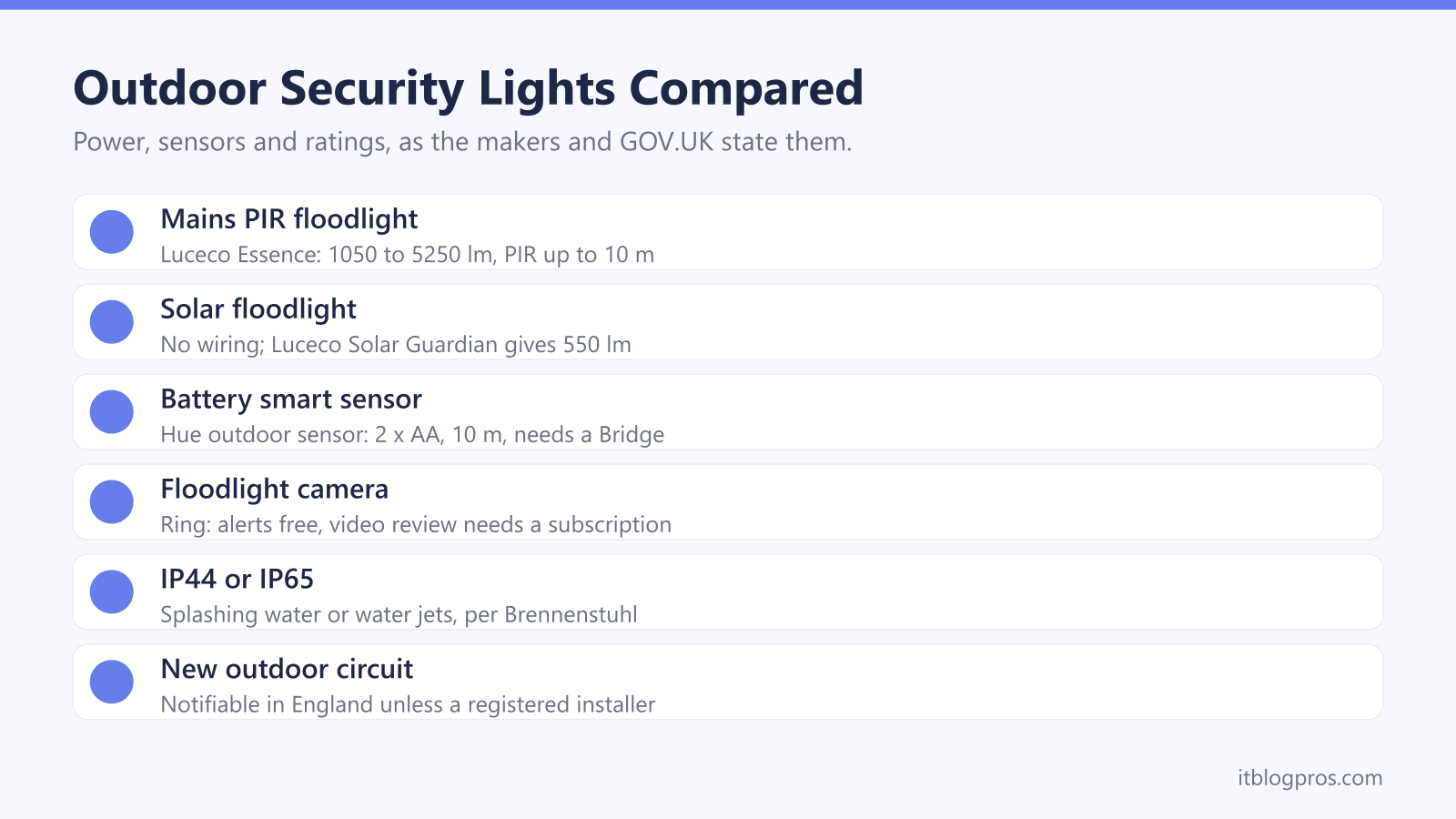
For a door or drive with an outdoor mains supply, a wired LED floodlight with a PIR motion sensor and an IP65 rating is the simple choice. Solar suits a sunny wall with no supply, and battery sensors avoid wiring altogether. Floodlight cameras add phone alerts, though Ring says reviewing recordings needs a subscription. In England, GOV.UK says a new circuit is notifiable unless a registered installer does the work.
Key Takeaways
- Luceco's manual gives the Essence floodlight's PIR sensor up to 10 metres over 120 degrees, Brennenstuhl lists 10 metres over 180 degrees for its WS 2050, and Ring lists 270 degrees for the Floodlight Camera 2K's lights.
- Brennenstuhl says about 3,000 lumens may be sufficient for a carport or house entrance, while Croydon Council advises against excessively bright lights for domestic security lighting.
- Brennenstuhl's guide to IP classes says IP44 covers splashing water from any direction and IP65 is dust-tight and protected against water jets, and it recommends at least IP44 for an outdoor LED spotlight.
- GOV.UK says a new circuit connected to the fuse box must be notified in England unless a registered installer does the work, while extra lighting points on an existing circuit do not need notifying.
- Ring says alerts and Live View are free but reviewing, saving and sharing video needs a Ring subscription, while eufy says its Floodlight Camera E340 records locally with no subscription fee.
PIR Sensors Differ in Range, Angle and Timer Settings
Most security lights switch on through a PIR, a passive infrared motion sensor, and makers describe its reach with two numbers: range and angle. Luceco's instruction manual for its Essence floodlight gives the PIR a maximum range of up to 10 metres over a 120 degree area, yet Luceco's own specification sheet shows 1 to 8 metres, so the two documents disagree. Brennenstuhl lists a 180 degree detection angle and a 10 metre range for its WS 2050 spotlight. Ring lists 270 degree PIR motion detection for the lights on its Floodlight Camera 2K.
The dials matter as much as the headline figures. According to Luceco's manual, the Essence stays lit for anything from 10 seconds to 8 minutes, a lux dial sets how dark it must be before the PIR responds, and pointing the PIR horizontally gives the longest range. Brennenstuhl adds that sensitivity can be adjusted so the light does not fire at the slightest movement. For all-night light, Luceco builds in a dusk-till-dawn mode that keeps the floodlight on until the set light level returns.
Lumens and IP Ratings Set Brightness and Weatherproofing
Brightness on an LED light is listed in lumens. Brennenstuhl's guide to outdoor floodlights calls the lumen figure decisive for how bright a spotlight is, says mounting height affects how many are needed, and suggests about 3,000 lumens may be sufficient for a carport or house entrance. Luceco sells its Essence PIR floodlight from 1050 lumens at 10W up to 5250 lumens at 50W. Brighter is not always kinder, though: Croydon Council advises against excessively bright lights and calls 300 or 500 watt bulbs too powerful for domestic security lighting.
Weatherproofing comes as an IP rating. Brennenstuhl's guide to IP classes says the first digit covers solid objects and the second covers water. IP44 means protection against objects of 1 mm or more and against splashing water from any direction, while IP65 is dust-tight and protected against water jets. Brennenstuhl stresses that IP44 does not make a product fully waterproof, yet recommends at least IP44 for any LED spotlight fitted outdoors. Luceco, Ring and eufy all list IP65 for the floodlights in the table below.
Mains, Solar and Battery Power Suit Different Spots
Mains power never runs flat. Luceco's specification sheet shows the Essence ships with a pre-wired 1 metre H05RN-F rubber cable, and Brennenstuhl lists its WS 2050 for a 220 to 240V supply. The catch is the wiring, covered next.
Solar removes the cable. Luceco describes its Solar Guardian floodlights as perfect for homes with no mains power, with no wiring required, and its specification sheet lists a 3.7V, 3000mAh lithium-ion battery in the 550 lumen model. Luceco's page does not list a run time or PIR range. Placement decides how well solar copes. Ring's advice for its own solar lights is to keep panels clear of shade from trees, overhangs and the house, and to face them towards the equator, which means south from the UK. On the north side of a home, Ring says, diffuse light severely limits charging, more so in winter.
Battery power suits smaller jobs. Brennenstuhl lists its LUFOS 200 battery light at 210 lumens, and the Philips Hue outdoor sensor runs on two AA batteries.
Mains Wiring Outdoors Falls Under Part P in England
GOV.UK's Approved Document P, written for England, says Part P of the Building Regulations covers fixed lighting on outside walls and in gardens. It lists three kinds of notifiable electrical work: a new circuit, a replacement consumer unit, and changes in special locations such as around a bath or shower.
GOV.UK's guide to building work, replacements and repairs puts it in homeowners' terms. Any new electrical circuit connected to the fuse box must be reported to a building control body unless a registered installer does the job, while additional lighting points and other changes to existing circuits away from baths and showers do not need notifying. GOV.UK points to the Electrical Competent Person Register to find a registered installer. Approved Document P adds that non-notifiable work should still meet BS 7671.
The camera makers lean the same way. Ring says installation by a qualified electrician may be required in your area, and eufy's UK page says that outside North America the E340 must be installed and wired by a licensed electrician. GOV.UK notes different rules in Scotland and Northern Ireland.
Smart Lights and Floodlight Cameras Add Phone Alerts
Smart lighting swaps a plain PIR for an app. Philips Hue says its outdoor sensor can trigger both outdoor and indoor Hue lights and alert you to an unwanted presence in the garden. Hue's motion sensor guide says a Hue Bridge is needed, although the outdoor sensor's spec list gives a light limit for use without one, so Hue's pages do not fully agree. The smart bulb guide covers the Bridge.
Floodlight cameras pair the light with video. Ring says notifications, Live View and Two-Way Talk come free on all Ring devices, while a Ring subscription lets you review, save and share videos, and its plan comparison adds that events are only recorded after you subscribe. By contrast, eufy says its Floodlight Camera E340 has no subscription fee and records around the clock once a microSD card of up to 128 GB or a HomeBase S380 is in place. The video doorbell guide weighs the same trade-off.
Both cameras need WiFi at the wall, and Ring lists 2.4 GHz only; the Ring extender guide helps where the signal is weak.
Aim the Light Down and Away From the Neighbours
A badly aimed floodlight can become a legal problem. GOV.UK's guidance on artificial light nuisance, which applies to England, lists domestic security lights among sources that can cause a nuisance if not maintained or used properly. To count as a statutory nuisance, GOV.UK says the light must unreasonably and substantially interfere with the use or enjoyment of a home, or injure health, and there are no set levels. Where a council agrees a nuisance exists, it must serve an abatement notice to stop or restrict the light.
Council pages fill in the practical side. Salford City Council says a light shining directly onto someone else's premises may be a statutory nuisance, and that front and back plates on fittings help reduce spill. Croydon Council suggests controlling lights with passive infrared detectors that are correctly aligned and installed. Cornwall Council suggests angling lights away from neighbours' windows, using a lower powered bulb and switching off between certain hours. Luceco's manual says the Essence is suitable for downward illumination only and must not be mounted facing up.
Five Lights Cover Mains, Solar and Smart Set-Ups
First, the caveats. None of these lights fixes a missing outdoor supply or weak WiFi, and both cameras run from mains power, with Ring and eufy each mentioning an electrician for installation. The Hue sensor needs Hue lights to switch, so it adds nothing to a plain floodlight. For cameras without a light, the home security camera guide covers the options.
With that settled, the table covers the common jobs. The Luceco Essence 20W PIR floodlight is the straightforward mains pick, with 2100 lumens, IP65 and adjustable time and lux dials. Luceco's Solar Guardian suits a shed, gate or side wall with no supply, at 550 lumens and IP65. The Philips Hue outdoor sensor is for homes that already run Hue outdoor lights and a Bridge, with a 10 metre detection area and IP54. Ring's Floodlight Camera 2K adds phone alerts and Live View to floodlights adjustable up to 2000 lumens, with recordings behind a Ring subscription. The eufy Floodlight Camera E340 suits recording locally, with two cameras, 2,000 lumens and no subscription fee.
| Product | Best for | Key specs | Price | |
|---|---|---|---|---|
 | Luceco Essence 20W PIR Floodlight Mains pick | Doors and drives with an outdoor mains supply | 2100 lm, IP65, PIR up to 10 m, 10 s to 8 min timer | Check price → |
 | Luceco Solar Guardian Floodlight 5W Solar | Sheds, gates and walls with no mains supply | 550 lm, IP65, PIR, 3000mAh lithium-ion battery | Check price → |
 | Philips Hue Outdoor Motion Sensor Hue add-on | Homes with Hue outdoor lights and a Hue Bridge | 0 to 10 m detection, IP54, 2 x AA batteries | Check price → |
 | Ring Floodlight Camera 2K (Wired) Smart camera | Phone alerts and Live View where mains is available | 200 to 2000 lm, 2K video, IP65, 2.4 GHz WiFi | Check price → |
 | eufy Floodlight Camera E340 No subscription | Recording locally with no subscription fee | 2,000 lm, 3K and 2K cameras, IP65, microSD to 128 GB | Check price → |