
A portable power station is a large rechargeable battery with an inverter and ordinary sockets, and the same box gets sold for camping trips, campervans, garden offices and power cuts. The spec sheet is where buyers go wrong, because watt-hours, watts, surge, cycle counts and UPS switchover times all answer different questions. This guide explains each one as Anker SOLIX, Jackery, Bluetti and EcoFlow describe them, then picks four power stations with UK sockets and a folding solar panel.
Match the watt-hours to how long the power has to last, and the continuous watts to the biggest thing you will plug in. Anker SOLIX's UK guide estimates run time as capacity times about 0.85, divided by the device's watts, so Jackery's 1,070Wh Explorer 1000 v2 runs a 100W load for about nine hours. Then check for LiFePO4 cells, UK three-pin sockets and the UPS switchover time.
Key Takeaways
- Anker SOLIX's UK guides say watt-hours decide how long a power station runs, continuous watts decide what it can power, and surge only covers brief start-up spikes from motors and compressors.
- Anker's rule of thumb for run time is capacity times about 0.85, divided by the device's watts, which allows for the 10 to 15 per cent it says the inverter loses.
- Makers count battery cycles to different end points: Jackery quotes 4,000 cycles at 70 per cent capacity for the Explorer 1000 v2, Bluetti 3,000 or more to 80 per cent and Anker 10,000 to 60 per cent.
- Anker's UK solar guide puts real-world losses at 20 to 30 per cent and says December gives roughly half the daily yield of July, so solar works as a top-up rather than the main charger.
- Jackery says its UPS modes switch in under 10 ms or within 20 ms rather than 0 ms, and tells buyers not to connect data servers or workstations that need an uninterrupted supply.
Watt-Hours Set the Run Time and Watts Set What It Can Power
Two numbers lead every spec sheet, and they answer different questions. Anker SOLIX's UK wattage guide says watts measure how much power a device draws at any instant, while watt-hours measure stored energy and so decide how long the unit runs. Continuous wattage matters most, Anker says, because it is what the power station can sustain. Peak or surge wattage only needs to cover brief start-up spikes.
Motors cause those spikes. Anker says a fridge, drill or air pump can spike at several times its steady draw, while a kettle is a large, sustained load that overwhelms a small inverter.
Some makers stretch the continuous figure. EcoFlow's UK X-Boost page says the feature marginally reduces voltage so a lower-rated inverter can run heavier appliances, lists a 1,500W kettle among its examples, and warns that the voltage change may affect performance with several devices connected. Bluetti calls its version Lifting Power and rates the Elite 30 V2 at 600W continuous, momentarily reaching 1,500W with purely resistive devices. For phones alone, a power bank is the lighter answer.
Run Time Is Capacity Divided by Watts, Less the Inverter's Share
Run time is simple division with a discount. Anker SOLIX's UK runtime guide gives the formula as capacity in watt-hours times about 0.85, divided by the device's draw, with roughly 10 to 15 per cent lost to inverter efficiency. Its own example puts a 1,024Wh unit running a 100W device at 10.24 hours before losses and roughly 8.7 to 9.2 hours after.
Bluetti's FAQ for the Elite 30 V2 goes further. It multiplies capacity by a 95 per cent depth of discharge and a 90 per cent inverter efficiency, then divides by the device's power plus the unit's own draw, which it lists as 4.5W with only the AC side on. On its 288Wh, a 60W laptop gets a little under four hours.
Anker's wattage guide puts a laptop at roughly 60W, a monitor at 30W, a desk lamp at 10W and a WiFi router at 10W. That 110W garden office desk would run for around eight hours on Jackery's 1,070Wh Explorer 1000 v2, and the garden office WiFi guide covers the broadband side.
LiFePO4 Cells Last Thousands of Cycles, Counted Differently
Every unit picked here uses lithium iron phosphate cells, written LiFePO4 or LFP. Anker SOLIX's UK battery guide gives LiFePO4 2,000 to 6,000 or more charge cycles, against 500 to 1,000 for NMC (nickel manganese cobalt) and around 300 to 500 for lead-acid. The trade-off, Anker says, is weight: LiFePO4 is heavier per watt-hour than NMC, but more thermally stable and far less prone to thermal runaway.
Cycle claims need care, because makers stop counting at different points. Jackery quotes 4,000 cycles at 70 per cent capacity for the Explorer 1000 v2 and 6,000 at 70 per cent for the Explorer 500 v2. Bluetti's UK spec table gives the Elite 30 V2 3,000 or more cycles to 80 per cent. Anker's UK page for the SOLIX S2000 claims 10,000 cycles to 60 per cent. A bigger number with a lower end point is not a like-for-like win.
For a cold van or shed, Jackery lists a charging range of 0°C to 45°C for the Explorer 1000 v2, and Bluetti 0°C to 40°C for the Elite 30 V2.
A UK Version Has Three-Pin Sockets and a UKCA Mark
Power stations are often built in several regional versions with different sockets. Bluetti's EU store sells a separate UK Plug version of the Elite 30 V2, and its UK spec table lists one AC outlet. Anker's UK page for the SOLIX S2000 lists two AC output ports but does not state the socket type, so that one needs confirming before ordering.
Jackery's UK pages are clearer. The Explorer 500 v2 page lists two AC outlets, and the Explorer 500 v2, 1000 v2 and 3000 v2 pages each list a UK 3-pin AC charge cable in the box. Jackery also lists UKCA among the certifications for the Explorer 500 v2 and 3000 v2.
Before buying, check that the main product photo shows UK three-pin sockets, that the spec table or box list says UK, and that Amazon or the brand's own UK store is the seller. A European or American socket version is the wrong product for a UK home, however close the listing title looks.
Mains Charging Takes Hours, Car and Solar Take Far Longer
Size and method both matter. Jackery's UK page quotes the Explorer 500 v2 at 1.3 hours from the wall, 2.8 hours from 200W of solar and 6 hours from a 12V car socket. The Explorer 1000 v2 takes 1.7 hours from the wall, or one hour in the app's Emergency Charge Mode, but 12 hours from a car. The 3,072Wh Explorer 3000 v2 needs 1.8 hours on mains and 36 hours from a 12V socket.
Solar is slower again in Britain. Anker SOLIX's UK solar guide says real-world losses of 20 to 30 per cent are normal, that cloud can cut output by 50 to 90 per cent, and that December gives roughly half the daily yield of July. It calls solar a top-up rather than the sole charging method, and Jackery's SolarSaga FAQ says the 100W rating is tested in an ideal laboratory.
Panels must match, too. Jackery says panels on both inputs must be the same model and number, while Bluetti accepts third-party panels at 12V to 28V and up to 200W on an XT60 connector.
UPS Mode Bridges a Power Cut but Is Not a 0 ms Switch
Jackery's FAQ for the Explorer 3000 v2 describes UPS mode: on mains, it powers devices from the grid, and in a sudden outage it switches to battery within 20 ms. Jackery quotes under 10 ms for the Explorer 500 v2 and 20 ms or less for the Explorer 1000 v2, while Bluetti and Anker quote 10 ms or less for the Elite 30 V2 and SOLIX S2000.
Jackery's pages for the Explorer 500 v2 and 3000 v2 say neither supports 0 ms switching, and the 500 v2 page rules out data servers and workstations, and asks for repeated compatibility tests first. The router battery backup guide covers smaller units for broadband alone, and the power cut guide covers reporting a cut.
Indoors, Anker SOLIX's UK safety guide says a power station gives off no exhaust or carbon monoxide, but should not be shut in a cupboard or covered, and should sit away from radiators, sunlight and flammable materials. Electrical Safety First's battery pack advice adds: unplug at once at any sign of smoke, swelling or odd smells.
Four Power Stations and a Solar Panel With UK Sockets
The four power stations below use LiFePO4 cells and show UK three-pin sockets, and all five picks come from Amazon or the brand's own UK store.
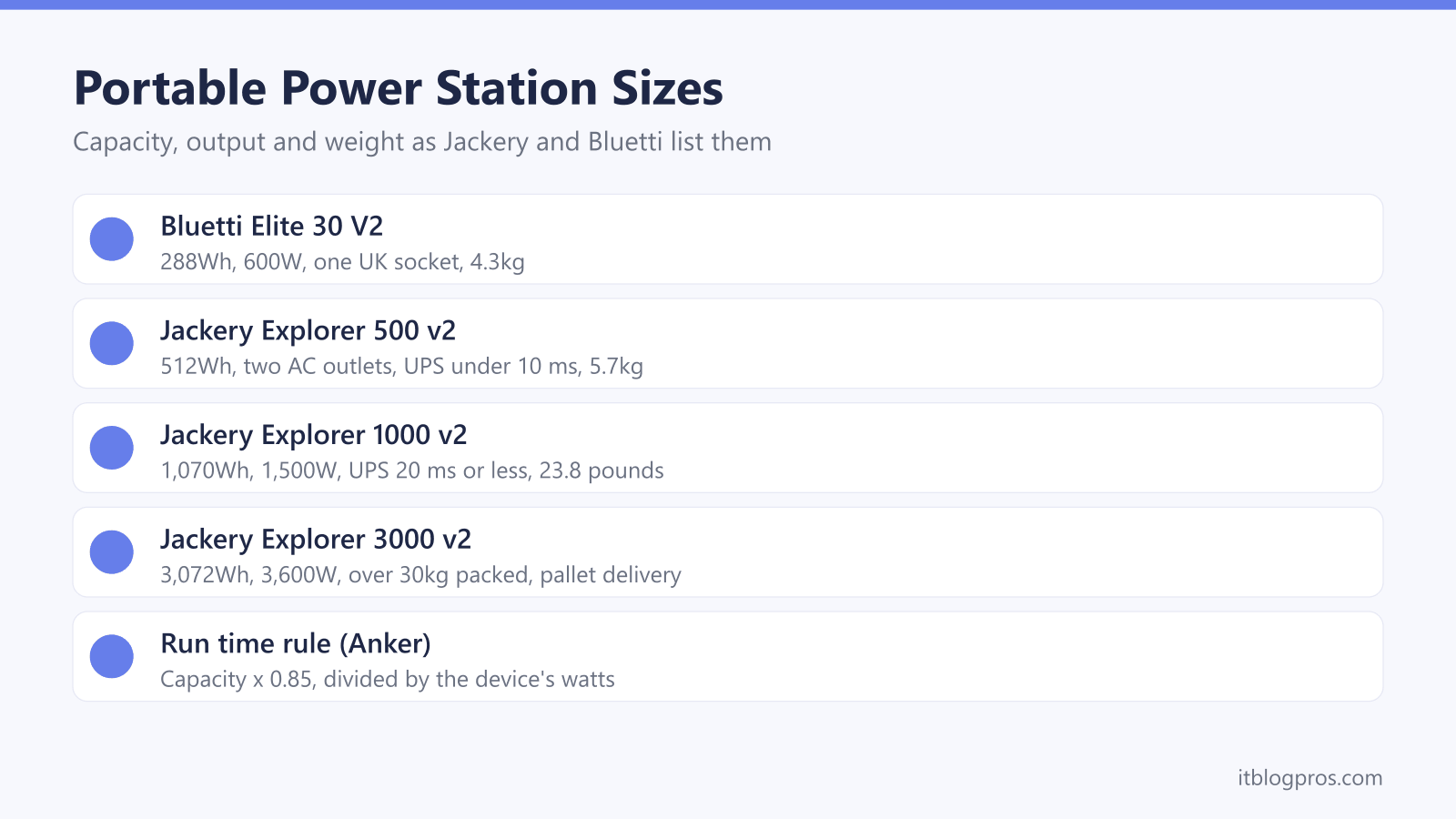
Jackery's Explorer 1000 v2 is the all-rounder: 1,070Wh, 1,500W and 23.8 pounds, and the garden office sum above gives it around eight hours of desk work. The Explorer 500 v2 halves the capacity to 512Wh and weighs 5.7kg, with two AC outlets. For long power cuts, the Explorer 3000 v2 holds 3,072Wh at 3,600W, though Jackery says it weighs over 30kg packed and arrives by pallet, to the kerbside or ground floor only.
Bluetti's Elite 30 V2 is the lightest power station here at 4.3kg, with one UK socket and 288Wh. Bluetti's own page is inconsistent on charging: the spec table lists 980W AC charging, while the FAQ gives 380W and 70 minutes, and 980W is the figure Bluetti elsewhere gives for bypass power. Jackery's SolarSaga 100W folds in two and weighs 8 pounds, though its page quotes efficiency of 23, 24.3 and 25 per cent in different places.
| Product | Best for | Key specs | Price | |
|---|---|---|---|---|
 | Jackery Explorer 1000 v2 Portable Power Station Our pick | Camping, van weekends and a day in a garden office | 1,070Wh, 1,500W AC, UPS 20 ms or less, 23.8lb | Check price → |
 | Jackery Explorer 500 v2 Portable Power Station with Car Charger Cable Compact | Weekend camping, laptops and lights in a power cut | 512Wh, 500W, two AC outlets, UPS under 10 ms, 5.7kg | Check price → |
 | Jackery Explorer 3000 v2 Portable Power Station Home backup | Running a fridge and essentials through a long power cut | 3,072Wh, 3,600W AC, 1.8h mains charge, UPS within 20 ms | Check price → |
 | BLUETTI Elite 30 V2 Portable Power Station Lightest | Day trips, or a laptop and router in a short cut | 288Wh, 600W, one UK socket, 10 ms UPS, 4.3kg | Check price → |
 | Jackery SolarSaga 100W Portable Solar Panel Solar | Topping up an Explorer 500 v2 or 1000 v2 off-grid | 100W, folds in two, 8lb, USB-C and USB-A outputs | Check price → |