
AT&T U-verse had a good run, but in 2026 it is a legacy service riding on copper phone lines while AT&T spends its money on fiber. When a U-verse connection slows down, most advice online is written for modern cable and fiber setups, and much of it simply does not apply here. This guide stays honest: some slowdowns are free to fix in ten minutes, and some are built into the wires under the street.
The whole diagnosis comes down to one split. Slow over WiFi but fine over Ethernet means a wireless problem that costs nothing to fix. Slow over Ethernet at the gateway means the line or the plan, and on VDSL copper there is a hard ceiling that no new router can raise.
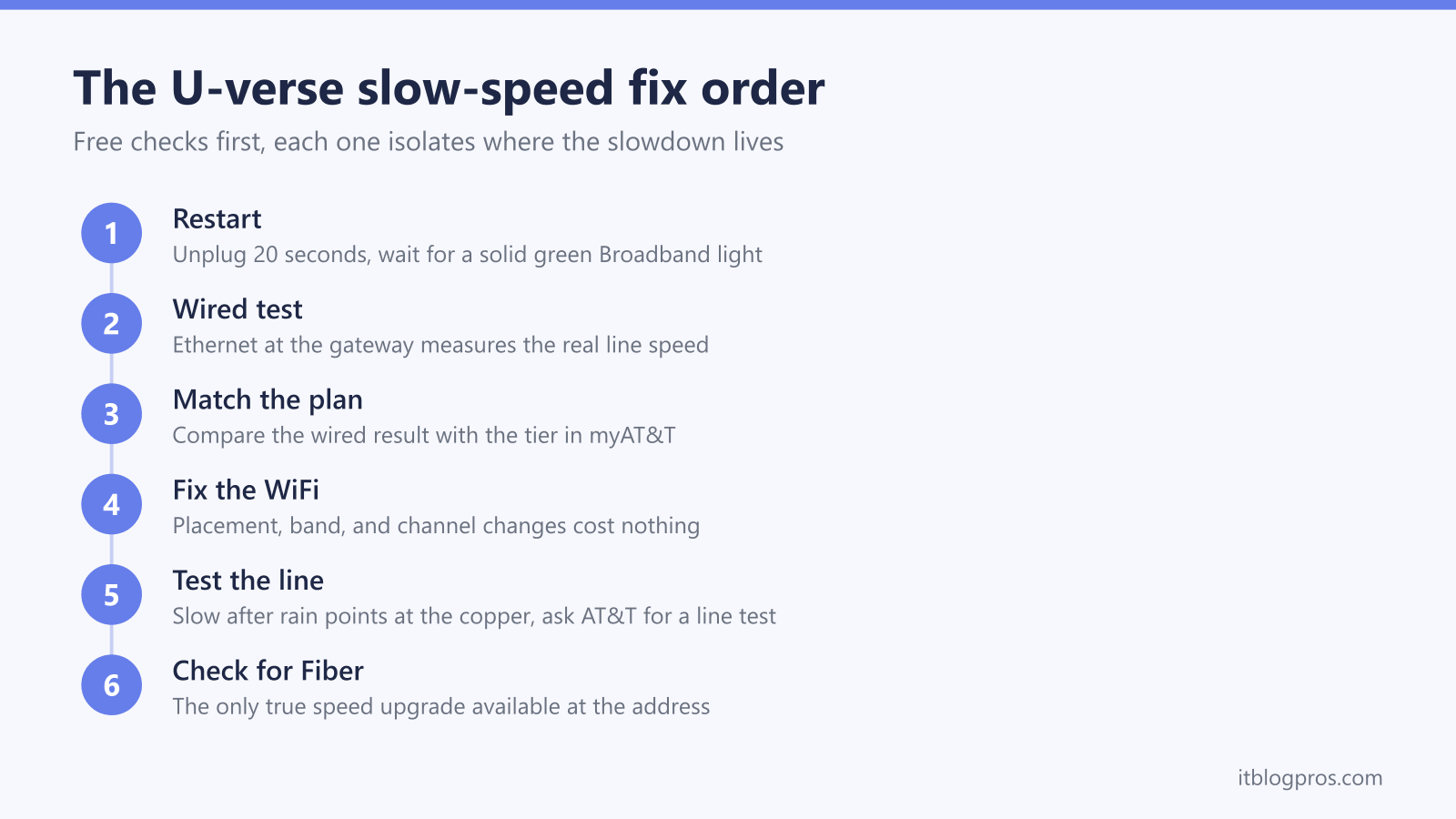
Restart the gateway, then run a speed test on a computer wired to it by Ethernet. If the wired result matches the plan you pay for, the slowdown is WiFi and fixable free with channel, band, and placement changes. If the wired result sits below the plan, the copper line or the plan tier is the limit, and on legacy VDSL no new router or modem raises that ceiling.
Key Takeaways
- U-verse internet runs on VDSL2 over copper phone lines, so distance from the AT&T node sets a hard speed ceiling that no equipment change can raise.
- A wired Ethernet test at the gateway splits every slowdown in half: full speed wired means a free WiFi fix, slow speed wired means the line or the plan.
- AT&T's official restart is a 20 second unplug followed by up to 10 minutes of waiting for a solid green Broadband light.
- Third-party modems never work on U-verse because AT&T gateways authenticate with 802.1X, so there is nothing worth buying for this platform.
- AT&T aims to retire most of its copper network by the end of 2029, so the lasting fix is AT&T Fiber where available or a different provider where it never arrives.
U-verse in 2026 runs on borrowed time, and that shapes every fix
AT&T stopped selling U-verse TV to new customers back in April 2020, and the internet side of the brand was folded into what AT&T now sells as AT&T Internet, with AT&T Fiber as the flagship replacement. A line still described as U-verse internet in 2026 runs on what AT&T calls IPBB: fiber to a neighborhood node, then VDSL2 or ADSL2+ over the old copper phone wiring for the final stretch to the house.
That last copper stretch is the whole story. VDSL2 tops out around 100 Mbps under ideal conditions, and speed falls away sharply with distance. In practice AT&T only provisioned the 100 Mbps tier on lines within roughly 1,000 feet of the node and 75 Mbps within roughly 1,500 feet, and past about 3,000 feet the line behaves more like old ADSL2+. The length of the wire was fixed when the street was built, which is why no router, modem, or hidden setting can raise a U-verse line's ceiling.
The clock is also running. AT&T announced in April 2026 that copper retirement begins across parts of its network in summer 2026, with a stated goal of exiting most of the copper footprint by the end of 2029. Nothing new is being built for this platform, so the realistic aim of every fix below is getting everything the line can already do, not more.
One wired test splits every slowdown in half
Skip the guesswork and measure the line itself. Take a computer with an Ethernet port, plug it straight into one of the LAN ports on the back of the AT&T gateway, and turn the computer's WiFi off so the test cannot sneak over wireless. Run the official test at att.com/support/speedtest, then a second independent test for comparison, and repeat once in the evening and once in the morning.
Reading the result is simple:
- Wired speed close to the plan tier. The line is delivering what AT&T sells. Slowness on phones, TVs, and laptops is a WiFi problem, and the WiFi section below fixes most of it for free.
- Wired speed well below the plan tier. WiFi is innocent. The cause is the gateway, the copper line, or a plan mismatch, covered in the restart, weather, and plan sections.
The Smart Home Manager app adds a useful cross-check on this hardware. AT&T lists the NVG589, NVG599, Pace 5268AC, and BGW210 among its compatible gateways, with features varying by model. Its gateway speed test measures from AT&T's network to the gateway itself, ignoring the home WiFi entirely, so it shows the line's real delivery even without an Ethernet cable to hand.
A proper gateway restart clears more than seems reasonable
Legacy AT&T gateways are old hardware running long uptimes, and a full restart genuinely resolves a share of slow-speed complaints. AT&T's official procedure: unplug the power cord from the back of the gateway, wait 20 seconds, then plug it back in. If the gateway has an internal battery backup, common on older U-verse installs, seat the battery back in before reconnecting power. Then leave it alone, because the Broadband light can take up to 10 minutes to settle on solid green.
Two cautions apply. The recessed reset button is not a restart: holding it performs a factory reset that wipes custom WiFi names and passwords. And after any restart, glance at the lights before testing again. A Broadband light that refuses to go solid green signals a sync problem rather than a speed problem, and the AT&T NVG599 gateway lights guide decodes each state. If devices reconnect to WiFi but pages still refuse to load, the guide on WiFi showing no internet walks that separate path.
Smart Home Manager can also restart the gateway remotely: open Network, then Home Network Hardware, then Wi-Fi Gateway, then Restart.
WiFi congestion fixes cost nothing and solve the common case
When the wired test passes, the line is fine and the wireless environment is the culprit. Work through these in order:
- Placement. Put the gateway central, elevated, and out in the open. Cabinets, closets, floor level, and spots next to cordless phone bases, microwaves, or baby monitors all cost real speed. Every wall between gateway and device takes a cut.
- Band choice. Later U-verse gateways broadcast both a 2.4 GHz and a 5 GHz network, named on the gateway's label. The 5 GHz band is faster and far less crowded but carries less distance, so it suits devices near the gateway. The 2.4 GHz band reaches farther and suits distant, low-demand devices.
- Channel. In apartments and dense streets, neighboring networks fight over the same 2.4 GHz airspace. Sign in to the gateway at http://192.168.1.254 using the Device Access Code printed on the gateway's label, open the WiFi settings, and try channels 1, 6, and 11 to find the quietest.
- Load. Legacy tiers fill up fast. A single 4K stream can take 15 to 25 Mbps, so a 25 or 50 Mbps line saturates with normal family use. On small tiers, slow WiFi is often just a full pipe, and pausing cloud backups and game downloads during the evening helps more than any setting. Smart Home Manager's device list shows which gadgets are eating the connection.
The plan tier decides what counts as slow
Before declaring anything broken, read what the account actually pays for. Sign in at att.com or in the myAT&T app and open the internet plan details, where the speed tier is listed. U-verse era tiers ranged from below 10 Mbps up to 100 Mbps depending on what the line could carry when it was provisioned, and plenty of grandfathered accounts still sit on 18, 25, or 50 Mbps tiers.
A wired test near the tier means the service works as sold, and the honest description of the problem becomes the plan is small, which no amount of troubleshooting changes. A wired test consistently far below the tier is worth a support conversation, because AT&T can check what rate the line actually syncs at. Where an aging line can no longer carry the provisioned tier, a downgrade at least cuts the bill to match reality.
The billing side of AT&T is its own maze, and the AT&T FastPay guide covers paying the bill without wrestling the login.
Weather turns copper lines into slow lines
Copper's oldest enemy is moisture. Rain works into aged insulation, splices, and junction boxes, line noise rises, and the gateway resyncs at a lower rate or drops the connection outright. The signature is unmistakable: speeds that sag during or after storms, a landline handset that crackles on voice calls, or a Broadband light that flickers while the weather is bad.
One detail catches people out. A line that resynced at a lower rate during a storm can stay slow after the skies clear, because the gateway holds the cautious sync until forced to renegotiate. The 20 second restart from earlier forces a fresh sync and often recovers the speed once the plant dries out.
When the pattern repeats every wet week, stop restarting and report it. Run the troubleshooting flow in Smart Home Manager or at att.com support, ask for a line test, and book a technician visit. Faults in AT&T's outside network are AT&T's to repair, and mentioning an audible crackle on voice calls points the technician straight at the physical pair.
Zero product recommendations appear here because none would be honest
Most slow-internet guides end with a router pitch. This one cannot, for a technical reason worth understanding. AT&T authenticates gateways against its network using 802.1X certificates, so only AT&T-supplied equipment connects on this platform. The gateways in circulation on U-verse lines, the NVG589, the NVG599, the Pace 5268AC, and the BGW210 family, are the only hardware that works. No modem sold on Amazon or anywhere else will sync on a U-verse line, and any page claiming otherwise is selling rather than helping.
One honest caveat: a router or mesh system already owned can sit behind the AT&T gateway to spread WiFi coverage across a larger home. That helps genuine dead zones, but it never raises the line rate, and on typical U-verse tiers the gateway's own WiFi already carries the full line speed at ordinary range. Money set aside for new hardware does more good funding the switch described next.
The upgrade paths that actually raise the ceiling
When the wired test shows the line at its limit and the limit is too small for the household, only a platform change helps:
- AT&T Fiber at the address. Enter the address at att.com/internet/availability. Where fiber is listed, ordering it replaces the copper run entirely, AT&T supplies a current gateway, and the VDSL ceiling disappears. Fiber plans frequently cost the same or less than a legacy copper tier.
- The notification list. Where fiber has not arrived, att.com/internet/fiber-is-coming registers the address for an alert when it does.
- AT&T Internet Air. AT&T's fixed wireless home internet runs over the mobile network and is offered at some addresses as the copper replacement. Performance depends on local signal strength, so compare its quoted speeds against the current line before committing.
- A different provider. Where AT&T offers nothing better, cable and rival fiber or fixed wireless providers at the address are the honest answer. With AT&T aiming to retire most copper by the end of 2029, staying on U-verse is choosing the date of the move rather than whether it happens.