If your iPhone or iPad shows the message "this WiFi network uses an older security standard" under the network name, this guide explains exactly what it means and how to clear it in a few minutes. It looks alarming, but it is a routine notice rather than a sign of any fault or break-in.
The "this WiFi network uses an older security standard" message on an iPhone or iPad means the router is using older WPA or WPA2-TKIP encryption instead of WPA2 (AES) or WPA3. It is a warning, not a sign of being hacked, and the connection still works normally. The fix is to log into the router and switch the WiFi security mode to WPA2 (AES) or WPA3.
Key Takeaways
- The message means the network is running below WPA2 (AES), usually on older WPA or WPA2-TKIP encryption, so iOS nudges you to upgrade it.
- It is informational, not an alert that you have been hacked; the WiFi keeps working exactly as before.
- The fix is to log into the router, set the security mode to WPA2 (AES) or WPA3, and turn off TKIP or any WPA mixed mode.
- WPA2 (AES) is the safest choice for most homes because it clears the warning while keeping older devices connected; WPA3 is stronger but a few old gadgets will not support it.
- Some ISP hubs lock this setting, in which case the warning is harmless, or you can run the hub in modem mode behind your own router for full control.
What "this WiFi network uses an older security standard" means
The notice appears in Settings, under Wi-Fi, beside or beneath the network you are connected to, often alongside the words "Weak Security". It is generated entirely by the iPhone or iPad, not by the router, and it reflects the encryption the network is advertising.
iOS raises it whenever a network uses anything weaker than WPA2 with AES encryption. In practice that means WEP, the original WPA, or WPA2 running in TKIP mode. Those standards are older and easier to attack than WPA2 (AES) or WPA3, so Apple surfaces the message to encourage an upgrade. The connection itself is unaffected; the warning is purely advisory.
The message is a warning, not a sign of being hacked
The wording worries people, but it does not mean anyone has accessed the network or that personal data has been exposed. It is the same kind of proactive nudge a browser shows for an out-of-date setting. Nothing has gone wrong, and there is no urgency beyond the general good practice of using current encryption. With every new device and software release, WiFi security standards move on, and older defaults gradually get flagged.
How to fix it: switch your router to WPA2 or WPA3
The fastest fix is to change the security mode in the router settings. The exact menu names vary by brand, but the steps are the same everywhere.
- Connect to your WiFi, then open a browser and go to the router admin address, commonly 192.168.0.1, 192.168.1.1, or 192.168.1.254. The address is usually printed on a label on the router.
- Log in with the admin username and password from that label, unless you have changed them.
- Open the wireless or security settings (often Advanced settings > Wireless > Security).
- Set the security mode to WPA2 (AES) or WPA3, and turn off TKIP or any WPA/WPA2 mixed option. If your 2.4GHz and 5GHz networks are listed separately, change both.
- Apply the change and let the router reboot.
- On the iPhone, forget the network and rejoin it so the device picks up the new setting.
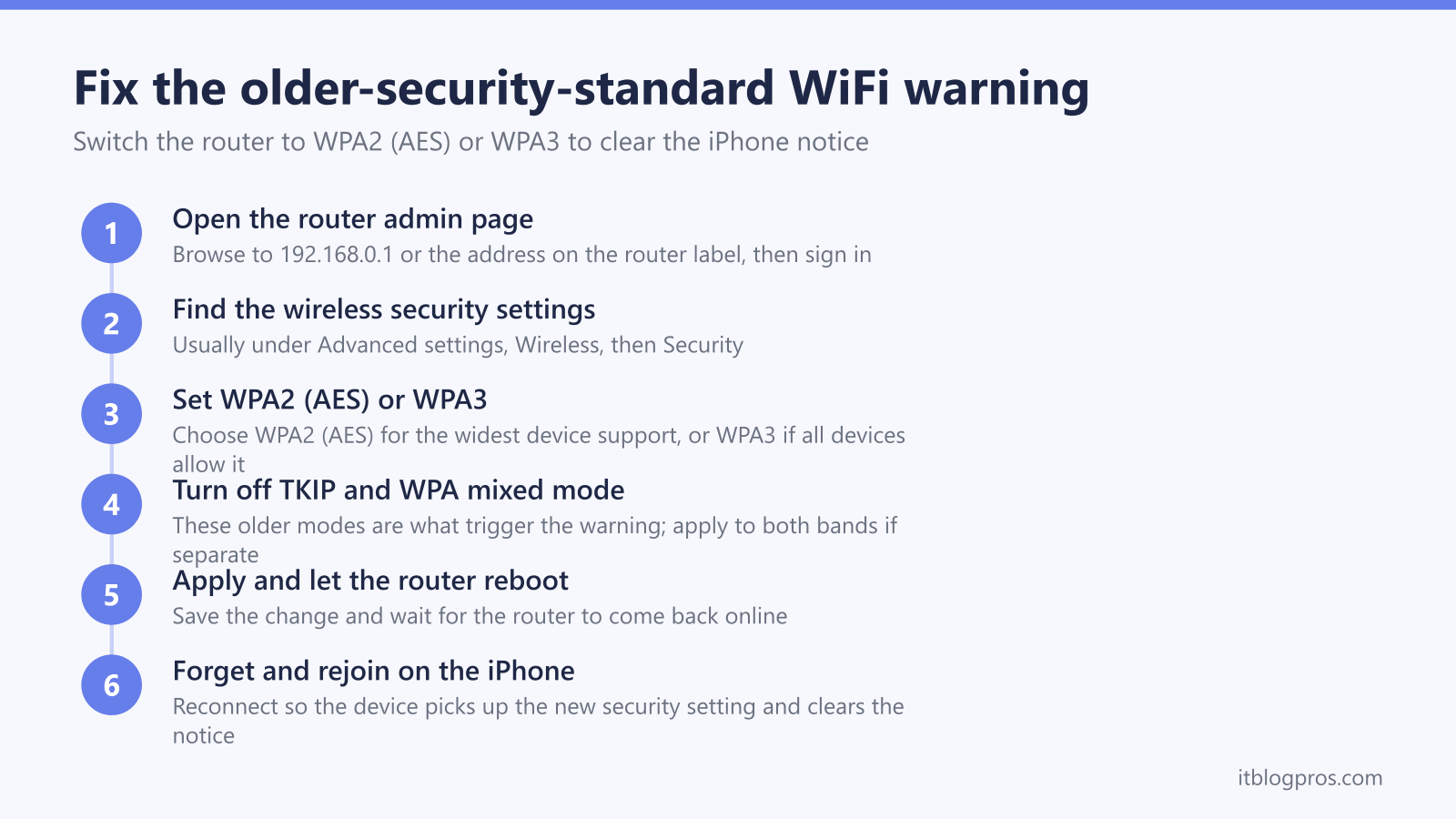
The hero diagram above lays out the same six steps as a quick reference. WPA2 (AES) is the recommended target for most homes: it removes the warning and keeps older devices working. Choose WPA3, or WPA2/WPA3 mixed, only if you are confident your devices support it.
Changing the WiFi security on a Virgin Media Hub
Virgin Media's older hubs, such as the Hub 3, often ship with a WPA or WPA2 mixed default, which is what triggers the message. To switch a Virgin Media Hub to WPA2-PSK:
- Connect to the hub and browse to 192.168.0.1.
- Sign in with the admin name and password printed on the base of the hub, if you have not changed them.
- Go to Advanced settings > Wireless > Security.
- If the 2.4GHz and 5GHz networks are separate, set the security dropdown to WPA2-PSK on each.
- Save the change. The hub refreshes, and once your devices reconnect the message should disappear.
If your hub lights are also misbehaving, the Virgin Media hub lights guide decodes every colour, and the WiFi not working guide covers connection faults.
Changing it on a Virgin Media WiFi booster
If the warning appears for a Virgin Media WiFi booster rather than the main hub, update the booster separately:
- Connect the booster to a laptop with an Ethernet cable.
- Browse to http://virginmedia-vmp to log in; this page is only reachable once the booster is connected.
- Use the settings password printed on the back of the booster.
- Open Wireless settings > Security.
- Set the security to WPA2-PSK for both the 2.4GHz and 5GHz networks if they are separate.
- Apply the changes.
When your ISP hub will not let you change it
Some ISP hubs lock the encryption mode and give you no way to change it. In that case the warning is harmless: the network is still encrypted, and you can safely ignore the notice. If you would rather be rid of it, the cleanest option is to put the hub into modem mode and run your own router behind it, which hands you full control of the WiFi security settings. The guides on using your own router with any UK ISP and Virgin Hub 5 modem mode walk through that.
If the hub is locked to an older WPA setting and modem mode is not an option, a VPN is a practical workaround. It wraps everything leaving your device in its own strong encryption, so far less of your activity is exposed by the weaker WiFi layer underneath, and your ISP cannot read the sites you visit or your DNS lookups either.
Add strong encryption over a locked hub →
The security settings worth checking while you are logged in
While you are in the router admin page, a few quick checks keep the network safe for both iOS and Android devices:
- Set a strong, unique WiFi password before anyone rejoins the network.
- Choose WPA2 (AES) for the widest compatibility, or WPA3 if all your devices support it.
- Avoid None, Open, or Unsecured, even on a guest network, as these leave the connection unencrypted.
- Update the router firmware from the manufacturer's site, since security fixes often ship that way.
For more on home-network security, the weak security on Virgin Media explainer covers the provider-specific angle, and the vulnerability-mapping beginner's guide explains how attackers probe weak networks.
Final thoughts
The "this WiFi network uses an older security standard" message is a prompt, not a problem. It means iOS would prefer the network to run WPA2 (AES) or WPA3 rather than an older standard. A two-minute trip into the router settings clears it for good, and the same visit is a good moment to confirm a strong password and current firmware. Once the router is on WPA2 (AES) or WPA3 and your iPhone has rejoined, the warning is gone.