Xfinity gateways let account holders restrict WiFi access by a device's MAC address, the unique hardware identifier built into every network adapter. It is set up through the xFi app rather than a separate router menu, and it comes in two different modes with real tradeoffs between security and hassle. This guide covers both modes honestly, walks through adding devices step by step, and explains the MAC randomization quirk that trips up more households than any other part of the feature.
Xfinity MAC filtering, managed in the xFi app's device list, works in two modes: an allow list that only lets named devices connect, and a block list that lets everything on except named devices. The allow list is more secure but needs upkeep, since every device needs a MAC address on file. Because MAC addresses can be spoofed and modern devices randomize them by default, treat this as a convenience layer rather than real security.
Key Takeaways
- MAC filtering controls WiFi access by a device's hardware address, managed through the connected devices list in the xFi app.
- The allow-list mode only lets named devices connect and is the more secure option, while the block-list mode lets everything on except named devices and is easier to maintain.
- Adding a device means finding its name in the xFi app or reading its MAC address from the device's own network settings.
- MAC addresses can be spoofed by anyone with the right software, so this feature works better as a parental-control tool than as strong network security.
- Modern phones, tablets and laptops randomize their MAC address per network by default, which can make a trusted device look unknown every time it reconnects unless private addressing is turned off for that network.
What MAC filtering actually controls
Every network adapter, whether it sits inside a phone, laptop, smart TV or games console, ships with a MAC address (Media Access Control address) burned into its hardware. It is a separate identifier from the device's IP address and does not change when the device moves between rooms or reconnects. MAC filtering uses that identifier as a second gate on top of the WiFi password: a device can know the correct password and still be turned away if its MAC address is not on the approved list, or is on the blocked list.
On an Xfinity gateway, this is managed through the xFi app rather than a classic router admin page. The app already tracks every device that has ever joined the network by its MAC address, which is what lets the connected-devices list show sensible names instead of a wall of hexadecimal codes.
Allow-list mode versus block-list mode
Xfinity offers two honest but different approaches, and picking the right one matters more than most guides let on.
Allow-list mode (sometimes called a whitelist) flips the network to deny by default. Only devices explicitly added to the list can connect, and anything else, including a guest's phone or a smart plug bought last week, is refused until it is added. This is the stronger option because an unlisted device cannot get on the network no matter what it tries, but it also means every new device in the household needs to be added by hand, and it is the mode most affected by the MAC randomization issue covered below.
Block-list mode (a blacklist) is the opposite: everything connects by default except the specific devices named on the list. This suits a household that wants to cut off one troublesome device, such as an old smart speaker or a device that used to belong to a former housemate, without managing a list for every phone and laptop in the home. It is far less maintenance, but it offers no protection against a device that has not been seen and blocked yet.
Households chasing genuine access control tend to reach for the allow list. Households just trying to kick one specific gadget off the network are usually better served by the block list, since it avoids the ongoing upkeep entirely.
Setting up MAC filtering in the xFi app
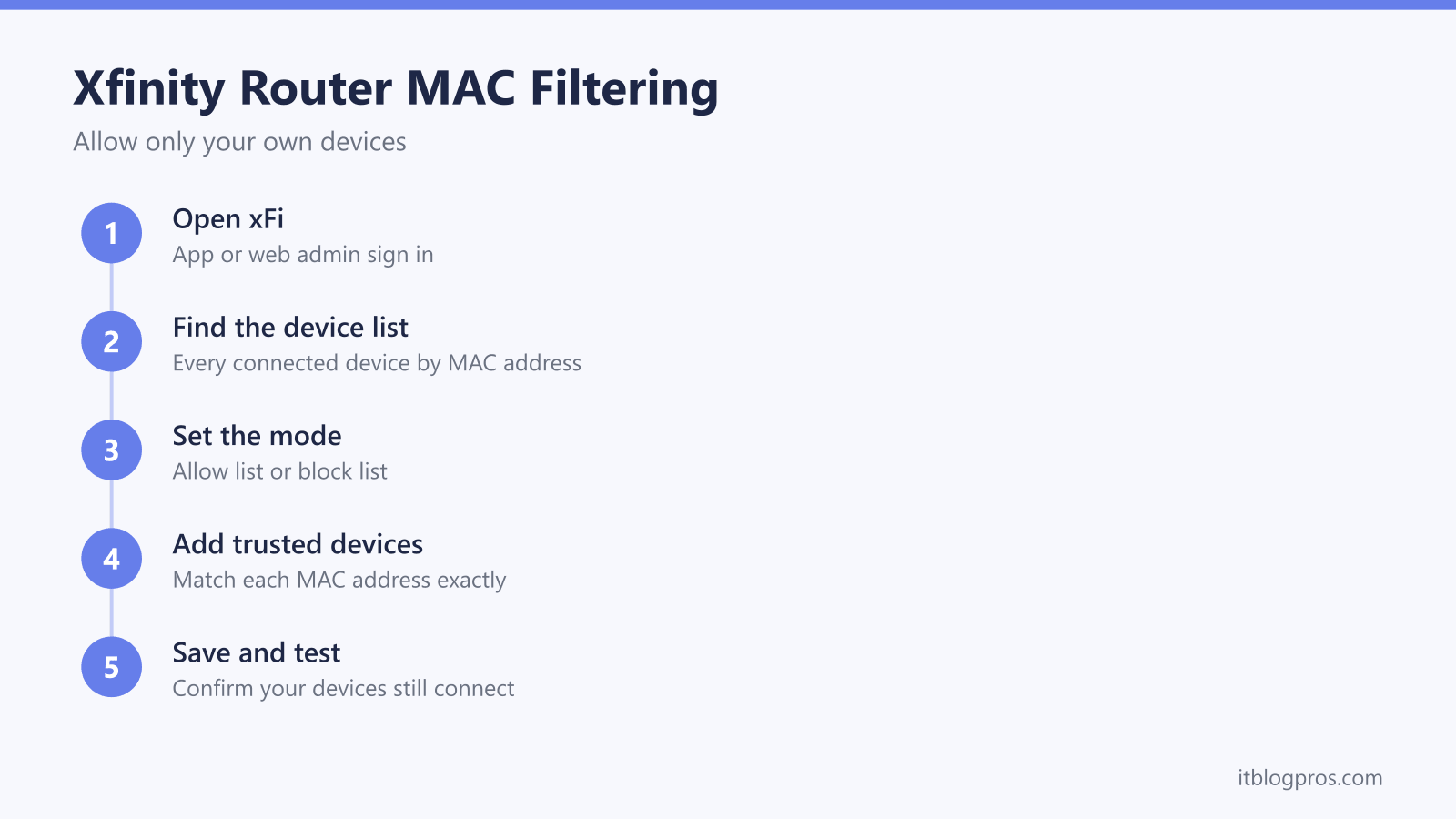
The xFi app is the primary place to manage this on current Xfinity gateways, and the general flow looks like this:
- Open the Xfinity app and go to the Connect tab, which shows the devices currently on the network.
- Tap through to view the full list of connected devices rather than just the shortlist on the main screen.
- Find the device by its network name. Xfinity usually labels devices sensibly (a phone model, a laptop brand, a smart TV), but an unfamiliar entry can be checked against its MAC address if the name alone is not conclusive.
- Select the device and choose the option to add it to the allow list, or to block it, depending on which mode is in use.
- Save the change and give it a minute to apply, then test by having the device attempt to reconnect.
Menu wording shifts slightly between app versions and gateway models, so if a specific screen looks different from what is described here, Xfinity's own support site (xfinity.com/support) has the current walkthrough for the exact hardware in use. Devices that are managed on a separate network, such as one running in bridge mode with a personal router, are controlled through that router's own settings instead of the xFi app.
Finding a MAC address on common devices
Adding a device to an allow list by hand, rather than picking it out of a list the app has already seen, means tracking down its MAC address first. The exact screen varies by device, but the general locations are:
- iPhone or iPad: Settings, General, About, then look for Wi-Fi Address.
- Android phone: Settings, About Phone, Status (sometimes labeled Status Information), then look for Wi-Fi MAC Address. The exact path varies by manufacturer and Android version.
- Windows laptop: Settings, Network and Internet, Wi-Fi, select the connected network, then Hardware Properties for the physical address.
- Mac laptop: System Settings (or System Preferences), Network, select Wi-Fi, then Details or Advanced for the hardware MAC address.
- Smart TVs, consoles and streaming boxes: usually under a Network or About Device settings menu, though the exact wording differs by manufacturer.
A MAC address is written as six pairs of characters separated by colons or hyphens, such as 3C:5A:B4:9F:12:0E.
The honest limitation: MAC filtering is not strong security
MAC filtering deters casual freeloaders and gives parents a workable way to manage which devices connect, but it should not be relied on as a real security measure. A MAC address broadcasts in the clear as part of normal WiFi traffic, which means anyone running basic network-scanning software can see the MAC addresses already allowed on a network and then reconfigure their own device to copy one, a technique known as MAC spoofing. Once spoofed, that device looks identical to the trusted one as far as the filter is concerned.
This does not make the feature pointless. It stops the average neighbor from hopping on, and it is genuinely useful as a parental-control layer for managing which household devices are online. It simply is not a substitute for a strong, unique WiFi password using WPA2 or WPA3 encryption, which remains the real barrier against unauthorized access. Readers weighing up how exposed their home network really is can start with what home WiFi safety actually depends on, which covers the encryption and password side of the picture in more depth.
The MAC randomization gotcha
The most common complaint about Xfinity MAC filtering, particularly with allow lists, is a phone or laptop that keeps getting treated as a brand-new unrecognized device even though it connects to the same home network every day. The cause is MAC randomization, sometimes called private WiFi address.
iOS, Android and current versions of Windows all generate a randomized MAC address for each WiFi network by default, as a privacy measure against tracking across different networks and locations. On some devices, particularly Android, that random address can rotate again periodically on the same network rather than staying fixed. From an allow list's point of view, a device that changes its MAC address looks like an entirely different, unlisted device, so it gets refused just like any other stranger.
The fix is to turn off private or random addressing for that one home network specifically, not for every network the device joins. Each operating system exposes this as a per-network toggle in the WiFi settings, usually labeled Private Address, Private WiFi Address or MAC Randomization, sitting on the same screen as the network's other details. Switching it off tells the device to use its real, fixed hardware MAC address on that network going forward, which is the address that should then be added to the allow list. This single setting resolves the vast majority of "device keeps getting kicked off" complaints tied to MAC filtering.
It is also worth checking what else on the network can already see connected devices and their activity before locking things down further; the guide on what Xfinity's xFi app can and cannot see about connected devices and browsing covers that separately. Anyone running their own router behind the Xfinity gateway instead of using xFi directly should also check the notes on setting up Xfinity bridge mode, since MAC filtering in that setup lives on the personal router rather than in the xFi app.