This guide explains what the lights on an EE router mean, what the colours on an EE router signify, and how to fix the EE internet problems behind each warning state.
These are both questions that we get asked a lot, and while we were researching this topic we found that there are not many definitive places out there to show EE users the answers, save for a few official EE resources.
If you want to upgrade your mesh WiFi system then be sure to look at our Best Mesh WiFi for EE Broadband article.
Finding out what do EE router lights mean doesn't have to be a long and arduous process: simply read our simple guide and find out for yourself exactly what each EE router light and colour of each light means.
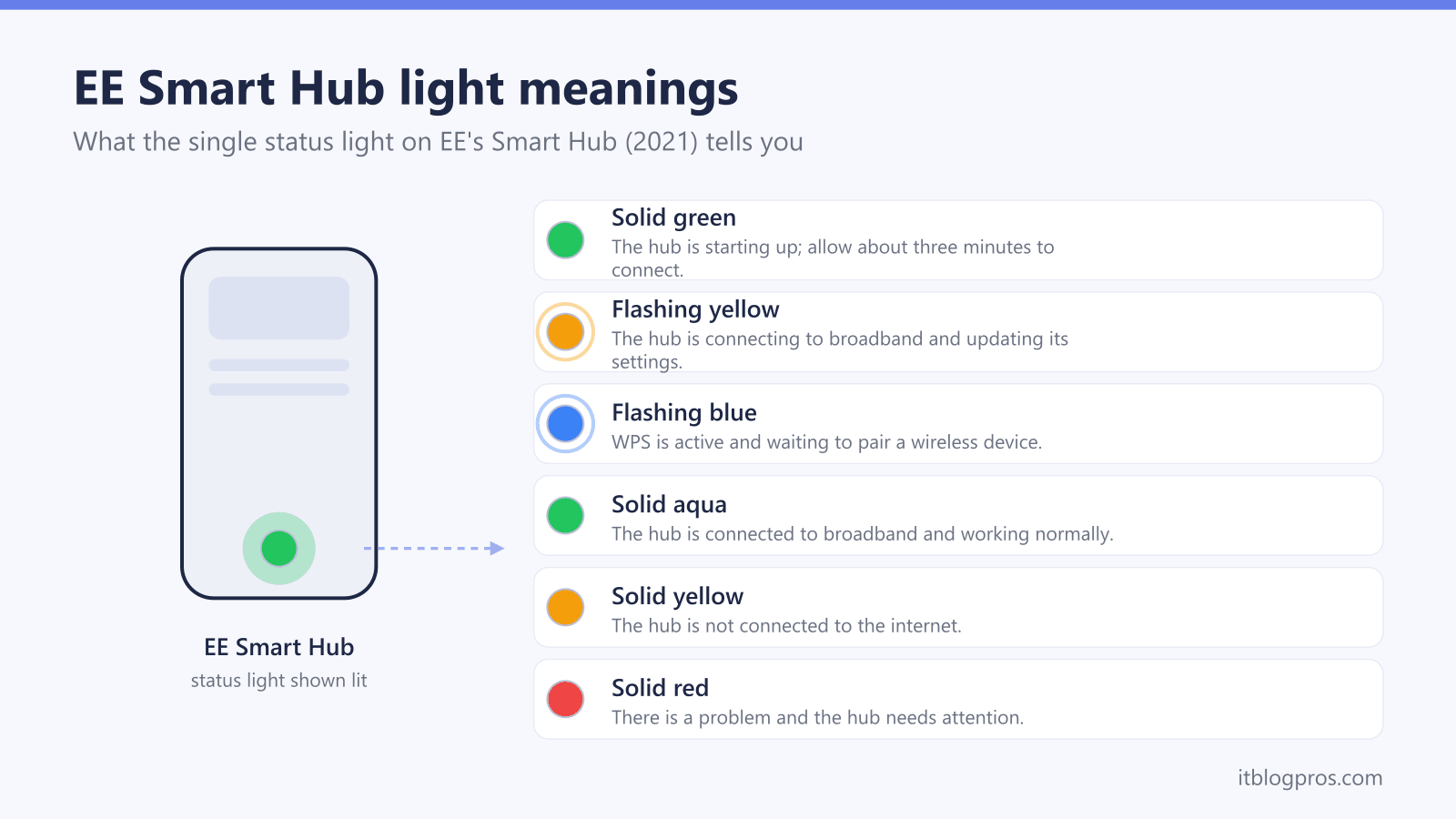
On a current EE Smart Hub, a steady aqua (teal) light means the Hub is connected and working normally. Solid orange means the hub is not connected to the internet, red is a separate fault, and flashing orange is the normal connecting state, so wait about three minutes for it to settle. Solid orange or solid red means no internet, while green is startup and flashing blue is WPS pairing. No light means no power.
Key Takeaways
- A flashing orange light is the normal connecting state; give the Smart Hub about three minutes to settle to steady aqua before treating it as a fault.
- Aqua (teal) is the all-clear colour on most current hubs, though the Smart Hub (2023) uses solid blue instead, and solid orange means no internet while red is a separate fault.
- Every EE hub EE still documents is covered separately here, because the colours differ by model: the Smart Hub 7 Pro, 7 Plus and 6 Plus signal in aqua, the Smart Hub (2023) uses blue and purple, and the Smart Hub (2021) and Smart Router use yellow in place of orange.
- A five-step fix ladder runs from a two-minute reboot through cable checks, EE service status and a factory reset, before escalating to EE on 0800 079 8586.
- The EE WiFi extender has its own light language and re-sync routine, and we explain when swapping in your own router over PPPoE is the honest long-term fix.
EE Smart Hub light meanings at a glance
| Light | What it means | What to do |
|---|---|---|
| Steady aqua (teal) | The Hub is connected to broadband and working normally. | Nothing to do. A steady aqua is the all-clear. |
| Flashing orange | The Hub is connecting to broadband, the normal startup-to-online state. | Wait about three minutes for it to settle to aqua. If it lasts past five minutes, power off for two minutes and reboot. |
| Solid orange | The Hub has finished trying and is not connected to the internet. | Work the fix ladder: reboot, check the cables and line, check EE service status, then factory reset. |
| Red | There is a problem somewhere. On the Smart Hub 7 Plus and 7 Pro red flashes and means low power mode. | Reboot, confirm the supplied power adapter is in use, stand the Hub upright with clear vents, then reset. |
| Green | The Hub is starting up and powering on. | Wait for it to finish booting. Frequent green flashes can mean an unstable power supply. |
| Flashing blue | WPS is active and the Hub is waiting for a device to pair. | Normal during WPS pairing. Press WPS on the device, or ignore it if you did not start WPS. |
| White | The Hub is running on Smart Hybrid Connect mobile backup, so the fixed line is down. | Check EE service status and work the fix ladder to restore the fixed-line connection. |
| No light | The Hub has no power. | Check the power cable and socket, and try a different socket. |
EE Smart Hub flashing orange: what it means and how to fix it
Flashing orange is the single most common EE Smart Hub light people search for, so we will lead with it. On a current EE Smart Hub and Smart Hub Plus, a flashing orange light means the Hub is connecting to broadband; it is the normal startup-to-online state, not a fault on its own. Give it at least three minutes to finish negotiating the line; when the Hub is ready and online the light settles to a steady aqua (teal).
If the light is still flashing orange after about five minutes, treat it as a stuck connection rather than a quick wait. Power the Hub off at the button, leave it off for two minutes, then power it back on and let it run through its green startup again. If it keeps flashing orange after a clean reboot, work down the fix ladder further below before we assume a line fault.
A quick word on the related states so there is no confusion: flashing orange is connecting, but a solid orange (or a solid red) means the Hub has finished trying and is not connected to the internet; that is the one that usually needs the full fix ladder or a call to EE.
What do EE Broadband Router Lights Mean?
Simply put, an unfamiliar pattern of lights on an EE router is worth looking up rather than guessing at, because the same colour can mean different things on different hubs. My EE is also an app that you can find on Google Play for Android and the Apple store which can help you with account related issues, technical settings and much more. The app also names your hub model and lets you turn the status light off, which is worth knowing before you treat a dark hub as a dead one.
We thought that this would be a great opportunity to help our readers and distill all of this information into a singular mega source of useful tips to help you figure out what the lights on your EE router mean.
How to reset your EE Smart Hub
If you want to perform a factory reset on your EE Smart hub then you have 2 options.
Option 1: Log into your router, navigate to the advanced settings option, then select 'Factory Reset' to restore the router back to its original configuration.
Option 2: Using a paperclip, locate the factory reset button and hold it in until the router reboots. Your router will default to how it was shipped from the factory.
Why broadband stops working
There are many reasons for broadband not to work. Check your internet connection. If you don’t get any errors from your ISP, try checking your internet connection. Turn off your modem or router, wait three minutes and turn it back on.
Try the same thing with your device or computer. Check that all of your Ethernet cables are properly plugged in, and that they are showing connectivity via a green or orange light.
How to fix the red light on your modem
It is possible to get your router working again with a number of really simple solutions.
They range from simple techniques such as restarting the device to more advanced ones such as performing a factory reset on your router.
What the colours mean on an EE router
Each router brand and model will be different, depending on the vendor that you have selected. See below for our definitive guide to the different colours of lights that you can expect to see on an EE router, and what each colour and state (flashing or not flashing) means.
This information could help save you precious time in getting connected back to the internet, so be sure to bookmark this article if you find yourself checking on the status of your router quite often.
If you are having problems consistently then be sure to contact EE to have them troubleshoot further than the scope of this article if you are really not coming right.
EE Smart Hub colour reference: every light state explained
Here is the precise colour reference for EE's current hubs, the Smart Hub 7 Pro, Smart Hub 7 Plus and Smart Hub 6 Plus, so you can match what you see at a glance. These three share one light language. The older hubs do not, so if yours is a Smart Hub (2023), a Smart Hub (2021) or a Smart Router, read the per-model sections below this one instead.
- Flashing orange: the Hub is connecting to broadband; wait about three minutes for it to settle to aqua.
- Solid orange: the Hub is not connected to the internet; this is the state that needs the fix ladder below.
- Red: there is a problem somewhere. This is a separate state from solid orange, and on the Smart Hub 7 Plus and 7 Pro it flashes rather than sitting steady, where it means low power mode.
- Green: the Hub is starting up; give it a couple of minutes to finish booting.
- Aqua (teal): the Hub is healthy and connected to broadband. If you are wondering what colour your EE Hub should be, this is the answer; a steady aqua is the all-clear.
- Flashing blue: the WPS button on the Hub has been pressed and it is waiting for a device to pair; this is normal during WPS pairing and is not a fault.
- White: an edge state that shows the Hub is running on a Smart Hybrid Connect mobile backup rather than the fixed line; if you see white when you expect aqua, your fixed broadband is down and the Hub has fallen back to mobile.
- No light: the Hub has no power, or the lights have been turned off in the settings; check the power button and the mains plug first.
Purple and yellow are both real EE states, just not on these three hubs. Purple belongs to the Smart Hub (2023), where a solid purple means Connectivity Backup is running and a flashing purple means the hub is not set up for Full Fibre. Yellow belongs to the Smart Hub (2021) and the Smart Router, where flashing yellow is the connecting state that orange handles on the newer hubs, and a steady yellow means no internet connection. Each of those has its own section below.
Every EE hub model and how to tell which one you have
EE's hub naming has changed more than once, which is why two guides to the same colour can disagree. Sorting that out first saves a lot of wasted rebooting. The model name is printed on the label on the back or the underside of the hub, and the EE app names it too.
On EE's own support pages the current line-up is three hubs, and EE publishes light guides for three older devices alongside them.
- Smart Hub 7 Pro: EE's top hub. WiFi 7 with tri-band technology, supplied with EE's 1.6Gbps Full Fibre plans or taken as an upgrade.
- Smart Hub 7 Plus: WiFi 7, dual band, capable of up to 1Gbps, the standard hub on EE's faster Full Fibre packages.
- Smart Hub 6 Plus: WiFi 6 and dual band, standard for new part fibre customers. EE's own device help page uses "Smart Hub Plus" and "Smart Hub 6 Plus" for the same hardware, model SH31B on part fibre and SH32B on Full Fibre, so a hub badged Smart Hub Plus is this one.
- Smart Hub (2023): the previous generation, and the one that breaks the pattern by signalling in blue and purple rather than aqua.
- EE Smart Hub (2021) and Smart Router: the older pair, still documented by EE, and the reason yellow shows up in so many EE light searches.
There is no current EE hub called simply the Smart Hub Pro or the Smart Hub Plus. Both names circulate, but EE's comparison page and its light guides now list only the numbered models, and the Smart Hub Plus name maps onto the Smart Hub 6 Plus.
EE Smart Hub 7 Plus and Smart Hub 7 Pro light states
| Light | What it means | What to do |
|---|---|---|
| Solid aqua | The hub is connected to broadband. | Nothing to do. If devices still cannot get online, reconnect them with the network name and password on the hub, or restart the hub for two minutes. |
| Flashing orange | The hub is connecting to broadband. | Give it at least three minutes. If it keeps flashing, reseat the cable with red ends at the socket marked WAN or 4 on the hub and at the Openreach modem's Port 1 or LAN1 socket. |
| Solid orange | The hub is not connected to the internet. | Power the hub off for two minutes and back on, check your activation date has passed, then check EE service status. |
| Green | The hub is starting up. | Wait three minutes for aqua. If it stays green, restart the hub, then hold the Reset button for around 20 seconds. |
| Flashing red | Low power mode. | Restart the hub, confirm the supplied power adapter is in use and seated at both ends, stand the hub vertical with the vents clear, then reset it. |
| White | Connectivity Backup, also called Smart Hybrid Connect, is in use and the hub is on the mobile network in resilience mode. | No action needed while the fixed line is down. The light returns to aqua once broadband is restored. |
| Flashing blue | The WPS button on the hub has been pressed. | Press or select the WPS option on the device you are pairing. |
| No light | The hub is powered off, or the light has been turned off. | Check the power cable and the Power button, then check whether the light was disabled in the EE app. |
The two WiFi 7 hubs share one light language, so a single table covers both. Two of these states behave differently from every older EE hub, and both catch people out.
The first is red. On the Smart Hub 7 Plus and 7 Pro, red flashes rather than sitting steady, and it means low power mode rather than a broken line. Rebooting on its own rarely fixes it, because the cause is usually power or heat. Power the hub off for two minutes and back on, then confirm the power adapter in the socket is the one EE supplied and that it is seated firmly at both the mains and the hub. Then stand the hub vertically and clear anything covering the vents, because these hubs throttle when they cannot shed heat. If flashing red survives all that, hold the Reset button for around 20 seconds until the light turns green.
The second is the cable check behind a flashing orange that will not settle. Both WiFi 7 hubs sit behind an Openreach modem, so the cable that matters is the one with red ends. One end belongs in the socket marked WAN or 4 on the back of the hub, the other in the Openreach modem's Port 1 or LAN1 socket. Reseat both ends before assuming a line fault, then check EE service status.
White on these hubs is worth naming precisely. EE labels it Connectivity Backup on the Smart Hub 7 Plus page and Smart Hybrid Connect on the Smart Hub 7 Pro page, but it is the same thing: the fixed line is unavailable and the hub has switched to the mobile network in resilience mode.
EE Smart Hub 6 Plus light states
| Light | What it means | What to do |
|---|---|---|
| Solid aqua | The hub is connected to broadband. | Nothing to do. If a device still cannot get online, move it closer to the hub or restart the hub for two minutes. |
| Flashing orange | The hub is connecting to broadband. | Wait three minutes. On part fibre, check the broadband cable at the socket marked Broadband, the filter and the phone socket. On Full Fibre, check the cable with red ends at WAN or 4 and at the Openreach modem's Port 1 or LAN1. |
| Solid orange | The hub is not connected to the internet. | Restart the hub, confirm your activation date has passed, then check EE service status. |
| Solid green | The hub is starting up. | Wait three minutes for aqua. If it stays green, restart the hub, then hold the Reset button for around 20 seconds. |
| Solid red | There is a problem somewhere. | Restart the hub, confirm the correct power supply is connected securely, stand the hub vertical with the vents unblocked, then reset it. |
| Solid white | A Smart Hybrid Connect (Connectivity Backup) device is in use, so the hub is running on mobile. | No action needed. Restore the fixed line to return the light to aqua. |
| Flashing blue | The WPS button on the hub has been pressed. | Press or select the WPS option on the device you are pairing. |
| No light | The hub is powered off, or the light has been turned off. | Check the power cable and the Power button, then check whether the light was disabled in the EE app. |
The Smart Hub 6 Plus keeps red as a steady colour rather than a flashing one, and EE's meaning for it is deliberately broad: there is a problem somewhere. Work it the same way as low power mode on the WiFi 7 hubs, because the underlying causes overlap. Power off for two minutes, confirm the correct power supply is connected securely, stand the hub upright with the vents unblocked, then hold Reset for around 20 seconds if it still will not clear.
Flashing orange on this hub splits by service type, which is the detail most guides miss. On part fibre or copper, the broadband cable goes into the socket marked Broadband on the hub, the other end into the broadband filter EE supplied, and the filter into the phone socket. EE adds one exception that is easy to get wrong: if your Openreach socket already has a filter built in, a double master socket, do not add the supplied filter as well. On Full Fibre the path is different again, running from the socket marked WAN or 4 on the hub to the Openreach modem's Port 1 or LAN1 socket.
Solid green here is startup and it should not last. Give it three minutes to reach aqua. A green light that never moves on is the signal to restart, then reset.
EE Smart Hub (2023) light states use blue and purple
| Light | What it means | What to do |
|---|---|---|
| Solid blue | The hub is connected to broadband. This hub uses blue, not aqua, as its healthy colour. | Nothing to do. |
| Flashing orange | The hub is connecting to broadband. | Wait three minutes, then check the broadband cabling for your service type before assuming a fault. |
| Solid orange | The hub is not connected to the internet. | Restart the hub, confirm your activation date has passed, then check EE service status. |
| Flashing purple | The hub is working but is not set up for Full Fibre broadband. | Check the cable with red ends is secure at the socket marked WAN or 4 and at the Openreach modem's Port 1 or LAN1, and try the next modem port along. |
| Solid purple | A Connectivity Backup device is in use and the hub is on the mobile network in resilience mode. | No action needed while the fixed line is down. |
| Green | The hub is starting up. | Wait three minutes for blue. If it stays green, restart the hub, then press the Reset button. |
| Red | There is a problem somewhere. | Restart the hub, confirm the correct power supply is in use, keep the vents clear, then reset it. |
| No light | The hub is powered off, or the light has been turned off. | Check the power cable and the Power button, then check whether the light was disabled in the EE app. |
This is the hub that breaks the aqua rule. On the Smart Hub (2023), EE says a solid blue light is the connected and working state. There is no aqua on this model at all, so anyone with a 2023 hub waiting for the light to turn aqua will wait indefinitely while the hub is already perfectly healthy.
Purple is the other difference, and it carries two entirely separate meanings depending on whether it is steady or flashing. Getting them the wrong way round sends you down the wrong fix, so they are worth separating clearly.
A flashing purple light means the hub is not set up for Full Fibre
Flashing purple on the Smart Hub (2023) means the hub is working but is not set up for Full Fibre broadband. The hub is alive and serving WiFi; what it cannot see is the Full Fibre connection it expects. EE's fix is a cable check at the Openreach modem: make sure the cable with red ends is securely connected to the socket marked WAN or 4 on the back of the hub and to the modem's Port 1 or LAN1 socket. If the modem has more than one port, EE suggests trying the next socket along and checking the lights again.
Solid purple means something else entirely. A steady purple shows a Connectivity Backup device is in use and the hub is running on the mobile network in resilience mode. On the newer hubs that same condition shows as white, which is why the two generations look so different during an outage.
EE Smart Hub (2021) and Smart Router light states use aqua and yellow
| Light | What it means | What to do |
|---|---|---|
| Solid aqua | The hub or router is connected to the internet. | Nothing to do. |
| Flashing yellow | The hub or router is connecting to broadband. | Give it at least three minutes to connect. The light turns aqua when it is ready. |
| Flashing aqua | The broadband cable is not connected, or the device has not been able to connect to broadband. | Check the broadband cable at the Broadband socket, the other end at the supplied filter, and the filter at the phone socket. Make sure any other phone on the line has its own filter. |
| Solid yellow | The hub or router is not connected to the internet. | Connect a device and follow the setup wizard, restart for two minutes, check your activation date, then check EE service status. |
| Green | The device is starting up. The Smart Router flashes green here, while the 2021 hub sits steady green. | Wait three minutes for aqua. If it stays green, restart, then hold Reset for around 20 seconds. |
| Red | There is a problem somewhere. | Restart for two minutes, confirm the correct power supply, keep the device vertical with clear vents, then reset it. |
| WPS flashing blue | The device is waiting for you to select WPS on the device you are pairing. | Press or select WPS on that device. |
| WPS flashing red | The WPS pairing did not connect. | Give it a couple of minutes and try again. |
| No light | The device is powered off, or the light has been turned off. | Check the power cable and the switch, then check the light setting in the hub manager at 192.168.1.254. |
On these two older devices, yellow does the job that orange does on every newer hub. Flashing yellow is the connecting state, and EE's instruction is to give it at least three minutes; the light turns aqua when the device is ready. A steady yellow is the failed version of the same thing, meaning the device is up but is not connected to the internet. Anyone reading a yellow light as a warning colour on these models is misreading it, because flashing yellow is entirely normal during startup.
Flashing aqua is unique to this pair and it is the most useful state on the list, because it points straight at the cable rather than at the line. On the Smart Router, EE says flashing aqua means the broadband cable is not connected. On the EE Smart Hub (2021), EE phrases it as the hub not having been able to connect to broadband, and the checks are the same either way: the broadband cable seated firmly in the Broadband socket, the far end in the supplied broadband filter, and the filter itself in the phone socket. EE also asks you to disconnect any other phone on the line, or make sure each one has its own filter, because an unfiltered handset is a common cause.
The Smart Router differs from the 2021 hub in one more place. Its startup colour flashes green, where the 2021 hub holds a steady green. Both should reach aqua inside three minutes.
The Connectivity Backup device has its own lights
The white light on a Smart Hub 6 Plus or a Smart Hub 7, and the solid purple on a Smart Hub (2023), all report the same thing: the hub has fallen back to mobile. The box actually doing that work is a separate device. EE calls it Connectivity Backup, and the same feature appears as Smart Hybrid Connect on some hub light pages, which is why both names turn up in EE's own text. That device has two indicators of its own, and reading them is faster than guessing from the hub.
The central light on the Connectivity Backup device reads like this.
- Solid aqua: the device is paired with your hub, which is the healthy state.
- Flashing aqua: it is pairing with the hub right now, so let it finish.
- Flashing green: it is not paired with your Smart Hub. Check the hub is powered on and the device is properly attached.
- Solid green: the device is starting up.
- Solid orange: it is too far from the hub, so move it closer.
- Flashing red: it cannot connect to the hub. Use an Ethernet cable or move it nearer.
- Solid red: there is a problem with the device. Restart it, and contact EE if it does not clear.
The signal bar reports the mobile side separately. Flashing aqua on the bar means it is connecting to the network, and solid aqua means a good signal, with two or three bars counting as healthy. A bar that is only partly lit means the signal is weak and the device would do better in another spot. Solid white on the bar means mobile data is in use, and solid red means a problem with the device.
What a green light on an EE router means
We cover this question further down in the article so, spoiler alert ! A green light simply means that your EE router is powering on. If you are seeing this quite often then make sure that your power is stable for the device, and make sure it is not being bumped or jostled out of place.
Consider swapping power outlets and plug it into another power source if you are not getting a secure fit when plugging the power adapter into the wall.
Also make sure that you are using the correct power supply that was provided to you by EE when you initially received your EE router. Using anything other than the recommended power supply can cause issues with your router, and may cause damage.
What colour your EE Hub should be
The standard colour that shows that you are connected to the internet is aqua.
Why your EE Hub flashes orange
This means that your router is connecting to broadband, which is the normal startup behaviour rather than a fault. EE's own instruction is to give it at least three minutes to connect before doing anything. If it is still flashing after that, the next step is the cable check for your hub and service type, not a phone call; calling EE is the last rung of the fix ladder further down, once a reboot, the cable checks, service status and a factory reset have all been tried.
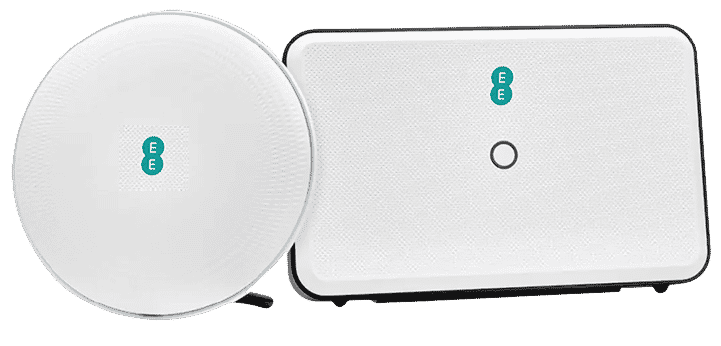
EE Routers Have LEDs For Diagnostics.
What the red light on your EE router means
We have collected all the important information about the EE router lights and their meanings below. This will help you to understand what's happening, and what you can do to try and identify the issues and then what to do next.
No light: Your EE router is not receiving power or your lights are off due to a configuration change in the EE router software.
If you haven't turned off the light yet, make sure the Hub's power button is on, the power cable at the mains is properly plugged in, and the power is on. Then you should contact EE on 0800 079 8586 for assistance if this does not resolve the problem.
Green light: The EE router/Hub has been powered on and is active, but is not ready yet.
You can only fix this issue by waiting for the startup process to finish for a couple of minutes.
Flashing yellow light: This indicates the EE router/Hub is connecting to broadband, on the Smart Hub (2021) and the Smart Router. It is not the connected state.
Waiting a few minutes and giving it a chance to connect is the easiest thing to do. The light will change to an aqua colour when it is ready and connected to the internet.
Flashing aqua light: The broadband cable is not connected, or the Hub has not been able to connect to broadband.
Check that the black broadband cable with grey ends is properly seated, and that your filter is installed if your installation came with one.
Yellow light: The Hub is up and running but there is no internet connection.
Using a cable or WiFi, connect a device to the Hub. Follow the on-screen help wizard to connect using the new web browser window.
Red light: Your router has detected an issue somewhere in the connection stream and cannot access the internet.
Use the power button to turn off and on your Hub again and then wait for it to start up.
Press a paper clip on your Hub's factory reset button while it is on if the light still doesn't turn aqua.
The light should turn green again after 20 seconds of holding the reset button down.Once you release the factory reset button the EE router will commence its factory restore.
Call EE on 0800 079 8586 if you still have the same issues after rebooting your router as there might be an issue in your area that cannot be resolved without a service team checking it out.
Aqua light: This light means that the Hub is working fine.
When you can't connect to the internet, there may be a problem with your computer, tablet, or mobile device. Restart the device and try again. If you’ve still got a problem, then you should check that you can connect to the internet by connecting an Ethernet cable directly to your EE router.
WPS button light: You have two minutes to press the WPS button on your computer or device if the blue light on the WPS button is flashing. Try again in a couple minutes if it's flashing red. It's connected if the light doesn't flash.
EE WiFi extender flashing aqua or orange: how to re-sync it
The EE WiFi extender (the booster that pairs to the Smart Hub to widen coverage) is a separate device with its own light, so it is worth treating on its own. People often see it flashing and assume the Hub is broken when the issue is really the link between the two. EE currently names these the WiFi Extender 7 Pro and the WiFi Extender 6 Plus, and both use the same light language.
- Green on the extender: it is starting up, which takes about a minute. Let it finish before reading anything into it.
- Flashing orange on the extender: the extender is not connected to your Smart Hub. This is the state to re-sync, using WPS or an Ethernet cable.
- Solid orange on the extender: it is working, but the signal could be better; move the extender closer to the Hub, or closer to another extender if you are running more than one, roughly halfway between the Hub and the dead zone.
- Flashing blue on the extender: it is connecting over WPS right now. Give it a couple of minutes to finish rather than pressing anything else.
- Aqua on the extender: the link is good over WiFi or Ethernet. Steady aqua is the only colour that confirms a healthy, connected extender, and EE does not document a flashing aqua state on these units, so treat a flashing aqua as still pairing and let it settle.
- Red on the extender: there is a problem; power both the Hub and the extender off and back on, and if the light still will not turn aqua, press the extender's factory reset button.
To re-sync the extender to the Hub: press the WPS button on the Smart Hub, then within two minutes press the WPS button on the extender. The extender light flashes blue while it negotiates and turns steady aqua when the link is healthy. If you would rather not rely on the wireless backhaul at all, an Ethernet cable run from the Hub to the extender gives the same solid aqua and a far steadier connection.
EE Smart Hub fix ladder: work through these in order
When the lights point to a problem (solid orange, solid red, or flashing orange that will not settle), work down this ladder in order; most faults clear in the first two steps.
- Reboot the Hub. Power it off at the button, wait two minutes, then power it back on and let it run through green startup to aqua.
- Check the line and cables. Make sure the broadband cable is firmly seated at the Hub and at the master socket or Openreach socket, with any microfilter fitted, and reseat both ends.
- Check EE service status. Confirm there is no known outage in your area on the EE service status checker before you change anything else; if the fault is at EE's end, no amount of resetting will fix it.
- Factory reset the Hub. If the lights still will not reach aqua, hold the recessed reset button with a paperclip until the Hub reboots and restores its factory configuration, then let it reconnect.
- Escalate to EE. If a clean factory reset still will not hold aqua, call EE on 0800 079 8586; a persistent fault usually needs a line check that is beyond what we can do from the front of the Hub.
When an upgrade is the honest fix
Sometimes the lights keep faulting no matter how often you reboot, and a factory reset simply will not hold for more than a day or two. When you reach that point, the durable fix is usually to stop fighting an ageing Hub and run your own router instead. EE lets you connect your own kit over PPPoE, so a full swap is realistic; you keep the EE line and just put a more capable, more stable router in front of it.
For most homes our all-rounder pick is the TP-Link Archer BE550. TP-Link lists it as a tri-band WiFi 7 router with a dedicated 2.5 Gbps WAN port and four 2.5 Gbps LAN ports, and its spec sheet includes PPPoE among the WAN connection types, so it can take the PPPoE route described above. Our best router for EE broadband guide runs through this pick and the value alternatives in full, with the honest PPPoE setup for running your own router on an EE line.

If the budget is tighter, the TP-Link Archer AX55 is a WiFi 6 router at a friendlier price and the easy value choice. If the real problem is patchy coverage rather than a flaky Hub, a mesh such as the TP-Link Deco X10 run in access-point mode behind your EE Hub is the safest way to kill dead zones without touching the EE connection at all. Our guide on wired extenders versus mesh and our best mesh systems ranked by real reviews walk through the trade-offs in more detail. If the lights themselves are what keep tripping you up across different routers, our router lights guide covering every colour and fix is the hub we keep updated, and if the real symptom is weak signal rather than a dead Hub, our note on WiFi only showing two bars is the faster read.
Let's be straight about what this does: none of these will raise the speed EE delivers to your line. What they do fix is reliability, control and coverage, which is most of what those recurring light errors are really about.
Wrapping up
Thank you for reading our article about EE routers and connectivity issues, and we hope that you have found the answers that you are after. Be sure to check in with us again over the next few weeks as we continue to grow our site.