Sky Broadband Hub Lights Explained. We have put together this article to get the lights on your Sky hub explained. If your internet is not working then we can help.
Follow our light guide below and find the model that you are trying to diagnose. Simply check our Table of contents below, or find the picture of your router further down in the article.
If you are not on Sky, our wider router lights guide covering what every colour means and how to fix it maps the same light states across every major UK provider.
Good luck!
Key Takeaways
- You'll learn what each light colour and flashing pattern means across every Sky hub generation, from the original Sky Hub to the white Sky Max Hub (SR213).
- We explain why a dark middle internet light on older multi-LED hubs usually points to a line fault rather than a failed hub, and which checks to run first.
- The guide covers the everyday fixes to try before calling Sky, including rebooting, checking cables and the master phone socket, and confirming whether there is an outage in your area.
- You'll see how factory reset timings differ between models; Sky's guides give the white Max Hub a thirty-second WPS hold and document a Reset button on it as well, while the older SR203 has a Reset button on the back.
- We cover how to sort patchy coverage and dead zones once the connection is stable, using a mesh system in access-point mode behind the Sky hub.
Sky hub light meanings at a glance
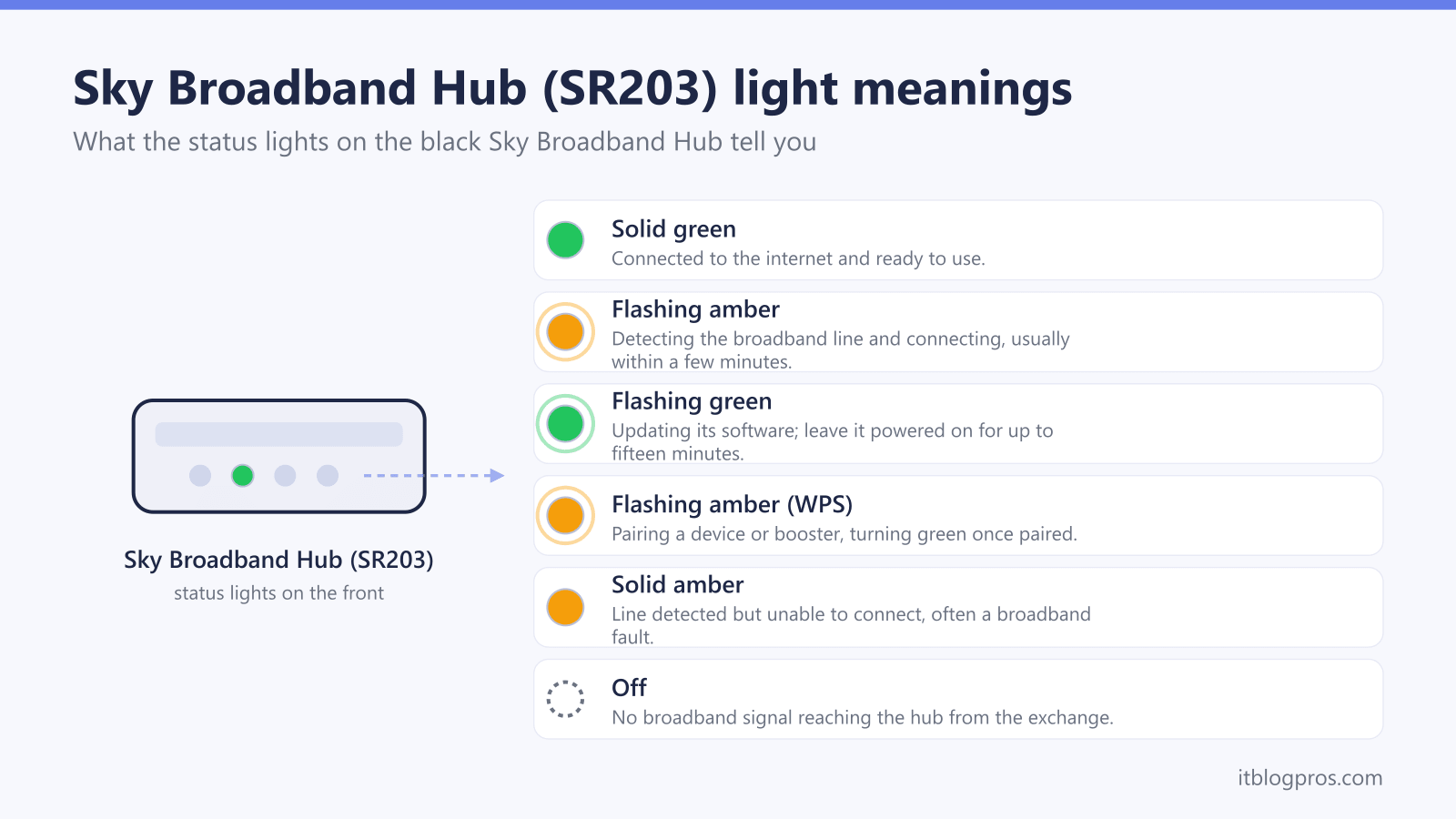
The Sky Max Hub (SR213) and the older Sky Broadband Hub (SR203) use different light schemes, so match the table to the hub you have.
| Light | What it means | What to do |
|---|---|---|
| Solid white | The hub is set up and connected to the internet. | Nothing to do. |
| Solid amber | The hub is powering up and turns white once it connects. | Give it a few minutes before touching anything. |
| Flashing amber | The hub is authenticating with Sky's network. | Wait a few minutes; use Service Checker if it never turns white. |
| Flashing green and amber | A software update is running. | Leave the hub alone; Sky puts this at about fifteen minutes. |
| Solid red | Sky treats this as a fault on the hub or the line. | Sign in to Service Checker so Sky can test the connection and setup. |
| Slowly flashing green | The hub has been authenticated and is about to come online. | Wait; if it still flashes after five minutes, power cycle it, then use Service Checker. |
| Quickly flashing green | The hub is resetting. | Do not disconnect the power until it finishes. |
| Flashing blue | WPS pairing is active for two minutes. | Press WPS on the device you are pairing, or ignore it if you did not start WPS. |
| No light | No power is reaching the hub. | Check the plug, the cable and the mains socket, then restart. |
| Light | What it means | What to do |
|---|---|---|
| Solid green | Connected to the internet and ready to use. | Nothing to do. |
| Flashing amber | Detecting the broadband line and connecting, usually within a few minutes. | Wait for it to connect and turn green. |
| Flashing green | Updating its software. | Leave it; do not switch the hub off while it updates. |
| Flashing amber | The hub is trying to connect, which is normal while it starts up. | Press WPS on the device, or wait for pairing to finish. |
| Solid amber | The line is detected but the hub cannot connect, often a broadband fault. | Check for a Sky outage and the master-socket connection; the fault is usually on the line. |
| Solid red (power) | A hard fault where the hub is not reaching a usable state. | Power cycle the hub. If red persists, sign in to Sky Service Checker so Sky can run the line tests. |
Every Sky Hub Light State by Colour and Model
Sky documents the lights for five hubs, and the same colour rarely carries the same meaning across them. The white Sky Max Hub (SR213) puts everything on one multi-colour indicator, and Sky's Max Hub light page lists nine states for it. The black Sky Broadband Hub (SR203), the Sky Q Hub and the original Sky Hub instead use a row of separate power, internet and wireless lights, with the Broadband Hub adding a voice light on the end. Sky's help pages now cover a fifth unit as well, the Sky Gigafast+ Hub, and route it to exactly the same light explanations as the Max Hub. Find your colour below, then read the line for your model.
Flashing Orange or Amber Means the Hub Is Still Connecting, Not Updating
On the white Sky Max Hub, flashing amber means the hub is authenticating with Sky's network. Sky says it can take a few minutes and that the light stops flashing and turns white once the connection is live. Sky also lists amber, flashing amber and flashing green as normal for the first few minutes after a Max Hub is switched on, so an orange flicker straight after a power cut is expected behaviour rather than a fault.
On the black Sky Broadband Hub (SR203), a flashing amber internet light means the hub is trying to connect, which Sky says usually happens while it is starting up or just after a restart. The threshold Sky gives is five minutes. If the internet light is still flashing amber beyond that, sign in to Service Checker so Sky can test the line and the setup.
A flashing amber power light is a different state again, and it is shared across the Sky Broadband Hub, the Sky Q Hub and the original Sky Hub. Sky says it means the hub is in recovery mode, which can follow a software update. If it has been flashing amber for more than fifteen minutes, Sky's fix is a reset: hold Reset on the back of the hub until the lights on the front change; Sky's SR203UK guide puts that at about 10 seconds and its Sky Q Hub guide at up to 10 seconds, while Sky's phone help page gives 30 seconds or until the front lights blink for the black hub. Wait a few minutes for the lights to settle, then check the broadband is working. That reset returns the WiFi password to the default printed on the hub, so expect to re-enter it on every device.
One model exception is worth knowing. Sky labels the Sky Q Hub internet light states as off, green and amber rather than listing flashing amber separately, though its own amber guidance illustrates a flashing light, so treat a flickering orange Q Hub light as the amber state.
Solid Amber Means Powering Up on the Max Hub and a Fault on the Older Hubs
This is the single biggest split between the generations, and it is where most second-hand advice goes wrong.
On the Sky Max Hub, a steady amber light means the hub is powering up. Sky's wording is that it can take a few minutes to start up and that the light turns white once it is connected. Nothing is broken, no reset is needed, and the fix is simply to wait.
On the older hubs, amber is a fault colour. Sky sends a solid amber internet light on the Sky Broadband Hub (SR203) and on the Sky Q Hub to the same destination: a page saying there might be a problem, with Service Checker as the next step. On the original Sky Hub, a solid amber power light gets Sky's blunter wording, that there might be a fault with the hub, again with Service Checker to run the tests.
Flashing White Belongs to the Original Sky Hub, Not the Max Hub
A flashing white power light on the original Sky Hub means the hub is running a software update. Sky puts that at about fifteen minutes and asks you not to turn the hub off while it is happening. If it is still flashing white past fifteen minutes, Sky's steps are to switch the hub off and on again at the mains socket, wait a few minutes while it starts back up, and get in touch if nothing changes, because there may be a problem with the hub itself.
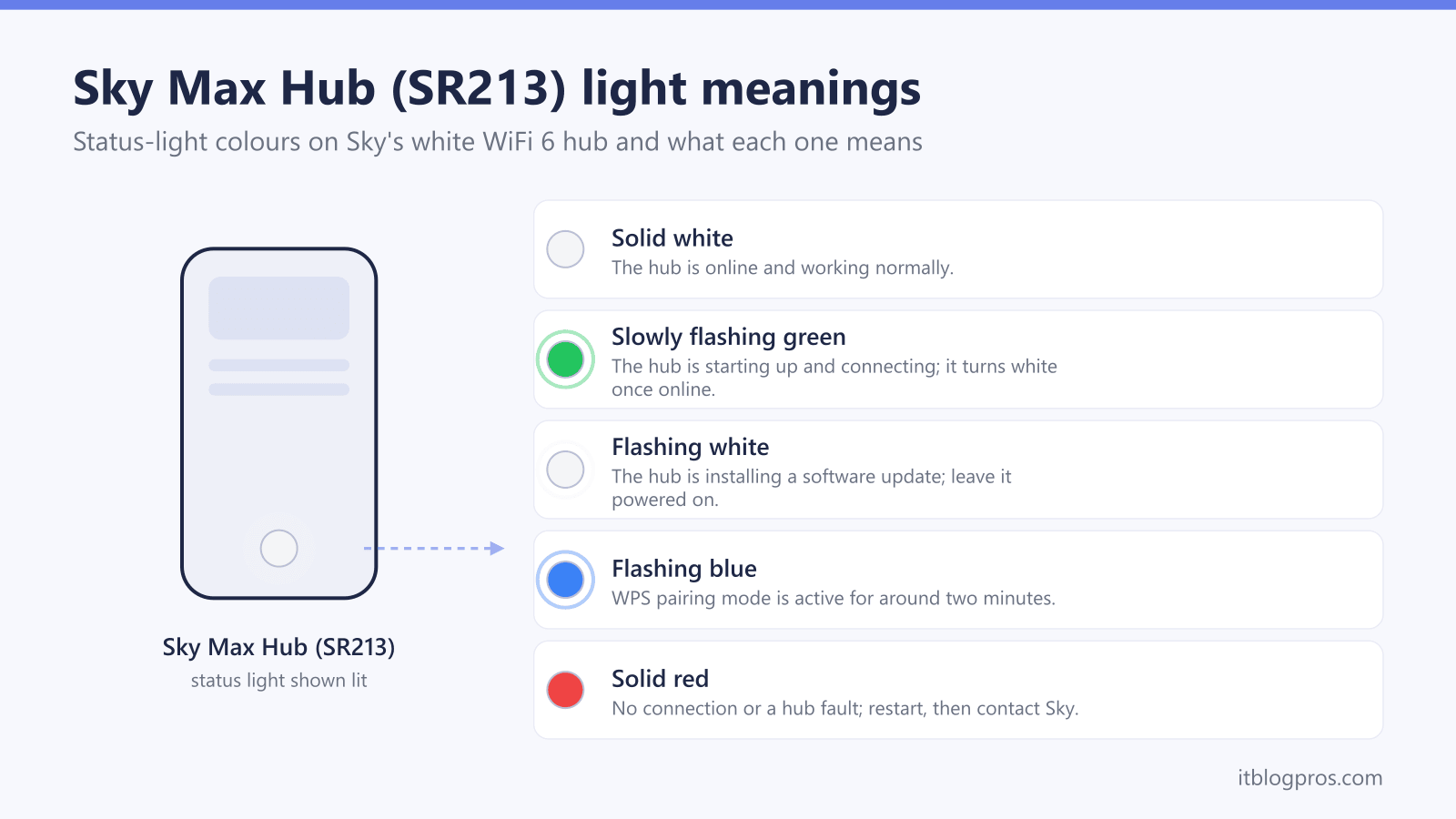
The white Sky Max Hub has no flashing white state in Sky's own list. Its documented states are off, white, red, flashing green and amber, flashing green, slowly flashing green, flashing blue, amber and flashing amber. If a Max Hub looks like it is flashing white, look again in better light, because the update state on that hub alternates green and amber.
Solid White Means the Connection Is Up on the Max Hub and the Original Sky Hub
Steady white on the Sky Max Hub is the everyday state. Sky's wording is that you are all set up and the hub is connected to the internet, so nothing needs doing.
On the original Sky Hub, white is spread across two lights, and a white power light next to a white internet light is the healthy pair. Sky adds a detail here that still catches people out: if the Sky+HD light is white too, the Sky+ box is connected and on demand is ready to use, and if that light is flashing, the box is downloading on demand content rather than reporting a broadband fault.
Flashing Green and Amber Together Means a Software Update on the Max Hub
The Max Hub signals an update by alternating green and amber. Sky says this usually takes about fifteen minutes, that the light stops flashing and turns white when it is done, and that you should not turn the hub off while it is running. Nothing here needs a reset, and cutting the power part way through an update is the one action that can turn a routine state into a real fault.
Flashing Green Means an Update on the Black Hub and a Reset on the White One
On the Sky Broadband Hub (SR203), a flashing green power light means a software update is running. Sky gives the same fifteen minute guide and the same warning about not switching the hub off part way through.
On the Sky Max Hub, green flashing carries two separate meanings, and the speed is what separates them. A quickly flashing green light means the hub is resetting, and Sky's instruction is not to disconnect the power while it is doing that. Sky ties the state to the Reset button being held for five seconds, and says holding it down for more than twelve seconds takes the hub all the way to a factory reset.
A slowly flashing green light on the Max Hub is the good version. Sky says the hub has been authenticated and will be ready in a moment, with the light turning white once the internet connection is live. Sky has since added a five minute rule to that page: if it is still slowly flashing green after five minutes there may be an authentication problem, so switch the hub off at the plug socket and back on, and use Service Checker if that does not clear it.
Solid Green Confirms a Working Connection on the Black Hubs
On the Sky Q Hub, a green internet light means you are all set up and the hub is connected to the internet. On the Sky Broadband Hub (SR203), green on the power light and then the internet light sends you on to the voice light, and green there means the hub is connected and the home phone service is ready to make calls.
Flashing Blue Is WPS Pairing, and Only on the Sky Max Hub
Sky documents blue on the Max Hub alone. It means WPS mode is active and the hub is ready to accept a device, so press WPS on the device you are pairing. The hub light flashes blue for two minutes while it tries, then stops. To go again, hold the WPS button on the hub for three seconds and let go.
The warning on that same Sky page is the one to read twice. Holding the WPS button for 30 seconds or more factory resets the hub, wiping any settings you have changed and putting the WiFi password back to the default Sky lists on the bottom of the hub and in the My Sky app. Three seconds pairs a device; thirty seconds wipes the hub.
Red Points at a Fault Sky Needs to Test on Every Generation
Red is the one colour that reads the same across the range, which makes it the easiest to act on. On the Sky Max Hub, Sky routes red to a page that says there might be a problem and hands you straight to Service Checker. On the Sky Broadband Hub (SR203) and the Sky Q Hub, a red power light gets the more specific wording that there might be a fault with the hub, with the same Service Checker route.
In every case Sky's documented next step is to sign in to Service Checker so it can run tests on the connection and setup, not to arrange a replacement hub yourself. If you are not the account holder on the line, Sky points to its general troubleshooting steps instead.
No Lights at All Is a Power Problem Until Proven Otherwise
Sky's order of checks for a completely dark hub rules out the cheap causes first, so it is worth following exactly. Switch the hub off at the mains. While it is off, check the power cable for damage, and confirm the plug socket itself works by trying another device in it. Switch the hub back on at the socket, then wait a few minutes for it to restart and the lights to return. If the lights are still off after that, Sky wants to run tests on the connection and setup.
The Voice Light on the Sky Broadband Hub Tracks the Phone, Not the Broadband
Only the Sky Broadband Hub (SR203) carries a voice light, and it reports on the home phone rather than the internet connection. Green means the hub is connected and the phone service is ready to make calls. Flashing green means an incoming landline call is arriving, which is normal behaviour and not a fault.
Amber on the voice light means the hub is connected to the internet but there is a problem with the home phone connection. Sky's fix is to switch the hub off at the plug socket for a few seconds, switch it back on, and wait a few minutes for the lights to return to normal, at which point the voice light should be green. If it stays amber after that, Sky asks you to get in touch.
A voice light that is off usually means nothing is wrong at all. Sky says it is off because Internet Calls is not part of your broadband package, Internet Calls being the arrangement where the home phone runs over the broadband connection instead of a traditional phone line.
Sky Broadband Problems and Solutions (Internet Fixes)
Sky Broadband Problems affect many users from time to time, as is the case with all internet service providers. An outage can be caused by many things, like a damaged cable coming into your home, a faulty junction or wall box, or even a faulty router.
Regardless of what the issue is, users throughout England, Ireland, Scotland and Wales sometimes report extremely slow speeds and disconnections.
This is not a unique problem that only applies to Sky Broadband, but it is helpful to have a resource for those users that are currently experiencing issues with the internet. We tackle some of the most common issues that Sky Broadband users experience, and how to resolve them.
Sky Broadband customers who think an outage is behind the problem should check the status of their services on Sky's service status page and contact Sky for an update if it reports a fault in their area.
Sky Broadband Down
The normal response that most people have if they’re having trouble with the Internet is to call their internet provider. This should rather be your last resort though, as fixing the issue for yourself can be far quicker, and sometimes doesn't even require much effort to do.
The first place to start is with your Sky router. Make sure that it is plugged in correctly, and that all of the status lights are flashing and blinking as they should.
It’s also important to check whether or not the issue is affecting anyone else near you, or if there is some Sky Broadband Maintenance on the go. If the problem is only happening to you, then it’s possible that the issue is with your equipment. You should try contacting the company again, but this time tell them about the other people experiencing the same problems.
Sky Broadband Outage
If you live in the UK or Ireland, and you use Sky Broadband, then you might have experienced an outage for yourself. Here is the Sky Broadband Outage page if you are currently experiencing problems with your internet.
So what can you do? Well, the best thing to do is to wait for the issue to get fixed if it appears to be an issue in your area. But, this may take a while. In the meantime, you could try running through the basic steps that have the potential to fix your internet such as:
- Restarting your router
- Check all the cables are plugged into your router
- Check your router's power
- Check that your router's settings are ok.
Sky Broadband Issues
If your internet light is off then you will need to contact Sky Broadband Support to take a look at your connection and Sky Broadband Status. This could be a fault on your line, so it is a good idea to get confirmation from them.
Navigate to https://www.sky.com/help/home and follow the prompts to explain your current internet problem that is preventing you from accessing the web.
After you have given all the necessary details, it's important to wait for a response.
Sky Broadband Router Lights Troubleshooting Guide.
Lights on Your Sky Hub Explained
Let's take a deep dive into the workings of your Sky Broadband equipment. We have gathered all the information that you need to get your internet back up and running by diagnosing the most common faults on your Sky Broadband routers.
Sky Hub
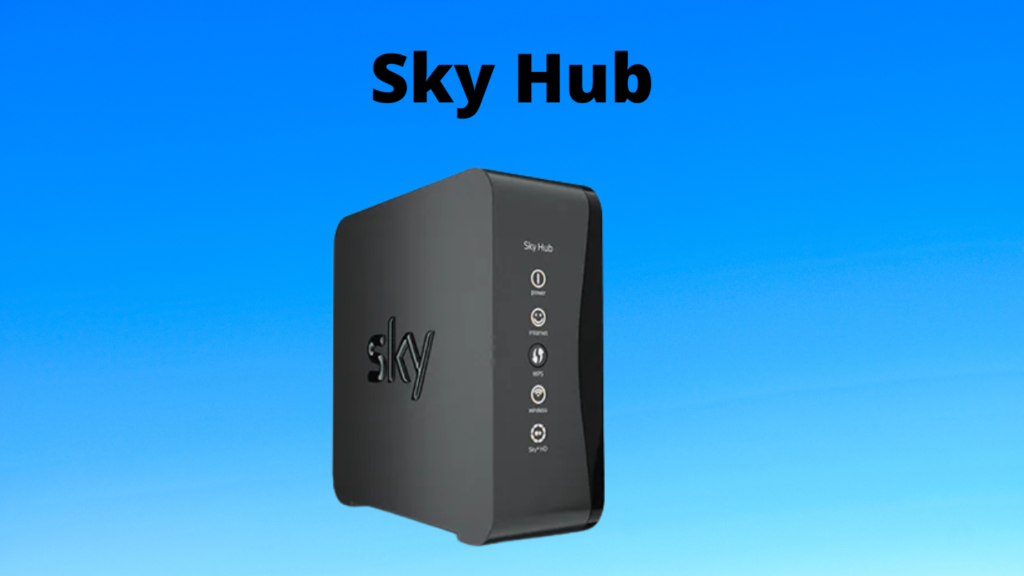
Lights on Your Sky Hub
Below is a quick reference intended for you to find and resolve issues based on your Sky Hub's lights, or lack thereof.
Problem: All Your Sky Hub Lights Are Off.
Solution: Check Your Hub and Its Power.
Power off your mains plug. When your hub is off at the mains, check the following:
- Your hub is securely connected to the blue power cable.
- A cable or plug doesn't appear to be damaged, and the device is plugged in.
- You might have a defective main wall socket or extension lead - Try plugging in another device or appliance into the socket to verify.
Switch your hub back on and wait a few minutes for it to fully restart and all the lights to return to normal. If your lights are still off then you will need to head to Sky Broadbands website and perform some additional checks.
Problem: Your Internet Light Is White.
Solution: Check The Following Behaviour of Your White Light.
The Sky router is sending or receiving data, indicating that it is connected to the internet.
Sky TV on demand is ready to use if the Sky+HD light is white too. On-demand content is downloading if the light flashes on your Sky box.
Problem: The Power Light Is Flashing White.
Solution: Observe Your White Flashing Light's Behaviour.
It's your lucky day! It means your Hub is updating its software.
You shouldn't turn your hub off during the update, which takes up to 15 minutes.
If the hub has been flashing for more than 15 minutes, Sky's steps are to switch it off and on again at the mains socket and wait a few minutes while it starts back up. If nothing changes after that, there may be a problem with the hub itself, and Sky's own hub lights guide routes you to Service Checker.
Problem: The Power Light Is Amber.
Solution: Your Hub May Be Malfunctioning.
In order to make sure your connection and setup are working, Sky will need to run some tests. Whenever they find a problem, Sky will show you how to fix it.
Problem: The Power Light Is Flashing Amber.
Solution: Possible Factory Reset.
Your hub is in recovery mode, which Sky says can happen after a software update. Give it fifteen minutes before doing anything, because that is Sky's own threshold for the state clearing on its own.
If it is still flashing amber past fifteen minutes, resetting is Sky's fix: hold Reset on the back until the lights on the front change, wait a few minutes for the lights to settle, then check the broadband is working. Sky's setup guides for the original Sky Hub name no hold time for this model, so let the lights tell you when it has taken. Have your account details to hand, and expect the WiFi password to go back to the default printed on the hub.
Sky Q Hub
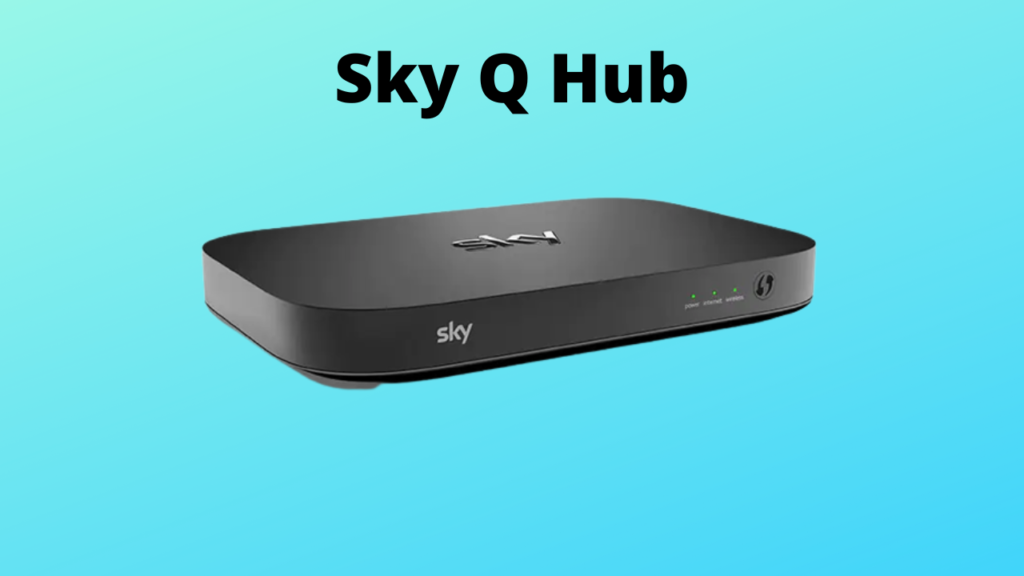
Sky Q Lights and Their Meanings
Many users sweat by their Sky Q Hub units. They are sleek looking, highly versatile, and they just seem to work. That is, until they don't anymore. Here are some common Sky Q Hub lights that users complain about, and how you can go about fixing them.
Problem: All Your Sky Q Hub Lights Are Off.
Solution: Check Your Sky Q Hub and Its Power.
Power off your mains plug. When your hub is off at the mains, check the following:
- Your hub is securely connected to the blue power cable.
- A cable or plug doesn't appear to be damaged, and the device is plugged in.
- You might have a defective main wall socket or extension lead - Try plugging in another device or appliance into the socket to verify.
Switch your hub back on and wait a few minutes for it to fully restart and all the lights to return to normal. If your lights are still off then you will need to head to Sky Broadbands website and perform some additional checks.
Problem: No Connection or Slow Wi Fi (internet Light Is Off or Amber)
Solution: Make Sure Your Hub Is Set up Correctly
You should connect your hub to your master phone socket for best speeds and stability.
It is usually found near the entrance to your house where the telephone line enters. The socket should have a line in the middle, a BT/Openreach logo, or be thicker than the others.
If you are still having issues then take a look at this article on the Sky Broadband site for more information.
Problem: The Power Light Is Red
Solution: Reboot your Sky Q Hub
If you are seeing a Red Power Light then the chances are quite high that you have a hard fault with your hub. When this happens, there isn't a whole lot that can be done, as the router is not powering on into a usable state.
Sky have put together this guide to help you navigate this issue if you are currently experiencing it for yourself.
Problem: Power Light Flashing Amber
Solution: Factory Reset
There is a problem with your hub. A software upgrade can sometimes cause this problem. You can try resetting your hub by following these steps:
- Hold the reset button on the back of your hub until the power light begins to flash green, which Sky's Sky Q Hub guide says can take up to 10 seconds.
- Make sure your broadband is working after the lights have returned to normal.
If you've changed your WiFi password, this will reset it to its default value. These settings can be changed again easily.
Middle LED Off on Older Multi LED Sky Hubs
The older Sky hubs, namely the original Sky Hub and the Sky Q Hub, carry a row of separate lights rather than one single indicator. On these models you get a power light on one side, an internet light in the middle, and a wireless light on the other side. Knowing which light is which matters, because the most common worry on these units is the middle light dropping out while the others stay lit.
When the power light and the wireless light are on or green but the middle internet light is off, the hub itself is healthy; it has mains power and it is broadcasting WiFi, so your devices can still connect to the hub. What it is not getting is a working broadband signal from the exchange. In plain terms the box is fine and the line into it is the problem; that is why local devices show "connected, no internet".
Work through these checks before assuming the hub has failed:
- Confirm there is no outage in your area on the Sky service status page, since a dark middle light often tracks a line fault rather than a hardware fault.
- Check the broadband cable from the hub to your master phone socket is seated firmly at both ends, and that nothing looks damaged or kinked.
- Reboot the hub by switching it off at the mains, waiting roughly ten seconds, then switching it back on; give it two to three minutes for the middle light to re-establish before judging the result.
- If a reboot does not bring the middle light back, a factory reset is the next step; our walkthrough on how to reset a Sky broadband router quickly and easily, including third party Sky routers covers the exact button timings for each hub generation.
If the middle light stays off after a reboot and a reset, the fault is almost certainly on the line, and Sky will need to test it from their end. Should you prefer to move off the supplied hub entirely once the line is stable, our guide on whether you can use any router with Sky broadband explains what is involved.
Sky Broadband Hub
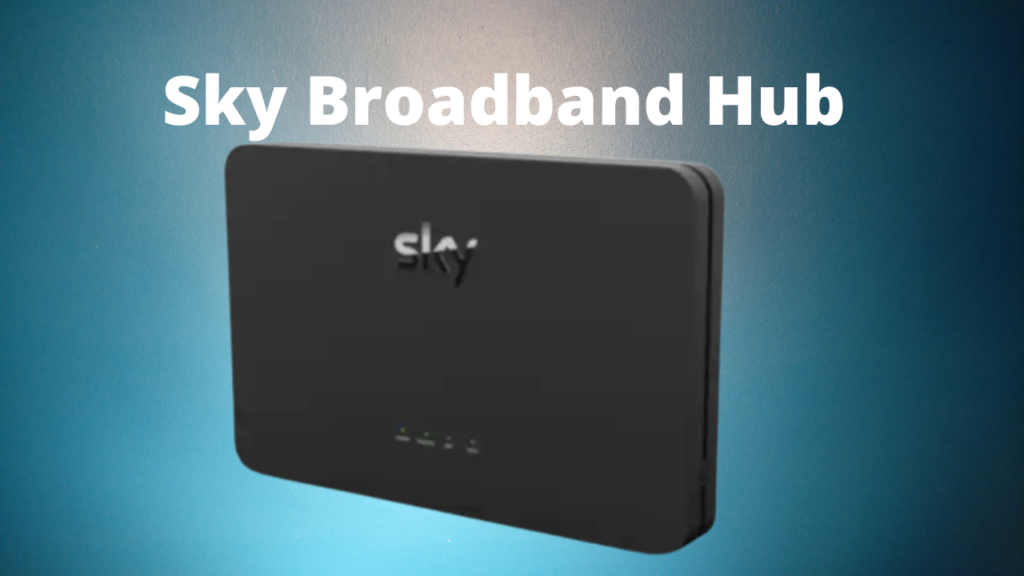
Sky Broadband Hub Lights Explained
Problem: All Your Sky Broadband Hub Lights Are Off
Solution: Check Your Sky Broadband Hub and Its Power.
Power off your mains plug. When your hub is off at the mains, check the following:
- Your hub is securely connected to the blue power cable.
- A cable or plug doesn't appear to be damaged, and the device is plugged in.
- You might have a defective main wall socket or extension lead - Try plugging in another device or appliance into the socket to verify.
Switch your hub back on and wait a few minutes for it to fully restart and all the lights to return to normal. If your lights are still off then you will need to head to Sky Broadbands website and perform some additional checks.
Problem: The Voice Light Is Flashing Green
Solution: Everything Is Working Fine
Everything is working fine on your hub, the green light simply means that there is an incoming call, so the Voice light is flashing green.
Problem: The Voice Light Is Amber
Solution: Reboot your Sky Broadband hub
Your internet should be working fine, this error indicates an issue with your phone. A simple reboot should resynchronize your phone, failing which you will need to contact Sky Broadband.
Problem: The Voice Light Is Off
Solution: No Voice Subscription is Currently Active
The hub itself is working and connected; the light is dark only because Internet Calls is not on your package. The detail Sky flags alongside it is easy to miss: the home phone has to be plugged into your main phone socket, because it will not work plugged into the hub. If you want Internet Calls added, you will need to get in touch with Sky Broadband.
Problem: The Power Light Is Flashing Amber
Solution: Factory Reset Your Sky Broadband Hub
There is a problem with your hub. After a software upgrade, this can sometimes happen if things don't quite go according to plan.
If you have trouble resetting the hub, try these steps:
You will be able to reset your WiFi password to its default if you have changed it. It can be changed again easily.
- Hold Reset on the back of your hub until the power light flashes green, which Sky's SR203UK guide puts at about 10 seconds, while Sky's phone help page gives 30 seconds or until the lights on the front blink.
- Make sure your broadband is working after the lights have returned to normal.
After it has been reset, if it is still flashing, please contact Sky Broadband.
Current Sky Max Hub (SR213) and Sky Broadband Hub (SR203) Single Light
The two newer hubs look very different from the older multi light units above. The Sky Max Hub (model SR213) is the white WiFi 6 router, and it carries just one light on the front rather than a row. The Sky Broadband Hub (model SR203) is the earlier black hub; on that unit the colour behaviour described in the section above applies, while the white Max Hub consolidates everything into that single indicator.
On the white Sky Max Hub, read the single light like this:
- Solid white means the hub is powered and connected to the internet; this is the everyday state and nothing needs doing.
- Solid amber means the hub is powering up, and Sky says the light turns white once it connects, so the answer is to wait rather than reset.
- Flashing amber (or orange) means the hub is authenticating with Sky's network, which also clears to white on its own within a few minutes.
- Flashing green and amber is the software update state on this hub; Sky puts it at about fifteen minutes and asks you not to switch the hub off part way through.
- Slowly flashing green means authentication has finished and the hub is seconds from coming online, while quickly flashing green means it is resetting, so leave the power alone until it settles.
- Flashing blue means WPS pairing is live for two minutes.
- Red sends you to Service Checker, which is where Sky runs its own tests on the connection and setup.
- Off means no power, so check the plug, the cable and the mains socket exactly as for the older hubs.
The Max Hub also changes how a factory reset works. Sky's guides hold the WPS button for the full thirty seconds, because a three second press only triggers WPS pairing, and Sky's flashing green light page documents a Reset button on that hub as well, saying a five second hold starts a reset and more than twelve seconds takes it to a factory reset. Sky's own warning on the WPS page is that thirty seconds or more wipes any settings you have changed and puts the WiFi password back to the default Sky lists on the bottom of the hub and in the My Sky app, and a quickly flashing green light is the hub confirming a reset is under way. The black SR203 has a Reset button on the back instead. Both methods, with the correct timings, are laid out in our guide to resetting a Sky broadband router quickly and easily.
https://youtu.be/oKX9WdYThME
Sky Hub Lights Video
Sorting Sky Coverage and Dead Zones for Good
Once the lights on your Sky hub are behaving and the connection is stable, the next gripe is usually patchy coverage; weak signal upstairs, a dead zone at the back of the house, or buffering in the room furthest from the hub. None of the kit below makes your Sky line faster, so let's be honest about that; what it does is fix the coverage, control and reliability that a single hub in one corner of the house simply cannot manage. If you are weighing up your options, our guide on wifi extender vs mesh and which actually fixes dead zones is a good starting point.
The simplest path on Sky is to leave the hub exactly as it is and add a mesh system running in access-point mode. That keeps Sky's setup untouched, with no change to the way the hub connects the line, since the hub keeps doing the broadband bit while the mesh blankets your home in one seamless network. For most homes our pick is the TP-Link Deco X10; TP-Link lists Access Point Mode as one of the two working modes on its spec sheet, so it runs off a spare Ethernet port on the Sky hub, which is why nothing on the Sky side has to be reconfigured to add it.

Our ranked round-up of the best wifi mesh systems covers the alternatives if you want to dig deeper. And if you would rather run your own router than add a mesh, our best router for Sky broadband guide covers the picks and the settings a replacement router can need on a Sky line.
Replacing the Sky hub with your own router is the advanced route; it is possible, but it takes extra setup on the replacement router, so we'd only suggest it if you specifically want full control over your network. For most people the mesh in access-point mode delivers the win with far less hassle.
Conclusion
We have gone through a lot of details in this article, and we hope that it has been helpful. While this information is relatively available on the internet, we though it would be way more helpful having everything on a single page that is easy to navigate.
Good luck with your Sky Broadband troubleshooting, and we hope that you have found this useful and informative.