A humming, whirring, or beeping Xfinity gateway is rarely a mystery once the sound itself is pinned down. Every gateway in the XB6, XB7, and XB8 families carries a real cooling fan, older Xfinity Voice gateways carry a backup battery, and each part announces trouble in its own distinctive way. Match the sound to the cause below and most fixes take about fifteen minutes.
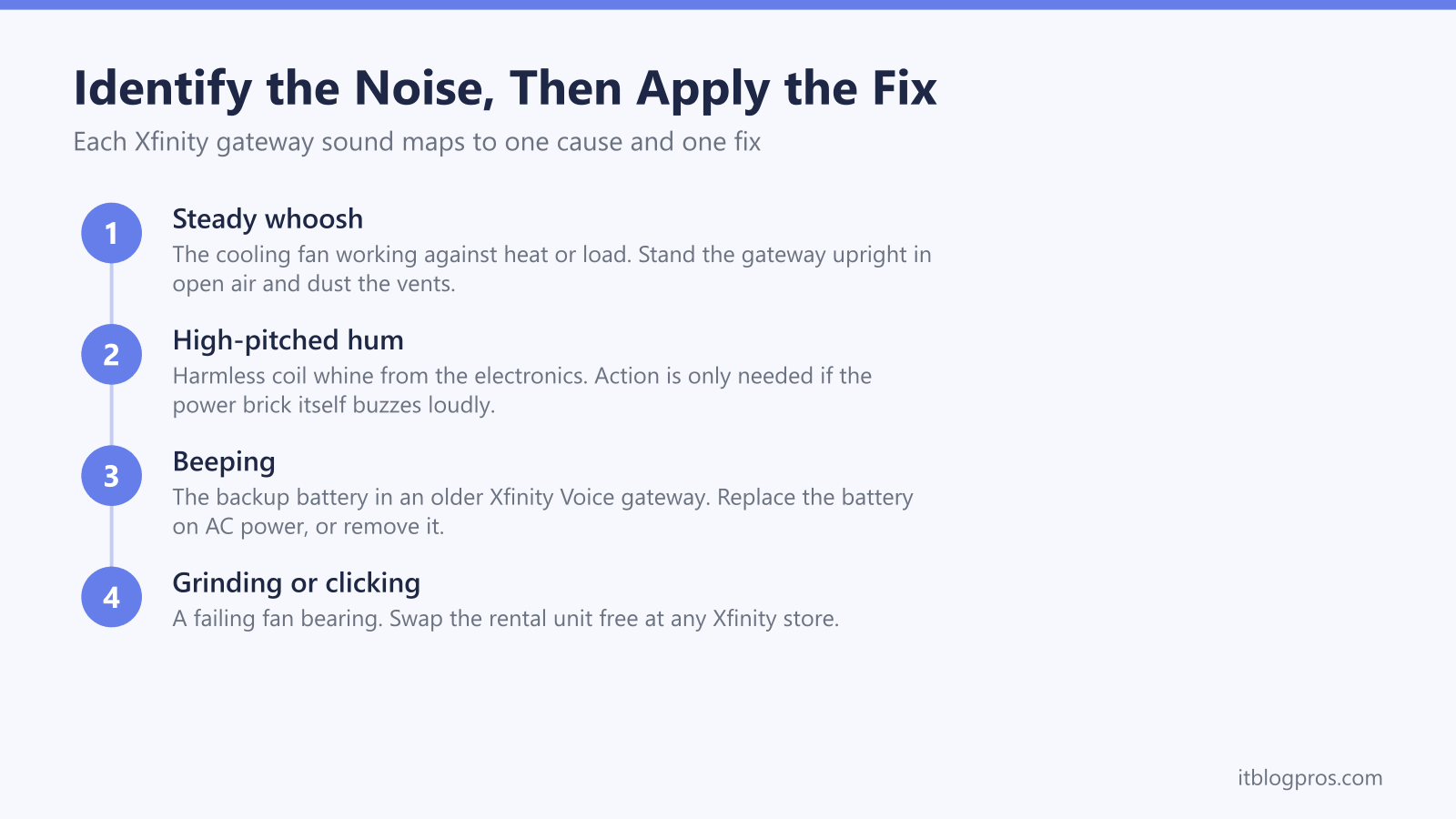
A noisy Xfinity gateway almost always means one of three things. A steady fan whoosh is the XB6, XB7, or XB8 cooling itself, and it gets quieter with upright placement, open air, and clean vents. Beeping comes from the backup battery in older Xfinity Voice gateways. Grinding, rattling, or clicking signals a failing fan, and Xfinity swaps rental units free at any Xfinity store.
Key Takeaways
- Every current Xfinity gateway in the XB6, XB7, and XB8 families has a real cooling fan, so a whoosh that rises during heavy use or warm weather is normal behavior.
- Placement quiets most fan noise: stand the gateway upright in open air with 3 to 4 inches of clearance on all sides, off carpet, out of cabinets, and with dusted vents.
- A faint high-pitched hum is harmless coil whine from the electronics, but a loud buzz coming from the power brick itself is a reason to have Xfinity swap the equipment.
- Beeping almost always comes from the backup battery in an older Xfinity Voice gateway, and replacing or removing that battery stops it.
- Grinding, rattling, or clicking means the fan bearing is failing; rental gateways are exchanged free at any Xfinity store, and an owned fanless DOCSIS 3.1 modem is silent by design.
The Three Noises an Xfinity Gateway Makes and What Each One Means
Xfinity gateway noise complaints break down into three families, and each points to a different part of the hardware.
- A steady whoosh or whir that rises and falls is the internal cooling fan. It responds to temperature and load, so it gets louder during big downloads, video calls, hot afternoons, or when the vents are choked with dust.
- A faint high-pitched hum or whine is coil whine from the power electronics, and a deeper mains buzz can come from the power brick. One of these is harmless; the other is worth acting on.
- Beeping is not the gateway's fan or electronics at all on current models. It is the signature of the telephony backup battery in older Xfinity Voice gateways, or of a separate UPS sitting near the router.
There is also a fourth sound that deserves immediate attention: grinding, rattling, or rapid clicking. That is a fan bearing on its way out, and the fix is a free equipment swap rather than anything done at home. Each case is covered in order below.
Fan Noise Is Normal on the XB6, XB7, and XB8 Under Load
All three current gateway generations have active cooling: the XB6 family, the XB7 (sold as the Technicolor CGM4331COM and Arris TG4482A), and the XB8 (Technicolor CGM4981COM). The sticker on the bottom of the unit shows which model is in the house. The fan only spins up when the gateway needs it, so a unit that sat silent for months can suddenly become audible after a heat wave, a firmware update that raised load, or a move to a worse spot.
Fan noise threads have been a fixture on the Xfinity forums since 2020, with the XB7 and XB8 generating a steady stream of "loud all of a sudden" reports. The XB7 in particular runs hot, and it protects itself by rebooting when it exceeds a safe operating temperature. A roaring fan and random reboots on an XB7 are usually the same underlying problem, heat, which is covered in depth in the guide to the four major XB7 issues.
A fan that spins up under load and settles back down is healthy. A fan that runs flat out around the clock, in a cool open spot with clean vents, is either fighting blocked airflow or beginning to fail.
Placement and Ventilation Fixes That Quiet a Constantly Running Fan
Xfinity's own overheating guidance doubles as the fan-noise fix list, because the fan only works hard when the gateway cannot shed heat passively.
- Stand the gateway upright on a hard, flat surface. The tower shape is the designed airflow path.
- Give it 3 to 4 inches of clearance on all sides. Pushed against a wall or wedged between boxes, the vents cannot breathe.
- Get it off soft surfaces. Carpet, rugs, and blankets block the bottom intake and insulate the case.
- Take it out of cabinets and drawers. Enclosed spaces recirculate hot air and are the single most common cause of a permanently roaring fan.
- Move it away from heat sources: heat vents, direct sunlight, game consoles, and AV receivers all pre-warm the air the gateway is trying to cool with.
- Dust the vents with a dry cloth. A gray felt of dust over the intakes forces the fan to compensate at higher speed.
Give the gateway ten minutes after the move. On a healthy unit the fan should drop back to a low hum or go silent once internal temperatures fall.
A High-Pitched Hum Is Usually Harmless Coil Whine
A faint, high-pitched electronic whine that changes character with network activity is coil whine: tiny inductors in the power circuitry vibrating as load fluctuates. It shows up in routers, graphics cards, and power supplies alike, it is not a defect, and it does not damage the hardware or predict failure. If the sound only exists with an ear a few inches from the case, no action is needed.
A louder, coarser buzz needs one extra check: put an ear next to the power brick, then next to the gateway itself. If the buzz clearly comes from the brick, especially if it has grown over time, crackles, or the brick is hot to the touch, treat the adapter as suspect. Do not substitute a random power supply of similar voltage; mismatched adapters are a genuine fire and damage risk. Because the gateway is rental equipment, the right move is to have Xfinity exchange the gateway and its power supply together, which costs nothing, rather than buying a third-party brick.
Beeping Points to the Backup Battery in Older Xfinity Voice Gateways
Current XB6, XB7, and XB8 gateways have no speaker to beep with, so a beeping "router" is nearly always one of two things.
The classic case is an older Xfinity Voice telephony gateway, such as the Arris TG862 or TG1682, which accepts an internal backup battery so home phone service survives a power outage. When that battery ages out, loses charge, or fails, the unit chirps to complain. The fix is to replace the battery, and Arris documents that the swap should be done while the gateway is running on AC power, not during an outage. Xfinity no longer supplies these batteries as standard, so a replacement is purchased separately; the alternative is simply removing the failed battery, which stops the beeping at the cost of phone service not working during a blackout. Households that keep landline service through Xfinity should weigh that trade-off honestly.
The second case is a separate UPS or battery backup unit sitting on the same shelf as the router. A UPS chirping about its own dying battery is routinely blamed on the gateway next to it, so check both boxes before booking a swap.
Clicking, Grinding, or Rattling Means the Unit Needs a Swap
A fan bearing that is failing announces itself with rapid clicking, grinding, buzzing that changes when the unit is tilted, or a rattle on spin-up. Forum staff and long-term users agree on the outcome: there is no fix for a dying gateway fan other than exchanging the unit. Opening a rental gateway to oil or replace the fan is not an option, and the noise only ever gets worse until the fan seizes, at which point the gateway overheats and drops offline.
The swap is free for rental equipment. Take the gateway and its power brick to any Xfinity store for an on-the-spot exchange, or arrange an exchange through the Xfinity app; returns can also go back by UPS at no charge. Activation of the replacement takes a few minutes in the app, and WiFi name and password can be set to match the old ones so devices reconnect on their own. A unit swapped for noise should come back silent; if a brand-new replacement also roars in a cool, open, dust-free spot, that is a placement or environment problem rather than bad luck twice.
When Replacing Beats Fixing, an Owned Modem Removes the Fan Entirely
For anyone allergic to fan noise on principle, there is a structural fix: most owned DOCSIS 3.1 cable modems are passively cooled and have no fan at all. The honest caveats come first.
- xFi Complete requires an Xfinity gateway. Returning the gateway forfeits xFi Complete's bundled unlimited data, the xFi app device controls, and any xFi Pods.
- Check the data-plan fine print. Xfinity's newer national plans, introduced in mid-2025, include unlimited data and the gateway in the price, which weakens the case for buying hardware. Older plans in most markets still carry a 1.2 TB monthly allowance, and own-modem customers on those plans pay for an unlimited add-on if they need it. Northeast markets have never had the cap.
- Xfinity Voice needs a telephony modem. A standard cable modem has no phone port, so landline customers cannot drop the gateway this way.
With those boxes checked, the Motorola MB8611 is the standard pick: a DOCSIS 3.1 modem with a 2.5 Gigabit Ethernet port, approved on Xfinity gigabit tiers, passively cooled, and completely silent, with the bonus of ending the monthly rental fee. It needs a separate WiFi router, and the full pairing options are laid out in the best modem for Xfinity guide.
Check the Motorola MB8611 price on Amazon →
The Rest of the Common Xfinity Complaints Have Equally Quick Fixes
Noise is one of the easier Xfinity problems to diagnose because the sound itself does the diagnostic work: whoosh means heat, whine means electronics doing their job, beeping means an old voice battery, and grinding means a free trip to the Xfinity store. Once the gateway is quiet, the same systematic approach knocks out the other frequent flyers, from dropped WiFi to activation loops, and the rundown of the eight most common Xfinity issues covers each one with the same identify-then-fix structure.