The EE Smart Hub is a perfectly usable router, but nothing about EE broadband locks you to it. The service runs over the Openreach network, the same fibre and copper that BT, Sky and Plusnet use, and a third-party router works on it once a handful of settings are right. This guide covers the line types, the settings that actually matter, the swap itself, and the caveats worth knowing before anything gets unplugged.
You can use your own router with EE broadband. On full fibre, the router's Ethernet WAN port plugs straight into the Openreach ONT; on part fibre it needs a built-in VDSL modem for the master socket. Set the router to PPPoE, which every EE line uses, and keep the Smart Hub in the chain if your home phone runs through it.
Key Takeaways
- EE broadband runs on the Openreach network, so a third-party router works on both full fibre and part fibre lines; EE support just will not help you set one up.
- On full fibre your router's Ethernet WAN port connects straight to the Openreach ONT, while an FTTC line needs a router with a built-in VDSL modem for the master socket.
- EE requires PPPoE on every broadband type, using the login BT Community threads report, [email protected] with BT or a blank password, and VLAN 101 on part fibre only.
- Swapping at a quiet time, with the old settings noted down first, means you can roll back to the Smart Hub in two minutes if something refuses to connect.
- EE's digital home phone runs through the Smart Hub, so keep the hub in the chain, or check EE's guidance first, if the landline matters in your house.
EE broadband does not lock you to the Smart Hub
EE delivers home broadband over Openreach infrastructure, and the Smart Hub is simply the router EE posts out to make setup painless. The account authenticates on the line, not on the box, which is why a properly configured third-party router connects just as happily as the supplied hub does. There is no whitelist of approved hardware and no technical block on other kit.
One honest catch comes with that freedom. EE's support team troubleshoots on EE equipment only, so if you ring up about a fault while running your own router, the first request will be to plug the Smart Hub back in. That is a reasonable ask rather than an obstruction; it lets both sides see whether the fault sits on the line or in your hardware. The same arrangement applies across most Openreach providers, and our overview of how to use your own router with any UK ISP shows where EE sits compared with BT, Sky and Virgin before you commit to any hardware.
Your line type decides where the router plugs in
Everything about the swap flows from one fact: whether your EE line is full fibre or part fibre.
On full fibre (FTTP), Openreach has fitted a small white box called an ONT on your wall, and the fibre terminates there. Your own router connects by running an Ethernet cable from the ONT's LAN port to the router's WAN port, at which point the Smart Hub becomes entirely optional. This is the cleanest version of the swap, and our guide to connecting your own router to an Openreach ONT walks through it port by port.
On part fibre (FTTC, and its phone-line-free sibling SOGEA), the connection arrives over copper from a street cabinet and terminates at the master socket. A router replacing the hub here must contain its own VDSL modem, because the ONT that does the signal conversion on full fibre does not exist on these lines. Plenty of routers and almost every consumer mesh kit lack a VDSL modem, which narrows the field considerably. The workaround, if your preferred router cannot do VDSL, is to keep the Smart Hub connected to the socket, switch its WiFi off, and run your own router behind it handling the actual network.
If you are not sure which line you have, the giveaway is the hardware. An ONT on the wall with a fibre light means full fibre; a hub cabled directly into the phone-style master socket means part fibre.
The settings to note before anything gets unplugged
The good news is that EE publishes one set of connection settings rather than a different one per line, so there is nothing to guess at. The setup comes down to two things: the connection type, which is the same everywhere, and VLAN tagging, which depends on the line.
Connection type. PPPoE, on every EE broadband type. EE states plainly that a router must support PPPoE to work on the EE broadband network, so a router set to plain DHCP, sometimes labelled IPoE or Automatic IP in router menus, will never bring the line up no matter how recently it was provisioned. The username is [email protected], the password is BT or can be left blank, authentication is CHAP, and IP and DNS settings stay automatic. That login is shared rather than unique to your account.
VLAN tagging. On a full fibre line no VLAN is needed, so leave tagging off and run the router's Ethernet WAN port into the ONT. Part fibre lines carry their broadband traffic on VLAN ID 101 with priority 0, and any router sold for the UK market with a built-in VDSL modem handles that with a single setting.
While the old network still works, it is worth logging into the hub and noting what it is doing now, along with the current WiFi name and password so devices can rejoin the new router without anyone retyping anything. Our EE Smart Hub login guide covers the 192.168.1.254 address and where the admin password is printed on the hub.
The swap, step by step
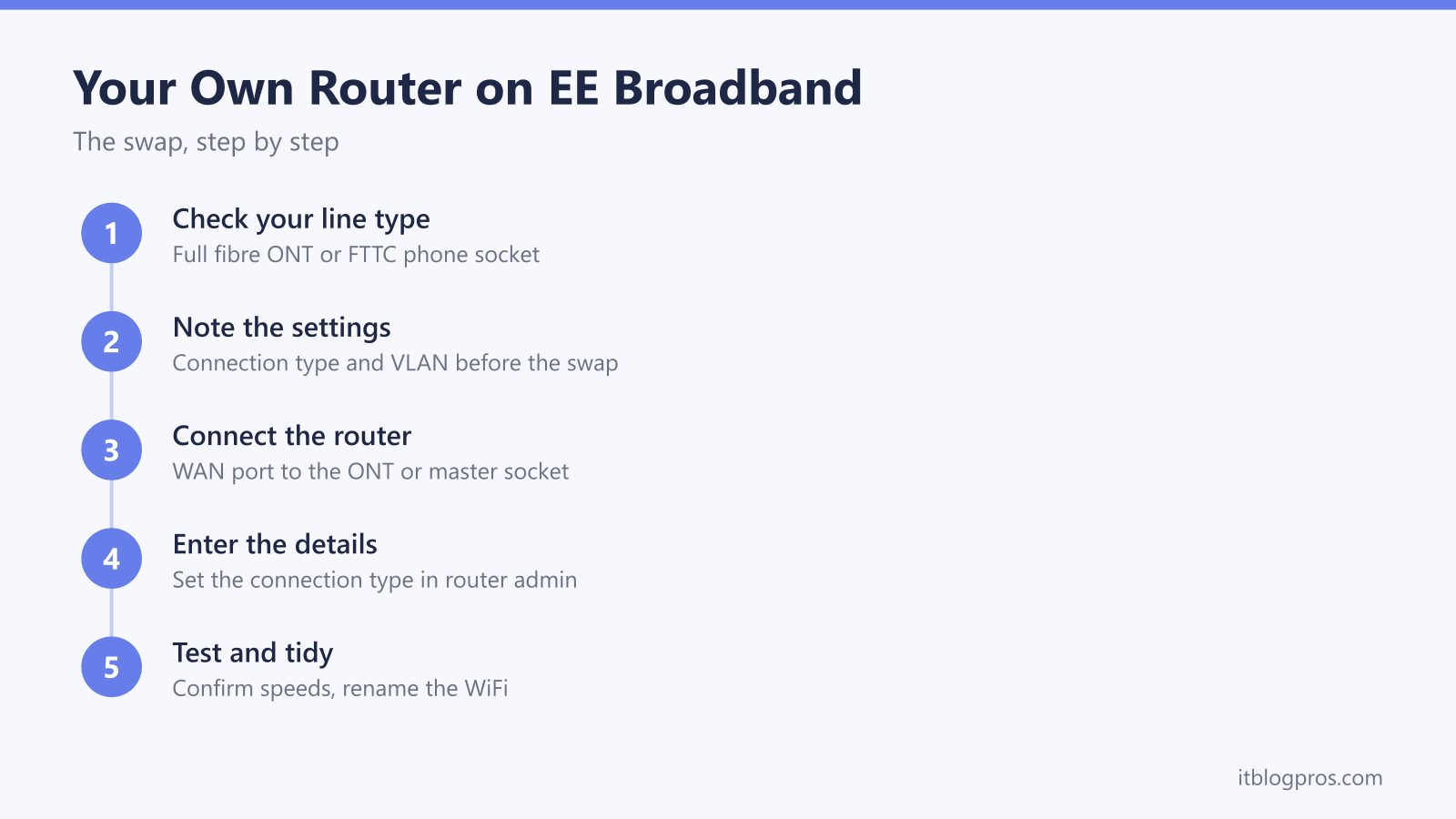
With the settings noted, the swap itself is a twenty-minute job. Done in this order, it stays low-risk because the Smart Hub remains a working fallback throughout.
- Note the settings. Have the PPPoE details to hand, and write down the hub's current WiFi name and password.
- Pick a quiet time. A weekday mid-morning beats a Sunday evening; nobody wants the connection down during a work call or a match.
- Connect the new router. Unplug the Smart Hub. On full fibre, cable the new router's WAN port to the ONT's LAN port. On FTTC, connect the router's DSL port to the master socket with the supplied filter or cable.
- Configure the connection. Run the router's setup wizard, choose PPPoE, and enter the login BT Community threads report, [email protected] with BT or a blank password, asking EE for your line's details if it is rejected. Leave VLAN tagging off on full fibre and set VLAN 101 with priority 0 on part fibre.
- Test wired first, then wireless. A laptop on an Ethernet cable proves the connection is up before WiFi enters the picture. Once wired works, check WiFi around the house.
- Tidy up. Reusing the old WiFi name and password means every phone, TV and doorbell rejoins on its own. Box the Smart Hub rather than binning it.
Should the new router refuse to connect, plug the hub back in, confirm the line itself is fine, and revisit the connection settings. On some lines a fresh PPPoE session takes a few minutes to establish after the old one drops, so a short wait before panicking is worthwhile.
The caveats that catch people out
The technical swap is the easy half. The caveats below are what actually trip households up, and the first one matters most.
The EE landline runs through the hub. EE's digital home phone plugs into the phone port on the back of the Smart Hub, not into the ONT or the master socket. Take the hub out of the chain and the landline goes silent. Households that use the EE home phone should keep the hub connected for voice, usually with its WiFi switched off while the new router handles the network, or check EE's digital-voice guidance before swapping anything. Skipping this check is the single most common way an own-router swap goes wrong.
Some EE extras are built around the hub. EE lists EE TV, the EE WiFi Extender, Connectivity Backup and WiFi Optimiser as services that need an EE or BT hub, and states that third-party routers are not compatible with EE Digital Home Phone either. Anything in the house that came from EE and talks to the hub deserves a quick think before the hub disappears.
Keep the hub for support calls. EE will only troubleshoot on its own equipment, so the hub earns its drawer space. Plugging it back in for ten minutes during a fault report proves whether the problem is the line or your router, and it keeps the support conversation short.
None of these caveats mean the swap is a bad idea. They just mean the Smart Hub should be boxed, not sold, and that phone users need one extra decision before unplugging it.
The router worth buying for an EE line
There is no need to duplicate a full buying guide here, but the default pick for running your own router on EE deserves a mention. The TP-Link Archer BE550 is a tri-band WiFi 7 router, and TP-Link's specification page lists PPPoE among its WAN types, which EE requires on every line, along with Tag VLAN. TP-Link lists a dedicated 2.5 Gbps WAN port and four 2.5 Gbps LAN ports, so on full fibre it connects straight to the ONT without bottlenecking EE's faster full fibre tiers. That WAN port is Ethernet rather than a VDSL modem, so on a part fibre line it runs behind the Smart Hub or a separate VDSL modem, as described above.
Check the TP-Link Archer BE550 price on Amazon UK →
For the wider field, including mesh systems, value picks and the setup that works on an FTTC line, our guide to the best router for EE broadband compares the current options and explains who each one suits. Whichever box you choose, the process on this page stays the same: confirm the line type, check EE's current settings guidance, swap at a quiet hour, and keep the Smart Hub within reach.