The XB7 sits in millions of American homes as the default Xfinity rental gateway, and the complaints about it cluster with remarkable consistency: WiFi that drops until somebody restarts the box, smart home gadgets that refuse to join the network, a unit that runs hot enough to worry people, and a single status light that takes some decoding. Xfinity's own community forums carry thread after thread on each one.
The good news is that all four problems have specific, repeatable fixes, and none of them needs a technician visit. This guide covers what the XB7 actually is, including which of the two hardware variants sits in your home, the fix for each major problem, what the Admin Tool at 10.0.0.1 still controls, and the honest math on bridging or replacing the gateway when patience runs out.
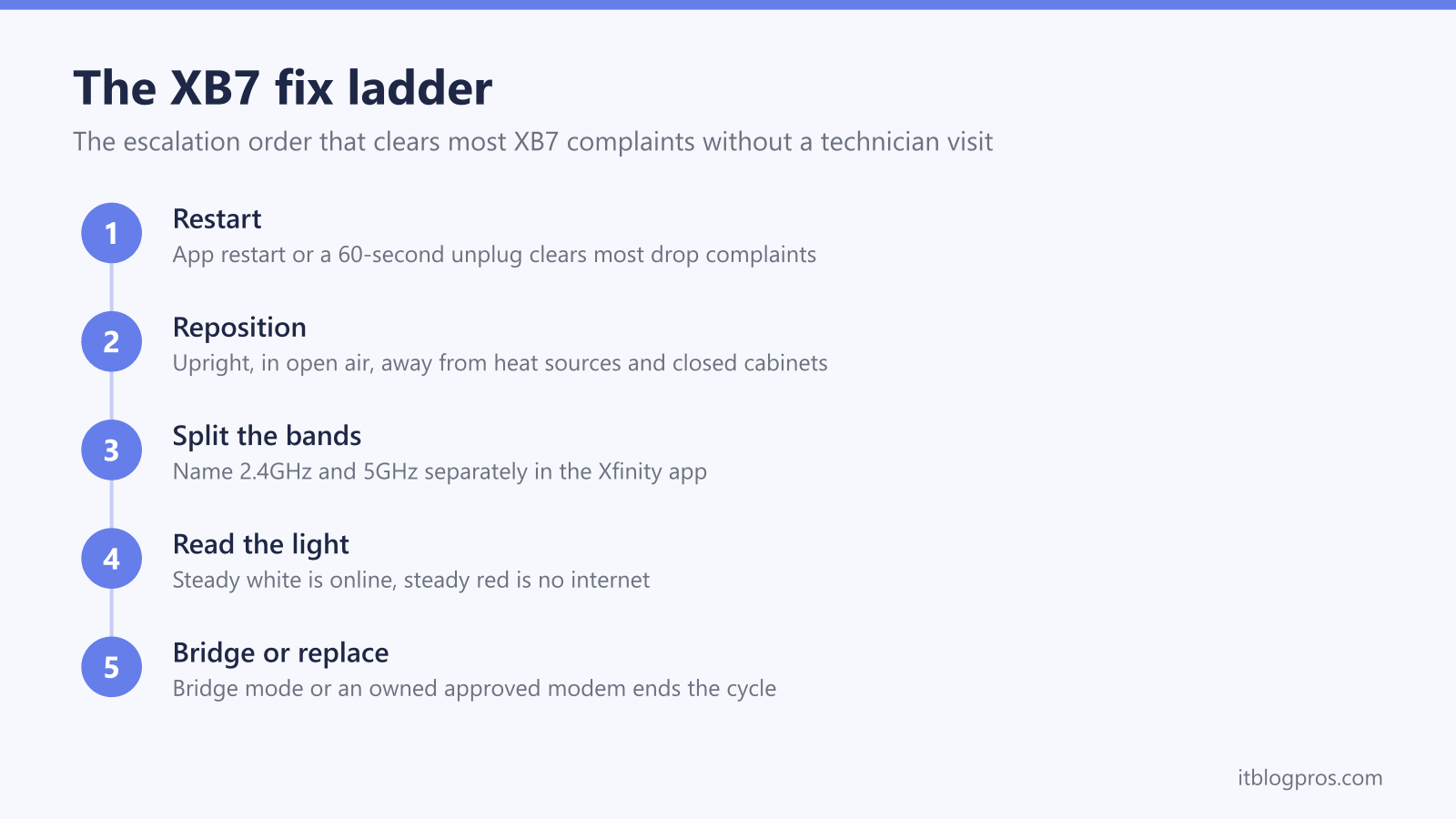
The four XB7 problems owners actually hit are periodic WiFi drops that need a restart, band steering that Wyze says can stall its camera setup, heat and placement sensitivity, and confusing light states. Restart from the Xfinity app or unplug for 60 seconds, split the band names in the app when a camera will not pair, stand the unit upright in open air, and treat a steady red light as no internet.
Key Takeaways
- The XB7 is Comcast's third-generation xFi Advanced Gateway, shipped as two hardware variants, the Technicolor CGM4331COM and the Arris TG4482A, and the label on the unit shows which one you have.
- Most XB7 WiFi drop complaints clear with a restart from the Xfinity app or a 60-second unplug; drops that keep returning usually trace to heat, loose coax, or firmware that support must check.
- Wyze names the XB7 among gateways that combine bands by default, which it says can stop a Wyze Cam pairing on 2.4GHz; Xfinity's app can split the band names, but not with Xfinity WiFi Extenders on the network.
- One status light does all the talking: steady white means online, steady red means no internet, blinking white means activation never finished, and blinking blue means WPS pairing.
- Bridge mode is the free escape from the XB7's WiFi behavior, and an owned approved modem such as the Motorola MB8611 ends the $15 monthly rental, but xFi Complete customers lose bundled unlimited data by returning the gateway.
XB7 light states decoded
| Light | What it means | What to do |
|---|---|---|
| No light | The gateway has no power | Check the power cable at both ends, try another outlet, and rule out a switched or tripped socket |
| Steady white | Online and working normally | No action needed; troubleshoot individual devices rather than the gateway |
| Blinking white | Activation has not finished, so the gateway is only partially operational | Complete activation in the Xfinity app; restart the gateway and retry if activation stalls |
| Steady red | No internet connection | Check the Xfinity app for a local outage first, reseat the coax connector finger-tight, restart the gateway, and contact Xfinity if red persists |
| Blinking blue | WPS pairing mode is active and searching for a device | Finish pairing the WPS device, or wait for the mode to time out and the light to return to steady white |
| Other blinking colors or combinations | The gateway is connecting to Xfinity systems | Xfinity's gateway lights article says to wait about 15 minutes for this cycle to complete, then contact Xfinity if the connection problem continues |
The XB7 is Comcast's third-generation xFi Advanced Gateway
XB7 is Comcast's friendly name for its third-generation xFi Advanced Gateway, the all-in-one rental box that combines a DOCSIS 3.1 cable modem, a dual-band WiFi 6 (802.11ax) router, four Ethernet LAN ports, and two telephone ports for Xfinity Voice. Comcast lists its maximum data throughput at 2.5Gbps, and it took over from the XB6 as the standard rental on most speed tiers; the differences between the two generations are covered in our XB6 vs XB7 comparison.
Two different manufacturers build the XB7, and the label on the unit shows which one you have:
- Technicolor CGM4331COM, the model number Comcast lists against the XB7 name.
- Arris TG4482A, built by Arris, now part of CommScope.
Both variants present identically in the Xfinity app, take the same firmware pushed by Comcast, and respond to the same fixes below, so the variant makes no difference to troubleshooting. What matters more is recognizing that the XB7 is a managed rental: Comcast controls the firmware, most WiFi management lives in the Xfinity app rather than on the box, and some traditional router settings are locked away entirely.
Problem 1: WiFi drops that only a restart clears
The most common XB7 complaint, by forum volume, is WiFi that degrades or drops entirely on a cycle of days or even hours until someone restarts the gateway. Xfinity's community forums carry long-running threads with titles like "New XB7, losing internet multiple times a day" and "XB7 frequently loses internet", and the pattern is consistent: everything works after a reboot, then the drops return.
Work through the causes in this order:
- Restart properly first. Open the Xfinity app, select the gateway in the WiFi section, and choose Restart this Device; the remote restart can take up to 12 minutes. Without app access, unplug the power cable from the back, wait a full 60 seconds, and plug it back in.
- Isolate WiFi from the internet connection. Run one device on Ethernet for a day. Wired staying up while WiFi drops points at the wireless side, so start with the placement checks in problem 3 below. Both dropping together points at the coax signal or the line.
- Check the coax path. Reseat the coax connector finger-tight at the gateway and at the wall plate, and remove any unnecessary splitters between the two; every splitter costs signal strength.
- Ask support to verify the firmware. Comcast pushes XB7 firmware automatically and owners cannot update it themselves. Outdated firmware is a recognized cause of random disconnections on XB6 and XB7 gateways, so ask an agent to confirm the version, and if the hardware itself is failing, a rental gets swapped at no charge, which remains the one genuine perk of renting.
Drops that survive all four steps call for the placement checks below, or a look for a wider service issue; our guide to the most common Comcast Xfinity issues covers outage checks and signal problems in more depth.
Problem 2: Band steering can stall smart camera setup
Xfinity's band steering article says its gateways pick the best band for each device, switching automatically based on signal strength and traffic, as long as all bands share one WiFi name and password. Wyze's dual-band troubleshooting article names the XB6, XB7, and XB8 among routers known to combine bands by default, and that combined name is where camera setup can stall.
Wyze's article says most Wyze devices need a 2.4GHz connection to complete setup, and that a router combining 2.4GHz and 5GHz can stop the camera finding and pairing to the 2.4GHz network. Smart plugs, bulbs, cameras, and thermostats from other makers have their own band requirements, so check the maker's setup guide for the band the device needs before blaming the gateway. A stationary device that seems slow in one spot is worth testing next to the gateway or on Ethernet before changing any band settings.
The fix Wyze gives is splitting the band names and connecting the phone to the 2.4GHz one before setting the camera up again, and on the XB7 that setting lives in the Xfinity app rather than the gateway's own interface. Xfinity's advanced WiFi settings article gives the route: select WiFi, then WiFi details, then Edit WiFi settings, where you can set a different name and password for each band, named along the lines of HomeNet-2G and HomeNet-5G. Wyze says the camera should stay connected to 2.4GHz even after the settings go back, so the split can be temporary.
Two caveats apply. Xfinity's advanced WiFi settings article says the split option does not appear when Xfinity WiFi Extenders are on the network or when advanced WiFi settings are being managed automatically, and its band steering article says WiFi Extenders only work if all bands use the same name and password, so households running them lose the split; another of Wyze's tips is moving farther from the router during setup so the phone can join 2.4GHz on its own. And the same band steering article warns that separate band names lose band steering, leaving you to choose bands by hand, which can cause slower or dropped connections.
Problem 3: Heat and placement make the XB7 unstable
XB7 units run warm in normal operation, and Xfinity's rental gateways, the XB6 and XB7 in particular, have a reputation for it. When the internal temperature climbs too high, the gateway protects itself by throttling performance or dropping connections, which produces the same symptom as problem 1: WiFi that degrades over hours and recovers after a restart, because the restart doubles as a cool-down.
Placement fixes most of it:
- Stand it upright. The XB7 tower is designed to run vertically; laid on its side, the vents do far less work.
- Give it open air. Cabinets, closets, drawers, and media consoles trap heat around the unit.
- Keep it off other electronics. A cable box or games console underneath adds its own heat to the XB7's.
- Keep it out of direct sunlight, especially near south-facing windows.
- Go central and elevated where possible, which helps WiFi coverage at the same time.
A gateway that stays uncomfortably hot in open air with good placement is worth reporting to Xfinity, since rentals get swapped at no charge and a failing unit is Comcast's problem rather than yours.
Problem 4: One status light does all the talking
The XB7 replaced the row of labeled indicator LEDs that older modems carried with a single light, which is tidier and considerably harder to read. The two states that matter most are simple: steady white means the gateway is online, and steady red means no internet connection. A steady red light earns 30 seconds of checking before any hardware fiddling: open the Xfinity app and look for a reported outage in the area, because no amount of restarting fixes an outage.
The table below decodes the states Xfinity documents. Xfinity's gateway lights article describes the remaining color combinations as the gateway connecting to Xfinity systems, and says to wait about 15 minutes for that cycle to complete before contacting Xfinity for help.
The Admin Tool at 10.0.0.1 keeps a smaller but real job
Comcast has moved most day-to-day WiFi management, including names, passwords, band splitting, and device pauses, into the Xfinity app, but the browser-based Admin Tool still controls things the app does not. From a device on the XB7's network, http://10.0.0.1 opens the login and the username is admin. The password is the part most write-ups get backwards. Xfinity's Admin Tool access article says that if you are enabling access for the first time, you are taken to a screen to set up a new password for the admin tool, so on a gateway enabled today the password is one you created during that step rather than anything printed on the box. The same article keeps the label as a narrow exception, saying users who enabled access prior to February 2026 may still use the default password found on the sticker on the bottom of the gateway. Older firmware shipped with the word password, which the tool now flags as a leaked credential and pushes you to replace.
Inside, the Admin Tool still offers per-band radio controls such as WiFi channel and mode selection, connected-device details, and most importantly bridge mode, which the app does not expose. On recent firmware, some owners find that 10.0.0.1 refuses to show a login page until Admin Tool access is switched on in the Xfinity app's advanced WiFi settings, a change Comcast rolled out quietly; enabling that toggle restores the login. The full walkthrough, including the fixes when the page refuses to load at all, is in our 10.0.0.1 Xfinity router login guide.
When replacing beats fixing
A stable XB7 is achievable for most homes with the four fixes above, and the rental has genuine advantages: free hardware swaps, zero compatibility questions, and Xfinity Voice support through its phone ports. The case for moving on comes down to money and control, and the math deserves honesty before any purchase.
The rental math. The xFi Gateway rental runs $15 a month on most plans, which is $180 a year, though some newer Xfinity plans bundle the gateway at no extra charge, so check the equipment line on your bill first. A one-time modem purchase typically pays for itself within the first year against a $15 monthly fee; against a bundled $0 gateway it never does.
The unlimited-data catch. xFi Complete costs $25 a month and bundles the gateway with unlimited data. Returning the gateway means giving up xFi Complete, and buying unlimited data as a standalone add-on with owned equipment costs $30 a month. A household that regularly clears Xfinity's 1.2TB monthly allowance can end up paying more overall after "saving" the rental fee, so check your last three months of data usage in the app before deciding.
The phone catch. The XB7's telephone ports carry Xfinity Voice. A standard owned cable modem has no phone ports, so voice customers need telephony-capable equipment or a plan change before the XB7 goes back.
Bridge mode is the free middle path. Enabled through the Admin Tool, bridge mode turns the XB7 into a plain modem and hands routing and WiFi to equipment you choose, which takes the XB7's own WiFi and band steering out of the picture while keeping the rental's swap-anytime safety net and xFi Complete's unlimited data. It pairs well with a proper mesh or prosumer setup, and our guide to running Ubiquiti on Xfinity shows that route end to end. Wyze's dual-band article lists mesh systems such as eero, TP-Link Deco, Google Nest Wifi, and Netgear Orbi as combining bands by default too, so the camera setup fix in problem 2 can still apply behind your own equipment.
For a full replacement, the Motorola MB8611 is the sensible pick for most XB7 leavers: a DOCSIS 3.1 cable modem with a 2.5Gbps Ethernet port, approved by Comcast for Xfinity plans up to and including its gigabit tiers, and it pairs with any router. The wider shortlist, including cheaper options for mid-tier plans, is in our best modem for Xfinity guide.