The eero 6 launched in 2020, Amazon's eero range has moved three generations since, and Xfinity's plans have crept into multi-gig territory. That combination makes the old "does it work" question worth a fresh, honest answer: yes it works, the setup has one important wrinkle, and whether the hardware is still worth buying depends entirely on which situation applies to you.
Yes, eero 6 works with Xfinity. Every eero is a router, not a modem, so it sits behind an owned DOCSIS modem or the xFi Gateway, and behind a gateway the clean setup is bridge mode to avoid double NAT. An eero 6 remains a sensible keeper on plans up to about 500 Mbps, while new buyers get better value from current models such as the eero Pro 6E.
Key Takeaways
- Every eero unit is a router, not a modem, so on Xfinity it always sits behind an owned DOCSIS modem or the xFi Gateway.
- Behind an xFi Gateway the clean setup is bridge mode, which hands all routing to eero and prevents double NAT.
- eero rates the 2020 eero 6 for internet plans up to 500 Mbps and the 2022 eero 6+ for gigabit plans, so neither suits Xfinity's 2 Gbps DOCSIS 4.0 tiers.
- Existing eero 6 owners moving to Xfinity should keep their kit, while new buyers get more headroom from the eero Pro 6E or the WiFi 7 models for similar money.
- eero is managed only through the app with an eero or Amazon sign-in, and the eero Plus subscription is optional rather than required.
The Compatibility Answer Rests on One Fact: eero Is a Router, Not a Modem
No eero, from the original 2016 units through the eero 6 to the current Max 7, has a coax port or a DOCSIS modem inside. eero's own support documentation is blunt about it: an eero needs an Ethernet connection to a modem or other upstream device, and it has been tested against most major US providers, Xfinity included.
On an Xfinity cable line that leaves exactly two working arrangements:
- eero behind an owned DOCSIS 3.1 modem. The modem does nothing but translate coax to Ethernet, eero does all the routing, and the monthly gateway rental fee disappears. The proven pairings are in the best modem for Xfinity guide.
- eero behind the rented xFi Gateway. This works too, but the gateway is a modem and router in one box, and two routers stacked on one line means double NAT unless the gateway is told to stand down.
There is no firmware trick, activation call, or special Xfinity-approved eero model involved. Compatibility was never the real question; the setup order in the next section is.
The Two Ways to Run eero on an Xfinity Line
Option one, the owned modem, is the cleaner build. A plain cable modem cannot cause double NAT because it does not route at all. The honest caveats: xFi Complete's bundled unlimited data and xFi Pods require keeping the Xfinity gateway, and Xfinity Voice customers need a telephony gateway that a standard modem cannot replace. With those boxes checked, modem plus eero is the arrangement eero's own support material assumes.
Option two keeps the xFi Gateway and bridges it. Log in to the gateway's admin tool at 10.0.0.1, choose Gateway then At a Glance, and enable Bridge Mode. That switch lives in the admin tool alone. The Xfinity app carries no bridge mode toggle, and its only role here is turning on Admin Tool access so the page will load, after which a bridged gateway makes the app's WiFi options disappear altogether. Bridging switches off the gateway's WiFi and routing so it behaves as a plain modem, and the eero then plugs into one of its Ethernet ports and takes over the network. Skipping this step leaves two devices handing out addresses, which shows up as gaming NAT errors, broken port forwarding, and devices on the eero side that cannot see devices on the gateway side. The full reasoning, and why bridge mode is the answer rather than a workaround, is walked through in the Xfinity with Ubiquiti guide, and it applies to eero unchanged.
During setup the eero's LED does the talking: blinking blue means it is broadcasting for setup, solid white means it is online. The eero blue light guide decodes the setup states, and the full eero light table covers every color the LED can show.
Where the eero 6 Sits in eero's 2026 Range
The eero 6 is now three generations back, and the differences are concrete rather than marketing.
- eero 6 (2020). Dual-band WiFi 6, officially rated by eero for internet plans up to 500 Mbps. The classic 3-pack shipped as one router plus two extenders, and those extenders have no Ethernet ports at all, which rules out wired backhaul and wired devices at the far ends of the house.
- eero 6+ (2022). Still dual-band WiFi 6, but with 160 MHz channel support and a rating for gigabit plans. Every unit in the box is identical, with two gigabit Ethernet ports each. It remains eero's budget entry in 2026.
- eero Pro 6E. Tri-band WiFi 6E with the 6 GHz band, one 2.5 GbE port plus one gigabit port per node, rated for combined wired and wireless speeds up to 2.3 Gbps, and a built-in Zigbee and Thread smart home hub.
- eero 7 (2025). The entry WiFi 7 model: dual-band with no 6 GHz radio, but two 2.5 GbE ports on every unit and support for plans up to 2.5 Gbps.
- eero Pro 7 (2025). Tri-band WiFi 7 with two 2.5 GbE ports per node, the mid-range pick for multi-gig plans.
- eero Max 7 (2023). The flagship: tri-band WiFi 7 with two 10 GbE and two 2.5 GbE ports per node, aimed at homes that genuinely wire for multi-gig.
All of them run the same TrueMesh software and the same app, and old and new eeros can even mesh together, so the generation question is purely about speed ceilings and ports.
What eero 6-Class Hardware Honestly Delivers on Xfinity's Speed Tiers
Xfinity's 2026 lineup typically runs from roughly 150 to 300 Mbps at the entry level, through 400 to 800 Mbps mid-tiers, to gigabit and 1.2 Gbps plans, with 2 Gbps tiers appearing in areas upgraded to DOCSIS 4.0.
Map the eero 6 family onto that and the picture is simple. An eero 6 is rated for plans up to 500 Mbps, which covers Xfinity's entry and lower mid-tiers comfortably; on faster plans it becomes the bottleneck, and no settings change fixes that. The eero 6+ is rated for gigabit plans and its two Ethernet ports per unit allow wired backhaul, so it stretches honestly across everything up to Xfinity's gigabit tier. As with any mesh, wireless speeds through walls and floors land below the plan speed on both models; that is physics, not a defect.
The hard ceiling is the ports. Both eero 6 models top out at gigabit Ethernet, so a 1.2 Gbps or 2 Gbps Xfinity plan can never reach a single device through them. eero's own page lists wired speeds up to a gigabit for the Pro 6E despite its 2.5 GbE port, so multi-gig tiers realistically belong with the eero 7, Pro 7, or Max 7, which eero built around 2.5 GbE and faster wired paths.
The Worth-It Verdict Changes With the Situation
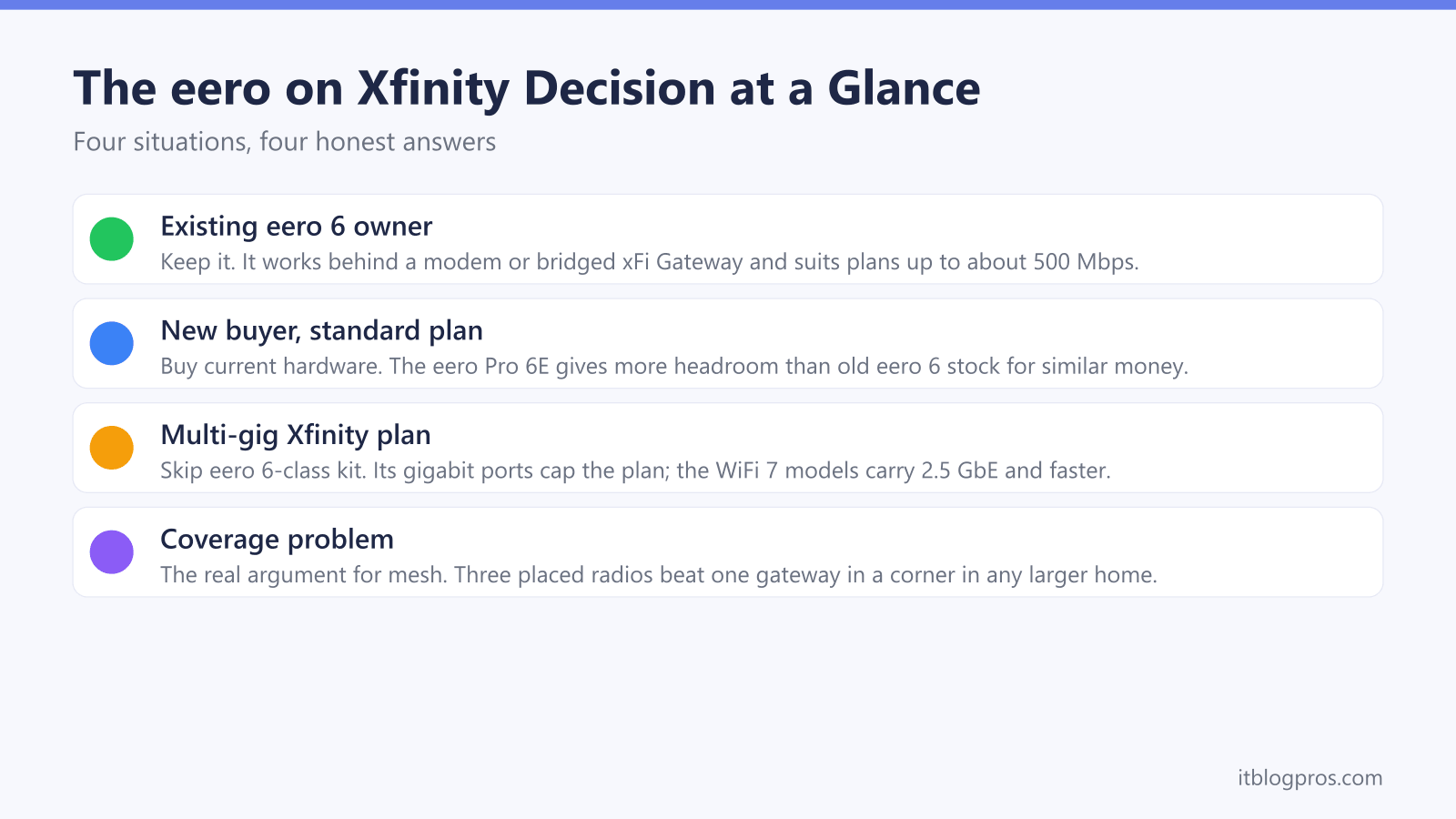
Already own an eero 6 and moving to Xfinity: keep it. It sets up behind a modem or bridged gateway in twenty minutes, and on a plan of 500 Mbps or below it delivers exactly what it always has. Upgrading hardware that matches the plan is spending money to feel modern.
Buying new on a standard plan: buy current, not old stock. A leftover eero 6 at a discount is a worse deal than it looks, because the Pro 6E and eero 7 cost similar money at street prices, carry higher ratings, better ports, and years more firmware runway.
On a 1.2 Gbps or 2 Gbps plan: skip the eero 6 family entirely. Gigabit ports cannot carry the plan. This tier belongs to the WiFi 7 models, paired with a DOCSIS 4.0-capable or multi-gig modem from the Xfinity modem guide.
Struggling with coverage: this is the real argument for eero. The xFi Gateway is one box in one corner of the house, and no single box beats three placed radios in a larger or awkwardly shaped home. Xfinity's answer is renting xFi Pods on top of the gateway fee; a mesh you own outright usually wins that comparison within a year or two of rental savings.
eero Quirks Worth Accepting Before Committing
eero's simplicity comes with trade-offs that deserve stating before any buy recommendation.
- App-only management. There is no local web admin page and no browser dashboard for network settings; everything runs through the eero app on a phone, signed in with an eero or Amazon account. Anyone who wants router settings on a big screen will not get them here.
- Deliberately sparse settings. eero handles channels, band steering, and node roaming automatically and exposes few knobs. That is the appeal for most households and a dealbreaker for tinkerers.
- The eero Plus upsell is optional. The subscription, at $9.99 a month or $99.99 a year, adds content filtering, ad blocking, and bundled security apps. The network routes, meshes, and updates at full capability without it, and the app's periodic nudges toward it can be ignored.
- eero 6 extenders have no Ethernet. Relevant to used-market buyers of the original 3-pack: only the router unit has ports.
- An unbridged gateway means double NAT. Not an eero flaw, but the most common self-inflicted problem in this exact pairing, and the reason the bridge mode step in the setup above is not optional.
The Sensible Current Buy for a New Xfinity Mesh
First, the honest caveat: an existing eero 6 or 6+ owner whose Xfinity plan sits at or below the hardware's rating has no reason to spend anything. The upgrade case only exists for new buyers, faster plans, or genuine coverage gaps.
For a new whole-home setup on Xfinity's mainstream tiers, the eero Pro 6E 3-pack is the sensible pick in 2026. It is tri-band with the uncongested 6 GHz band, rated for combined speeds up to 2.3 Gbps with a 2.5 GbE port on every node, covers up to 6,000 square feet, and runs mature, long-settled firmware. It rides the WiFi 7 generation's price pressure while still clearing every Xfinity plan short of the 2 Gbps tier, and it pairs with any owned modem from the best modem for Xfinity guide to eliminate the gateway rental fee at the same time. Households on a 2 Gbps DOCSIS 4.0 plan should step up to the eero Pro 7 instead for its dual 2.5 GbE ports.