Weak WiFi on a TELUS connection is rarely a plan problem. TELUS PureFibre delivers full speed to the gateway, and then a single box is left to cover a Canadian home with concrete floors, a basement media panel, and three levels of drywall. The good news is that TELUS has an official fix, its Boost Wi-Fi access points, and current PureFibre plans include them at no extra charge. Third-party extenders and mesh systems also work behind TELUS gateways, with some caveats worth knowing before spending money. This guide covers what TELUS actually offers, how the gateway hardware differs, where third-party kit fits, and the one thing no booster can ever do.
TELUS fixes weak WiFi with its own Boost Wi-Fi access points, which pair with TELUS gateways and are included at no extra charge on current PureFibre plans, so check your account before buying anything. Third-party extenders and mesh systems also work behind a TELUS gateway because WiFi is a standard, though TELUS support only covers TELUS equipment. No booster of any kind raises your plan speed.
Key Takeaways
- TELUS supplies its own boosters, called Boost Wi-Fi access points, and current PureFibre plans include them at no extra charge, so ask TELUS before spending money.
- The TELUS Connect app, formerly My Wi-Fi, handles Boost Wi-Fi setup, placement, renaming, and management using My TELUS login credentials.
- Third-party extenders and mesh systems work behind any TELUS gateway because WiFi is an open standard, but TELUS support only covers TELUS equipment.
- TELUS fiber gateways such as the Wi-Fi Hub and Network Access Hub have no officially supported bridge mode, so third-party mesh runs best in access point mode.
- Boosters extend coverage and never raise speed, so the plan tier paid for stays the ceiling in every room of the house.
Weak TELUS WiFi Usually Starts With Gateway Placement
Before adding any booster, TELUS or otherwise, look at where the gateway actually sits. TELUS fiber installs in newer builds often terminate in a structured wiring panel, a metal media cabinet in the basement or a closet, and TELUS even publishes guidance for activating a Network Access Hub and Boost Wi-Fi 6 that were pre-installed inside a media panel. A metal box in a basement corner is close to the worst possible place for a WiFi radio, and no amount of extra hardware fully compensates for a signal that starts out smothered.
If the gateway can move, move it first. Central, elevated, out in the open, away from the furnace room, large appliances, and aquariums. Even shifting it from inside the media panel to a shelf beside it can noticeably change coverage upstairs. If the fiber entry point cannot move, which is common, that is exactly the situation TELUS's Boost access points were designed for: the gateway stays where the fiber terminates, and access points carry the signal to the floors where people actually live.
One more placement rule applies to any booster added later: halfway between the gateway and the dead zone, not inside the dead zone. A booster placed where the signal is already terrible only rebroadcasts a terrible signal.
TELUS Boost Wi-Fi Is the Official Fix and Current Plans Include It
TELUS's answer to dead zones is its Boost Wi-Fi family. These are small access points that pair with the TELUS gateway and create one seamless network with a single name, closer to a mesh system than to a cheap repeater. There are two distinct generations. The original Boost Wi-Fi launched as a plug-in booster kit for older gateways. The current generation, Boost Wi-Fi 6, pairs with TELUS's fiber gateways, and TELUS publishes a dedicated self-install guide for it. The generations are not designed to mix, and older Boost units will not extend a current Wi-Fi 6 generation network, so confirm with TELUS which generation matches the installed gateway before adding units.
The pricing picture is unusually good. TELUS's own internet pages state that current PureFibre plans include the WiFi gateway and Boost Wi-Fi access points at no extra charge, with new customers on gigabit-class plans eligible for the newest WiFi 7 equipment. Anyone on a recent PureFibre plan with dead zones should ask TELUS for Boost hardware before buying anything third party, because the official fix may cost nothing.
TELUS also sells Wi-Fi Plus, an add-on that at the time of writing runs about $10 per month and layers on professional installation, priority WiFi support, and extra network security features, with a one-time installation fee for standalone subscriptions that TELUS waives for new internet customers. It is optional, cancellable anytime, and worth it mainly for households that want someone else to own the problem.
The TELUS Connect App Manages Boost Access Points
TELUS Boost hardware is set up and managed through the TELUS Connect app, previously called My Wi-Fi, available for iOS and Android. Sign in with My TELUS account credentials and the app walks through adding a booster: plug the new unit in near the gateway, follow the pairing prompts, then move it to its final location.
Beyond setup, the app is the ongoing control panel for the whole network. It can rename boosters, change the intensity of their LED indicators, show which devices are connected where, track data usage per device, pause WiFi for the whole house or a single device, manage the guest network, and set parental control schedules. TELUS also maintains a Boost troubleshooting guide for units that drop offline or refuse to pair.
The app only manages TELUS hardware on a TELUS gateway. A third-party extender or mesh system brings its own app and its own network view, which is one genuine advantage of staying inside the TELUS ecosystem: one app, one network, one support number.
TELUS Gateway Names Decoded, From Wi-Fi Hub to Network Access Hub
Knowing which TELUS gateway is in the house matters, because it determines which Boost generation pairs with it and what is possible with third-party gear.
The TELUS Wi-Fi Hub is a fiber gateway built by Arcadyan, notable because the fiber line can plug directly into it, removing the separate optical network terminal older installs needed. The Network Access Hub, often shortened to NAH, is the newer fiber gateway family, a multi-gigabit unit designed for media panel installs with integrated fiber cable management; units in the wild carry model codes such as NH20A, built by Arcadyan, and NH20T, built by Technicolor. Current PureFibre plans ship with WiFi 6E capable gateway hardware, and TELUS has begun offering WiFi 7 equipment to new customers on gigabit and faster plans. Older copper and DSL era homes may still run Actiontec-built T-series gateways, the T1200H, T2200H, and T3200M, which matter later in this guide for one specific reason: they are the only TELUS gateways with an officially supported bridge mode.
The model name is printed on the label on the back or bottom of the unit. Check it before buying anything, and mention it when calling TELUS, because coverage advice differs by generation.
Third-Party Extenders and Mesh Systems Work Behind a TELUS Gateway
WiFi is an open standard, so any reputable extender or mesh system can operate behind a TELUS gateway. A plug-in extender can repeat the gateway's signal into one stubborn room, and a mesh system can blanket the house using the TELUS gateway purely as the internet source. The honest caveats come first, though.
TELUS support covers TELUS equipment only. Community moderators on TELUS's own forum are clear that third-party routers and extenders are unsupported, so when something breaks, TELUS will troubleshoot to its gateway and no further. Homes with Optik TV have a second caveat: the TELUS gateway typically feeds the TV boxes as well, so it must stay in place and keep doing its job regardless of what WiFi gear sits behind it. And a mesh system left in its default router mode behind the TELUS gateway creates double NAT, two routers each doing address translation, which is harmless for browsing and streaming but can frustrate gaming, VPNs, and port forwarding. Running the mesh in access point mode avoids that entirely.
For picking between a single extender and a mesh system, the deciding factors are the number of dead zones and the size of the home, covered in detail in the extender versus mesh decider. And if an existing plug-in booster runs warm in a tight hallway outlet, that heat is usually normal, though airflow still matters.
Bridge Mode on TELUS Fiber Gateways Is Not Officially Supported
Anyone hoping to switch the TELUS gateway's router functions off entirely and hand the whole job to their own mesh system needs to hear this before buying: TELUS officially supports bridge mode on exactly three gateways, the T1200H, T2200H, and T3200M, all from the older copper era. The current fiber gateways, the Wi-Fi Hub and the Network Access Hub family, have no officially supported bridge mode.
Workarounds circulate on the TELUS Neighbourhood forum, including per-port bridging combined with PPPoE credentials on NH20A units and DMZ passthrough arrangements that forward all inbound traffic to a third-party router. Some users report success. TELUS moderators state plainly that bridging on this hardware is unsupported, which means a firmware update can break the arrangement at any time and TELUS will not help put it back. This guide deliberately avoids step-by-step instructions for those workarounds because they vary by model and firmware; anyone determined to try should check TELUS's current guidance and the forum threads for their exact model first.
The pragmatic setup for most households is simpler: leave the TELUS gateway doing the routing, disable nothing, and run the third-party mesh in access point mode off one of the gateway's ethernet ports. That delivers the mesh coverage without double NAT and without fighting unsupported settings.
A Booster Never Raises TELUS Plan Speed
The last honest limit applies to every product on this page, TELUS-made or not. A booster, extender, access point, or mesh node extends coverage. It never increases speed beyond the plan TELUS delivers to the gateway. A 500 Mbps PureFibre plan is a 500 Mbps ceiling in the room next to the gateway and in the garden office, and each wireless hop between gateway and booster typically loses some throughput rather than gaining any, which is why wired backhaul over ethernet beats wireless relaying whenever a cable run exists.
That distinction also diagnoses the problem correctly. WiFi that is strong everywhere but slow everywhere points at the plan, the gateway, or the line rather than coverage, and no booster fixes it. WiFi that shows full bars but no connection is a different fault again, covered in the no internet troubleshooting guide.
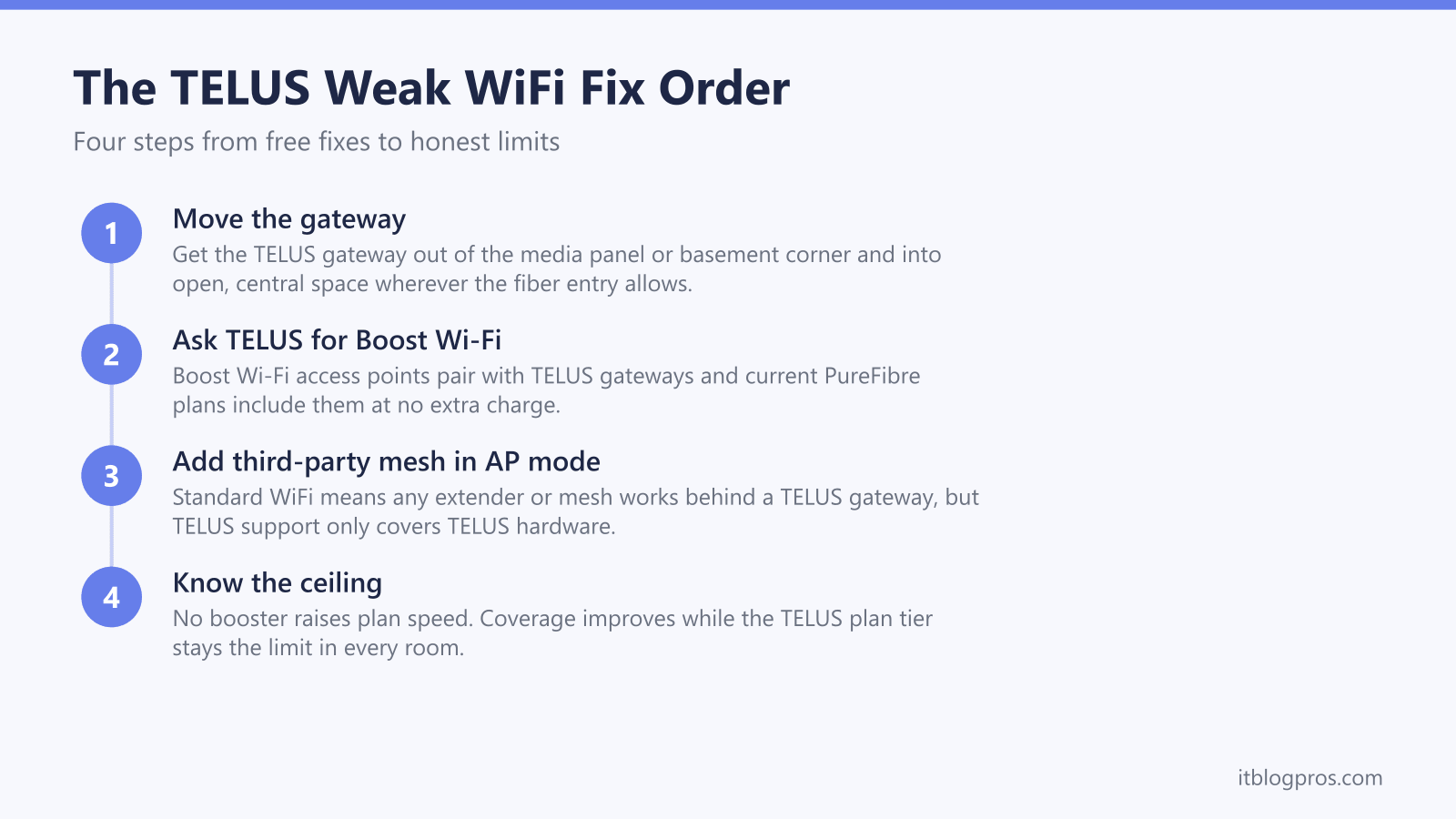
The fix order for weak TELUS WiFi, then: move the gateway out of the media panel if possible, ask TELUS for the Boost Wi-Fi access points the plan likely already includes, add third-party mesh in access point mode if the TELUS route falls short, and accept that the plan tier stays the speed limit throughout. Most households never need to go past step two.