Questions about Xfinity WiFi safety usually mix together two very different networks: the password-protected WiFi inside your home, and the public hotspots that rented Xfinity gateways broadcast to anyone nearby. The honest answer depends entirely on which one your device is connected to. This guide separates the two, explains what actually protects you on each, and shows where a VPN fits in.
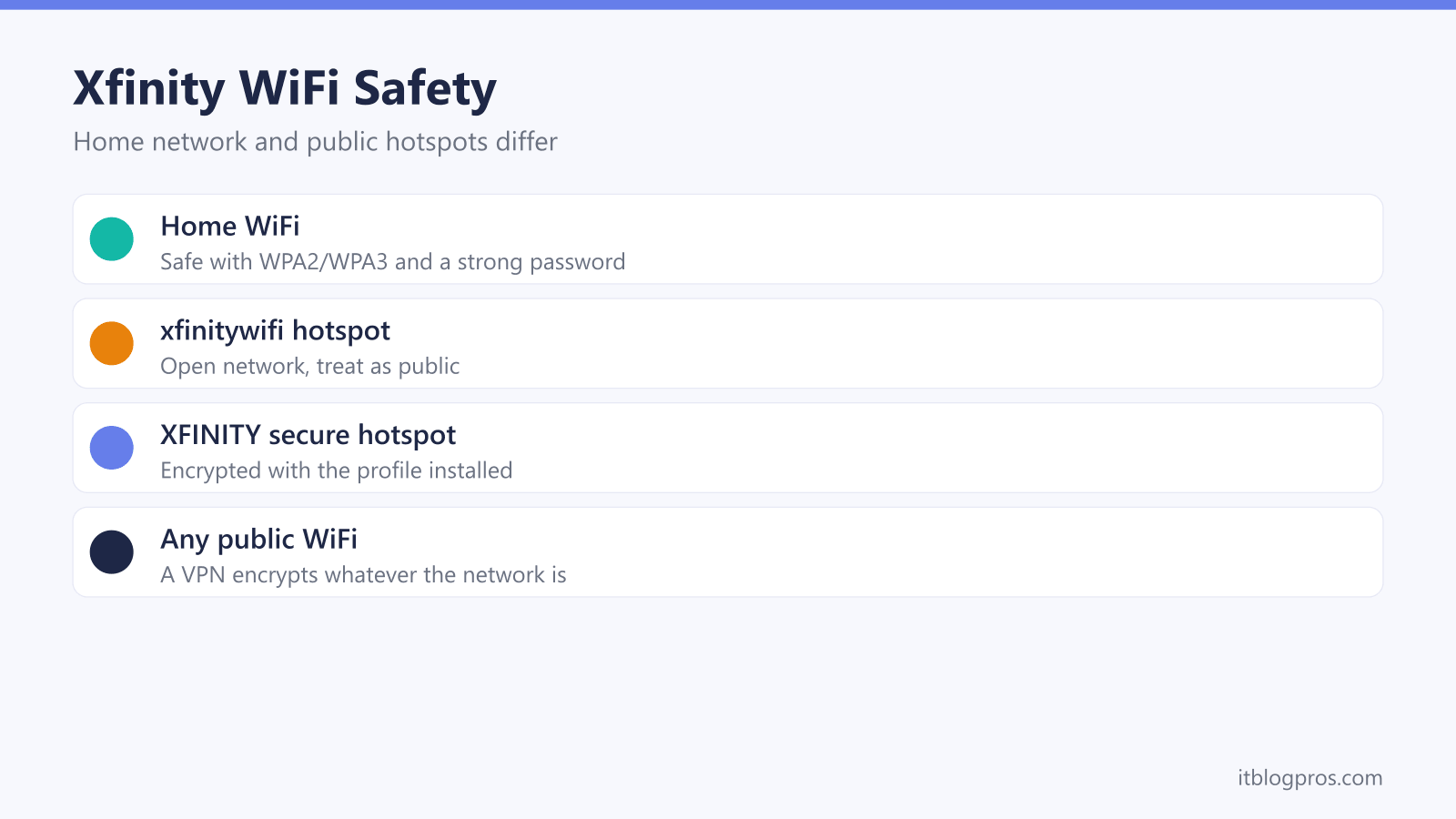
Your home Xfinity WiFi is safe when it runs WPA2 or WPA3 with a strong, unique password, and rented gateways get firmware updates automatically. The open xfinitywifi public hotspot is a different network: it has no encryption over the air, so treat it like any public WiFi. The XFINITY secure hotspot is better, and a VPN adds real privacy on all of them.
Key Takeaways
- Home Xfinity WiFi secured with WPA2 or WPA3 and a strong, unique password is safe for everyday banking, shopping, and streaming.
- Rented Xfinity gateways receive firmware updates automatically, so the home side stays patched without any effort on your part.
- The open xfinitywifi hotspot has no WiFi encryption, so anyone nearby can join it and unencrypted traffic can be observed.
- The XFINITY secure hotspot encrypts traffic over the air once Xfinity's WiFi profile is installed, making it the better public choice.
- A VPN encrypts everything leaving your device, which is what makes an open hotspot, a secure hotspot, or any other network private.
Home WiFi and the Public Hotspot Are Two Separate Networks
A rented xFi gateway usually runs two networks at the same time. The first is your private home WiFi, the one with the network name and password you chose, protected by WPA2 or WPA3 encryption. The second, on most rented gateways, is a public hotspot named xfinitywifi that any Xfinity customer within range can sign in to using their own account.
Comcast keeps the two apart. Hotspot guests authenticate with their own Xfinity credentials, their traffic is separated from your home devices, and anything they do online is tied to their account rather than yours. Comcast also states that the hotspot runs on bandwidth allocated separately from your home service. Those separations are why a properly configured home network stays safe even while the hotspot broadcasts; the genuine safety questions live on the public side, and this guide gets to those below.
Older advice that treated Xfinity WiFi as a single thing missed this completely. Answering the safety question properly means answering it twice.
Your Home Xfinity WiFi Is Safe When the Basics Are Right
Modern Xfinity gateways ship with WPA2 encryption as the minimum, and newer models support WPA3, the current standard. Either way, the traffic between your devices and the gateway is encrypted, so neighbors and anyone outside cannot read it. That baseline puts home Xfinity WiFi on the same footing as any well-run home network, and it is genuinely fine for banking, shopping, and everything else.
A few habits keep it that way:
- Use a strong, unique WiFi password. The Xfinity app lets you change the network name and password in about a minute; pick a password you use nowhere else.
- Change the defaults. The name and password printed on the gateway sticker work fine, but changing them removes any value that sticker has to anyone who has ever seen it.
- Let firmware handle itself. Comcast pushes firmware updates to rented gateways automatically, so patching needs no action from you.
- Glance at the connected device list. The Xfinity app shows every device on your network, and removing anything you do not recognize takes seconds.
Turning the Public Hotspot Broadcast Off
Plenty of people simply do not want their gateway broadcasting a public network, and Comcast provides an off switch. Sign in to your Xfinity account on the web or in the Xfinity app, open the WiFi or hotspot settings, and turn the Xfinity WiFi Hotspot option off. The change reaches the gateway shortly afterwards, and the xfinitywifi broadcast stops.
Two honest notes before flipping it. First, because Comcast allocates the hotspot bandwidth separate from your home service, switching it off is unlikely to make your own WiFi faster; this is a control and preference decision rather than a performance fix. Second, the hotspot only exists on rented Comcast gateways in the first place. Owning your own equipment removes the public broadcast entirely, along with the monthly rental fee, and our guide on buying your own modem instead of renting the Xfinity gateway covers the payback math.
The Open xfinitywifi Hotspot Deserves Real Caution
The xfinitywifi SSID is an open network. Open means there is no WiFi encryption at all: your device talks to the hotspot in the clear, and anyone nearby with basic software can capture what travels over the air. Anything a website or app sends unencrypted can be read by a stranger sitting in the same parking lot.
The second classic risk is impersonation, often called an evil twin. Nothing stops an attacker from broadcasting their own network named xfinitywifi from a laptop or a pocket-sized device. Phones and laptops that have joined the real hotspot before will happily auto-join the fake one, because devices recognize networks by name alone. A fake sign-in page on such a network is a convincing way to harvest Xfinity account credentials.
None of this makes the hotspot useless. For casual browsing it is a genuinely handy perk, and HTTPS blunts a lot of the snooping risk, which the next sections cover. But it belongs in the same mental category as coffee shop or airport WiFi: convenient, public, and not private.
On open and public networks like this, the reliable fix is a VPN, because it encrypts your traffic on the device itself, before anything touches the network. It then no longer matters who else is on the hotspot, or even who is running it.
Protect yourself on public WiFi with NordVPN →
The Secure XFINITY Hotspot Is the Better Public Option
Alongside the open network, Xfinity operates a secure hotspot SSID, shown as XFINITY rather than xfinitywifi. It uses enterprise-grade WPA2 encryption, so traffic between your device and the hotspot is encrypted over the air for each user individually. Connecting takes a one-time setup: installing Xfinity's WiFi profile on your device, available through the Xfinity app or Xfinity's official hotspot pages. That profile also lets the device check it is talking to a genuine Xfinity hotspot before signing in, which makes name-based impersonation much harder.
When both names appear in your WiFi list, the secure XFINITY network is the one to pick. It is still a public place, so the usual common sense applies, but the over-the-air snooping problem is largely dealt with.
HTTPS Protects the Contents, Not the Whole Picture
Being honest about modern web security matters here. Most websites now use HTTPS, and the padlock means the contents of your session, including passwords and card numbers, are encrypted between your browser and the site itself. Even on an open hotspot, a snooper cannot read what you typed into an HTTPS page. This is why casual browsing on public WiFi is far less dangerous than it was a decade ago.
The gaps are what remain. DNS lookups, the requests that turn a name like example.com into an address, usually travel unencrypted, and the SNI field in the HTTPS handshake states the domain in plain text. An observer on the network still learns which sites you visit and when, just not what you did there. That domain-level visibility applies on your home line too, and the details are in our guide to what Xfinity xFi can and cannot see about your browsing. Evil twins also stay dangerous regardless of HTTPS, because a fake network can serve fake portal pages and lean on you to hand over credentials yourself.
A VPN Is the Layer That Makes Any of These Networks Private
A VPN closes those gaps in one move. It encrypts everything leaving your device, DNS lookups included, inside a single tunnel to the VPN server. On the open hotspot, nearby snoopers capture only ciphertext. On the secure hotspot or your home network, the domains you visit stop being visible to the network operator. The same protection travels with the device to hotel WiFi, airports, and anywhere else it roams.
Honesty cuts both ways, so two limits are worth stating. A VPN moves trust from the network to the VPN provider, which is why an independently audited no-logs policy matters when choosing one. And no VPN stops phishing or fixes a weak password; it protects the connection, not your judgment.
One Xfinity-specific quirk deserves a mention. On the home network, the gateway's xFi Advanced Security feature sometimes interferes with VPN tunnels, and a connection that keeps dropping usually traces back to it. The fixes are in our guide to a Comcast Xfinity VPN that is not working.
xFi Advanced Security Is Home Filtering, Not Hotspot Protection
Rented xFi gateways include a feature called xFi Advanced Security, and it deserves an accurate description. It is gateway-level filtering: it watches traffic passing through the gateway, blocks connections to known malicious destinations, and flags unusual behavior from smart home devices. For a house full of cameras, TVs, and plugs that never receive security updates of their own, that is genuinely useful.
Its limit is location. Advanced Security protects devices only while they sit behind your gateway on the home network. The moment a laptop joins a public hotspot, a hotel network, or cellular data, the gateway is out of the picture and so is its filtering. Treat it as a complement to device-level protection and a VPN rather than a replacement for either.
The Bottom Line on Xfinity WiFi Safety
Home Xfinity WiFi, secured with WPA2 or WPA3 and a strong unique password, is safe for everyday use, and rented gateways keep themselves patched. The open xfinitywifi hotspot is public infrastructure and deserves the same caution as any open network, while the secure XFINITY hotspot with the profile installed is a solid step up. The one protection that works identically on all of them is a VPN, because it encrypts your traffic before the network ever sees it.