A laptop that refuses to list your Xfinity WiFi while every phone in the house connects fine is one of the most common Comcast complaints there is. The network has not vanished; something between the laptop's wireless hardware and the gateway's broadcast is getting in the way. The fixes below run from ten-second checks to the honest hardware answer, in the order worth trying them.
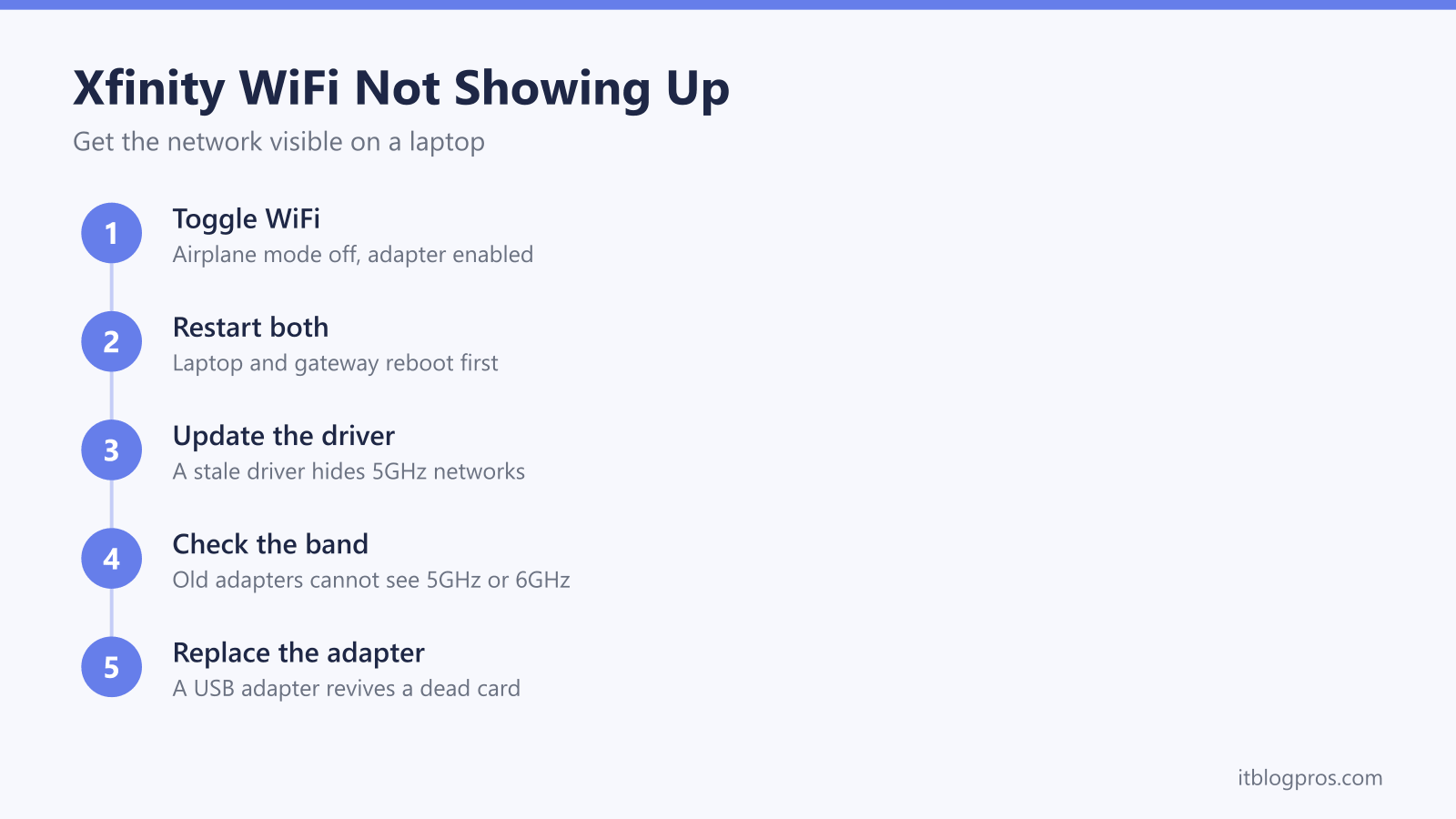
When Xfinity WiFi is not showing up on a laptop, the cause usually sits on the laptop side: WiFi switched off, a broken Windows driver, or an adapter that cannot see the band the gateway is using. Toggle WiFi and airplane mode, restart both the laptop and the gateway, then update or reinstall the WiFi driver. If the internal card is dead or 2.4GHz-only, a USB WiFi 6 adapter restores the connection.
Key Takeaways
- Airplane mode, the WiFi toggle, and the physical wireless switch on older laptops account for a surprising share of missing-network complaints.
- Restarting the laptop and power-cycling the gateway clears most temporary glitches; the gateway needs a couple of minutes to rebuild its broadcast.
- Updating or reinstalling the WiFi adapter driver in Device Manager fixes the classic case where every network vanishes after a Windows update.
- A 2.4GHz-only adapter cannot see 5GHz or 6GHz networks, which is why an old laptop skips names that every phone in the house lists fine.
- A USB WiFi 6 adapter is the honest fix when the internal card is dead or ancient, and it costs a fraction of a repair or a new laptop.
Start With the Ten-Second Checks
Before touching drivers or gateway settings, rule out the switches. Click the network icon in the Windows taskbar and confirm two things: airplane mode is off, and the WiFi tile is actually on. Windows updates and stray keyboard shortcuts flip both more often than seems reasonable, and either one empties the network list completely.
Older laptops add a third switch worth hunting for. Plenty of machines from the mid-2010s and earlier have a physical wireless slider on the side or front edge, or a function-key combination (often Fn plus one of the F-keys with a small antenna icon) that kills the radio at the hardware level. When that switch is off, no amount of software troubleshooting brings the network back, because the radio is genuinely powered down.
If the switches all check out, forget the network and rescan. Go to Settings, then Network and internet, then WiFi, then Manage known networks, and remove the entry for your home network if one exists. A saved profile with stale settings can stop Windows from displaying or joining a network cleanly. After forgetting it, click the network icon again and let the laptop scan fresh.
One more quick comparison is worth making now: check whether the laptop sees other networks. A list full of neighbors' WiFi with only yours missing points at the gateway or at band support. A completely empty list points at the laptop, and the driver section below becomes the priority.
Restart the Laptop and the Gateway Together
Restarts feel like a cliche, but they clear real faults on both ends. On the laptop, use Restart rather than Shut down. With Fast Startup enabled (the Windows default), a shutdown does not fully reload drivers on the next boot, while a proper Restart does. A wireless driver stuck in a bad state often comes back to life on a genuine restart and stays broken through a dozen shutdowns.
Give the gateway the same treatment. Unplug the Xfinity gateway's power cord, wait about 30 seconds, plug it back in, and leave it alone until the light settles to steady white. That takes a few minutes, and the WiFi network is one of the last things it brings back up, so a scan 60 seconds after plugging in proves nothing. The Xfinity app can also restart the gateway remotely if the power outlet is awkward to reach.
Stick to a power cycle here. The recessed pinhole on the back is a factory reset that wipes your WiFi name and password, which turns a small problem into an evening project. Our guide to restarting the router or gateway for every US ISP covers the difference in detail, along with the light patterns worth waiting for.
Fix the Windows Driver and the Wireless Service
When restarts change nothing and the laptop lists no networks at all, the Windows driver is the prime suspect. Right-click the Start button, open Device Manager, and expand Network adapters. The wireless adapter is the entry with WiFi, Wireless, AX, AC, or 802.11 in its name. Right-click it and choose Update driver, then let Windows search automatically.
If Windows claims the best driver is already installed but the problem persists, go one step further: right-click the adapter, choose Uninstall device, and restart the laptop. Windows detects the hardware on boot and reinstalls a clean copy of the driver. This one move fixes the classic case where a Windows update quietly breaks wireless. For a stubborn machine, download the latest wireless driver directly from the laptop manufacturer's support page over Ethernet or a phone hotspot, since the maker's driver frequently behaves better than the generic one Windows picks.
Take note of what Device Manager shows while you are in there. A wireless adapter with a yellow warning triangle, or no wireless adapter listed at all, is evidence of a hardware-level failure, and the USB adapter section below is where that story ends.
Two more Windows-side fixes are worth running. First, the built-in network reset: open Settings, then Network and internet, then Advanced network settings, and choose Network reset. Windows removes and reinstalls every network adapter and resets the networking stack, then restarts the machine; saved WiFi passwords need re-entering afterwards, so keep yours handy. Second, check the service that runs wireless scanning. Press Windows key plus R, type services.msc, and find WLAN AutoConfig. If it is stopped, no wireless network will ever appear. Double-click it, set the startup type to Automatic, and click Start. Our Windows 11 WiFi problems guide walks through these fixes with screenshots if any step is unclear.
Band Support Decides Which Networks the Laptop Can See
Here is the explanation behind the strangest version of this problem, where the laptop happily lists half the neighborhood but not your own network. WiFi runs on three bands: 2.4GHz, 5GHz, and (on the newest hardware) 6GHz. An older adapter built for 2.4GHz only is physically incapable of seeing a 5GHz or 6GHz broadcast. The network is not hidden from it; the radio simply cannot tune to that frequency.
Checking the laptop's side takes one command. Open Command Prompt and run netsh wlan show drivers, then read the line labeled Radio types supported. If it includes 802.11a, 802.11ac, or 802.11ax, the adapter can use 5GHz. If the list only shows 802.11b, 802.11g, and 802.11n, the adapter is almost certainly 2.4GHz-only.
On the gateway's side, current Xfinity xFi gateways broadcast one network name shared across their bands, and the 2.4GHz radio carries that name too, so even an old laptop should see the network as long as that radio is enabled. Sign in to the gateway's admin page at 10.0.0.1, or open the Xfinity app, and confirm the 2.4GHz band is switched on and the network name is not set to hidden. A hidden SSID keeps the network out of every device's list by design.
One naming wrinkle causes plenty of confusion here. Leased xFi gateways broadcast a separate public hotspot called xfinitywifi by default, alongside your private home network. Spotting xfinitywifi in the list while your own network is missing is actually useful evidence: the gateway's radios clearly work, so the fault sits in the home network's settings or in the laptop's band support rather than in the hardware. The hotspot itself can be disabled from your Xfinity account if you would rather not broadcast it.
A USB Adapter Is the Honest Fix for a Dead or Ancient Card
Some laptops arrive at this point with clear symptoms of a hardware problem: the wireless adapter has vanished from Device Manager, it shows an error code that driver reinstalls never clear, or the command above confirms a 2.4GHz-only card in a home that needs 5GHz. Replacing an internal laptop WiFi card means opening the chassis, matching a compatible module, and hoping the antenna leads cooperate, which is not a sensible weekend job for most people.
A USB WiFi adapter sidesteps all of it. It plugs into a spare USB port, brings its own modern radio and driver, and completely takes over from the internal card, which can stay disabled in Device Manager. A WiFi 6 model gives an older laptop dual-band support and current-generation speeds for a fraction of what a repair shop charges to open the case. The TP-Link AX1800 USB adapter is the one we point people to for this job: WiFi 6, both bands, and a simple driver install.
Check the TP-Link AX1800 USB adapter price on Amazon →
To be clear about scope: a USB adapter fixes laptop-side problems only, meaning a dead or outdated internal card. If the gateway has stopped broadcasting, or the network is missing on every device in the house, new laptop hardware changes nothing, and the gateway sections above are where the fault lives.
Bridge Mode and Your Own Router End the Gateway Battles
Plenty of readers land on this page after months of recurring WiFi weirdness from the rented gateway, and for that group the durable fix is to stop depending on its WiFi entirely. Putting the gateway into bridge mode turns off its routing and wireless so a router you own (and control fully) handles the network instead; our Xfinity bridge mode guide covers the whole process, including what happens to the public hotspot when bridge mode is on.
Going one step further drops the monthly rental fee altogether. Buying a compatible modem and pairing it with your own router pays for itself within the first year or two, and the walkthrough in our guide to replacing the rented Xfinity gateway with your own modem covers approved hardware and the activation steps. Either route puts the WiFi network under your control, with hardware that gets chosen for your home rather than shipped by the truckload.
A laptop that cannot see Xfinity WiFi nearly always comes right with one of the steps above: a toggled switch, a clean restart on both ends, a reinstalled driver, a band setting, or an inexpensive USB adapter when the internal card has genuinely died. Work down the list in order and the network list fills back in.