The short answer behind this page's title has not changed since 2021: Ubiquiti gear works on Xfinity, and Comcast has no say in the matter. What has changed is everything around that answer. The UniFi lineup now spans Dream Routers, Dream Machines, Cloud Gateways, and U6 and U7 access points, current xFi Gateways ship with the local admin tool switched off, and bridge mode now costs you xFi Pods and app features that did not exist when the original guide was written. This rewrite covers the whole path: what Comcast actually restricts, why double NAT wrecks a UniFi network that skips bridge mode, the exact current route to the bridge mode switch, and the setup order that gets a UniFi console online without locking you out of the Xfinity app halfway through.
Ubiquiti UniFi equipment works on Xfinity internet without restriction. Comcast only certifies the modem; anything behind it, including a Dream Machine, Dream Router, Cloud Gateway, or U6 and U7 access points, is yours to run. Put the xFi Gateway into bridge mode so the UniFi gateway gets the public IP, or replace the rental with an approved owned modem, then let UniFi handle all routing and WiFi.
Key Takeaways
- Comcast approval only applies to the modem, so every UniFi gateway, console, and access point works freely behind it.
- Bridge mode through the Admin Tool at 10.0.0.1 turns the xFi Gateway into a plain modem and hands UniFi the public IP.
- Bridge mode switches off gateway WiFi, xFi app controls, WiFi Boost Pods, and xFi Advanced Security, and already-activated Pods block it until they are removed.
- A skipped bridge mode leaves double NAT, which shows up as strict NAT on consoles, dead port forwarding, and failed VPN connections.
- Dream Router and Dream Machine consoles run standalone, while U6 and U7 access points need a console or a self-hosted UniFi Network application.
Xfinity and Ubiquiti UniFi work together with zero restrictions from Comcast
Comcast's compatibility rules apply to exactly one box: the modem, the device that speaks DOCSIS to the cable plant. That device must appear on the approved list at My Device Info, Comcast's official compatibility checker, and it must support the speed tier on the account. Everything behind the modem is invisible to Comcast. The network only sees one connected device pulling one IP address, and whether that device is a rented xFi Gateway, a $60 plastic router, or a rack-mounted UniFi Dream Machine Pro makes no difference to the service. The persistent myth that Xfinity somehow does not support Ubiquiti comes from support calls, not from the network. Xfinity agents will not troubleshoot third-party routers, and a frustrated agent saying that is not supported gets remembered as it does not work. The connection side of UniFi is ordinary Ethernet WAN with DHCP, which is precisely what Xfinity hands out. The one genuine difference worth knowing up front is the management model: UniFi devices are configured through the UniFi Network application, either on a UniFi OS console or self-hosted on a computer, rather than through the simple web wizard most consumer routers use. That makes setup a different experience from plugging in a store-bought router, but it changes nothing about compatibility.
Double NAT is what breaks when the xFi Gateway keeps routing
Plug a UniFi gateway into an xFi Gateway that is still in its default mode and both boxes route and translate addresses. The xFi Gateway holds the public IP, and the UniFi gateway's WAN port receives a private address from it, typically starting with 10.0.0. That stack of two NAT layers is double NAT, and it degrades the network in ways that basic browsing never reveals. Game consoles report strict NAT on Xbox or NAT Type 3 on PlayStation because UPnP cannot negotiate across two routers, which blocks game hosting and voice chat. Port forwarding rules built in UniFi Network test as closed from outside because inbound traffic dies at the first NAT layer before the rule ever sees it. WireGuard and Teleport VPN connections into the home fail, remote camera access breaks, and UniFi's cloud features work erratically. Web pages and streaming keep working throughout, which is why double NAT setups limp along for months before anyone diagnoses them. The check takes seconds: open the UniFi Network application, look at the Internet section, and read the WAN IP. An address beginning with 10., 172.16 through 172.31, or 192.168 means a second router still sits in front. Several of the complaints in the most common Xfinity issues guide trace back to exactly this arrangement.
Bridge mode switches off the xFi extras before it gives you anything
Bridge mode demotes the xFi Gateway to a plain modem, and the honest accounting of what that costs comes before any recommendation to do it. The gateway's own WiFi switches off entirely. The Xfinity app keeps handling the account and billing, but loses network management: no WiFi settings, no device list, no parental controls. WiFi Boost Pods stop working completely, and the dependency runs both ways, because a gateway with Pods or WiFi extenders already activated on the account refuses to enter bridge mode until they are removed. xFi Advanced Security, the gateway-level threat filtering, switches off as well. Comcast also supports only one device connected to the gateway's Ethernet ports in bridge mode, and that device has to be the UniFi gateway. None of these losses matter in a full UniFi build, which is the point of doing it: the UniFi Network application replaces the app's controls with far deeper versions, U6 or U7 access points replace Pods, and UniFi's own traffic filtering on Cloud Gateways and Dream Machines covers the security angle. Households that want to keep the xFi app, Pods, and Advanced Security have a legitimate middle path too: skip the UniFi gateway, leave the xFi Gateway routing, and run U6 or U7 access points with a self-hosted UniFi Network application. Access points do not route, so that layout adds no second NAT layer.
The bridge mode path runs through the Xfinity app and then the Admin Tool
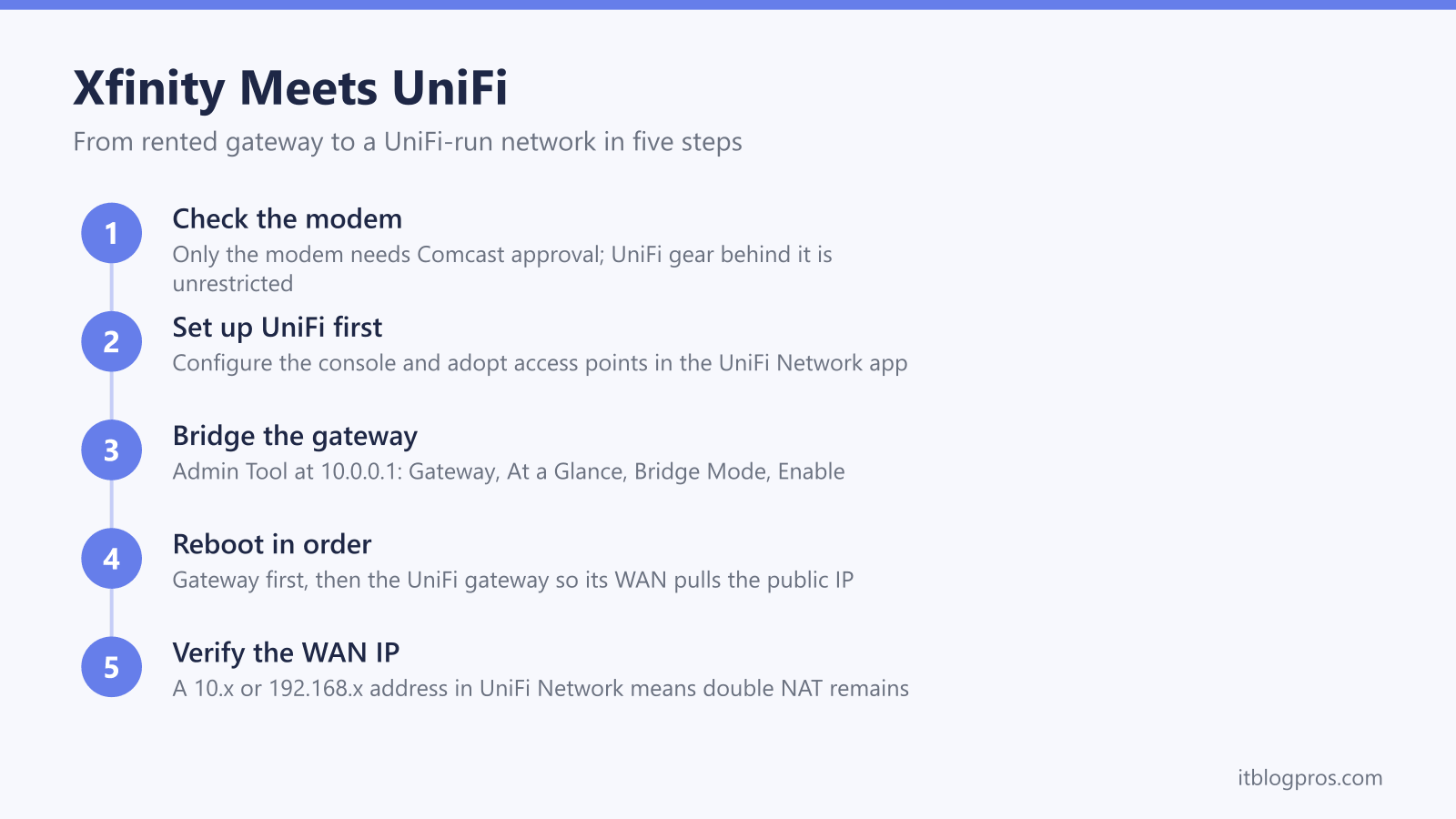
Current xFi Gateway firmware ships the local admin tool disabled, so the route to bridge mode starts in the Xfinity app rather than the browser. Open the app and sign in with the account's Xfinity ID, go to the WiFi tab, select View WiFi Equipment, open Advanced Settings, choose Admin Tool Online Access, slide the toggle to allow access, and save. That first enabling also sets the password: Xfinity's article says you are taken to a screen to set up a new password to access the admin tool, so create one and keep it. Then, on a device connected to the gateway, browse to http://10.0.0.1 and sign in with the username admin and that created password. Xfinity words the old route narrowly, saying only users who enabled access prior to February 2026 may still use the default password found on the sticker on the bottom of the gateway, and older units shipped with the word password. In the left-hand menu choose Gateway, then At a Glance, find Bridge Mode, click Enable, and accept the warning. The gateway reboots as a plain modem and its WiFi networks disappear, which is expected rather than broken. Run an Ethernet cable from any gateway LAN port to the UniFi gateway's WAN port, remembering the one-device rule. Afterwards, switch Admin Tool Online Access back off in the app. Reversing the change later works the same way through the wired connection at 10.0.0.1, and a factory reset restores full routing if the admin password ever goes missing, using whichever control that gateway has. Xfinity's reset article gives the pinhole held for 30 seconds and covers the XB2 and XB3 alone, while a Comcast employee on Xfinity's forum says the XB7 resets from the WPS button held 15 seconds or more.
Owning the modem beats bridging a rented gateway
A bridged xFi Gateway does nothing an owned modem cannot, and the rental fee, around $15 a month on most plans, keeps billing either way. Once UniFi handles all routing and WiFi, the natural next step is replacing the gateway with a purchased DOCSIS 3.1 modem from Comcast's approved list, which does the identical modem-only job and typically pays for itself inside a year. The pairing makes particular sense with Ubiquiti because UniFi makes no cable modems at all; an approved modem plus a UniFi gateway is the complete replacement stack. Verify any candidate against My Device Info before buying so it is both approved and rated for the plan's speed tier, and the best modem for Xfinity roundup covers certified picks that match current tiers. One honest caveat before ordering: customers on plans with the 1.2 TB data cap who rely on xFi Complete get unlimited data bundled with the rental, and standalone unlimited data costs more with customer-owned equipment, so heavy-data households should run that math first. A side benefit of the swap is capacity, since the practical connection ceilings covered in the Xfinity device limit guide stop mattering once UniFi access points carry the client load instead of the gateway.
The UniFi lineup splits into all-in-one consoles and access points that need one
Picking the UniFi piece for an Xfinity connection comes down to which devices can run the network by themselves. The Dream Router line is the single-box answer: a desktop unit with built-in WiFi that runs UniFi OS and the full UniFi Network application, so it replaces the bridged gateway's routing and WiFi in one step. The Dream Machine line, including the rack-mount Dream Machine Pro models, provides the same console brain with more routing muscle but pairs with separate access points for wireless coverage. The Cloud Gateway line, with models such as the Cloud Gateway Ultra, Cloud Gateway Max, and Cloud Gateway Fiber, offers compact wired gateways that also run the Network application and suit builds where access points handle all WiFi. The U6 family covers WiFi 6 and 6E access points and the U7 family covers WiFi 7, and neither is a router: every U6 or U7 needs a UniFi OS console somewhere on the network, or a self-hosted UniFi Network application on a Windows, macOS, or Linux machine, plus PoE power from a switch or injector. Management for all of it happens through adoption in the UniFi Network application rather than a plain web wizard, so the first access point on the network always arrives alongside something capable of running that application.
The setup order that avoids locking yourself out
Sequence matters here because the Xfinity app hides its WiFi menus once the gateway is bridged, so anything the app has to do must happen first. Enable Admin Tool Online Access in the app while the gateway is still routing. Next, set up the UniFi side behind the un-bridged gateway, since UniFi tolerates double NAT during initial configuration: connect the UniFi gateway's WAN port to a gateway LAN port, run through setup in the UniFi Network application, install firmware updates, adopt any U6 or U7 access points, and name the new WiFi with the same SSID and password the old gateway network used so phones, TVs, and smart home devices rejoin on their own. With the UniFi network proven working, enable bridge mode through 10.0.0.1 as described above. Then reboot in order: gateway first, wait until its status light settles, then the UniFi gateway so its WAN request pulls the public IP rather than a stale private lease. Confirm in the UniFi Network application that the WAN address is public; a lingering 10.0.0.x address usually clears with one more power cycle of both boxes in the same order. Finish by switching Admin Tool Online Access back off in the Xfinity app.
Fixes for the leftover problems after the switch
A few predictable issues surface in the first week after the changeover, and all of them have quick answers. The old Xfinity WiFi network vanishing from every device is by design, since bridge mode kills the gateway's radios along with the public xfinitywifi hotspot the gateway used to broadcast; laptops still hunting for the old name need pointing at the new UniFi SSID, and the laptop cannot find Xfinity WiFi guide covers the stubborn cases where a saved profile gets in the way. A UniFi WAN address still showing 10.0.0.x means bridge mode did not take or the reboot order ran backwards: sign back into 10.0.0.1 over the wired connection, confirm Bridge Mode still reads enabled under Gateway and At a Glance, and power cycle gateway first, UniFi second. Devices that refuse to rejoin usually saved the old network with a slightly different password, and forgetting the network on the device before reconnecting clears it. Service-level problems, including outages, speed drops at peak time, and billing quirks, continue exactly as before because no router choice touches them, and the most common Xfinity issues rundown separates those from equipment faults. From this point the UniFi Network application, not the Xfinity app, is the place to look first when WiFi misbehaves.