
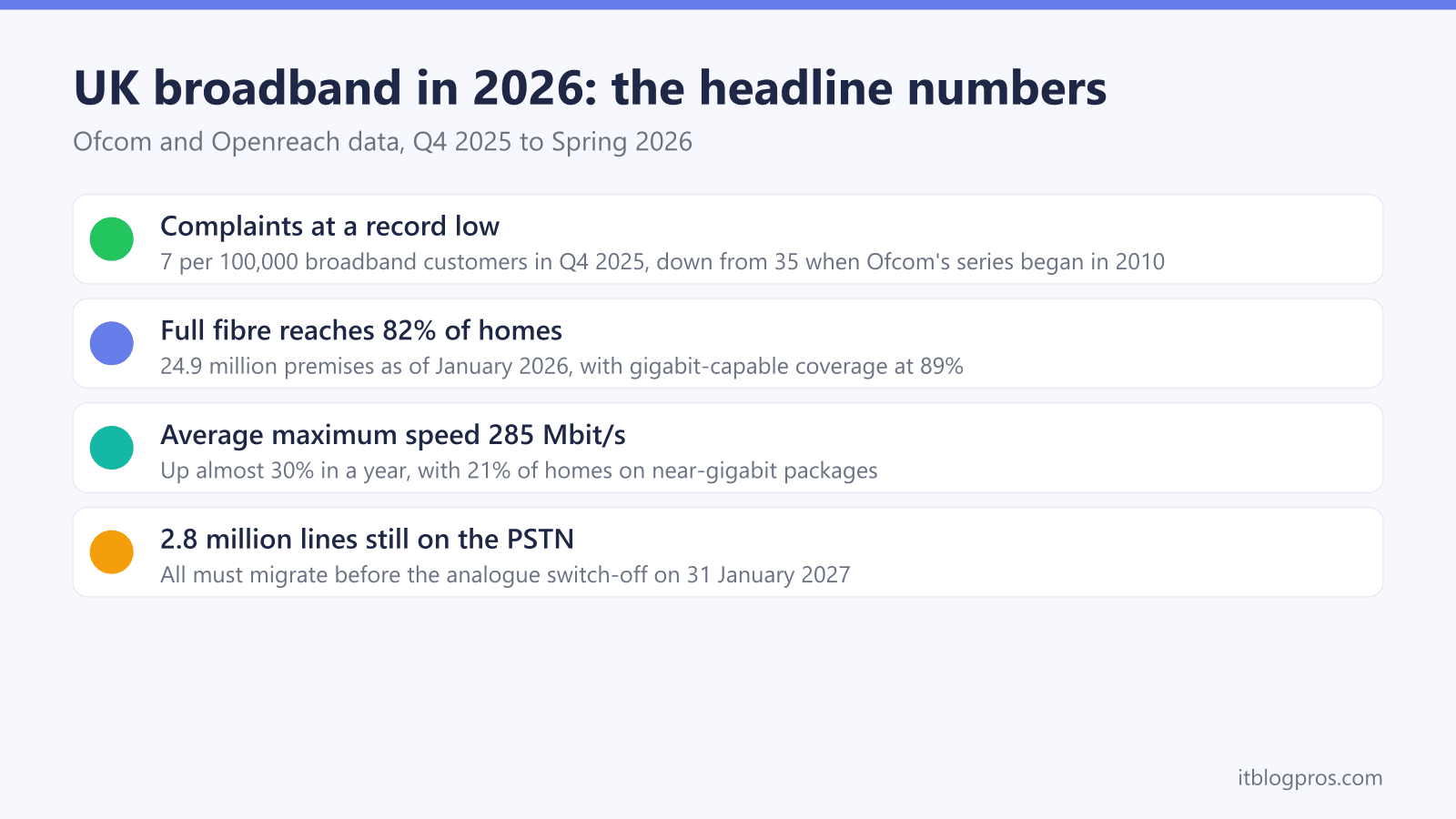
Every number on this page comes from a named Ofcom, Openreach or UK government publication, with the source and reporting period stated inline and linked in full at the end. It covers the three datasets journalists ask about most: Ofcom's per-provider complaint rates for Q4 2025, the Connected Nations coverage and speed figures through Spring 2026, and the countdown numbers for the PSTN switch-off on 31 January 2027. The data is free to reuse with attribution.
The UK's fixed broadband complaints average fell to 7 per 100,000 customers in Q4 2025, the lowest on record per Ofcom. Full fibre now reaches 82% of homes (24.9 million premises) as of January 2026, the average maximum download speed hit 285 Mbit/s, and roughly 2.8 million lines still need to migrate before the PSTN switch-off on 31 January 2027.
Key Takeaways
- Fixed broadband complaints fell to 7 per 100,000 customers in Q4 2025, the lowest since Ofcom's series began at 35 in Q4 2010.
- Vodafone (11) and TalkTalk (10) were the most complained-about broadband providers in Q4 2025; Plusnet and Virgin Media were the least at 5 each, per Ofcom.
- Full fibre reached 82% of UK homes (24.9 million premises) by January 2026 and gigabit-capable coverage hit 89%, per Ofcom's Connected Nations Spring 2026 update.
- The average maximum download speed delivered to UK homes rose almost 30% in a year to 285 Mbit/s, per Connected Nations 2025.
- The PSTN switch-off is locked in for 31 January 2027, with roughly 2.8 million lines still to migrate as of February 2026, per Openreach.
The headline UK broadband numbers for 2026
These are the figures most often quoted from this page, each with its source and period.
- 7 complaints per 100,000 broadband customers: the fixed broadband industry average for Q4 2025, the lowest in a series that began at 35 in Q4 2010, per Ofcom's Q4 2025 complaints data (published 11 May 2026).
- 82% full-fibre coverage: 24.9 million of 30.5 million UK homes could order full fibre as of January 2026, per Ofcom's Connected Nations update: Spring 2026 (published 13 May 2026).
- 89% gigabit-capable coverage: 27.1 million UK homes as of January 2026, per the same Spring 2026 update.
- 285 Mbit/s: the mean of maximum download speeds delivered to residential connections as of July 2025, up almost 30% from 223 Mbit/s in 2024, per Ofcom's Connected Nations UK Report 2025 (Table 2.8).
- 31 January 2027: the confirmed date BT Group will retire the analogue Public Switched Telephone Network (PSTN), per Openreach's February 2026 announcement, with roughly 2.8 million lines still to migrate at that point.
- £23.8 million: Ofcom's December 2025 fine on Virgin Media for failures in protecting vulnerable telecare customers during digital landline migration.
Broadband complaints by provider, Q4 2025
Ofcom publishes complaint volumes per 100,000 subscribers each quarter for the largest providers. The Q4 2025 figures (October to December 2025, published 11 May 2026) put Vodafone and TalkTalk at the top of the table and Plusnet and Virgin Media at the bottom.
| Provider | Complaints per 100,000 subscribers | Movement, per Ofcom |
|---|---|---|
| Vodafone | 11 | Up on Q3 2025; most complained-about (joint with TalkTalk) |
| TalkTalk | 10 | Static vs Q3 2025 |
| BT | 8 | Down from 9 in Q3 2025 and 10 in Q4 2024 |
| EE | 8 | Down from 9 in Q3 2025 and 12 in Q4 2024 |
| Sky | 7 | Up from 6, after five straight quarters at 6 |
| Industry average | 7 | Down from 8 in Q3 2025 and 9 in Q4 2024; series low |
| Plusnet | 5 | Least complained-about (joint with Virgin Media) |
| Virgin Media | 5 | Down from 7 in Q3 2025 and 11 in Q4 2024 |
| NOW Broadband | 4* | Down from 11 in Q2 2025 |
*NOW Broadband's figure is the latest published (Q3 2025, as restated in the Q4 2025 edition); Ofcom's dataset contains no Q4 2025 broadband figure for NOW Broadband.
Virgin Media's turnaround is the standout trend in the series: from a peak of 32 complaints per 100,000 in Q3 2023 to 11 in Q4 2024, 7 in Q3 2025 and 5 in Q4 2025, per Ofcom's summary CSV.
The comparability caveat journalists should carry. Ofcom notes that the measurable difference was less than one complaint per 100,000 between several groups in Q4 2025: Virgin Media and Plusnet; Sky, the industry average and BT; the industry average, BT and EE; and TalkTalk and Vodafone. Those pairs and groups should therefore be treated as statistically comparable rather than strictly ranked.
Landline complaints by provider, Q4 2025
Landline complaints sit even lower than broadband. The industry average fell to 3 per 100,000 customers in Q4 2025, the lowest in a series that began at 42 in Q4 2010, per Ofcom's Q4 2025 complaints data.
| Provider | Complaints per 100,000 customers | Movement, per Ofcom |
|---|---|---|
| EE | 6 | Static vs Q3 2025; joint highest figure |
| NOW Broadband | 6 | Up from 5 in Q3 2025 |
| BT | 5 | Static vs Q3 2025 |
| TalkTalk | 5 | Down from 6; TalkTalk stood at 141 per 100,000 in Q4 2010 |
| Plusnet | 5 | Static vs Q3 2025 |
| Industry average | 3 | Down from 4 in Q3 2025 and 5 in Q4 2024; series low |
| Vodafone | 3 | Down from 4 in Q3 2025 |
| Sky | 2 | At 2 every quarter since Q3 2022 |
| Virgin Media | 2 | Down from 3 in Q3 2025 and 6 in Q4 2024 |
| Utility Warehouse | 1 | Least complained-about landline provider overall |
Ofcom's headline verdict groups BT, EE, NOW Broadband, Plusnet and TalkTalk as the statistically comparable most-complained-about landline providers for the quarter, with Utility Warehouse the least complained-about.
Much of today's landline friction is migration friction: complaints cluster around the move from analogue lines to broadband-based calling. Households mid-migration can work through the common failure points in the guide to Digital Voice not working.
Complaint volumes fell through 2025 while mobile bucked the trend
The full-year trajectory shows steady quarter-on-quarter improvement in fixed services, per Ofcom's Q4 2025 summary CSV.
- Broadband industry average per 100,000: Q1 2025: 10; Q2 2025: 8; Q3 2025: 8; Q4 2025: 7.
- Landline industry average per 100,000: Q1 2025: 5; Q2 2025: 4; Q3 2025: 4; Q4 2025: 3.
The wider picture was less tidy. Per Ofcom's Q4 2025 news release, total telecoms and pay-TV complaints increased quarter on quarter for the first time since 2023: broadband and landline complaints fell and pay-TV held steady, but mobile complaints rose following mid-contract price rise announcements by some providers, including O2.
Full-fibre and gigabit coverage keeps climbing
Ofcom's Connected Nations UK Report 2025 (published 19 November 2025, data as of July 2025) put full-fibre coverage at 78% of UK residential premises, or 23.7 million homes, up 9 percentage points and 3 million premises year on year. The Spring 2026 update (published 13 May 2026, data as of January 2026) lifted that to 82% of homes, 24.9 million of 30.5 million residential premises, an increase of 1.2 million homes in six months.
Gigabit-capable availability followed the same path: 87% of residential premises (26.4 million homes) in the 2025 report, up from 83% in 2024, and 89% (27.1 million premises) by January 2026 per the Spring 2026 update.
Coverage is uneven across the nations. Per Table 2.1 of Connected Nations 2025, full fibre reaches 95% of residential premises in Northern Ireland, 79% in England, 78% in Wales and 71% in Scotland.
At the other end of the scale, around 44,000 UK premises could not get decent broadband (10 Mbit/s down, 1 Mbit/s up) from fixed or fixed wireless networks as of July 2025, falling to around 39,000 premises (0.1%) in the Spring 2026 update.
Build continues at pace: Openreach targets 25 million homes and businesses passed with full fibre by December 2026, a target Ofcom's Telecoms Access Review 2026-31 confirms as on track, with a stated ambition of up to 30 million premises by the end of the decade. Households booking an upgrade can see what actually happens on the day in the guide to a full fibre install day.
Speeds, take-up and data usage
Availability is running ahead of adoption, and both are rising, per Connected Nations 2025 (data as of July 2025).
- Average maximum download speed: 285 Mbit/s across residential connections, up almost 30% in a year from 223 Mbit/s in 2024; Northern Ireland leads at 325 Mbit/s (Table 2.8).
- Near-gigabit packages: 21% of residential connections are on packages of 900 Mbit/s or faster, up from 17% in 2024 and 14% in 2023 (Table 2.10).
- Full-fibre take-up where available: 42% of premises that can get full fibre have taken it, with rural take-up (56%) ahead of urban (40%).
- Full-fibre take-up overall: 33% of all UK premises, 10.6 million connections, up from 23% in 2024.
- Gigabit-capable take-up where available: 56%, up 7 percentage points year on year.
- Data usage: the average fixed line carried 583 GB in July 2025, rising to 738 GB on full-fibre lines.
- Fixed wireless access: mobile-network home broadband from EE, Three and Vodafone is available at 96% of UK premises, with WISPs covering a further 8% (Table 2.11). Ofcom publishes availability rather than an adoption figure here.
- 5G: outdoor 5G coverage from at least one operator reaches 94 to 97% of UK premises, and 5G Standalone is available across 83% of areas outside premises from at least one operator.
A fast line only performs as well as the equipment behind it, which is why the per-ISP router guides for BT, Sky, Vodafone and EE exist alongside this data.
Altnets now carry a quarter of full-fibre connections
Competition data comes from Ofcom's Telecoms Access Review 2026-31 Statement (published 17 March 2026, in force from 1 April 2026).
- Around a quarter of UK full-fibre connections are delivered by alternative networks: Ofcom cites Point Topic Q3 2025 figures of 3.02 million altnet full-fibre connections out of 11.56 million total.
- Take-up rates diverge sharply: altnets average around 18% of premises passed, versus approximately 38% for Openreach, as of September 2025.
- Ofcom's 'Area 2', where there is actual or likely material and sustainable network competition, expanded from 70% to 86% of UK premises since 2021, driven by altnet build.
- Per Connected Nations 2025 (Table 2.2), 57% of UK residential premises now have a choice of more than one gigabit-capable network, up from 47% in July 2024.
The PSTN switch-off numbers
The UK's analogue phone network retires on 31 January 2027. Openreach confirmed in February 2026 that all technical barriers are resolved and the date is locked in. The original industry target was 31 December 2025, pushed back to put vulnerable-customer protections in place after migrations were paused twice, per the House of Commons Library briefing CBP-9471 (1 April 2026).
The countdown numbers, each attributed:
- Roughly 2.8 million lines remained on the Openreach PSTN as of February 2026, per Openreach's 'big switch-up' announcement (5 February 2026).
- More than 500,000 of those lines still serve business premises, per the same Openreach announcement.
- Around 3 million lines needed upgrading as of November 2025, requiring roughly 47,000 conversions every week to hit the deadline, per Openreach's price-changes announcement (12 November 2025).
- 3.2 million residential landline customers were still on the PSTN in July 2025, down from 5.2 million in July 2024, a fall of 2 million in one year, per Ofcom's Connected Nations 2025 (p23). That is just under a fifth (19%) of all UK residential landline connections.
- Over 1 million households dropped their landline entirely in favour of broadband-only service in the year to July 2025, per Connected Nations 2025.
- 53% of digital voice migrations were provider-led (managed) rather than customer-initiated in the year to June 2024, per Connected Nations 2024 (p26).
- September 2023: the date Openreach stopped selling analogue lines to new customers nationally (the WLR stop sell), per Openreach's help pages.
- Over 2,600 major incidents hit the ageing PSTN between April 2024 and March 2025, each affecting 500 or more customers, per DSIT written ministerial statement HCWS668 (2 June 2025). This is the core reliability case for retirement.
- Legacy line rental doubles in 2026: Openreach's analogue (WLR) rental rises 20% from 1 April 2026, then 40% from 1 July 2026 and another 40% from 1 October 2026, doubling the current £10.65 rental by October 2026, per the 12 November 2025 announcement, deliberately pricing the remaining lines towards migration.
- 1 February 2027: launch of a post-deadline emergency voice-only safety net for lines not migrated in time, including vulnerable customers and Critical National Infrastructure, per the same Openreach announcement.
Households hitting problems mid-migration can start with the Digital Voice troubleshooting guide.
Vulnerable customers, power cuts and the £23.8 million fine
The protections around the switch-off produce their own set of citable numbers.
- Minimum 1 hour of emergency-call access in a power cut: Ofcom's guidance under General Condition A3 (published 10 October 2018) requires providers to offer at least one free solution, such as a battery back-up unit, giving landline-dependent customers access to emergency organisations during a power cut. Some providers now offer back-up of up to seven hours. The full consumer rights are set out in the guide to digital landline power cut rules.
- 5 commitments, signed 18 December 2023: the PSTN Charter, signed by BT, Virgin Media O2, Sky, TalkTalk, Vodafone, Shell Energy and KCOM, per DSIT. It includes no non-voluntary migrations without full vulnerable-customer protections, no telecare user migrated without a confirmed compatible and functioning telecare solution, and battery back-up beyond the Ofcom 1-hour minimum.
- 1,000+ pilot migrations, 4,000+ trained engineers, 40+ telecare providers: Openreach's 'Prove Telecare' service safely migrated over 1,000 fixed-line telecare customers with no disruption in its pilot, completed September 2025 ahead of a UK-wide launch in October 2025, per Openreach.
- £23.8 million: Ofcom's fine on Virgin Media, issued 1 December 2025, for serious failures in protecting vulnerable customers, disconnecting telecare users during digital-landline migration without appropriate support, covering failures from August 2022 to December 2023.
- January 2026: Ofcom wrote to industry one year out from the switch-off, setting expectations for safe migration, including the commitment not to migrate telecare users without a confirmed compatible solution and assessment of Critical National Infrastructure customers.
How to cite this page
The compilation on this page is free to use in news articles, reports, broadcasts and research with attribution to ITBlogPros and a link to this page (itblogpros.com/uk-broadband-statistics/). No permission request is needed. The underlying figures belong to their original publishers, Ofcom, Openreach, DSIT and the House of Commons Library, and citing the original source alongside this page is encouraged; every source URL is listed below. For questions about the data or the collection dates, use the site contact page and the reply typically arrives the same working day.
Sources
Every statistic above traces to one of the following publications.
- Ofcom, Telecoms and Pay TV Complaints Q4 2025 summary CSV (published 11 May 2026): ofcom.org.uk complaints Q4 2025 CSV
- Ofcom news release, Latest telecoms and pay-TV complaints revealed, Q4 2025: ofcom.org.uk complaints Q4 2025 release
- Ofcom, Connected Nations UK Report 2025 (published 19 November 2025): ofcom.org.uk Connected Nations 2025 PDF
- Ofcom, Connected Nations update: Spring 2026 (published 13 May 2026): ofcom.org.uk Connected Nations Spring 2026
- Ofcom, Connected Nations UK Report 2024 (published 5 December 2024): ofcom.org.uk Connected Nations 2024 PDF
- Ofcom, Telecoms Access Review 2026-31 Statement, Volume 1 (published 17 March 2026): ofcom.org.uk TAR 2026-31 Volume 1 PDF
- Ofcom, guidance on emergency access during power cuts (published 10 October 2018): ofcom.org.uk power cut guidance PDF
- Ofcom, Protecting customers during the migration to digital landlines (January 2026): ofcom.org.uk migration expectations
- Ofcom enforcement decision, £23.8 million fine on Virgin Media (1 December 2025): ofcom.org.uk Virgin Media fine
- Openreach, Time for a 'big switch-up' as PSTN switch-off looms (5 February 2026): openreach.com big switch-up
- Openreach, price changes to encourage digital adoption (12 November 2025): openreach.com price changes
- Openreach, Openreach clears major hurdle to PSTN switch-off (17 September 2025): openreach.com telecare milestone
- Openreach, Upgrading the UK to digital phone lines: openreach.com digital phone lines help
- Openreach, Where and when we're building Full Fibre Broadband: openreach.com full fibre build
- House of Commons Library, The switch to digital landlines, CBP-9471 (1 April 2026): commonslibrary.parliament.uk CBP-9471
- DSIT, Public Switched Telephone Network Charter (18 December 2023): gov.uk PSTN Charter
- DSIT written ministerial statement HCWS668 (2 June 2025): questions-statements.parliament.uk HCWS668