The eero versus Deco question comes up whenever a UK home outgrows a single ISP router and dead zones start to bite. Both the Amazon eero 6+ and the TP-Link Deco X50 are dual-band WiFi 6 mesh systems in the same price bracket, so the choice rarely comes down to raw airtime. It comes down to how many units you get in the box, how much control the app hands you, whether you want to live inside the Amazon and Alexa ecosystem, and how many of the good features sit behind a monthly subscription. This comparison puts the eero 6+ 2-pack against the Deco X50 3-pack on the specifications that actually differ, then gives an honest verdict and a clear pick-one recommendation for each type of household.
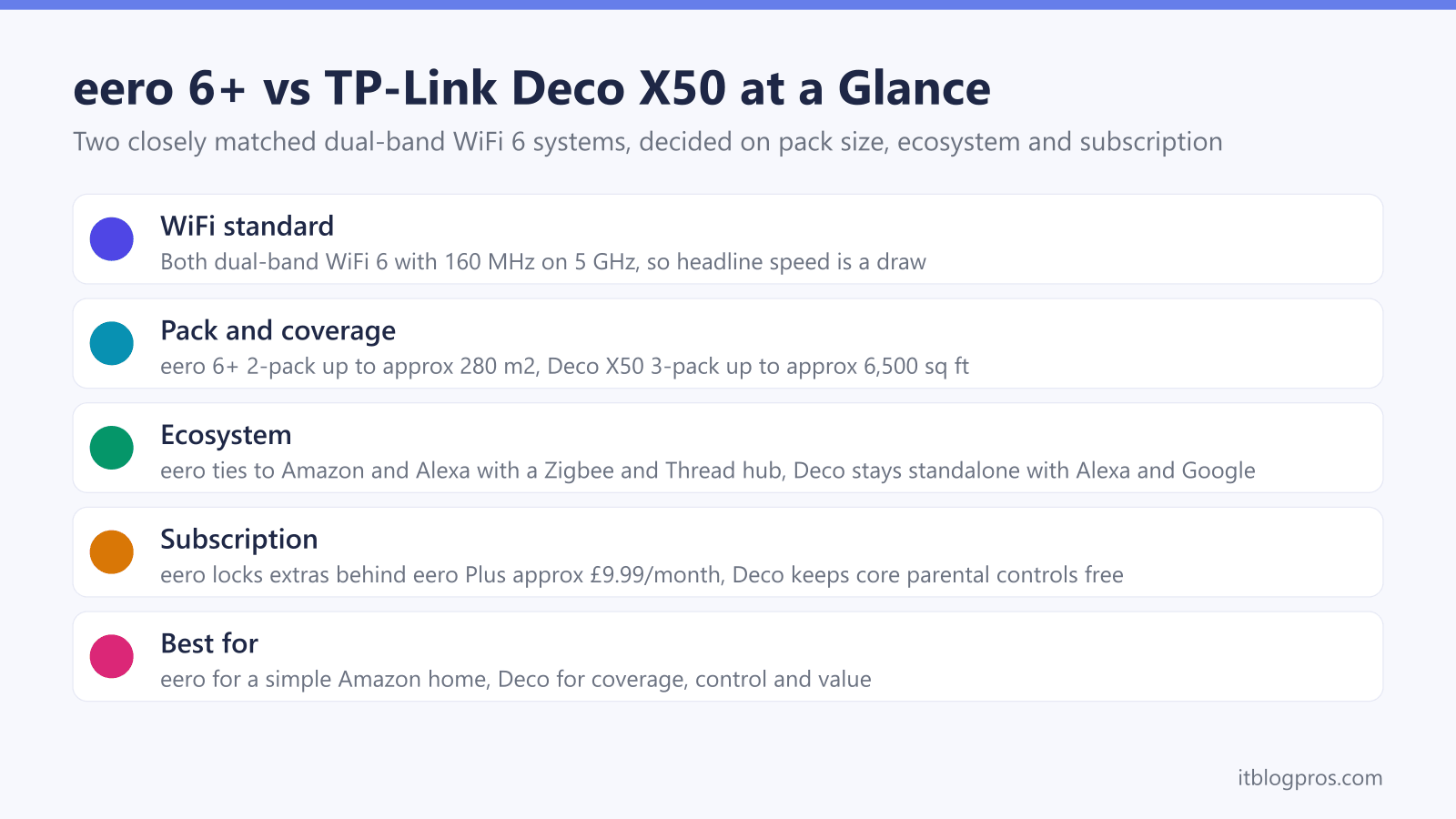
The eero 6+ and the TP-Link Deco X50 are closely matched dual-band WiFi 6 systems. eero wins on app polish and Amazon smart-home integration but ships a 2-pack and locks extras behind eero Plus. The Deco X50 ships a 3-pack, hands over more manual control, and keeps core parental features free, making it the stronger value pick for larger homes.
Key Takeaways
- Both systems run dual-band WiFi 6 with 160 MHz support on the 5 GHz band, so headline speeds are broadly equivalent and neither is the fast one on paper.
- The eero 6+ ships as a 2-pack covering up to roughly 280 square metres, while the Deco X50 ships as a 3-pack covering up to roughly 6,500 square feet, giving the Deco more raw coverage per box.
- eero ties tightly to Amazon and Alexa with a built-in Zigbee and Thread smart-home hub, whereas the Deco X50 stays standalone and works with both Alexa and Google Home.
- eero locks VPN, content filters and advanced security behind eero Plus at around £9.99 a month, while the Deco keeps core HomeShield parental controls and basic security free.
- The Deco X50 is the better value pick for larger homes and tinkerers, and the eero 6+ is the easier pick for a simple, hands-off Amazon-centric setup.
Both Systems Are Dual-Band WiFi 6, So Raw Speed Is a Draw
The most important thing to understand about the eero versus Deco matchup is that neither product is meaningfully faster than the other on paper. Both the Amazon eero 6+ and the TP-Link Deco X50 are dual-band WiFi 6 (802.11ax) systems, and both support 160 MHz channels on the 5 GHz band, which is the single feature that unlocks the higher client speeds WiFi 6 is capable of. The Deco X50 is rated AX3000, delivering up to 2402 Mbps on 5 GHz and 574 Mbps on 2.4 GHz. eero does not publish AX marketing numbers, but the eero 6+ sits in the same gigabit-class tier with the same 160 MHz support.
What this means in a real UK home is that both systems will comfortably saturate a typical full-fibre connection up to around a gigabit, and any real-world difference between them comes down to placement, backhaul and how many units you have, not the WiFi radios themselves. If you were hoping one of these was the clear speed champion, that is not the deciding factor. The decision is made on pack size, app, ecosystem and price, which the sections below cover. For a wider view of how these two sit against the rest of the market, the mesh pillar ranks the leading systems by real user reviews.
eero Ships a 2-Pack and Deco Ships a 3-Pack, Which Changes the Coverage Maths
This is the difference that catches most buyers out. The eero 6+ under this comparison is a 2-pack, rated for coverage up to roughly 280 square metres and 75-plus connected devices. The TP-Link Deco X50 here is a 3-pack, rated for coverage up to roughly 6,500 square feet (around 604 square metres) and up to 150 devices. For a similar outlay you get an extra node with the Deco, and that third unit does real work in a larger or more awkwardly shaped property.
Coverage ratings from any manufacturer are optimistic and assume open-plan space with no thick walls, so treat both figures as ceilings rather than promises. The practical takeaway is that a three-piece system gives you more placement flexibility to route around solid walls, chimney breasts and upstairs dead zones. A two-piece eero setup is plenty for a typical two or three-bedroom flat or terrace, but a three or four-bedroom house with brick internal walls benefits from the extra Deco node. If you are still weighing whether you even need three units, the mesh-or-new-router decider walks through when a single stronger router solves the problem instead.
The eero App Is More Polished, the Deco App Gives You More Control
App experience is where the personalities of these two systems diverge most clearly. The eero app is widely regarded as the most polished and beginner-friendly in the category. Setup takes minutes, the interface hides complexity, and the whole thing is designed so a non-technical person never has to think about their network again. The trade-off is that eero deliberately withholds granular controls. There is no deep manual tuning, and several genuinely useful features are reserved for the paid tier.
The Deco app is still easy to set up, but it exposes far more of the network to you. You get more manual control over channels, port settings, QoS and device management, plus core HomeShield parental controls without paying. For someone who likes to tinker, or who wants to set up specific rules, the Deco is the more satisfying tool. For someone who wants to plug it in and forget it, eero is calmer. Neither approach is wrong, it depends on whether you see your router as an appliance or a hobby. If you hit a status light you do not recognise during setup, the eero light meanings and Deco light meanings guides decode what each colour is telling you.
eero Ties to Amazon and Alexa, the Deco Stays Standalone
Ecosystem is the other decider, and it cuts both ways. The eero 6+ is an Amazon product through and through. It includes a built-in smart-home hub that can control compatible Zigbee and Thread devices, and it integrates naturally with Alexa, letting you pause WiFi or manage the network by voice. If your home already runs on Amazon Echo speakers and Alexa routines, eero slots in as a native citizen and reduces the number of separate hubs you need.
The Deco X50 is deliberately standalone. It is not tied to any single retailer or voice platform, and it works with both Amazon Alexa and Google Home for basic voice commands rather than committing you to one camp. For a household on Google Assistant, or anyone wary of deepening their dependence on the Amazon ecosystem, that neutrality is a genuine advantage. The flip side is that the Deco does not double as a Zigbee or Thread smart-home hub in the way the eero 6+ does, so an Amazon smart-home enthusiast gets more from the eero. Decide which ecosystem you are already invested in, because that single fact resolves this section for most people.
eero Puts Key Features Behind eero Plus, the Deco Keeps More Free
Subscriptions are where the long-term cost of these two systems parts company. With eero, the essentials are free, WPA3 encryption, automatic firmware and security updates and basic device pausing cost nothing. But the features many families actually want, VPN, content filtering, ad blocking and advanced threat protection, sit behind eero Plus at around £9.99 a month in the UK. Over a couple of years that subscription can cost more than the hardware did.
The Deco X50 uses TP-Link HomeShield, and the balance is more generous at the free tier. Core parental controls such as age-based content filters, allow and deny lists, WiFi pause and usage insights are available without a subscription, and only the advanced controls and full security suite require paying for HomeShield Pro. If you want strong parental controls without an ongoing bill, the Deco is the cheaper system to actually live with. If you would never pay for the extras anyway, both are fine free, but the Deco simply gives you more before the paywall. Factor the running cost in, not just the sticker price.
Comparison Table: eero 6+ 2-Pack Against Deco X50 3-Pack
The table below lines up the two systems on the specifications that actually differ. Prices are approximate UK figures that move with sales and stock, so check the live listing before buying.
| Product | Best for | Key specs | Price | |
|---|---|---|---|---|
 | Amazon eero 6+ (2-pack) Easier pick | A simple, hands-off Amazon-centric setup with Alexa | Dual-band WiFi 6, up to approx 280 m2, 2 gigabit ports per unit | Check price → |
 | TP-Link Deco X50 (3-pack) Value pick | Larger homes and tinkerers who want coverage and control | Dual-band WiFi 6 (AX3000), up to approx 6,500 sq ft, 3 gigabit ports per unit | Check price → |
The pattern is clear. The two systems are level on WiFi standard and both do 160 MHz, but the Deco gives you an extra node, an extra Ethernet port per unit, wider voice-assistant support and more free features, while the eero gives you the slicker app and the Amazon smart-home hub.
Buy the eero 6+ for a Simple Amazon Home
The Amazon eero 6+ 2-pack is the right buy for the household that wants networking to disappear. Pick eero if you already run Alexa and Amazon smart-home devices and want the mesh to act as a native Zigbee and Thread hub, if you value the calmest and most polished app in the category, and if you are happy in a two-node footprint for a flat or a typical smaller house. The catch to accept going in is that the features beyond the basics live behind eero Plus, so budget for that subscription if you want VPN, content filtering or advanced security.
For an Amazon-centric home that prizes simplicity over control, the eero 6+ is the honest recommendation, and it is available on Amazon UK.
Buy the TP-Link Deco X50 for Coverage and Control
The TP-Link Deco X50 3-pack is the stronger all-round value pick and the one to choose for a larger home. Pick the Deco if you have a three or four-bedroom house with solid internal walls where a third node earns its place, if you want more free parental controls and security without a monthly bill, if you prefer an app that hands you real manual control, or if your home runs on Google rather than Amazon. The main thing you give up versus eero is the built-in Amazon smart-home hub and a slightly less glossy app, which most value-focused buyers will happily trade for the extra unit and the free features.
For most UK homes weighing eero versus Deco on value and coverage, the Deco X50 is the recommendation, and it is available on Amazon UK. If your dead zone is confined to a single room rather than the whole house, a good WiFi 6 extender such as the TP-Link RE705X can be a cheaper fix than any full mesh, and the extender-versus-mesh guide covers when that makes sense. For a tighter budget still, the WiFi 5 TP-Link Deco E4 review tests the cheapest Deco mesh on a real fibre line.