Every garden office WiFi comparison lists the same three boxes: a powerline kit, a mesh system and a plug-in extender. Almost none of them mention the fact that decides the contest before any box is opened: how the electricity reaches the building. A garden room fed from its own consumer unit over buried armoured cable behaves completely differently from one sharing the house circuits, and a wall stuffed with foil-faced insulation changes the answer again. This comparison starts with the wiring and the walls, then names the winner for each scenario.
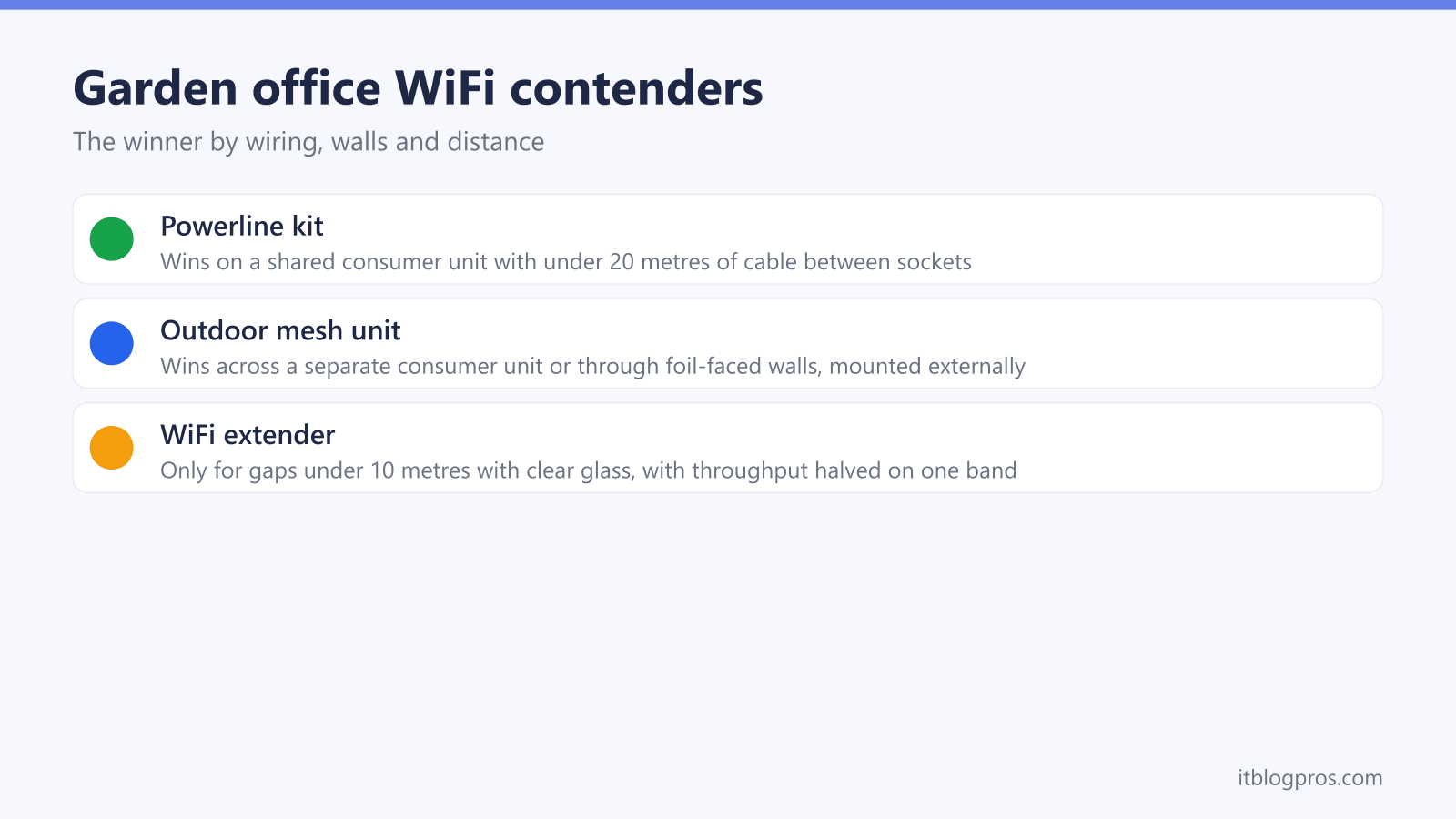
Powerline wins only when the garden office shares the house consumer unit and the cable run stays under roughly 20 metres. A separate consumer unit, an RCBO feed or a long buried SWA cable attenuates the HomePlug signal badly, so choose an outdoor mesh unit mounted on the external wall instead. A WiFi extender only makes sense for a gap under 10 metres with clear glass between router and office.
Key Takeaways
- Powerline is the right choice only when the garden office shares the house consumer unit and the total cable path between sockets stays under roughly 20 metres.
- A separate garden consumer unit, an RCBO-protected way or a long buried SWA feed attenuates HomePlug AV2 signals badly and can stop the adapters pairing at all.
- Foil-faced PIR insulation acts as a Faraday cage, so a mesh node placed inside the office often hears nothing; a weatherproof unit mounted on an outside wall restores the link.
- A single-band WiFi extender halves throughput by design and only earns its place across a gap under 10 metres with clear glass between router and desk.
- Powerline should always be tested at the actual sockets inside a returns window, with the link rate checked in the tpPLC app before the purchase is final.
The wiring decides before anything goes in the basket
Powerline, mesh and extenders all solve the same problem in marketing copy. In a real UK garden, two physical facts pick the winner long before specifications matter.
The first is the electrical path. A professionally installed garden room is rarely spurred off the kitchen ring. The standard job is a dedicated way in the house consumer unit, protected by an RCBO or RCD, feeding a buried steel wire armoured (SWA) cable that terminates in a small consumer unit inside the garden room. That layout is exactly what safe wiring practice calls for, and it is also close to the worst-case environment for powerline networking.
The second is the wall build-up. Insulated garden offices are typically lined with foil-faced PIR boards, and that foil reflects WiFi like a mirror, which undermines any plan built on indoor wireless kit.
Distance, glazing and budget sort out the rest. The complete garden office WiFi guide covers every route including a buried data cable, which beats all three options here whenever a trench is open. This page settles the three-way fight for everyone who cannot dig.
Powerline fails across a separate consumer unit for predictable reasons
HomePlug AV2 adapters superimpose a data signal at roughly 2 MHz to 86 MHz on top of the 50 Hz mains supply. Domestic wiring was never designed to carry those frequencies, and every component between the two adapters takes a toll.
Protective devices sit directly in the signal path
Breakers, RCDs and RCBOs are built around 50 Hz. At powerline frequencies the toroidal sensing coil inside an RCD or RCBO presents significant impedance, and TP-Link's own support guidance lists ground-fault, surge and arc-fault protection as functions that can interfere with or block powerline connectivity. Signals crossing a consumer unit mostly do so by coupling across the busbar rather than passing cleanly through the protective devices, and each crossing costs signal strength. A garden office feed typically involves two consumer units, so the signal pays that toll twice.
The SWA run adds length and takes away the earth path
AV1000 kits are rated for up to 300 metres of wiring, but the link rate falls with every metre, and a garden feed adds 10 to 40 metres of buried cable before the office sockets are reached. AV2's MIMO mode also relies on the earth conductor as a second transmission path. On an SWA feed the earth is often the steel armour itself, whose high-frequency behaviour differs sharply from a copper core, and many outbuildings are earthed as a separate TT island with a local rod, which removes the metallic earth path back to the house entirely. The adapters fall back to slower single-pair operation, or fail to pair at all.
None of this means a faulty kit. It means the electrical layout was decided years before the adapters arrived. A link that once worked and has since degraded points to a different fault list, covered in garden office WiFi not working.

The honest test protocol costs nothing but time
No spec sheet, forum thread or installer can predict how a specific pair of consumer units will treat a powerline signal. The only trustworthy data comes from the actual sockets, which is why the sensible purchase is from a retailer with an easy returns window.
The procedure is short. Plug one adapter into the wall socket nearest the router and the other into the exact socket the desk will use, avoiding extension leads and surge-protected strips at both ends because both smother the signal. Pair the units, read the true powerline link rate in the tpPLC app rather than trusting the WiFi bars, and run a broadband speed test from the desk. Repeat in the evening with the kettle, tumble dryer or EV charger running, since powerline throughput drops as electrical noise rises.
A kit that syncs at a strong rate on day one and holds it through a noisy evening has earned its keep. A kit that limps or refuses to pair goes back in the box, and the mesh route below takes over.
Powerline stays the tidy winner when the circuit allows it
When the garden office shares the house consumer unit and the total cable path is short, powerline delivers a stable, low-latency link with zero configuration drama and nothing mounted on any wall.
The TP-Link TL-WPA7617 kit fits this scenario. The powerline side runs HomePlug AV2 at an AV1000 link rate, and the far unit broadcasts dual-band AC1200 WiFi, which TP-Link rates at 300 Mbps on 2.4 GHz plus 867 Mbps on 5 GHz, with a gigabit Ethernet port for a desktop, a switch or a docking station. OneMesh support lets it share the main WiFi name when paired with a OneMesh TP-Link router, and on other routers TP-Link's Wi-Fi Clone button copies the main network name and password; keeping a separate network name instead suits a work-only office network anyway. Both units belong in wall sockets, never extension leads.
Wired latency over powerline is consistently steadier than distant WiFi, which is why the same technology holds up in powerline for gaming compared with WiFi. Virgin Media households with a Hub at the front of the house have their own shortlist in the best powerline adapters for Virgin Media.
Foil-faced walls defeat indoor mesh nodes, so the node moves outside
A mesh system's usual trick is placing a node halfway between router and dead zone. A modern garden room breaks that trick, because foil-faced PIR insulation in the walls and roof behaves like a Faraday cage. A node inside the office sits behind a metal screen, and a node at the house window must still punch through that screen. Even the glazing is not free passage, since low-emissivity coatings on modern double glazing carry a thin metallic layer that attenuates WiFi further.
The fix is to stop asking the signal to pass through the building fabric. A weatherproof outdoor mesh unit mounted on an external wall, either on the house facing the garden or on the office itself, keeps the wireless hop in open air. TP-Link's Deco X50-Outdoor is built for exactly this: AX3000 WiFi 6, an IP65 enclosure, power over 802.3at PoE or a mains supply, two gigabit ports and wall or pole mounting.
TP-Link states that every Deco model works with every other Deco model, so the outdoor unit slots straight into a network built on the standard Deco X50 three-pack, which covers the house and leaves a unit spare for the garden-facing side. A data cable already in the trench upgrades any node to full-speed Ethernet backhaul. Houses whose main obstacle is masonry rather than foil have a dedicated shortlist in the best mesh WiFi for thick walls.
An extender only earns its keep on a short, clear hop
A plug-in extender is the cheapest option on the shelf and the most oversold. A single-band extender has one radio doing two jobs, receiving each packet from the router and retransmitting it to the laptop, so available airtime is halved before distance or interference take their share. Real-world results commonly land at 30 to 40 percent of the router's nearby speed.
That still leaves a legitimate niche: a gap under 10 metres, a clear line of sight through ordinary glass, and light duties such as email, browsing and audio calls. A socket by a rear window facing the office door can serve a lightly used garden room for under forty pounds. Anything involving video calls, large file transfers or more than one worker deserves mesh, and the full trade-off is set out in WiFi extender versus mesh for dead zones.
The verdict for every garden office scenario
| Scenario | Winner | Reason |
|---|---|---|
| Shared consumer unit, under 20 metres between sockets | Powerline (TL-WPA7617 kit) | The AV2 signal stays on one board and short runs hold a high link rate |
| Garden office on its own consumer unit, RCBO way or long SWA feed | Outdoor-mounted mesh | Protective devices and cable length gut the powerline signal; an open-air wireless hop bypasses the wiring |
| Foil-faced insulated walls | Outdoor-mounted mesh | The foil is a Faraday cage; an external unit feeds the office without crossing it |
| Gap under 10 metres with clear glass and light use | WiFi extender | Cheapest fix for a short clear hop, with halved throughput accepted |
| Data cable already buried in the trench | Mesh node on Ethernet backhaul | Full speed with no wireless compromise, ahead of all three plug-in options |
Two purchases cover every wireless outcome above. The TL-WPA7617 kit settles the powerline scenario, and the Deco X50 family settles both mesh scenarios, with the three-pack as the base and an outdoor unit added where foil walls demand it. Whichever route wins, the buying rule stays the same: order from a retailer with painless returns, test against the real sockets and the real walls, and let the building decide.
