The Sky Hub does a reasonable job for most households, but nothing about a Sky broadband contract requires it to stay plugged in. The service runs over shared national infrastructure rather than Sky-only wiring, and a third-party router can connect once the line type and the authentication method are both correct. This guide covers the line types, the settings that matter, the swap itself, and the caveats worth knowing before the hub gets unplugged.
Sky broadband works with a third-party router, since the service runs over the Openreach network, or Sky's own full fibre in places, rather than proprietary wiring. Sky signs the connection in over DHCP rather than PPPoE, so on full fibre the order is to try plain automatic DHCP into the ONT first and add a DHCP Option 61 client ID only if that fails. Note the line type, and keep the hub if Sky Talk or a Sky TV product needs it.
Key Takeaways
- Sky broadband runs on the Openreach network, or Sky's own full fibre in places, so a third-party router is never blocked outright, though Sky only supports troubleshooting on its own hub.
- Full fibre lines connect a router straight to the ONT; FTTC lines need the VDSL modem the Sky Hub carries, and Sky documents no bridge mode to hand that job over cleanly.
- Sky authenticates over DHCP rather than PPPoE, so there is no standard username and password, and a DHCP Option 61 client ID is needed on some lines but not on others.
- Noting the current settings, swapping at a quiet time and testing wired before wireless keeps the Sky Hub as a fallback throughout the process.
- Sky Talk and some Sky TV products such as Sky Q, Sky Glass and Sky Stream are built around the hub, so check those before removing it from the network.
Sky broadband does not lock you to the Sky Hub
Sky delivers home broadband over the Openreach network across most of the UK, with Sky's own full fibre build reaching some areas directly, and the Sky Hub is simply the router Sky posts out to make setup straightforward. There is no proprietary Sky-only wiring and no hardware whitelist stopping another router from connecting, provided that router matches the line type and the way Sky signs the connection in.
The honest catch is support. Sky troubleshoots faults on its own equipment, so a call about a dropped connection while running a third-party router usually starts with a request to plug the Sky Hub back in. That is reasonable rather than obstructive, since it is the fastest way to tell whether a fault sits on the line or in the replacement hardware. Other Openreach-based providers work the same way, and the guide to using your own router with any UK ISP sets out where Sky sits next to BT, EE and Plusnet on this.
Your line type decides where the router plugs in
Everything about the swap depends on whether the Sky line is full fibre or part fibre.
On full fibre (FTTP), Openreach or Sky's own network fits a small box called an ONT on the wall, and the fibre ends there. A router with an Ethernet WAN port connects to the ONT's LAN port directly, and the Sky Hub becomes optional at that point, subject to the authentication caveat covered below.
On FTTC, the connection arrives over copper from a street cabinet and lands at the master socket. Signing in on this kind of line needs a router with a built-in VDSL modem, since there is no ONT doing that conversion. The Sky Hub carries this modem internally, and since Sky documents no bridge or modem-only mode, there is no clean way to hand that job to a separate router the way full fibre allows. The workable setup on FTTC is to keep the Sky Hub connected to the socket, turn its WiFi off, and run the new router behind it handling the WiFi and the rest of the home network.
Checking which line type is in the house is straightforward: an ONT on the wall with a fibre light means full fibre, while a hub cabled into a phone-style master socket means FTTC.
Sky's settings differ from most providers
Most UK broadband runs on PPPoE, a username-and-password style login. Sky does not. Sky signs the connection in over DHCP, often labelled IPoE, and on some lines the router also has to send a DHCP Option 61 client ID before the link comes up. The how to use any router with EE broadband guide shows what the more common PPPoE pattern looks like on a similar Openreach line for comparison.
There are two paths here, not one, and Sky publishes nothing about which lines use which. Start with the simpler one: set the router's IPv4 connection type to automatic DHCP, plug it into the ONT, and see whether the connection comes up with nothing else entered. Reports through 2025 and 2026 describe Sky full fibre lines working exactly that way with no client ID at all, including one where adding a client ID broke a working connection.
If the line will not come up, the second path is a DHCP Option 61 client ID. DrayTek's UK guide documents the mechanism, explaining that when the router requests an IP address it sends DHCP option 61, the client ID, along with the request to authenticate its access to the Sky Fibre Broadband network. That guide gives the client ID as the router's MAC address followed by @skydsl, a pipe and eight hex characters, in the form 7c4ca5123456@skydsl|abcd1234, rather than the shorter anything@skydsl string that circulates online. It is scoped to VDSL2 and FTTC and carries no last-updated date, so treat it as a starting point rather than gospel.
Router support for the field is narrower than for PPPoE, but it is not confined to two brands. ASUS documents an Option 61 field in its firmware, in an FAQ last updated in April 2026, though it names neither Sky nor the UK. Netgear publishes a list of models carrying the field, but it is an ageing set covering units such as the R9000, R7800, XR500, RAX80 and D7000v2, it never mentions Sky, and it includes no WiFi 6E or WiFi 7 model, so anyone eyeing a current Nighthawk should check that specific model rather than trust the brand. Other manufacturers are worth checking on the same basis, by looking for the field itself.
VLAN tagging depends on where the modem sits. In DrayTek's guide a router with its own built-in VDSL modem has VLAN tag insertion enabled with a tag value of 101, while a router on an Ethernet WAN behind a separate modem or an ONT leaves tagging off, because whatever sits in front of it is already handling that. All of this describes Sky UK home broadband; Sky Ireland uses PPPoE with VLAN 10, and Sky business lines are reported to use PPPoE too.
Before any of the old network is unplugged, it is worth logging into the existing hub to note its current WiFi name and password, so devices reconnect to the new router without retyping anything on every phone and laptop in the house. The Sky Hub login guide covers the 192.168.0.1 address and where the admin password is printed on each hub model.
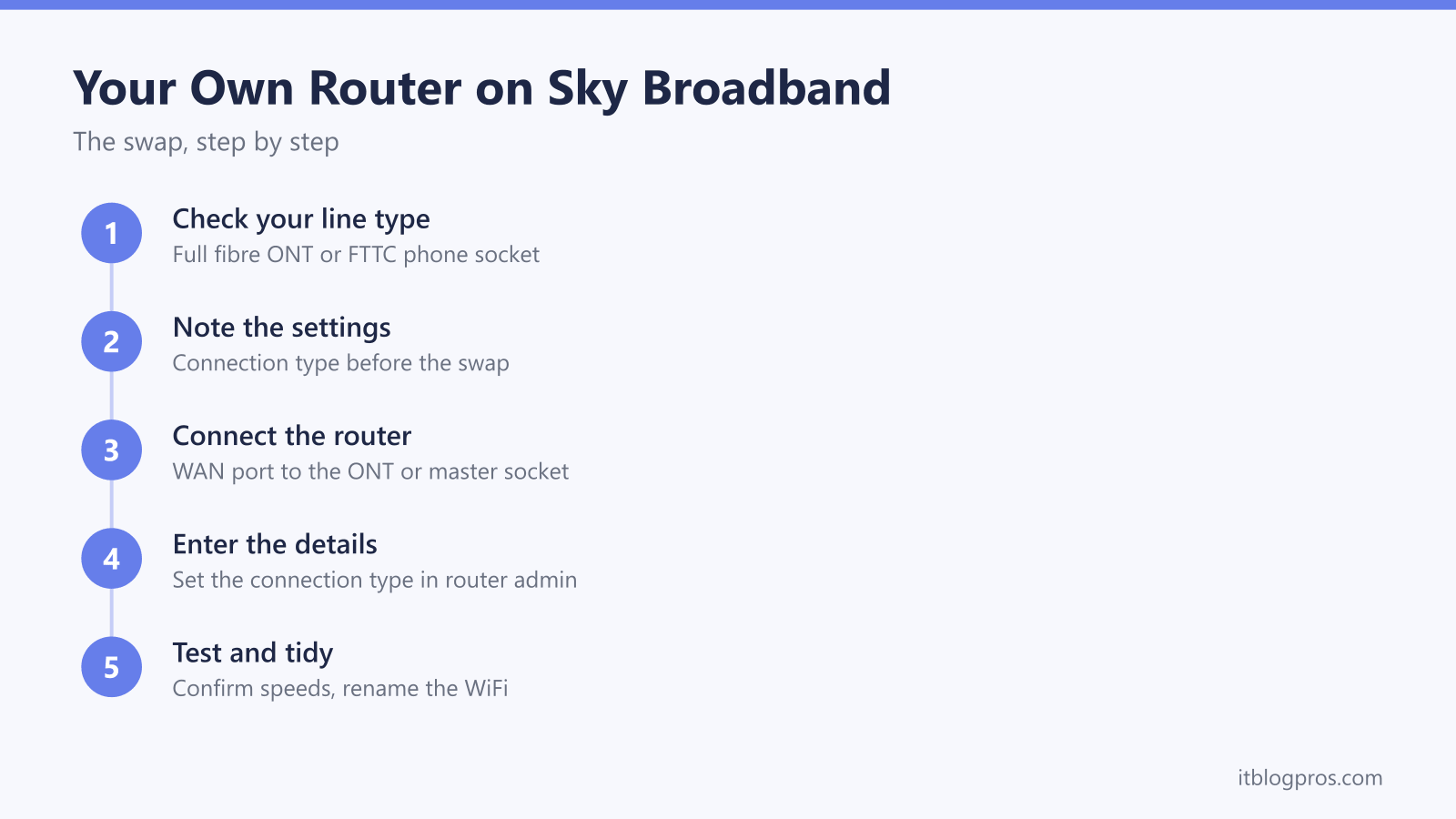
The swap, step by step
With the line type confirmed and the settings noted, the swap itself is a short job that stays low-risk because the Sky Hub remains a working fallback throughout.
- Note the settings. Record the Sky Hub's current WiFi name and password, and confirm whether the line is full fibre or FTTC, since an FTTC line needs the hub kept in place for its VDSL modem.
- Pick a quiet time. A weekday mid-morning causes less disruption than an evening with the household relying on the connection.
- Connect the new router. On full fibre, cable the router's WAN port to the ONT's LAN port in place of the Sky Hub. On FTTC, or where the line turns out to need an Option 61 client ID the router cannot supply, leave the Sky Hub connected to the master socket or ONT and cable the new router into one of the hub's LAN ports instead.
- Configure the connection. On a full replacement, set the IPv4 protocol to automatic DHCP and try it with nothing else entered, adding an Option 61 client ID only if the line will not come up. On a behind-the-hub setup, run the new router's own setup wizard and switch the Sky Hub's WiFi off so only one WiFi network is broadcasting.
- Test wired first, then wireless. Confirm a laptop on Ethernet gets online before checking WiFi coverage around the house.
- Tidy up. Reusing the old WiFi name and password lets phones, TVs and smart devices rejoin automatically. Box the Sky Hub rather than disposing of it.
If the new router will not connect, plug the Sky Hub back into its original position, confirm the line itself is working, and revisit the connection settings before trying again.
The caveats that catch people out
The technical side of the swap is the easy half. These are the details that actually cause problems.
Sky Talk runs through the hub. Sky Talk with Internet Calls plugs into the phone port on the back of the Sky Hub, not into the ONT or the master socket. Removing the hub from the network disconnects the landline, so anyone using Sky Talk should keep the hub in the chain, generally with its WiFi switched off, or check Sky's current guidance before making any change.
Some Sky TV products expect the hub on the network. Sky Q, Sky Glass and Sky Stream can have their own network requirements, and it is worth checking Sky's guidance for the specific box in the house before the hub disappears, particularly if it currently talks to the hub for updates or a second-room connection.
Keep the hub for support calls. Sky troubleshoots faults on its own equipment, so boxing the hub rather than getting rid of it is worthwhile. Reconnecting it briefly during a fault report is the fastest way to confirm whether an issue sits on the line or the replacement router.
None of this makes the swap a bad idea. It simply means Sky Talk users and anyone on certain Sky TV products need one extra check before the hub comes out, and that the hub itself is worth a shelf in a drawer rather than the bin.
The router worth buying for a Sky line
A full buying guide is not necessary here, but the Option 61 question decides which job a router can do on Sky, so it is worth being precise. ASUS documents a DHCP Option 61 field on its routers (ASUS FAQ 1011715), which is the setting to reach for if a Sky line will not come up on plain automatic DHCP, though that FAQ is written at brand level and names no specific model. Anyone who already owns an ASUS router can check its firmware for the field before attempting a full replacement.
For a router to buy, the TP-Link Archer BE550 is a tri-band WiFi 7 router, and TP-Link lists a dedicated 2.5 Gbps WAN port and four 2.5 Gbps LAN ports for it. TP-Link's online firmware emulator for the BE550, a US version 2.0 build, shows no Option 61 field in its Dynamic IP settings, so on Sky it is a behind-the-hub pick: it runs behind the Sky Hub as the WiFi layer, with the hub's own WiFi switched off, and it could only replace the hub on a full fibre line that comes up on plain automatic DHCP. On FTTC it sits behind the hub in every case, because the hub's VDSL modem is still needed.
Check the TP-Link Archer BE550 price on Amazon UK →
For the wider field, including mesh systems for larger homes and value picks that run behind the hub, the best router for Sky broadband guide compares the current options and explains which setup suits which router. Whichever box gets chosen, the process on this page stays the same: confirm the line type, try plain automatic DHCP before anything more exotic, swap at a quiet hour, and keep the Sky Hub within reach.