Ethernet cables are sold by category, and the listings climb from Cat5e and Cat6 to Cat7 and Cat8 with bigger numbers, bigger claims and bigger prices. For a UK home the choice is much simpler than the packaging suggests, because the router port at one end and the device at the other decide the speed long before the cable does. This guide sets out what each category is rated for, what a home connection needs and which cable suits each job, from a desk lead to a garden run.
Cat6 is the cable most UK homes should buy. CommScope rates it for gigabit to 100 metres and Fluke Networks for 10Gb/s over shorter runs, which covers the gigabit and 2.5Gbps ports on Virgin Media and BT hubs. Fluke specifies Cat8 for 30 metre data-centre links, so at home it adds cost without adding speed. Cat6a is the step up for a 10Gbps port.
Key Takeaways
- Fluke Networks rates Cat5e at 100MHz, Cat6 at 250MHz and Cat6a at 500MHz, and only Cat6a carries 10Gb/s the full 100 metres.
- Cat6 reaches 10Gb/s over shorter runs only: Fluke puts the limit at 35 metres and CommScope at about 55 metres.
- Fluke specifies Cat8 at 2GHz for 30 metre, two-connector links between data-centre servers and switches, a job no home network has.
- Virgin Media's spec table lists gigabit ports on its hubs plus one 2.5Gbps port on the Hub 5 and one 10Gbps port on the Hub 5x, so the port sets the ceiling.
- Belden says unshielded cable needs no grounding, and Siemon's outdoor Cat6 adds a UV-resistant jacket and water-blocking gel for buried runs.
Each Cable Category Is Rated for Frequency, Speed and Distance
An Ethernet cable is a copper lead with an RJ45 plug at each end, and Belden describes this kind of wiring as balanced twisted-pair cabling with its roots in telephone wiring. The category printed on the jacket tells you what the cable is built to carry, in frequency, speed and distance.
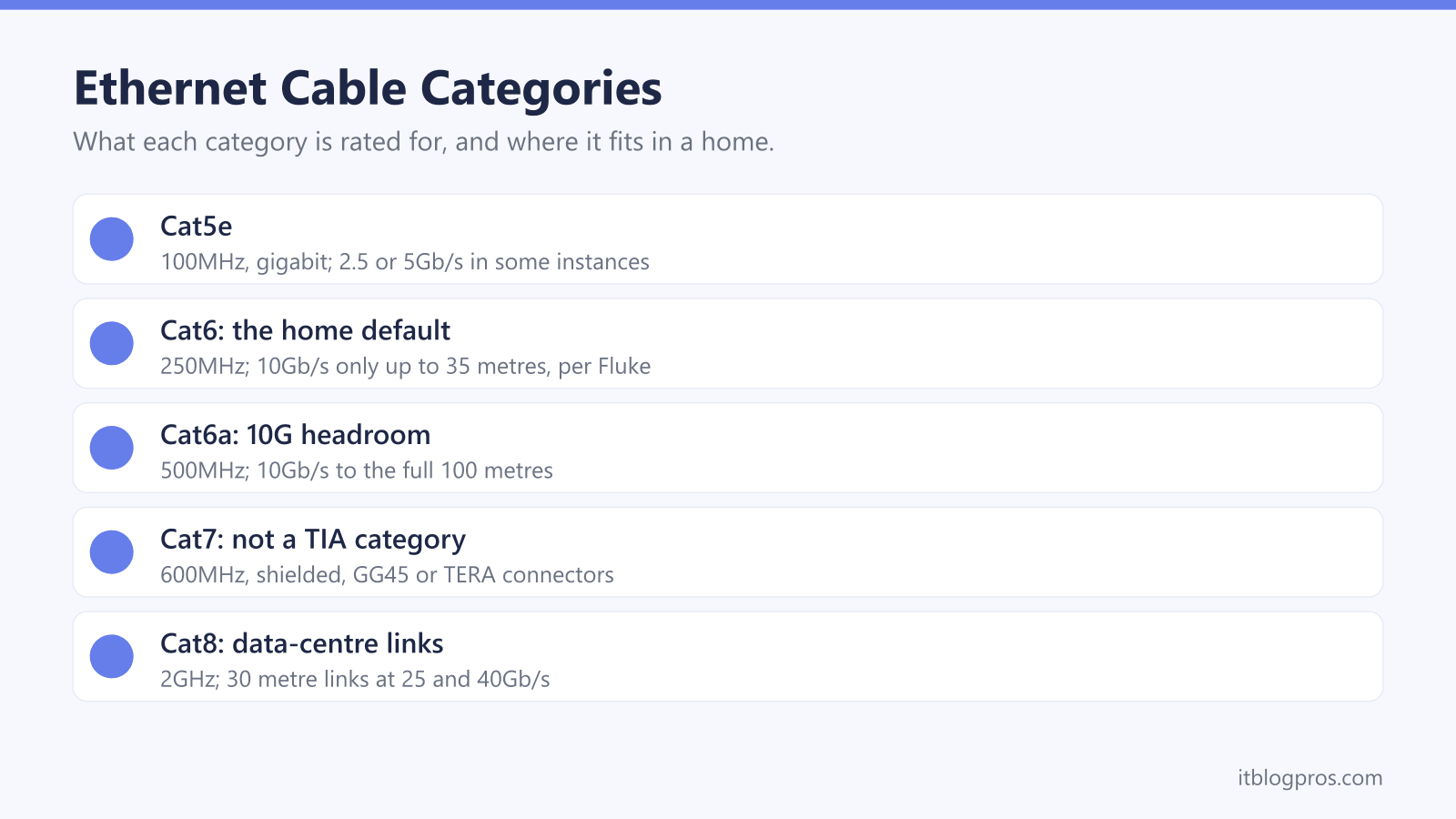
Fluke Networks, which makes cable test equipment, sets the main ratings out in its history of the categories. Cat5e is rated at 100MHz for 1,000Mb/s, and Fluke notes it can reach 2.5 or 5Gb/s in some instances. Cat6 is rated at 250MHz, and CommScope's Cat6 page lists gigabit up to 100 metres. At 10Gb/s the two firms disagree: Fluke says Cat6 manages it only up to 35 metres, while CommScope gives about 55 metres.
Cat6a removes that doubt. Fluke rates it at 500MHz for 10Gb/s to 100 metres, Panduit's comparison gives the same 500MHz and 100 metre figures, and Fluke calls Cat6a the recommended medium for all new horizontal LAN deployments, meaning the cabling run through a building to each outlet.
Cat7 and Cat8 Were Built for Jobs a Home Does Not Have
Cat7 is the odd one out. Fluke Networks says it was ratified in the ISO/IEC 11801 standard in 2002, but TIA, the body behind the American cabling standards, decided not to recognise it. Fluke describes Cat7 as a fully shielded cable running at 600MHz for 10 Gigabit Ethernet over 100 metres, terminated with GG45 or TERA connectors. A budget lead sold as Cat7 with ordinary RJ45 plugs is not quite the system Fluke describes.
Cat8 is newer and more specialised. Fluke says it is characterised to 2GHz, specified for 30 metre, two-connector channels and targeted at copper links between servers and switches in data centres, and that it is a shielded cabling system. Its history of the categories says Cat8 was promoted for 25 and 40Gb/s links of 30 metres. Siemon, a cabling maker, describes Category 8.1 systems as RJ45-based and positions its own Category 8.2 system for 25 and 40 Gig data-centre use.
The fastest port on any hub in Virgin Media's spec table is 10Gbps, so that extra capability goes unused at home.
The Router Port Sets the Speed Limit, Not the Cable
In a UK home the cable is rarely the bottleneck. Virgin Media's hub spec table lists four 1Gbps Ethernet ports on the Hub 3 and Hub 4, one 2.5Gbps port and three 1Gbps ports on the Hub 5, and one 10Gbps port and three 1Gbps ports on the Hub 5x. BT's help page says the Smart Hub 2 and Smart Hub 3 each have four gigabit ports.
Gigabit sits within Cat5e and Cat6, and Fluke's table lists Cat6 for 2.5, 5 or 10Gb/s in some instances, which covers the Hub 5's faster port. Only the Hub 5x's 10Gbps port asks for more, and a long run to it points to Cat6a. The device matters too: a laptop or console with a gigabit port connects at gigabit whatever the cable.
Virgin Media's gigabit page gives average downloads of 1,130Mbps on Gig1 and 2,000Mbps on Gig2, both more than one gigabit port carries. The Gig2 router guide covers the 2.5G ports that unlock it, and the guide to Ethernet and wireless devices covers whether wiring one device affects the rest.
Flat or Round and Shielded or Unshielded Leave the Category Unchanged
Shape is about where the cable has to go. Jadaol's listing for its flat Cat6 says the flat profile lets it run along walls, follow edges and corners or slide under a carpet, and it still lists 250MHz, the same rating Amazon Basics gives its round Cat6 leads. Flat suits a run under a rug or along the skirting to a TV box, which is the situation the Sky Stream puck guide deals with. Round cable remains the usual choice for trunking and short patch leads.
Shielding is where the box can mislead. Belden says shielded cables are less flexible, heavier, larger in diameter and more expensive, and that a shield which is not grounded properly can act as an antenna and pick up unwanted signals. Belden adds that a well-balanced unshielded cable can often protect against interference just as well, and that unshielded cable needs no grounding at all.
Fluke describes both Cat7 and Cat8 as shielded, so Belden's points about diameter and flexibility apply to those leads too.
Length and Pure Copper Matter More Than the Number on the Box
Measure before buying. CommScope lists Cat6 for gigabit up to 100 metres, so length makes no practical difference to speed inside a house, but a lead that falls short is useless and one far too long leaves a coil behind the sofa. Follow the route along skirting boards and around door frames, then add a little slack at each end.
What the conductors are made of matters more. Fluke Networks warns about copper clad aluminium, sold as CCA, saying such cables are not standards compliant and often lack a valid UL safety listing, and that their higher resistance means more heat and lower voltage at a powered device. Check the listing for CCA and choose a cable that states pure or bare copper.
Listings can contradict each other as well. Amazon Basics' five-pack of 3 metre Cat6 leads quotes up to 10Gb/s and a 100 metre distance, while its 1.5 metre five-pack quotes 1Gb/s. Fluke's 35 metre figure for Cat6 at 10Gb/s is the more cautious guide, and for a short lead to a desk neither claim changes anything.
Outdoor and Buried Runs Need Cable Made for Them
A normal indoor lead is the wrong cable for a garden. Siemon's outdoor Cat6 spec sheet shows what an outdoor rating involves: a UV-resistant jacket, a core filled with non-conductive water-blocking gel to keep moisture out, and approval for direct burial, aerial and underground conduit use. The 50 metre outdoor Cat6 lead from kenable lists a UV-resistant PE jacket and pure copper conductors, and says it can be buried in protective trunking or run along external walls. The guide to running network cables in your garden covers conduit, connectors and keeping water out.
A ready-made lead has a moulded plug at each end, and a plug will not pass through a small hole in a wall. That is when crimping your own makes sense: pull bulk cable through first, then fit the plugs. The 50 metre outdoor reel from kenable lists pure copper pairs that work with Cat5e and Cat6 RJ45 connectors, and the step-by-step guide to making an Ethernet cable walks through stripping, ordering the wires and crimping.
The Right Cable for Each Job in the Home
For most rooms a Cat6 multi-pack is the answer. Amazon Basics' five-pack of 3 metre leads covers a desk, a TV and a console near the router, and its listing gives 250MHz, 26 AWG bare copper conductors and snagless plugs. Jadaol's flat Cat6 runs to 30 metres and comes with 25 cable clips for a run under carpet or along the skirting.
For a 10Gbps port, such as the one on Virgin's Hub 5x, Cable Matters' shielded Cat6a lead lists 10Gbps, 550MHz and compliance with the TIA/EIA 568-C.2 Category 6a standard in a 15 metre length. It gains nothing on a gigabit port, and its shield is not the reason to buy it, so it only earns its place beside a 10Gbps port and a matching network card. For outdoor runs, kenable's outdoor Cat6 lead lists ISO/IEC 11801 compliance and a UV-resistant jacket.
None of these cables makes a connection faster than the broadband package or the router port allows. The best Ethernet cable for Virgin Media guide applies the same thinking to each Virgin hub.
| Product | Best for | Key specs | Price | |
|---|---|---|---|---|
 | Amazon Basics Cat6 Ethernet Cable, 3 m (5-pack) Our pick | Desks, TVs and consoles near the router | Five 3 m Cat6 leads, 250MHz, 26 AWG, snagless | Check price → |
 | Jadaol Cat6 Flat Ethernet Cable, 30 m Flat run | Long runs under carpet or along skirting | Flat UTP Cat6, 250MHz, bare copper, 25 clips | Check price → |
 | Cable Matters Shielded Cat6A Ethernet Cable, 15 m 10G headroom | A 10Gbps port such as the Hub 5x's | Cat6a S/FTP, 550MHz, 10Gbps, 26 AWG bare copper | Check price → |
 | kenable Outdoor Cat6 Ethernet Patch Lead, 50 m Outdoor | Garden offices, sheds and garages | Cat6 UTP, 24AWG pure copper, UV-resistant PE jacket | Check price → |