Robot vacuum listings lead with suction figures, yet the things that decide whether a robot hoover copes in a UK home are less glamorous: how it finds its way round, whether its mop stays off the rug, how often the base needs emptying, what it can climb and whether it will join your WiFi at all. This guide takes each one as eufy, Shark, iRobot, Roborock and Dreame describe it on their own product and support pages.
For most homes a robot with LiDAR mapping is the safer buy: eufy says its gyroscope-guided models cannot store a map, and the no-go zones eufy, Roborock and iRobot advertise are drawn on that map. Add a self-emptying base to skip bin duty, and lifting mops only if you have hard floors and rugs. Before ordering, check your WiFi, because eufy, Shark, Roborock and Dreame all say their robots need a 2.4GHz network.
Key Takeaways
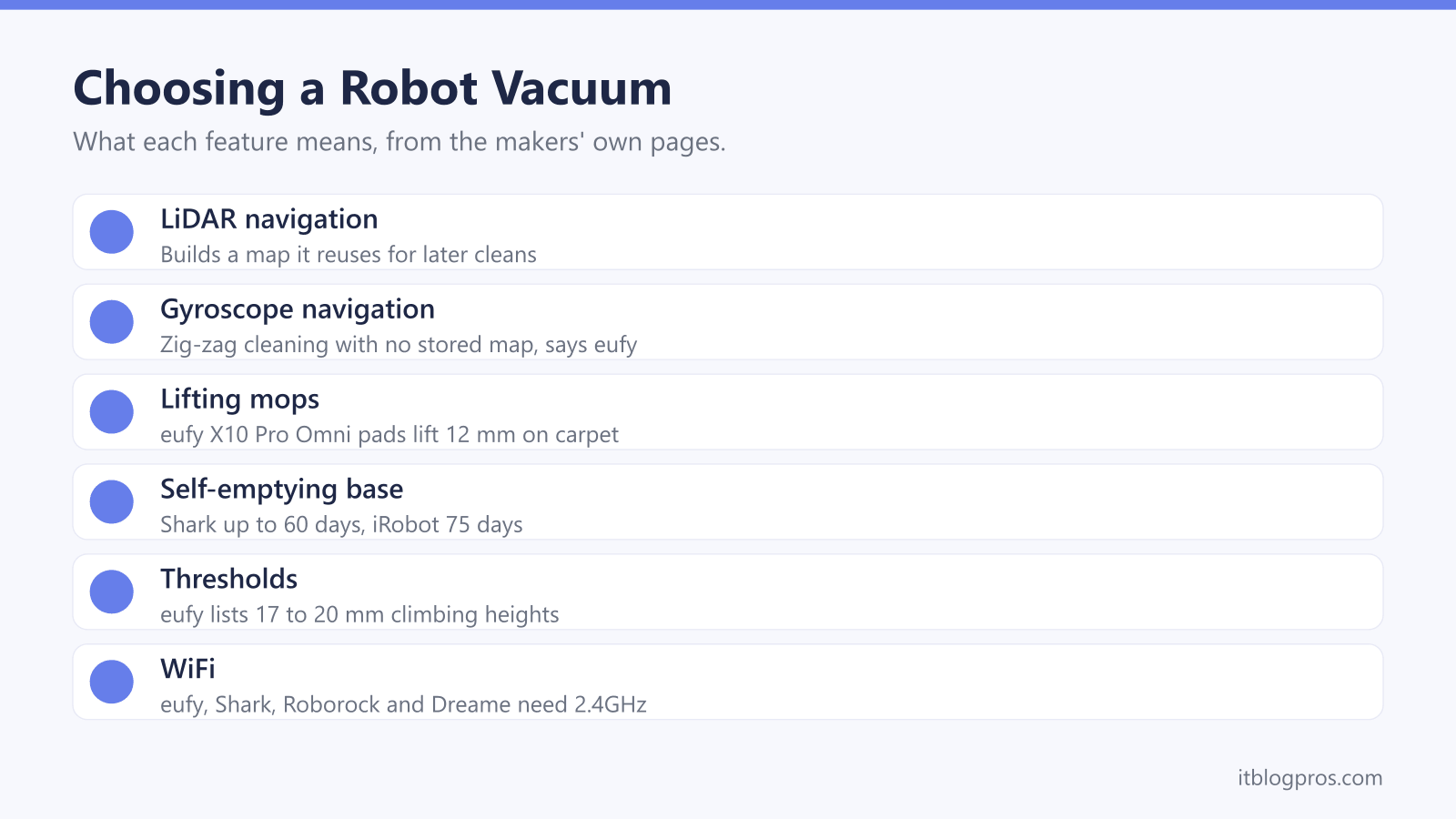
- eufy's support page says its gyroscope models clean in a zig-zag without storing a map, while its iPath models use LiDAR to build a map they reuse.
- eufy says the X10 Pro Omni's two rotating mop pads lift 12 mm when it detects carpet, while Roborock's Q7 page lists a detachable mop with no lift mentioned.
- Makers rate self-emptying bases in days rather than litres: Shark says up to 60 days, iRobot says 75 days and eufy says a 2.5L bag lasts 2 months.
- eufy's support FAQ lists climbing heights of 17 to 20 mm for its X8 and L-series robots and warns that carpets thicker than 26 mm can trap the brushes and wheels.
- eufy, Shark, Roborock and Dreame support pages say their robots need a 2.4GHz network, and iRobot's own support pages disagree on which Roombas also use 5GHz.
LiDAR Builds a Map, a Gyroscope Only Steers
eufy's support page on navigation sets out the main types plainly. Its Bounce models use infrared sensors, clean in a random pattern and cannot map the room. Dynamic Navigation models use gyroscope and accelerometer sensors to clean in a zig-zag, but cannot store a map. iPath models use a LiDAR sensor, a spinning laser, to build a map they reuse on later cleans.
Cameras add object recognition on top. eufy's UK robot vacuum page says its AI.See system uses 3D ToF sensors and an AI camera to steer round household objects, and the X10 Pro Omni page says it identifies over 100 objects, such as wires, shoes and toys, even at night. iRobot's features chart lists gyros on the Roomba Essential, LiDAR on the Roomba 105, 205 and 405, and LiDAR plus a camera on the 505 and 705. iRobot's UK page says the Roomba Max 705 Vac's PrecisionVision AI steers round cords, socks and pet waste.
To send a robot to one room or fence off a rug, pick a model that stores a map.
Robot Mops Drag a Pad or Spin, and Only Some Lift for Carpet
Robot mops come in two broad designs. Roborock's Q7 page describes a detachable mop with three water-flow levels and a DEEP mode with slower, finer passes, and the Q7 M5 box includes a moisture-proof mat for under the dock. The page does not say the mop lifts, so in homes with rugs it makes sense to unclip the mop module before a carpet clean.
eufy's X10 Pro Omni uses two rotating pads instead. eufy says they spin at 180 rotations per minute with 1 kg of downward pressure, and lift by 12 mm when the robot detects carpet so the rug stays dry. Its station washes the pads with clean water, dries them with 45°C heated air and holds a 3L clean water tank.
iRobot takes a third route on some models. Its features chart says the Roomba 405 and 505 carry no water tank on the robot; the dock wets the pad before the clean starts, and the robot returns when the pad needs more liquid.
Self-Emptying Bases Are Rated in Days, Not Litres
A self-emptying station, eufy's UK guide explains, adds a second vacuum inside the dock that pulls dirt out of the robot's bin. Makers mostly rate them in days. Shark says the PowerDetect's bagless base holds up to 60 days of dirt and debris, and iRobot says the Roomba Max 705 Vac's AutoEmpty dock gives 75 days of hands-free cleaning, trapping debris as small as 0.7 microns in an enclosed bag. Neither page gives a capacity in litres.
eufy is more specific: the X10 Pro Omni empties into a 2.5L dust bag that needs replacing every 2 months. Roborock's Q7 page says the RockDock Plus bag lasts up to 7 to 9 weeks, based on its own internal testing.
The base adds noise of its own. eufy's noise page for its Omni X12 Pro lists 57 dBA in Quiet mode and 60 dBA in Max mode, rising to 70 dBA during the brief dust collection run. Roborock calls the Q7 M5 low-noise but gives no decibel figure, and the Shark and iRobot pages give none.
Pet Hair Brushes, Thresholds and Thick Rugs Need Checking
Each maker here claims some defence against hair wrapping round the brush. eufy says the X10 Pro Omni's roller brush spins in reverse while its Pro-Detangle Comb flips down to clear hair. Roborock fits the Q7 M5 with a JawScrapers Comb main brush and an anti-tangle side brush, citing TÜV Rheinland testing, and iRobot calls the Roomba Max 705's dual rubber brushes anti-tangle. Shark's page for the PowerDetect self-empty model does not mention hair wrap.
Thresholds and rugs are the other check. eufy's support FAQ lists a climbing height of 17 mm for its X8 series and 20 mm for its L-series, says carpets thicker than 26 mm can trap the brushes and wheels, and warns against tassels and very thick wool. Roborock's support FAQ gives 2 cm for its robots, apart from the older S4 at 1.5 cm, while its flagship Saros 20 page claims carpet pile up to 3 cm once its chassis lift is enabled in the app. Shark says NeverStuck lifts the robot over thresholds and onto thick carpets, but its page gives no height.
Apps Handle No-Go Zones, Floors, Voice and Camera Privacy
Once a robot has a map, the app does the rest. eufy says its AI.Map 2.0 lets you draw No-Go Zones and virtual boundaries on the X10 Pro Omni, and the page lists multi-level mapping. Roborock's Q7 page says the app suggests No-Go Zones under chairs and tables, remembers multiple maps for multiple floors and adds off-peak charging and a child lock. iRobot says the Roomba Max 705 scans the home to create up to 5 maps, names rooms automatically and supports Keep Out Zones.
For voice control, Roborock's Q7 page lists Alexa and Google Home, and iRobot lists Alexa, Siri and Google Assistant. The Echo buying guide covers the speaker side.
Camera models raise a fair privacy question. eufy says its AI.See camera system is built around privacy and security. iRobot's FAQ says it encrypts stored data, strictly limits access and lets owners delete data before passing a robot on. Roborock's Saros 20 page calls privacy its top priority but does not say whether camera images leave the robot. The home camera guide covers similar questions for security cameras.
Most Robot Vacuums Only Join a 2.4GHz Network
WiFi is where setup most often stalls. eufy's support article says its WiFi RoboVacs do not support 5GHz, because app commands travel through eufy's cloud servers and the robot needs a stable, long-range link more than speed. Shark's support page says Shark robots do not support 5GHz, that the phone must be on the 2.4GHz network during setup, and that VPNs and WiFi isolation must be off. Roborock and Dreame say their robots only support 2.4GHz. iRobot contradicts itself: its setup requirements page names only the Roomba s9, i7/i8 and j7 as 5GHz-capable, while its features chart lists the Max 700 series on both bands.
This matters most on hubs that show one network name for both bands. Roborock says to try that network first, then ask your broadband provider or router maker to separate the bands, and Dreame recommends turning off dual-band merging. The guides to splitting the bands on the BT Smart Hub and Sky Hub show how, and the smart plug guide covers the same 2.4GHz problem.
Four Robot Vacuums for Four Kinds of Home
The table covers four common needs, and each pick has a caveat worth knowing first. The Roborock Q7 M5 is the budget route to LiDAR mapping and a pad mop, though it has no self-emptying base, and Roborock contradicts itself on suction: its Q7 series page gives the M5 8,000 Pa, while the M5 product page says 10,000 Pa.
The Roomba Max 705 Vac pairs LiDAR with a camera and an AutoEmpty dock, but as the Vac version it does not mop. The eufy X10 Pro Omni suits hard floors with rugs, thanks to its lifting rotating mops and washing station, though its UK page gives no WiFi or voice assistant details. The Shark PowerDetect is the bagless self-emptying pick for carpets and thresholds, although Shark's own page disagrees with itself on the box contents, listing a Self-Empty Base and two side brushes in one place and a NeverTouch Pro Base with mopping pads in another.
Whichever you choose, check that your hub offers a 2.4GHz network before ordering.
| Product | Best for | Key specs | Price | |
|---|---|---|---|---|
 | Roborock Q7 M5 Robot Vacuum Cleaner with Mop Budget | A first robot with LiDAR mapping and a pad mop | PreciSense LiDAR, anti-tangle brushes, 3 water levels | Check price → |
 | iRobot Roomba Max 705 Vac Robot + AutoEmpty Dock LiDAR and camera | Mapped cleaning that steers round cords and pet waste | ClearView Pro LiDAR, up to 5 maps, 75-day AutoEmpty | Check price → |
 | eufy X10 Pro Omni Robot Vacuum and Mop Vacuum and mop | Hard floors with rugs and hands-free mop washing | Rotating mops lift 12 mm, 2.5L dust bag, iPath laser | Check price → |
 | Shark PowerDetect Self-Empty Robot Vacuum AV2820VEUKWH, White Self-emptying | Carpets, thresholds and bagless emptying | Bagless base holds up to 60 days, NeverStuck lift | Check price → |