An instant camera, or instant print camera, prints the photo on the spot, but the film decides almost everything else. Fujifilm's instax range uses three film sizes, mini, SQUARE and WIDE, and each camera takes only one of them. Hybrid instax models add a screen and a memory card so only the keepers get printed, while Polaroid makes its own larger i-Type, 600 and Go films. This guide sets out sizes, batteries, selfie features and development times from Fujifilm's and Polaroid's own UK pages.
For most people an instax mini camera such as the mini 12 is the place to start: Fujifilm lists a selfie mirror, Close-up mode and two AA batteries good for about 10 packs of instax mini film. Choose a hybrid such as the instax mini Evo to print only the shots you want, the WIDE 400 for bigger prints, or the Polaroid Now Generation 3 for Polaroid's full-size i-Type and 600 film.
Key Takeaways
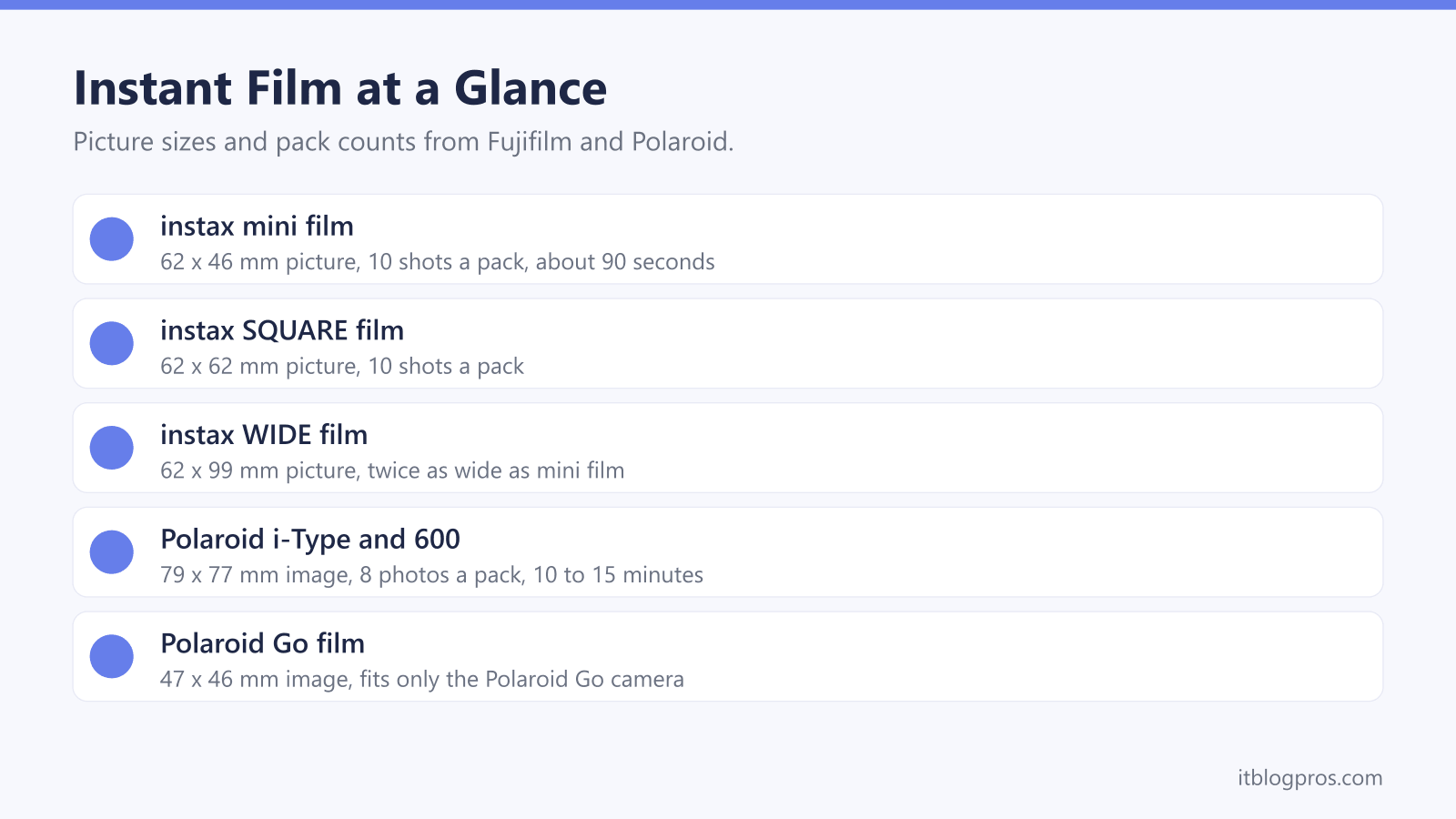
- Fujifilm lists three instax film sizes, mini, SQUARE and WIDE, with pictures of 62 x 46 mm, 62 x 62 mm and 62 x 99 mm, and each camera takes only one of them.
- Fujifilm's spec pages give about 90 seconds for instax film to develop, while Polaroid lists 10 to 15 minutes for its colour i-Type, 600 and Go films.
- Hybrid instax cameras such as the mini Evo and mini LiPlay save shots to internal memory or a microSD card, print only the ones you pick and also print photos from a phone.
- Basic instax mini cameras run on two AA batteries, the hybrids and the mini Link 3 printer charge a built-in battery, and Polaroid rates its Now and Go cameras at up to 15 film packs per charge.
- Polaroid's Now Generation 3 takes both i-Type and 600 film, but Polaroid says its Go film fits only the Polaroid Go camera.
Fujifilm Makes instax Film in Three Sizes That Do Not Swap
Fujifilm's UK film page lists three instax formats. The mini film measures 86 x 54 mm with a 62 x 46 mm picture, roughly credit-card sized in Fujifilm's words. SQUARE film is 86 x 72 mm with a 62 x 62 mm picture, and WIDE film is 86 x 108 mm with a 62 x 99 mm picture, which Fujifilm describes as twice as wide as mini film.
Each format fits only its own cameras and printers. The same page lists mini film for the mini cameras, the mini LiPlay and mini Evo models and the mini Link printers, SQUARE film for the SQUARE cameras and SQUARE Link, and WIDE film for the WIDE 400, WIDE Evo and Link WIDE printers. Fujifilm trips over this itself: its SQUARE SQ1 page describes a Boots bundle with instax mini film, although the SQ1's own specifications name instax SQUARE film.
Fujifilm's UK eShop sells packs of 10 shots and Twin Packs of 20 in all three sizes. Its spec pages give a development time of about 90 seconds, varying with the ambient temperature.
The instax mini 12 and mini 13 Keep Things Simple
Fujifilm's mini 12 page describes a twist-to-operate camera: turn the lens to switch on, turn further for Close-up mode, and turn back to switch off. Exposure and flash are automatic. Close-up mode covers 0.3 m to 0.5 m with parallax correction, so the viewfinder lines up with the lens for close shots, and a selfie mirror sits beside the lens. Power comes from two AA alkaline batteries, which Fujifilm rates at about 10 packs of 10 exposures.
The newer mini 13 keeps the mirror, Close-up mode and AA batteries, and adds a self-timer with 2-second and 10-second options plus an angle accessory built into the wrist strap. Fujifilm's mini 41 page lists the same batteries and Close-up mode in a classic black body.
For more control, the mini 99 is the step up. Fujifilm lists six colour effects, a five-step brightness dial, Bulb and Double Exposure modes, and a rechargeable NP-70S battery rated at about 100 prints, with its charger in the box.
SQUARE and WIDE Cameras Trade Pocket Size for Bigger Prints
Bigger film means a bigger camera. Fujifilm gives the mini 12 a weight of 306 g and the WIDE 400 616 g, both without batteries, strap or film.
Fujifilm's UK page also lists the new instax SQUARE 2. It pairs a selfie mirror with Close-up mode for 30 cm to 50 cm, adds a Landscape mode and Warm and Cool mood filters, and runs on four AA batteries rated at about 30 SQUARE 10-packs. The SQUARE SQ1 and SQ40 use a selfie mirror with Selfie mode instead, and take two CR2 lithium batteries, which Fujifilm also rates at about 30 packs.
At the large end, Fujifilm's WIDE 400 page lists four AA batteries in the box, rated at about 100 prints. It has Normal and Landscape focus modes, a clip-on Close-up lens for 40 cm to 50 cm, a self-timer lever with 4, 6, 8 and 10-second delays, a tripod mount and an angle accessory. The page does not mention a selfie mirror, so self-portraits rely on the timer.
Hybrid instax Cameras Save a Digital Copy Before Printing
A hybrid shoots digitally, shows the photo on a screen and prints only the ones worth keeping. Fujifilm's mini Evo page lists internal memory for about 45 images and a microSD or microSDHC slot holding about 850 images per 1 GB, so a small card from the SD card guide goes a long way. Ten lens effects and ten film effects combine into 100 looks, plus a selfie mirror and a macro mode from 10 cm.
The mini Evo app also lets the camera print photos from a smartphone, and Fujifilm says the app saves every printed image in digital form. Charging is built in: Fujifilm rates the mini Evo at about 100 prints per charge and 2 to 3 hours to recharge, and its spec list shows the port moving from Micro USB to USB-C.
The mini LiPlay is the lighter 2-in-1 at about 255 g, with USB-C and a Sound mode that prints a QR code linked to a short recording. The mini LiPlay+ adds a front selfie camera, and the WIDE Evo prints on WIDE film.
A mini Link Printer or instax Pal 2 Suits Phone Photographers
Anyone who already shoots everything on a phone may not need an instant camera at all. Fujifilm describes the instax mini Link 3 as a smartphone printer for instax mini film. Its page lists JPEG, PNG, HEIF and DNG files, a print time of about 15 seconds and about 100 prints per charge from a USB-C port, and the app adds frames, collages and prints taken from a frame of video. For A4 pages or larger photo prints, a home inkjet does a different job, which the home printer guide covers.
The instax Pal 2 is the odd one out. Fujifilm calls it a digital camera, and it does not print on its own: shots go over Bluetooth or USB-C to the Pal 2 app, or to an instax Link printer or hybrid camera for printing on mini, SQUARE or WIDE film. Fujifilm lists room for about 100 images inside, a microSD slot for cards up to 2TB, a 1.0-inch screen and a weight of about 87 g.
Polaroid i-Type, 600 and Go Film Take Minutes to Develop
Polaroid's camera guide lists i-Type and 600 film for the Now, Now+, Flip and Mod, and Go film for the Go. The i-Type and 600 films share a 107 x 88 mm format with a 79 x 77 mm image, 8 photos per pack. Power is the difference: Polaroid says each 600 pack holds a battery for the camera and flash, which old Polaroid 600 cameras run on, while its i-Type page lists that film as battery-free and not compatible with vintage Polaroid cameras. Go film measures 66.6 x 53.9 mm with a 47 x 46 mm image, Polaroid says it fits only the Polaroid Go, and it comes as a 16-photo double pack.
Patience is part of it. Polaroid lists 10 to 15 minutes for its colour films, against about 90 seconds for instax. Its black and white i-Type page gives 5 to 10 minutes while a Polaroid support article says about 5 to 7, and Polaroid advises checking the back of the film pack for exact times and shielding photos from light while they develop.
Five Picks Across instax Sizes and Polaroid
Two caveats come first. Film is a running cost and it is format-specific, so a camera is only as handy as the film for it. And Polaroid's support page says the Now Generation 3 box has no charging cable. Its manual asks for a standard USB-C charger rated 5V/1A, as in the USB-C charger guide, and quotes about 2 hours for a full charge and 15 packs of film per charge.
The instax mini 12 is the easy all-rounder, and the mini Evo suits anyone who wants to choose before printing. Groups and landscapes suit the WIDE 400. The Polaroid Now Generation 3 takes i-Type and 600 film; its manual recommends i-Type and standing at least 55 cm from the subject, and its product page lists no selfie mirror, which Polaroid's Go Generation 3 page does. Video is a different job: Fujifilm's mini Evo Cinema records clips of up to 15 seconds in total, so the action camera guide is the better start. The mini film Twin Pack fits every mini camera here.
| Product | Best for | Key specs | Price | |
|---|---|---|---|---|
 | instax mini 12, Lilac Purple Our pick | Simple point-and-shoot prints and selfies | mini film, two AA batteries, selfie mirror, Close-up mode | Check price → |
 | instax mini Evo hybrid camera, Black Hybrid | Choosing shots on screen and printing from a phone | mini film, microSD slot, built-in battery, 100 effects | Check price → |
 | instax WIDE 400, Black Bigger prints | Groups and landscapes on WIDE film | WIDE film, four AA batteries, Close-up lens, tripod mount | Check price → |
 | Polaroid Now Generation 3, Arctic Blue Polaroid | Full-size Polaroid prints on i-Type or 600 film | i-Type and 600 film, USB-C charging, 15 packs per charge | Check price → |
 | instax mini film Twin Pack, White Border (20 shots) Film | Any instax mini camera, mini hybrid or mini Link printer | 20 shots, 86 x 54 mm film, 62 x 46 mm picture | Check price → |