Amazon eero and Netgear Orbi sit at opposite ends of the mesh market, and the choice between them comes down to a single honest trade-off. Orbi is the raw-performance system, with what Netgear calls a dedicated connection for router-satellite communication and large hardware, while eero is the simpler, cheaper, set-and-forget system. This comparison puts the Amazon eero 6+ against the tri-band Netgear Orbi 760 series on backhaul, coverage, real-world speed, price, the app and ecosystem lock-in. It also flags where the eero Pro 6E tier changes the maths. Both are good mesh systems. The right one depends on the size of your home, the speed of your line and how much you are willing to pay for headroom you may never use.
Netgear's UK RBK763S page gives the Orbi 760 a dedicated connection for router-satellite communication, larger hardware and a three-pack rated up to 7,500 sq. ft., but it costs far more and puts Armor behind a charge after the first year. Amazon eero wins on price, simplicity and Alexa smart-home integration, and eero calls the eero 6+ ideal for ISP plans up to a gigabit.
Key Takeaways
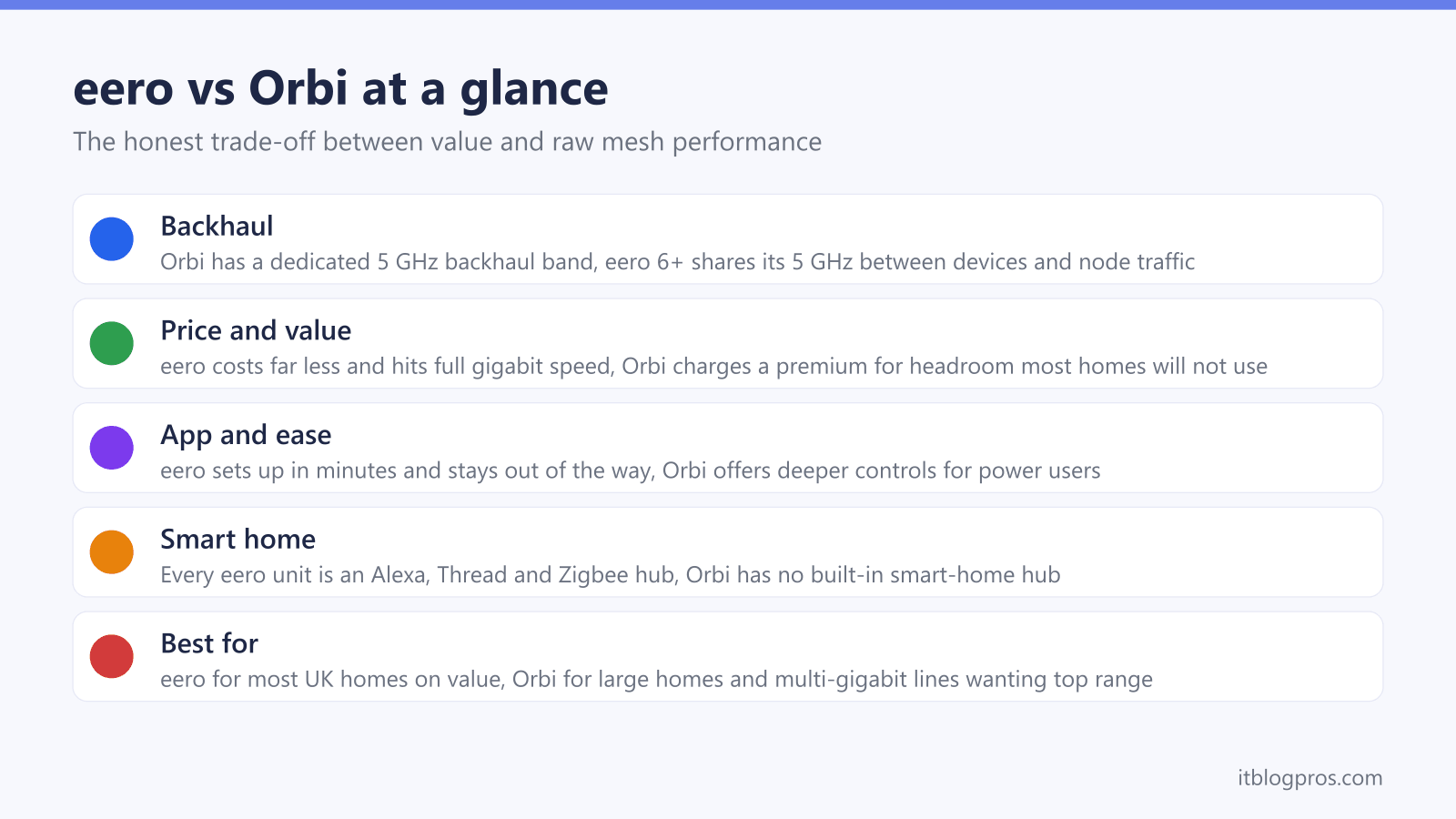
- Orbi's headline advantage is what Netgear's RBK763S page calls a dedicated connection for instant router-satellite communication; Netgear lists two 5 GHz radios without saying which one carries it, while the dual-band eero 6+ has a single 5 GHz band for clients and node-to-node traffic together.
- eero wins decisively on price and simplicity: at eero's and Netgear's UK list prices an eero 6+ two-pack costs a fraction of a tri-band Orbi 760 kit, sets up in minutes in the app and includes what eero's spec page lists as an Alexa, Thread and Zigbee smart-home hub in every unit.
- Orbi's raw performance is real but overkill on a line of a gigabit or below, where Netgear lists a 1 Gigabit WAN port on the Orbi 760 router and eero lists speeds up to a gigabit with 160 MHz channel support for the eero 6+.
- Both brands sell subscriptions: Netgear's UK page charges for Armor after the first year, and Netgear's Smart Parental Controls article puts content filtering and time limits in a paid Premium tier without naming the Orbi 760 among its products, while eero's UK page lists guest WiFi and automatic updates as included free.
- For a very large home, step up to the tri-band eero Pro 6E rather than paying Orbi money, since eero lists 6 GHz, a 2.5 GbE port and dynamic backhaul band selection for it while keeping the eero app and value, though eero's product page still lists wired speeds up to a gigabit for it.
The core trade-off is Orbi's backhaul against eero's price and simplicity
Every mesh system faces the same problem: the satellites have to talk to the main router, and that node-to-node link, called backhaul, eats bandwidth. How each brand solves it defines the entire comparison.
Netgear's page for the tri-band Orbi 760 lists two 5 GHz radios and describes a dedicated connection for router-satellite communication. Netgear does not say which of those radios carries that connection, but it does say WiFi speed stays fast as more devices connect. This is Orbi's signature advantage and it is genuine.
The Amazon eero 6+ is dual-band. It has 2.4 GHz and 5 GHz radios, and the 5 GHz band has to do double duty, carrying both your devices and the backhaul link. eero's TrueMesh support page says the technology dynamically finds the ideal path for data, but on a dual-band system that path shares the 5 GHz band with your devices. Neither company publishes like-for-like distance figures, so compare the rated coverage each one gives: eero lists 3,000 sq. ft. for an eero 6+ two-pack, Netgear up to 7,500 sq. ft. for an Orbi 760 three-pack.
The honest summary is that Orbi wins the backhaul argument on paper. What follows is whether that advantage is worth Orbi's much higher price for your particular home, which comes down to your floor area, your line speed and where the dead zones actually sit.
Specs and price compared side by side
The table below sets the widely sold Amazon eero 6+ two-pack against the tri-band Netgear Orbi 760 series (RBK763S), the closest Orbi on price and positioning. Specs come from eero's compare and UK eero Plus pages and from Netgear's UK RBK763S page; street prices move constantly, so treat prices as a guide rather than a quote.
| Spec | Amazon eero 6+ (2-pack) | Netgear Orbi RBK763S |
|---|---|---|
| WiFi standard | WiFi 6 (802.11ax) | WiFi 6 (802.11ax) |
| Bands | Dual-band (2.4 + 5 GHz) | Tri-band (2.4 GHz plus two 5 GHz radios) |
| Dedicated backhaul | No, shares 5 GHz | Yes, Netgear calls it a dedicated router-satellite connection and names no band |
| Rated speed | Up to 1 Gbps, 160 MHz channels | Up to 5.4 Gbps (AX5400) |
| Coverage | Up to 3,000 sq. ft., about 279 m2 (2-pack) | Netgear's page gives 5,500, 6,000 and 7,500 sq. ft., about 511 to 697 m2 (3-pack) |
| Hardware size | Small, discreet | Large, tall units |
| Ethernet | 2 x 1 Gbps per unit | 1 Gbps WAN and 3 x 1 Gbps LAN on router, 2 x 1 Gbps LAN per satellite |
| Smart-home hub | Yes, Thread, Zigbee, Alexa | None listed in Netgear's spec |
| Security subscription | eero Plus, optional, £9.99 a month or £99.99 a year | Netgear Armor, 1 year included then a $99.99 charge |
| Approx UK price | Lower, value tier | Much higher, premium tier |
| Amazon affiliate link | Yes | No |
The pattern is clear. Orbi carries far higher rated speed, more coverage and dedicated backhaul, and it costs a great deal more. eero counters with a much lower price, a smaller footprint and a built-in smart-home hub, where Netgear's Orbi 760 spec lists no Zigbee, Thread or smart-home hub.
Where Orbi genuinely wins and it is worth saying so
Fairness matters, and Orbi earns real credit. Netgear rates the 760 three-pack for far more area than eero rates an eero 6+ two-pack, and the dedicated router-satellite connection Netgear describes is aimed at exactly that case.
The hardware backs this up. Netgear lists each Orbi 760 unit at 8.3 x 6.6 x 2.5in with four internal antennas, against 3.9 x 3.8 x 2.6in for an eero 6+ on eero's page. Netgear's ports list for the RBK763S, though, is one 1 Gigabit WAN port and three 1 Gigabit LAN ports on the router and two 1 Gigabit LAN ports per satellite, so this Orbi has no multi-gigabit port to take a faster broadband line past a gigabit; the eero Pro 6E section below covers that case.
Orbi's app is also capable, with detailed controls for users who want to tune their network rather than leave it alone. For a large detached home, a home office with heavy simultaneous 4K streaming and video calls, or a demanding power user, Orbi's advantages are real and not marketing. The catch is the price, and the recurring cost, covered next.
Where eero wins on a line up to a gigabit
For a home two nodes can cover on a line up to a gigabit, eero is the smarter buy, and the reasons are practical rather than about peak numbers.
Price is the headline. At the list prices on eero's and Netgear's UK pages, an eero 6+ two-pack costs a fraction of a tri-band Orbi 760 kit, and eero lists speeds up to a gigabit with 160 MHz channel support, calling it ideal for ISP plans up to a gigabit. Netgear lists a 1 Gigabit WAN port on the Orbi 760 router, so Orbi's 5.4 Gbps rating is capacity your broadband line cannot feed through that port.
Simplicity is the second win. The eero app sets the whole system up in minutes, updates itself automatically and largely stays out of the way. There are no menus to master and no channels to tune. It is the definitive set-and-forget mesh.
The third win is the smart-home hub. eero's spec page lists a Thread and Zigbee smart-home hub in every eero 6+ unit, controlled through Alexa, and eero says compatible lights, locks and plugs then connect without a separate hub. Netgear's Orbi 760 spec lists no Zigbee, Thread or smart-home hub. If you live in the Amazon and Alexa ecosystem, eero is the natural fit.
For a flat, a terraced house or a semi on a line up to a gigabit, eero's own rating covers the speed that line can deliver, for much less money. Run a speed test in the far rooms after setup to check that two nodes reach them.
App and ecosystem lock-in, the subscription reality on both sides
Neither brand is a saint on subscriptions, and buyers should know that going in.
eero keeps core network management free in the app: its UK eero Plus page lists guest WiFi, device blocking, network health checks and automatic software updates as included. Active threat protection, ad blocking and content filters sit behind the paid eero Plus tier, which that page prices at £9.99 a month or £99.99 a year, so the essentials remain free.
Orbi splits its extras across two services. Netgear's UK RBK763S page says one year of Armor is included, after which a $99.99 charge is applied to continue the service. Netgear's Smart Parental Controls article lists a free tier and puts content filtering, usage tracking and time limits in a paid Premium tier, although its list of applicable products does not name the Orbi 760, so check the Orbi app for what your own kit offers before paying.
Ecosystem lock-in cuts differently. eero locks you into the Amazon and Alexa world, which is a plus if you already live there and a constraint if you do not. Orbi is more platform-neutral but gives you less built-in smart-home value in return. On balance, eero's subscription pressure is real, and its ecosystem tie-in is a benefit if you already use Alexa rather than a cost.
The recommended buy: Amazon eero 6+
For readers weighing eero against Orbi on a line up to a gigabit, the Amazon eero 6+ two-pack is the pick. eero lists it as dual-band WiFi 6 with 160 MHz channel support and speeds up to a gigabit, covering up to 3,000 sq. ft. (about 279 square metres) across two units, with bandwidth for 75 or more devices and an Alexa, Thread and Zigbee smart-home hub in every unit. Setup takes minutes in the eero app.
You give up Orbi's dedicated router-satellite connection and its higher rated wireless speed. On a line up to a gigabit that rating is headroom the line cannot feed through Netgear's 1 Gigabit WAN port, and you keep a large amount of money and a much smaller, tidier set of units. If your home has notable dead zones on a single router, this is the honest, value-first fix. It also carries a smart-home hub that Netgear's Orbi 760 spec does not list.
If you decide a mesh is more than you need and only one room is weak, a single strong extender can be a cheaper stopgap, though it will not roam seamlessly the way a true mesh does; the extender versus mesh guide covers that call. For the wider ranked field see the best mesh systems guide, and the eero light meanings and Netgear Orbi light meanings guides decode each system's status LEDs.

When to step up to eero Pro 6E instead of paying Orbi money
If you genuinely have the fast line and large home that make Orbi tempting, the upgrade worth pricing first is to stay with eero and step up to the tri-band eero Pro 6E rather than switch brands.
eero lists a third radio on the 6 GHz band for WiFi 6E, plus one 2.5 GbE port and one gigabit port on each unit for WAN or LAN, and eero's TrueMesh support page says the Pro 6E picks the ideal backhaul band dynamically for each connected device. eero's compare page lists a 2-pack at up to 4,000 sq. ft. (about 372 square metres), and its product page says the Pro 6E supports 100+ connected devices. That is a different approach from the dedicated router-satellite connection Netgear describes for Orbi, and it keeps the eero app, the smart-home hub eero lists for the Pro 6E and the simpler experience.
Netgear still describes the Orbi's router-satellite connection as dedicated, and rates the 760 three-pack for more area, so for a sprawling property with heavy simultaneous demand Orbi remains a fair choice, assessed honestly, even without an affiliate link here. But if what you want is headroom rather than more floor area, the eero Pro 6E is the cheaper way to buy it.
The short verdict: buy the eero 6+ for value, step up to the eero Pro 6E for a very large home, remembering that eero lists wired speeds up to a gigabit for it, and choose Orbi only if you specifically need its dedicated router-satellite connection and top-end rated coverage and are happy to pay a premium, plus any Armor or Smart Parental Controls Premium subscription you decide to keep.